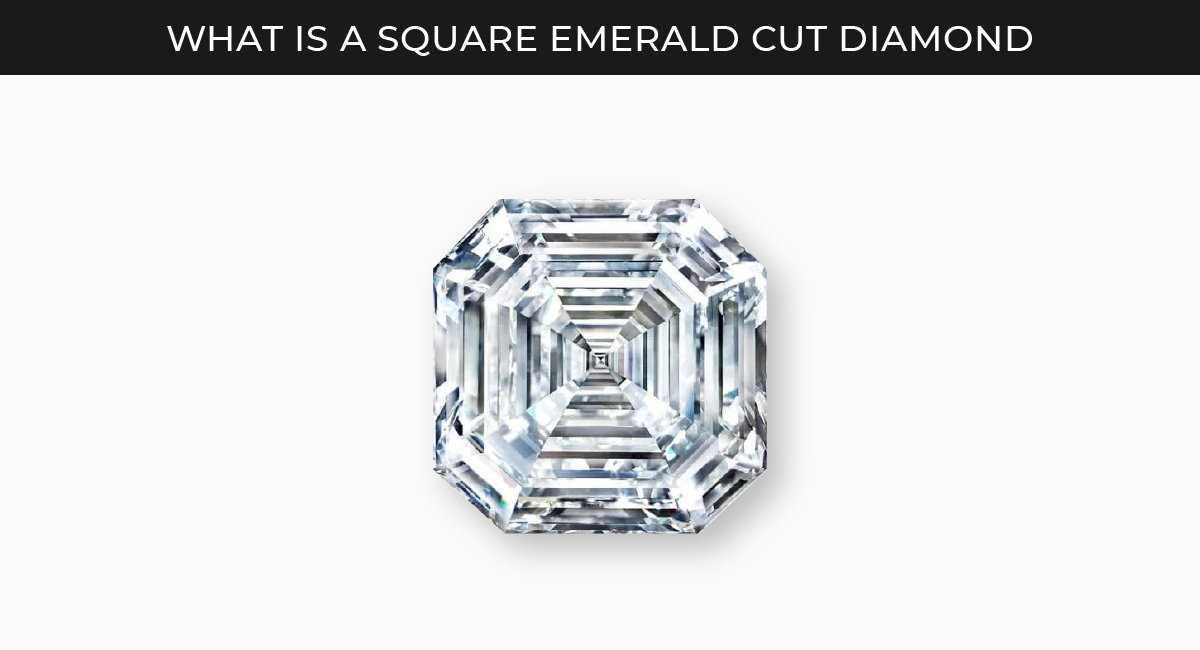
In the diamond world, there are many different cuts to consider before buying. Every different cut signifies different aspects of a diamond and you need to explore every cut in detail before you make a final choice. The Asscher cut diamond is considered to be one of the most symmetrical and eye-pleasing cuts in the world of diamonds.
If you’re someone who has been exploring cuts for pure diamond engagement rings for a significant diamond pendant then this article is perfect for you to understand what an Asscher cut is and what are the different aspects of the Asscher cut.
What is Asscher Cut Diamond?
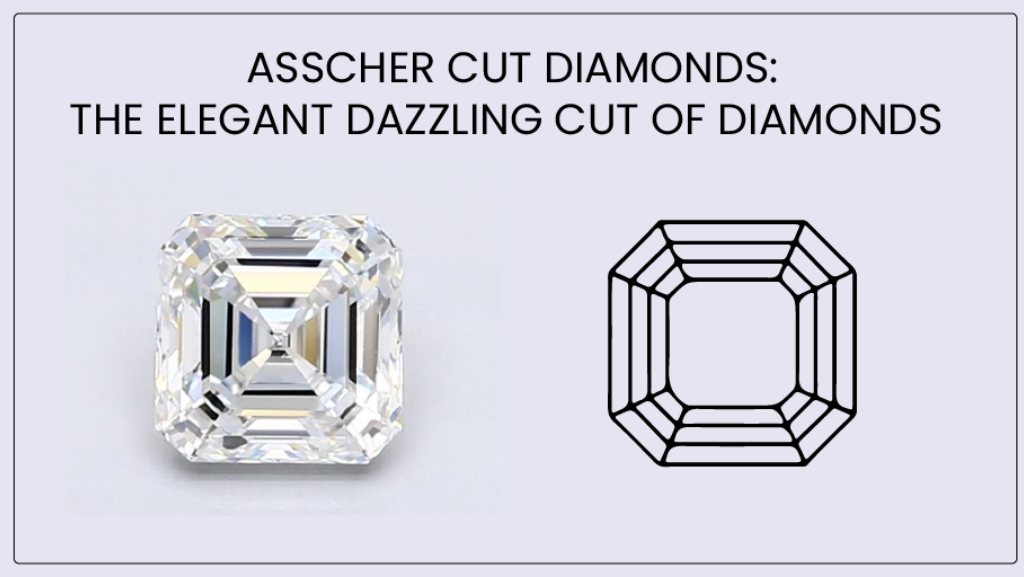
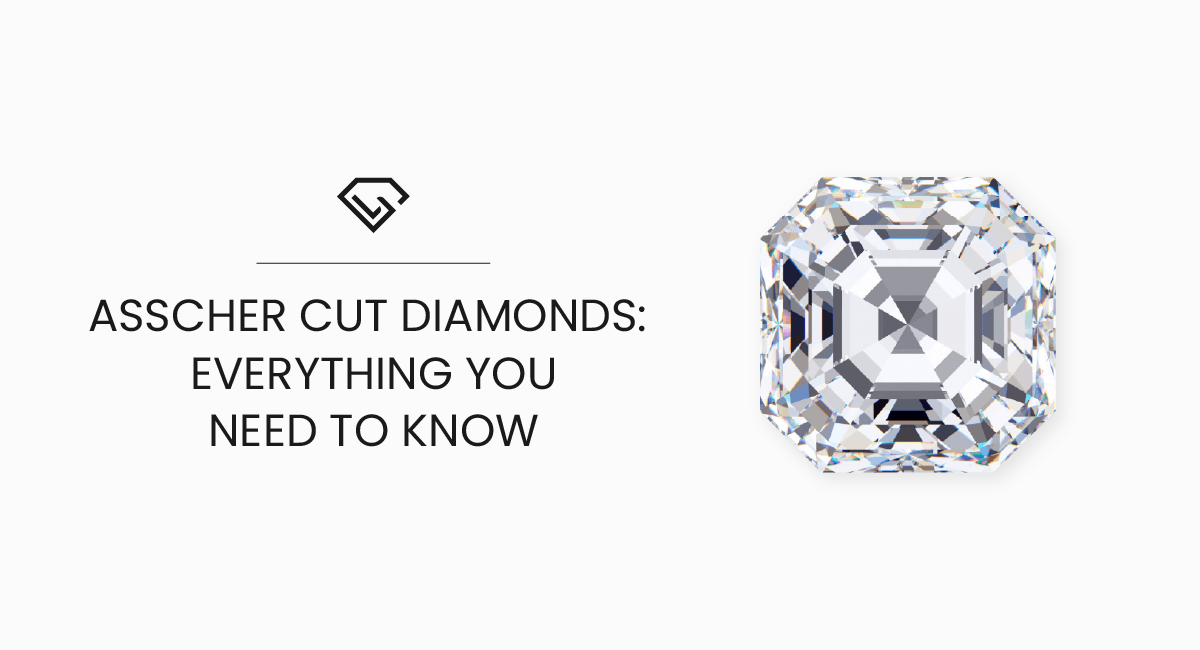
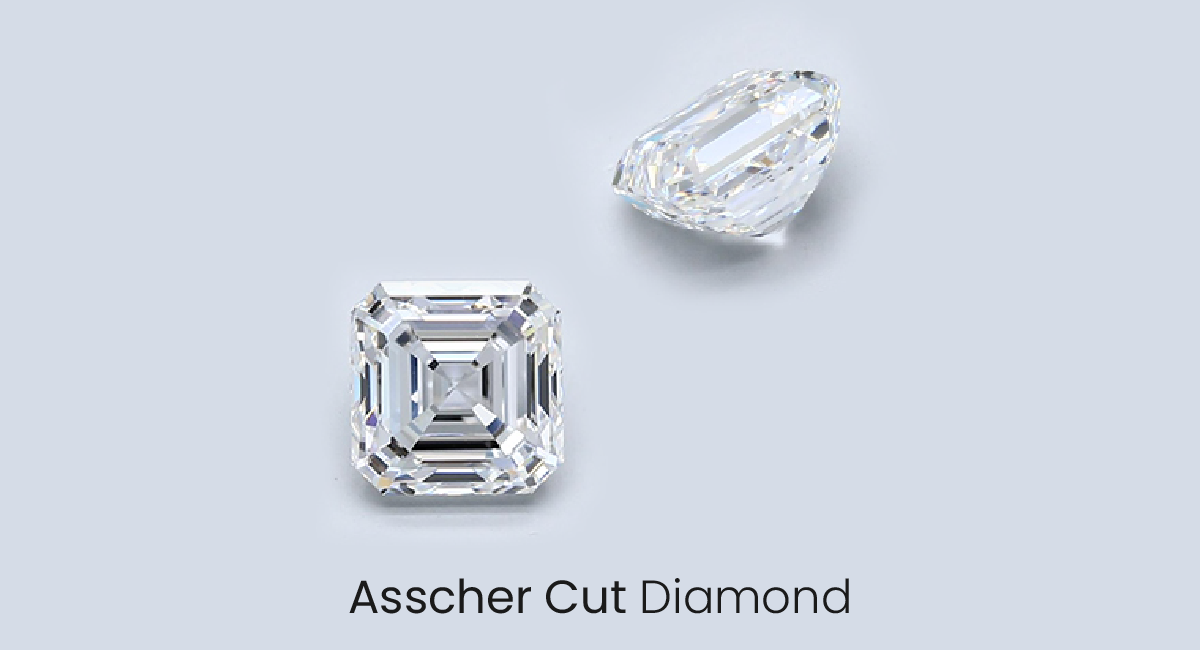
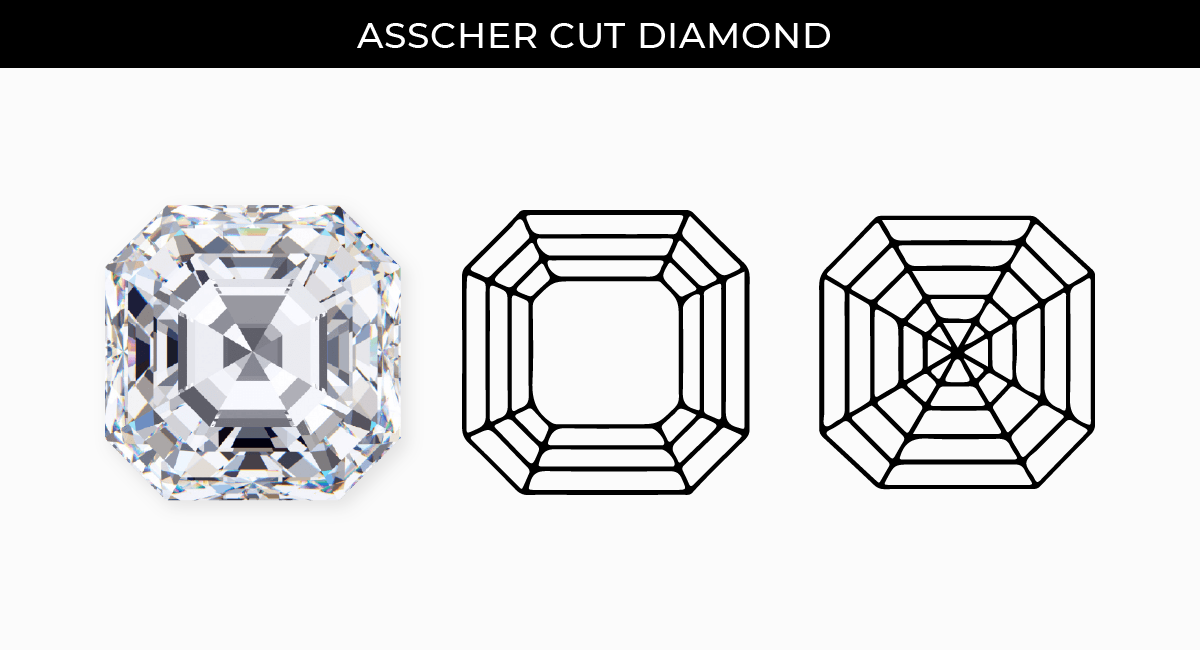
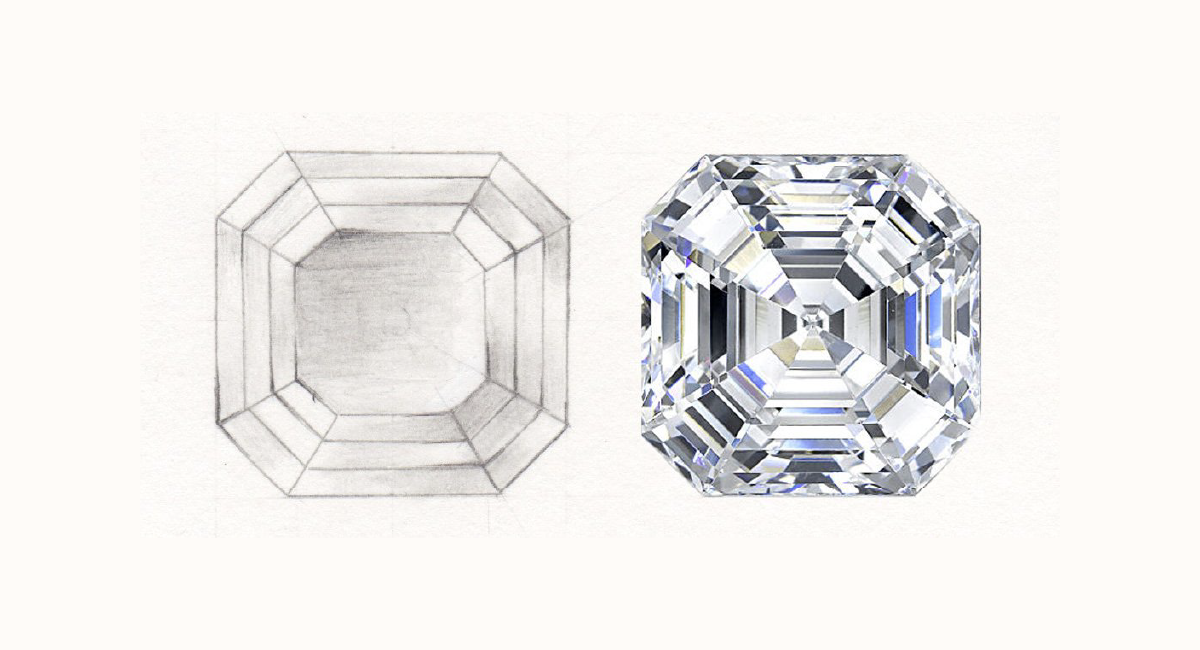
The Asscher cut diamond has 8 edges and hence is often known as the octagonal diamond as well. The main identifying features of an acid cut are it is square in shape and has a significantly small table. All the facets of the diamond are rectangular in shape and this is what gives the effect inside the diamond.
The Asscher cut is also known as a step-cut diamond because the diamond is cut at different levels exactly like a staircase. The diamond is also often compared to the emerald cut and the Princess cut because of its shape and similarity in cutting style.
There are two types of Asscher cut diamond 1 is the classic Asscher cut which has 58 facets and the other one is known as the Royal Asscher cut diamond which has 74 facets. Both these cuts are identified as having a tall crown and a deep pavilion.
The Asscher cut diamond is named after its founders which were the Astor brothers and specifically the diamond is named after Joseph Aster who founded the cut. The diamond cut is only 120 years old and was discovered in the early 1900s.
The Asscher cut diamond became super popular very early after its conception because in 1920 the art deco period started which is an era that was popular for geometrical and symmetrical pieces of art. Many say that the popularity of the Asscher court was heavily influenced by the ongoing industrial revolution.
Geometry and Modernity were seen as a sign of prosperity and the Asscher cut which is highly symmetrical of course gained popularity in terms of design.
Till today as Asscher cut diamonds are considered an elegant choice because of their unique cut. Throughout history, lab grown Asscher diamonds, which are the favorite of the royal families around the world and are still the highlight of many historical pieces.
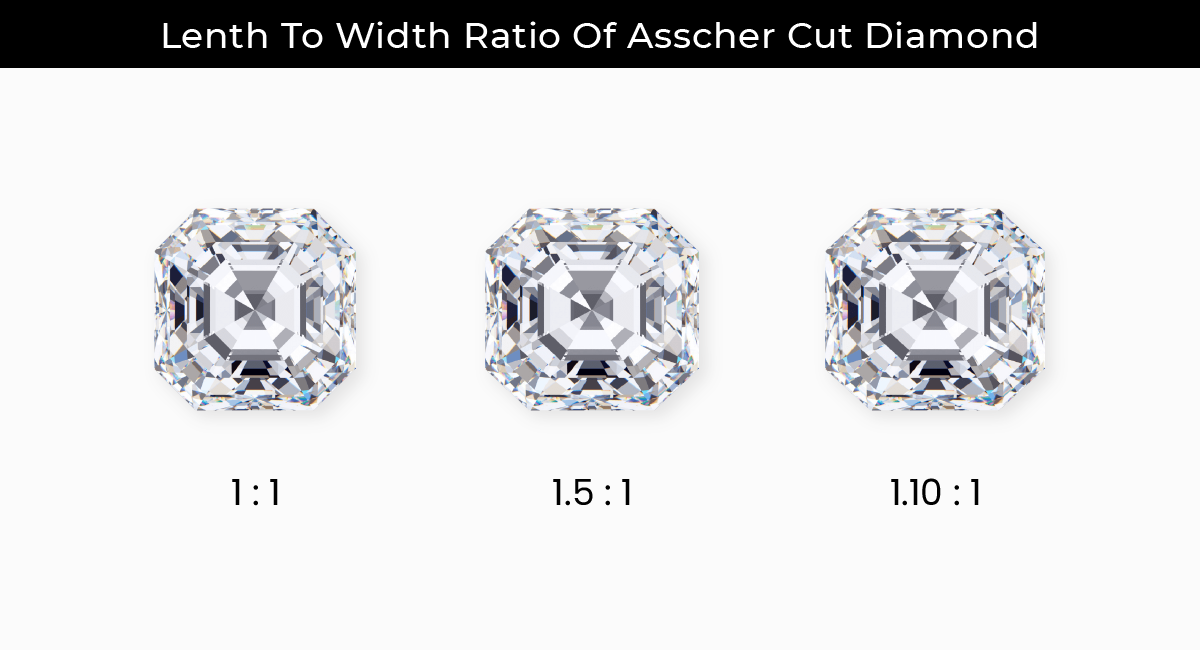
Length to Width Ratio of Asscher Cut Diamond
The Asscher cut is known for its symmetry and geometric appearance. The best ratio is 1.00-1.05 when it comes to the Asscher cut.
A ratio of 1.05-1.10 is considered the second-best side-to-side ratio for an Asscher cut. A 1.10-1.15 ratio is considered poor but if you have no other option, you can consider this as the last resort.
What Makes Asscher Cut Diamonds a Great Choice?
Other than its appearance, lab created Asscher cut diamond offers a lot of other plus points that make them worth their price.
– They are a perfect blend of emerald cut diamond’s elegance and brilliance of a princess cut diamond, which makes these Asscher cut diamonds quite unique and one of a kind.
– In proper settings, Asscher lab diamonds may look bigger for their carat value. This can be further enhanced by adding a halo around the center diamond. Hence you could end up with a much bigger diamond compared to the price range.
– Asscher cut diamonds have a clean, neat, fine, and elegant look. Their perfect blend of vintage and modern makes them quite an excellent choice for any piece of jewelry, especially an engagement ring.
– Due to their large facets and tables, the body color is easily refracted from within the Asscher diamond. This makes the lab grown asscher cut diamond perfect for every skin tone. Coupling the warmer-hued diamonds with yellow gold or rose gold might just enhance its vintage and timeless appeal. By going for white gold or platinum with a colorless diamond, the overall look may appear very elegant and sophisticated to anyone who would look at it.
– Asscher cut diamonds are one of the most affordable diamond cuts. Since the amount of wastage that occurs while the diamond is cut is very low, it also makes the price of the diamond drop. If you’d like to make the diamond even more affordable, you can go for lab-grown diamonds. They are real diamonds that are manufactured synthetically in machines.
Asscher as mentioned before are highly symmetrical and have a lot of texture in themselves already. This is also the reason why simple settings are considered best for Asscher cut diamonds. If you are someone looking for an engagement ring setting for Asscher cut diamonds we suggest you go with pave set bands and a 6-prong or a 4 Prong solitaire setting.
Asscher cut diamonds look best with white gold and platinum bands because they enhance the brilliance of the Asscher cut. Simple small diamond accents in a pave setting or a gypsy set band look great. You can also opt for Asscher cut diamond in a Halo setting where the central diamond is complemented by a fancy colored diamond like a green diamond or maybe another precious stone.
When it comes to fancier setting variations designs in the band itself are our favorite. Small engravings on the band look minimal and do not take the spotlight away from the diamond itself.
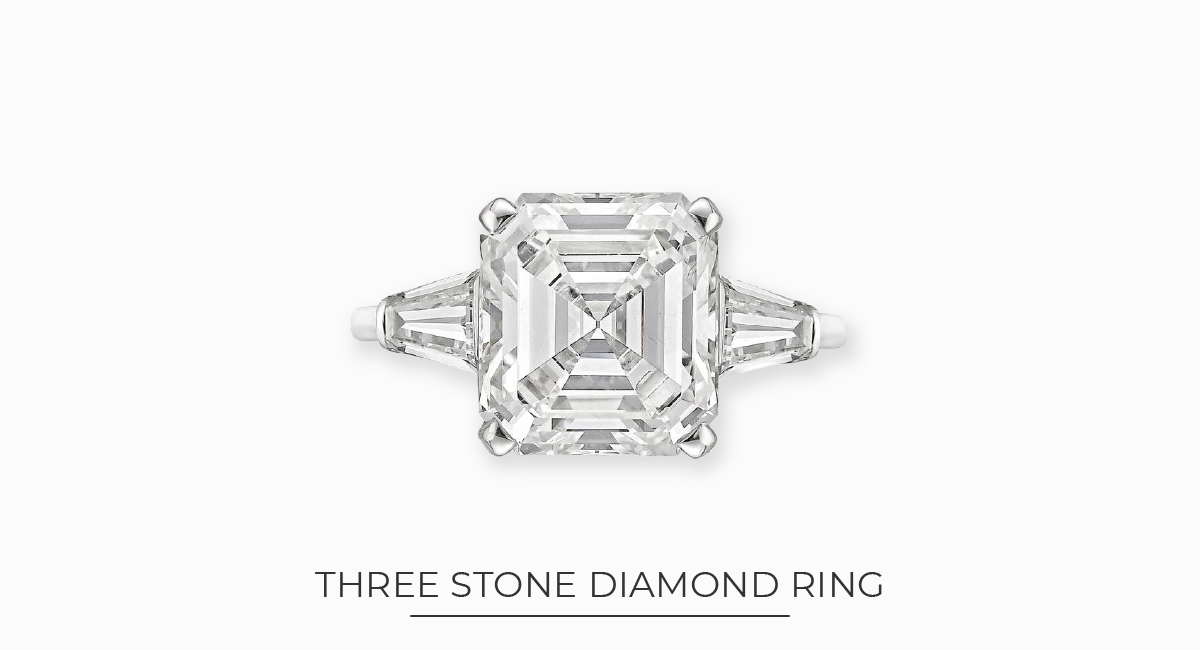
Another few setting variations you can go for are old vintage art deco designs. Since the Asscher cut was the highlight of the Art Deco era, these designs complement the cut beautifully. The three diamond ring with trapeze-shaped diamond accents is a great design.
Another famous design from the Art Deco age would be the Jessyca ring design which features a big Asscher cut Centra diamond, multiple types of diamond accents, and an intricate grain design on a platinum band.
Wearing an Asscher cut diamond ring on finger adds an air of timeless elegance, as the distinct facets of the diamond catch the light and exude a subtle yet captivating sparkle.
We at Loose Grown Diamond sell best-price asscher cut diamonds and provide GIA/GCAL and IGI certification for authenticity. If you’re unsure about the pricing, you can utilize our diamond price calculator for assistance. Explore unparalleled discounts using our exclusive promo code while enhancing your diamond shopping journey.
Asscher cuts are vintage diamond cuts that are still thriving in the modern world. They are elegant, sophisticated, and antique which has quite a high appeal to the contemporary crowd. Lab grown diamonds sweeten the pot further as they are natural diamonds grown in man-made conditions that yield the same results. It is impossible to tell the difference between earth-mined diamonds and synthetic diamonds without their grading certificate.
They make a great substantial, ethical and amazing substitute to natural diamonds. These budget-friendly diamonds look great in a wide variety of settings. They are less bound to get damaged or chipped which makes them perfect candidates for brides with an active lifestyle.
FAQs
Are Asscher cut diamonds suitable for engagement rings?
Yes, Asscher cut diamond engagement rings are popular choices. Their vintage-inspired look and elegant appearance make them a timeless option for those seeking a classic yet sophisticated ring.
Can Asscher cut diamonds be customized in terms of settings?
Asscher cut diamonds can be set in a variety of settings. Customization allows you to create a unique and personalized engagement ring or jewelry piece.
Does Asscher cut diamonds sparkle?
Yes, Asscher cut diamonds do sparkle, but their sparkle is more subtle and elegant compared to brilliant cuts like round or princess cuts.
Diamonds have always been available in a wide variety of qualities, cuts, colors, shapes, etc. to customers around the world. While the diamond has many important features, one of its most important aspects includes how the diamond has been cut by the jeweler or designer. Hence, every piece of diamond is available to the customers in various cuts such as the round cut, radiant cut, emerald cut, princess cut, etc.
One such example is the emerald cut and the radiant cut made in diamonds. Although similar from many perspectives, both cuts signify different things and are suitable for different kinds of diamond wearers. Hence, customers should choose according to their personal preferences and what they think would accurately symbolize the situation for which the diamond jewelry is being bought.
The emerald cut and the radiant cut are very similar in their outward appearance and hence might tend to confuse people when seen from afar. They are cuts that stay unique and individual in their appearance. Emerald cut diamonds have been a classic cut that imparts a vintage feel to the jewelry. While radiant cut diamonds have a more modern twist and give off an aesthetic vibe.
What is an Emerald-Cut Diamond?
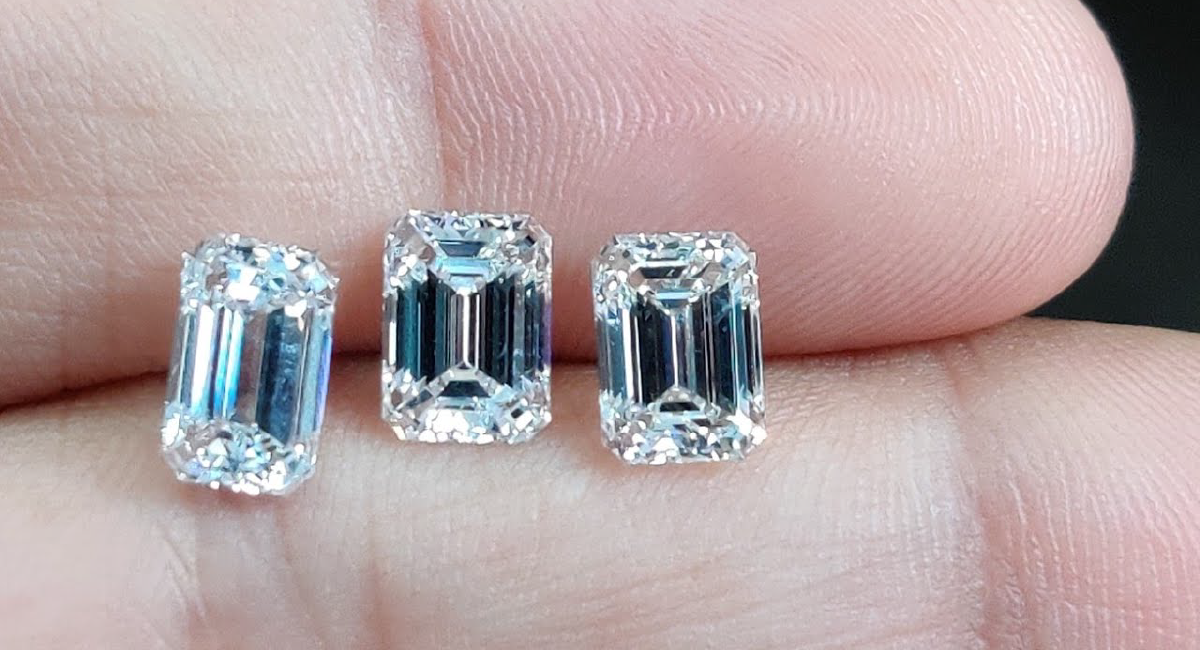
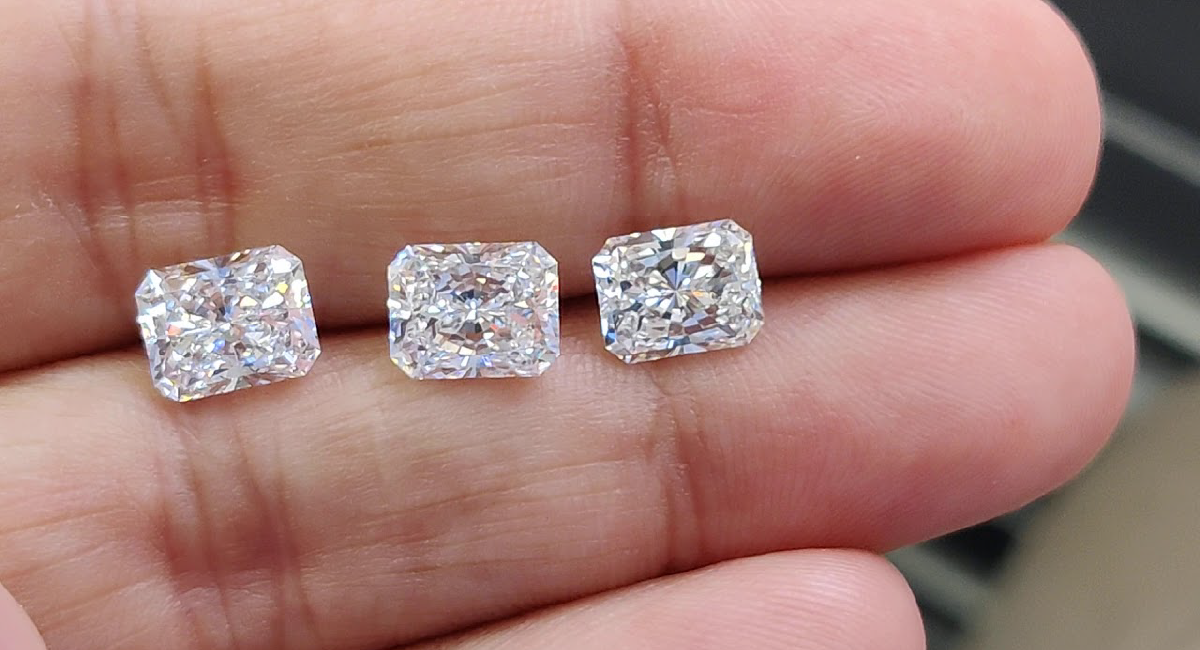
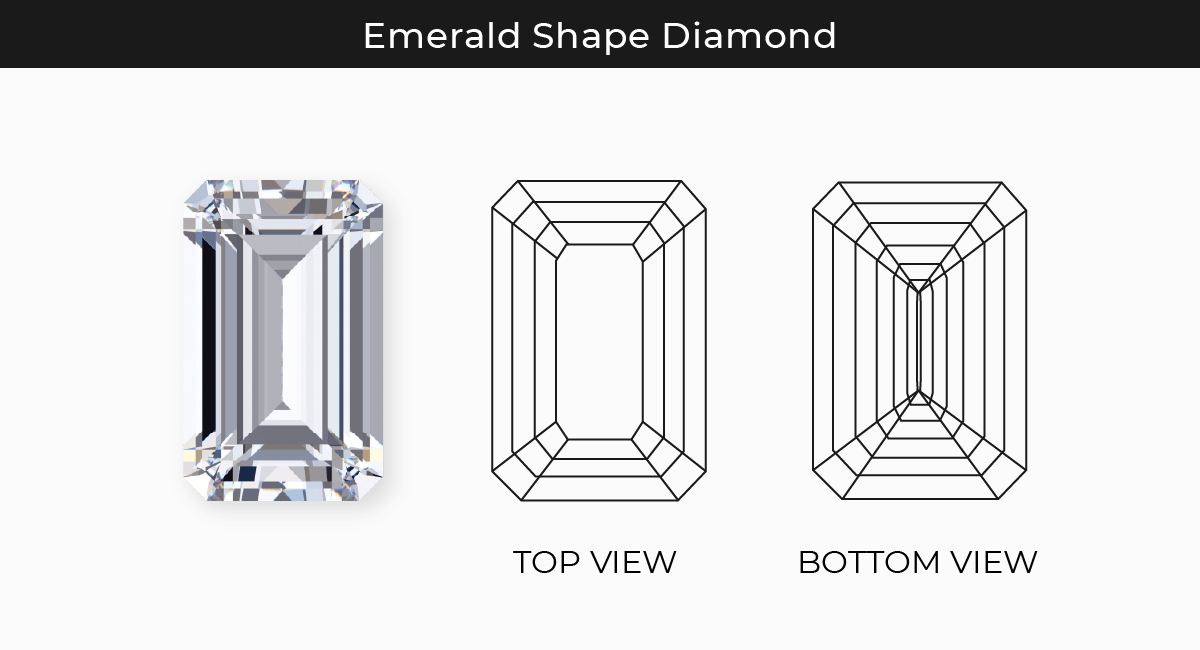
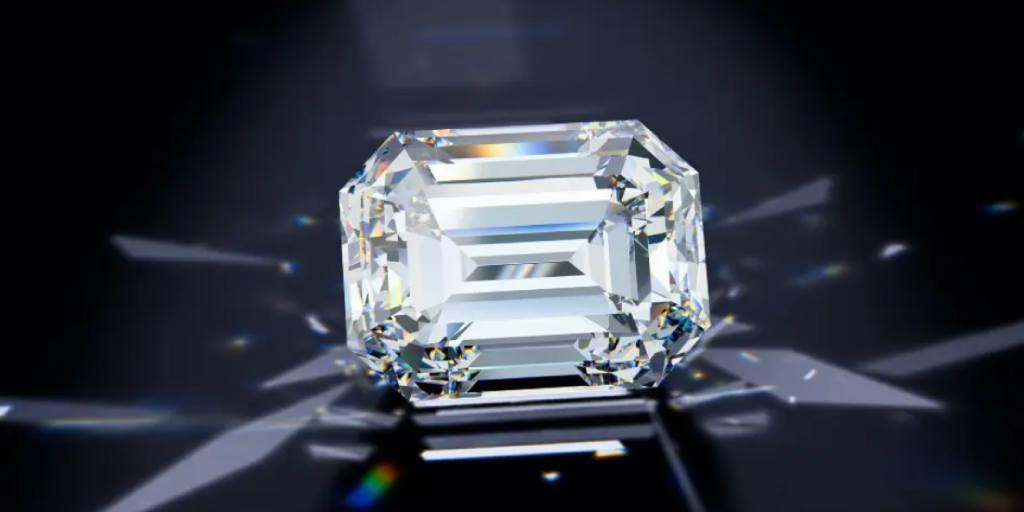
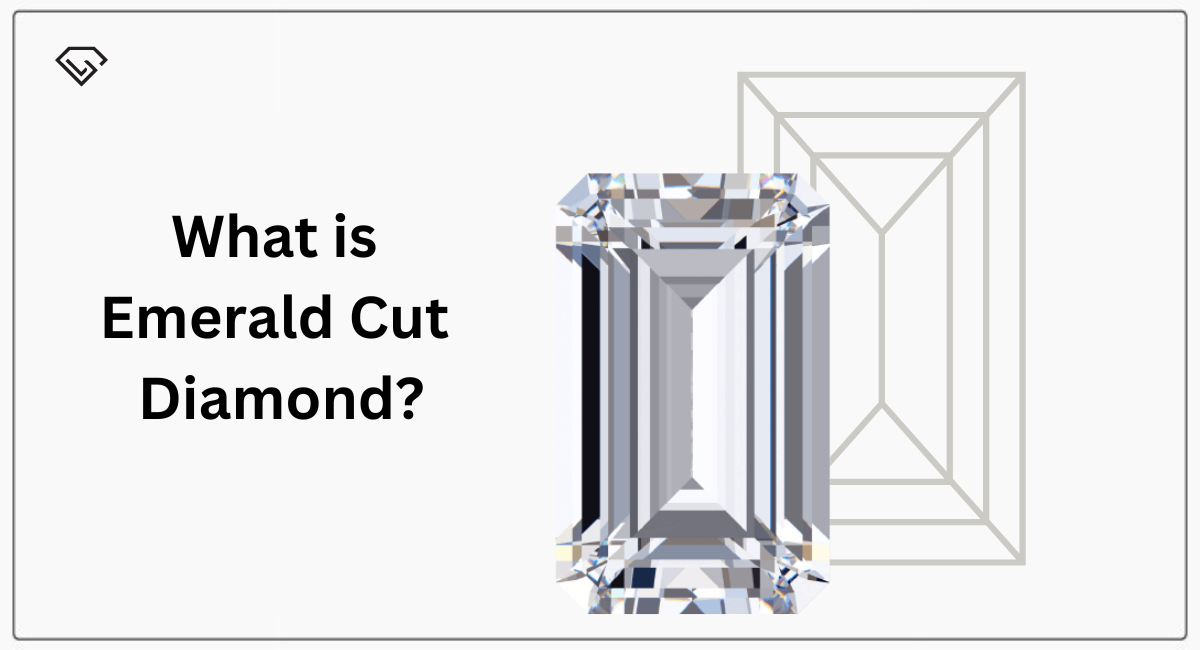
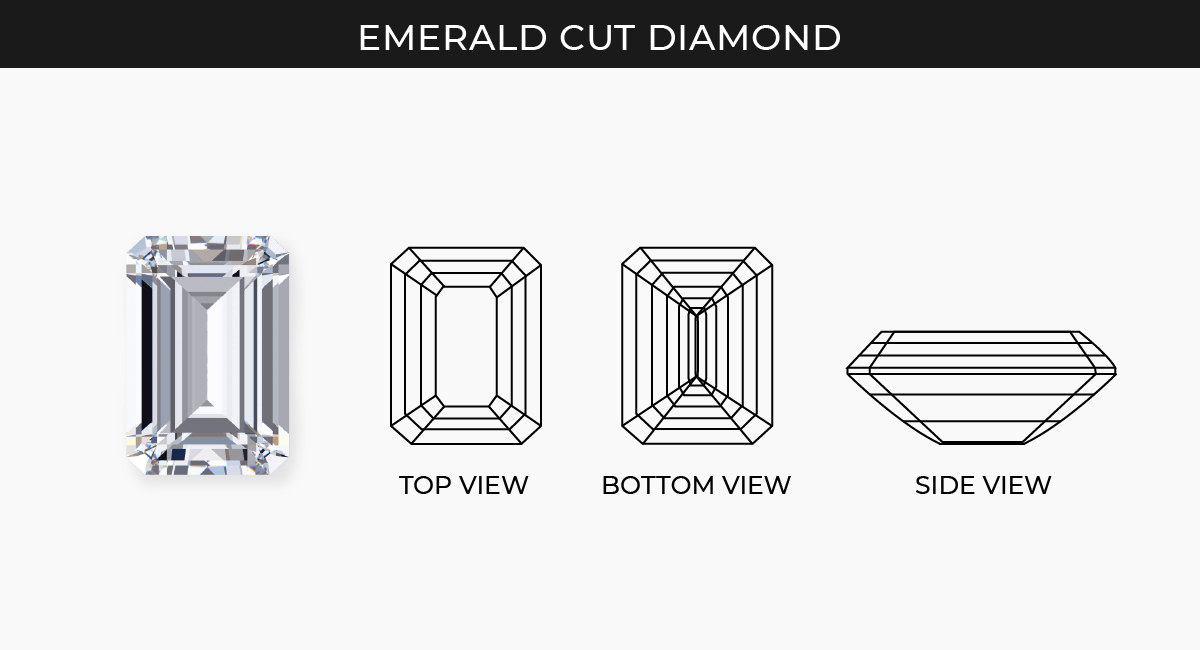
An emerald-cut diamond is shaped like a rectangle with accurately cut corners. Owing to their step-cut facets, a term coined due to their staircase-like ascending cuts, emerald diamonds feature numerous long, beautiful dashes of light. The paralleled cuts form the iconic hall-of-mirrors appearance of the diamond.
The Emerald Cut became rather prevalent during the period of Art Deco (1920-30). The cut gradually became more complex as it was given more facets by jewelers around the world, and became the contemporary cut as we know it today. Currently, the emerald cut is primarily used to emphasize the clarity and purity of the color of the gem.
The cut is unforgiving to diamonds with the slightest of inflictions as blemishes are easily susceptible to the naked eye. The name was coined due to the sequential arrangement of its 57 facets, which are separated into 24 facets on the base, 8 facets on the girdle, and 25 facets on the table. The flat tabletop does have a broad and dazzling width.
Having merely ten more facets and a cubical shape similar to the emerald cut diamond, one can argue that the radiant cut diamond might have a similar outline as the former. However, there are crucial differences that help people choose between the two.
Invented by Henry Grossbard, a renowned diamantaire during World War II, in 1977, the radiant cut is a stunning square geometry of the gemstone that incorporates every one of the biggest outlines seen in the round cut and emerald cut. Hence, it has flashes of a rainbow and bright white light.
Square cuts hold an innate beauty within themselves that stands out among the other varieties of diamond cuts. The radiant cut is a middle ground between the emerald cut and a round brilliant diamond.
The 70 facets transport the light to the center of the stone and help it bounce back, giving the stone incomparable sparkle. It is commonly believed that radiant cut is the only cut that comes close to outperforming brilliant cut in terms of dazzle and brilliance.
Radiant cut diamonds seem bigger than other diamond cuts having similar carat weight owing to their oblong form. Also, because of its oblique edges, the radiant-cut diamond is immune to the damage and ravages of time, making it far more durable.
To help customers get a better idea about the differences that lie between an emerald cut and a radiant cut diamond, here are some of the factors that cause the variations between the two.
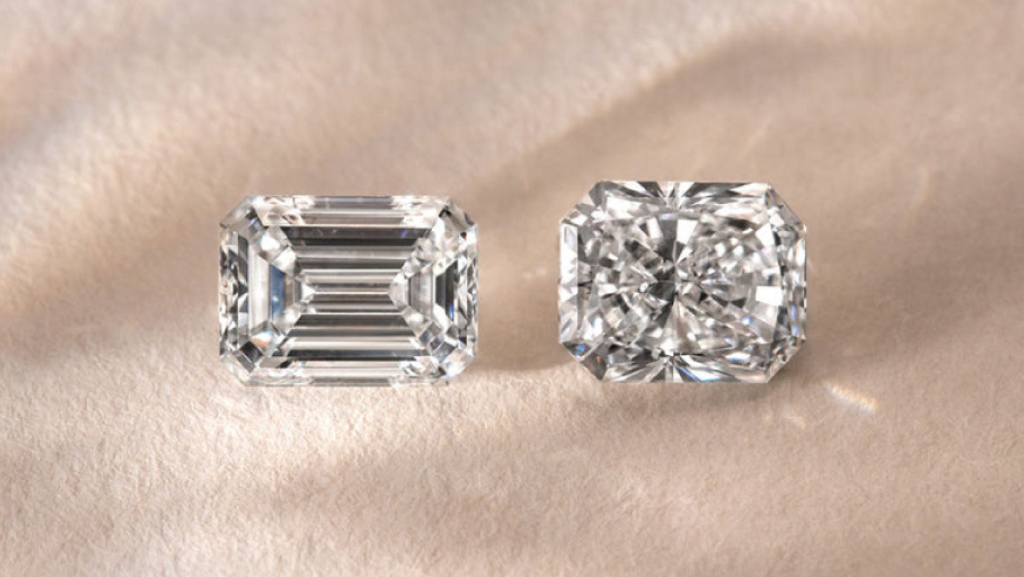
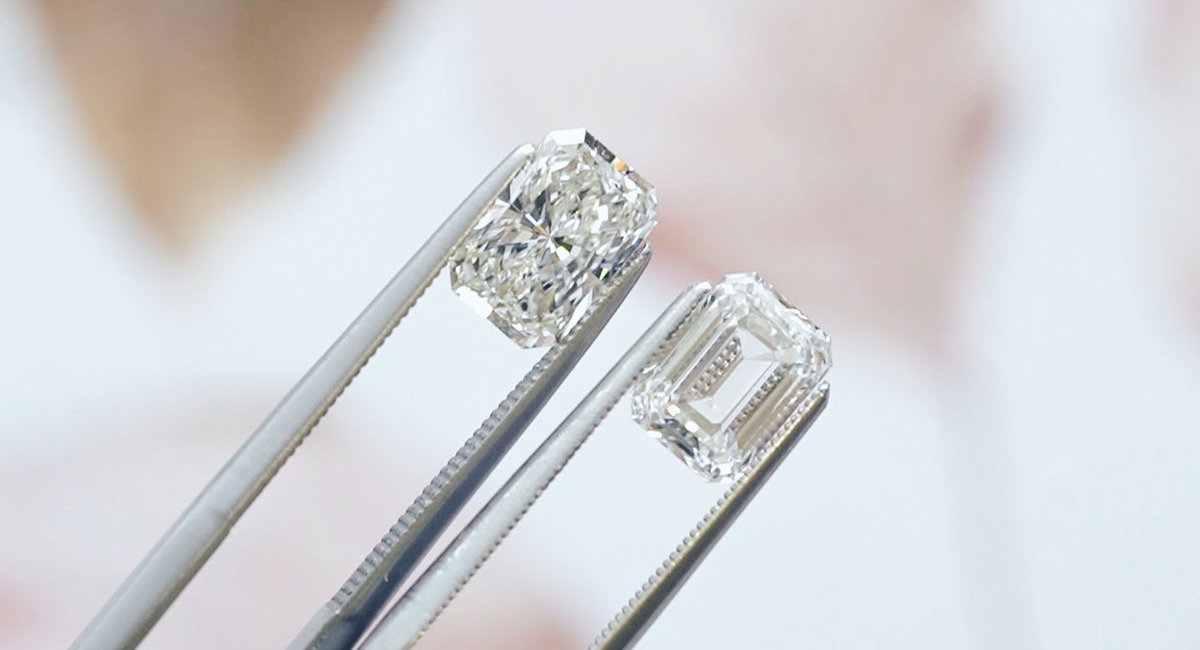
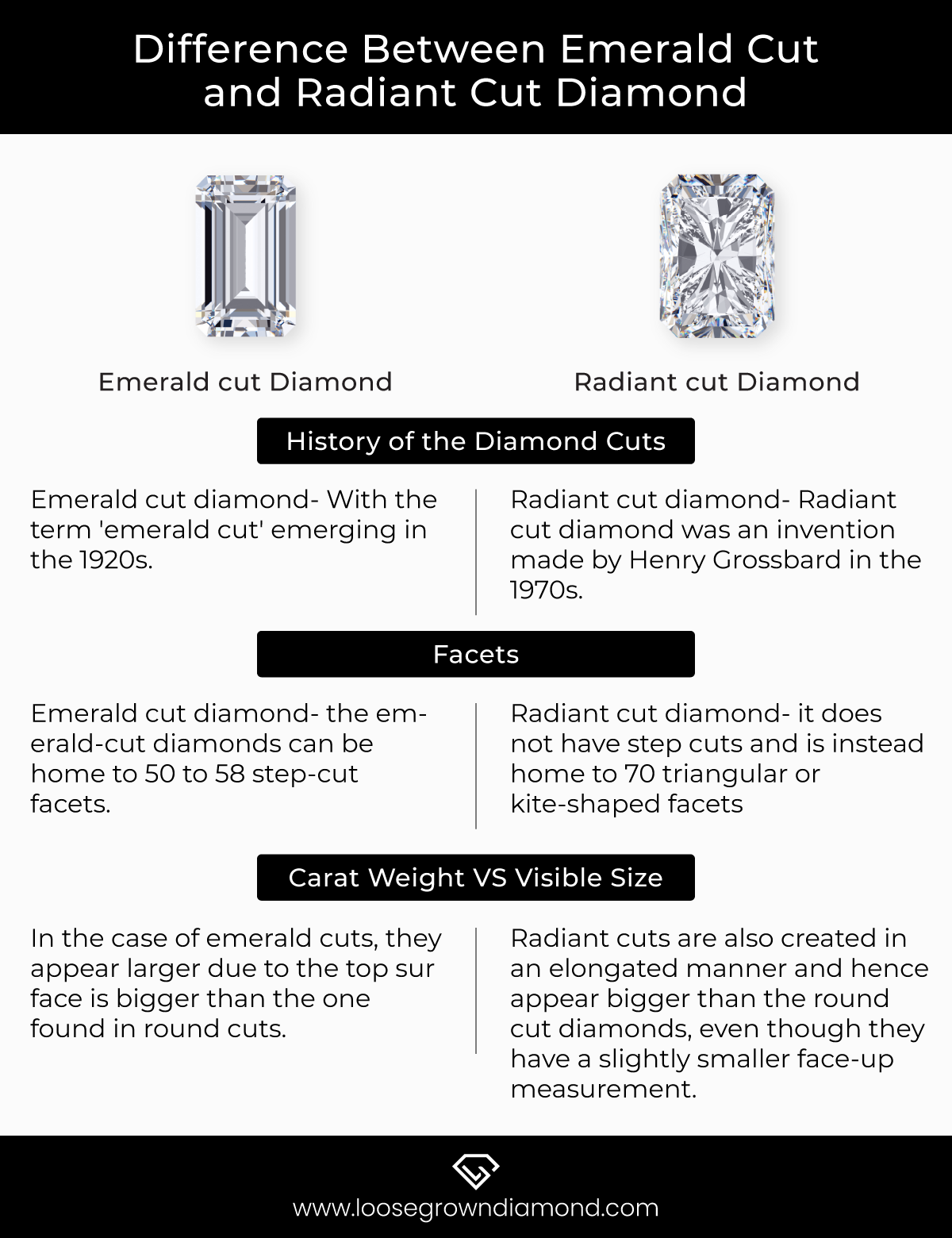
The basic distinction between the Emerald cut vs radiant cut is the appearance of the diamond’s brilliance. The emerald-cut diamonds have straight cuts and light can be seen in the form of strips through the diamond. Whereas, the radiant cut diamond is seen sparkling with flashes of light here and there.
Emerald Cut vs Radiant Cut: History of the Diamond Cuts
Emerald Cut
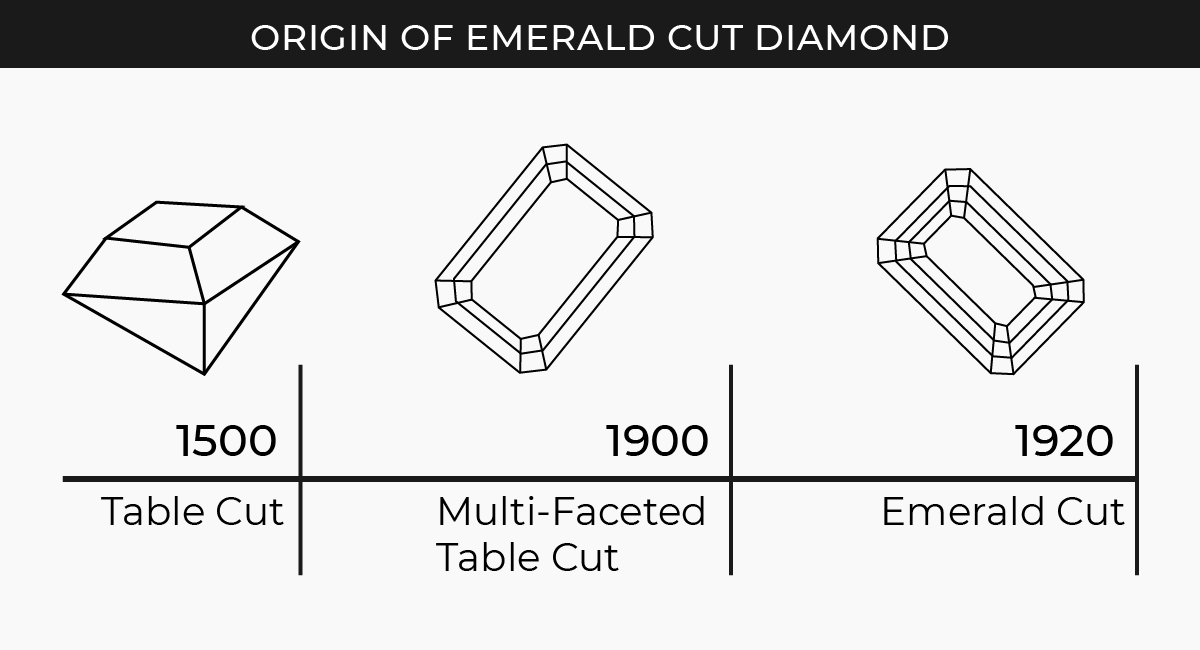
One of the oldest diamond shapes to exist, the emerald cut can be traced back to the table cut of the 1500s from which the emerald cut was further developed. Originally termed as the multi-faceted table cut, the cut was first and foremost used on emeralds as the name suggests, and was only a lot later on brought as another variety into the world of diamonds.
With the term ‘emerald cut’ emerged in the 1920s, it has often been associated with the era of Art Deco wherein clean lines and symmetry were in trend amongst the people and enjoyed their own class of popularity. Then in the 1940s, the cut was further more refined and standardized which could be done with the invention of much more advanced and systematic diamond-cutting tools.
Radiant Cut
Unlike the emerald cut which is a design of the olden times, the radiant cut is a much more modern style that was an invention made by Henry Grossbard in the 1970s. The term ‘radiant cut’ has been patented by Grossbard so generally on the laboratory certificates provided by GIA or AGS, the cut is referred to as a “rectangular brilliant” or “cut-cornered square”.
The radiant cut was created as a hybrid wherein the cut has many facets that have been designed in a manner to maximize the brilliance and beauty of the diamond. One of the sparkliest varieties in cuts for the diamond industry, the radiant cut diamond is made with a brilliant faceting pattern that is present in both the crown and pavilion of the gemstone.
Emerald Cut vs Radiant Cut: Facets
The number of facets on an emerald cut diamond is 57, whereas in a radiant cut diamond is 70. In an emerald diamond, one can see that the facets are created in a ‘stepped manner’ (one step after another like a staircase) that adds a mirror effect to the diamond cut. The facets are all elongated and hence we can see that the inclusions are very evident if any. The diamond appears very sleek and classy.
In a radiant cut diamond, one can observe the facets to be triangular or kite-shaped. These angular facets add more character to the rectangular diamond and mask a lot of inclusions that the diamond might possess. The cuts of the diamond make it appear shiny and brilliant. A lab-grown emerald-cut diamond will be as stunning and brilliant as a naturally extracted diamond.
Emerald Cut
The emerald-cut diamonds have a rectangular outline and the corners are cut in a particular manner. Depending on the dimensions of the gem, the emerald-cut diamonds can be home to 50 to 58 step-cut facets. The step cuts are arranged parallelly and this leads to the creation of stunning flashes of light which in turn causes a “hall of mirrors” effect. This cut is known to be slightly more elegant than radiant cut diamonds and also exhibits a more sophisticated sparkle.
Radiant Cut
The major difference in the radiant cut is that although it is rectangular in shape much like the emerald cut, it does not have step cuts and is instead home to 70 triangular or kite-shaped facets which originate from the center and do an excellent job of maximizing the brilliance and sparkle of the stone.
Emerald Cut vs Radiant Cut: Carat Weight vs Visible Size
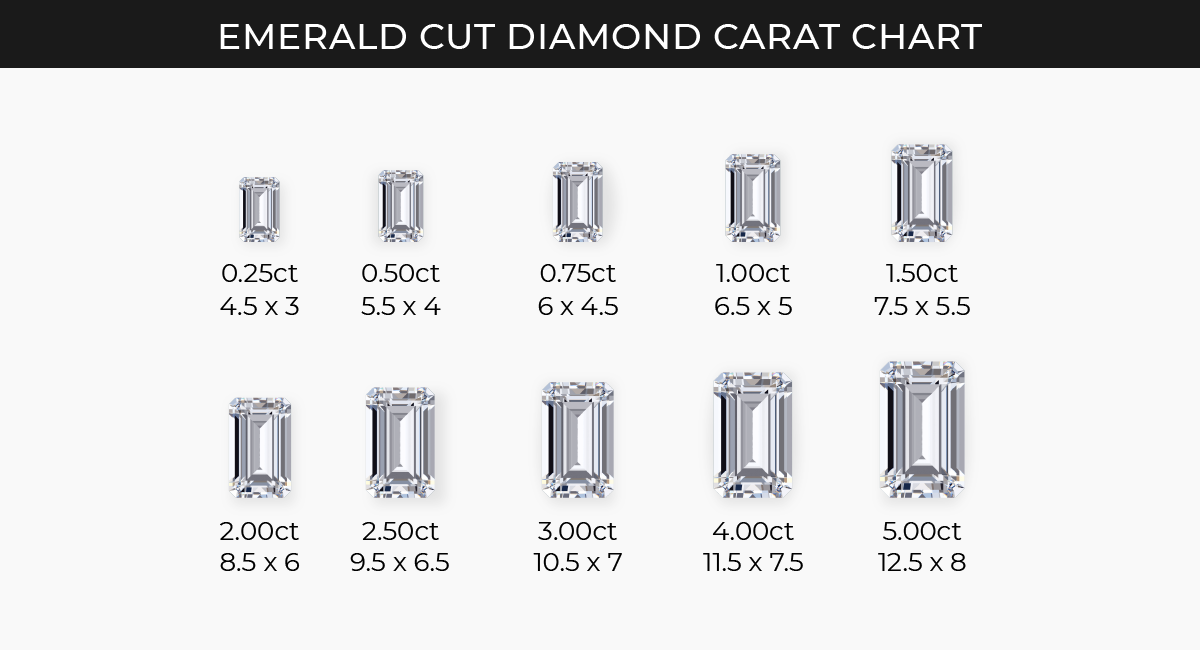
The difference between carat weight and the visible size between the emerald and radiant cuts is almost the same, with both the cuts appearing larger than their actual carat weight. You can use our Diamond Carat Size Chart to determine the right size for your diamond.
When comparing a round brilliant cut diamond with an emerald and radiant cut diamond, all of the same carat weight, it can be easily noticed that both these diamonds appear larger. In the case of emerald cuts, they appear larger due to the top surface is bigger than the one found in round cuts.
Radiant cuts are also created in an elongated manner and hence appear bigger than the round cut diamonds, even though they have a slightly smaller face-up measurement when compared with the round cuts of the same weight.
With radiant diamonds, it was within Grossbard’s interest to create a diamond that would appear as large as possible by investing not too much. And so, he paired a broad and shallow design with a highly brilliant faceting pattern. This gave rise to an excellent optical illusion wherein the radiant cut diamonds truly felt like they were radiating brilliance and shimmer.
Emerald Cut vs Radiant Cut: Clarity and Inclusions
Emerald cut diamonds emphasize clarity, with their step-cut faceting style making inclusions more visible. It’s essential to prioritize high clarity when choosing an emerald cut. In contrast, radiant-cut diamonds are more forgiving with inclusions due to their brilliant-cut facets that disperse light, making flaws less noticeable.
This allows for flexibility in selecting a slightly lower clarity grade while still achieving a brilliant appearance. Your choice should depend on your preference for clarity and the balance between clarity and brilliance in your diamond.
When choosing between the two cuts, consider how you prioritize clarity in your diamond and your willingness to balance it with other factors such as brilliance and sparkle.
Emerald Cut vs Radiant Cut: Which is Better?
The choice between an emerald cut and a radiant cut diamond ultimately depends on your personal preferences and the specific qualities you value in a diamond. If you value a classic, understated look and are willing to prioritize clarity, the emerald cut might be the better choice. On the other hand, if you’re drawn to a more brilliant, contemporary, and versatile option with exceptional sparkle and are open to various clarity grades, the radiant cut could be the ideal choice for you.
Radiant cut diamonds are known for their exceptional brilliance and fire. The emerald cut is often associated with a classic and timeless look. Both radiant-cut diamond and emerald-cut diamond have their strengths and beauty. The radiant cut vs emerald cut diamond is a tough choice, wherein the radiant cut is more modern and the emerald cut is more vintage.
Emerald Cut vs Radiant Cut: Valuable Tips for Choosing Diamonds
Different diamond cuts have varying degrees of leniency in relation to the 4C categories. Two particular cuts, the Emerald Cut and the Radiant Cut, exhibit significant differences in how they showcase flaws.
When opting for an emerald-cut diamond, it is advisable to prioritize a higher clarity grade. This is because the large table of an Emerald Cut tends to highlight any visible inclusions. Due to the lower concentration of color in this cut, you can compromise on the color grade and instead focus on securing a higher clarity grade.
On the other hand, Radiant Cut diamonds feature a faceting style that is more forgiving of internal flaws, effectively concealing inclusions with intense brilliance. It is possible to find a stunning Radiant Cut diamond with an SI1 or SI2 clarity grade. With this cut, you can consider upgrading to a higher color grade, as the faceting style tends to reveal a more pronounced concentration of color.
Regardless of the chosen cut, you have some flexibility in sacrificing a bit on the color grade if your ring is crafted from yellow or rose gold, as opposed to white gold or platinum.
Where to Buy Emerald Cut and Radiant Cut Diamonds?
An emerald-cut diamond or a radiant-cut diamond can be bought at Loose Grown Diamonds. We offer the best in class diamonds which can be shipped anywhere on the globe. Additionally, if you are confused about determining the price of your selected diamond, you can use our Diamond Value Calculator.
From customizations in pieces of jewelry to the availability of a specific type of stone we have it all. You can have a look at our inventory and also get a discount by using our promo code.
Ending Remarks
Emerald cut vs radiant cut diamonds have seen some similarities and some differences. The beauty of these diamonds is most enhanced in diamond rings and that is when the diamond tends to individually stand out within themselves.
The emerald cut engagement rings have had the vintage touch and hence the huge demand for this classy style. The radiant cut diamond ring has its own fan following. But as a diamond ring has an amalgamation of classy and modern styles you can choose which stone favors your personality. Both of these cuts have their own strongholds and hence both stay as beautiful and stunning, evolving through the test of time.
FAQs
How much is a 2 carat emerald cut diamond?
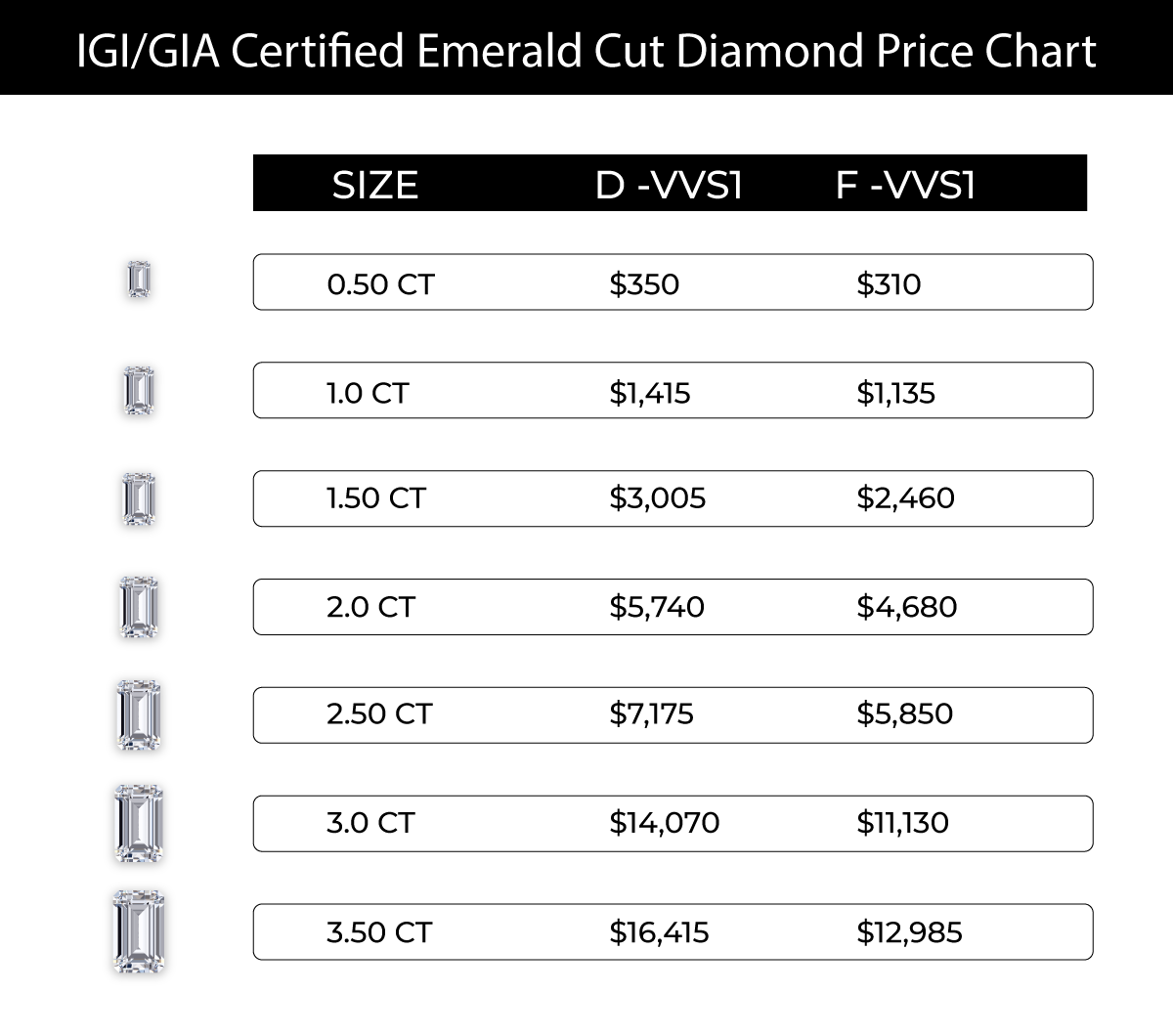
A 2 carat emerald cut diamond can cost starting from around $600 and increases based on the other 3 C’s that are chosen.
Which is the more expensive emerald cut and radiant cut?
A radiant cut diamond is slightly more expensive than the emerald cut diamond as we see the number of facets increase and so does the effort to add those facets.
Which cut is more suitable for an engagement ring?
Both the radiant cut and the emerald cut look absolutely stunning in an engagement ring.
Can I customize the ratio of length to width for emerald and radiant cuts?
Yes, the ratio of length to width can be customized. For an emerald cut diamond, the ideal ratio is 1.3- 1.6 and for a radiant cut diamond is 1-1.35.
Deciding which accessory would best suit your beloved someone is a task involving creativity and confusion. But when the options are irresistibly beautiful, it gets a bit difficult to choose the best jewel from the lot.
An emerald cut diamond brings outclass strength and the latest trends. Modern boss ladies like Beyoncé adore the shape, with many ladies respecting its capacity to show quality more than other fancy shaped diamonds.
Just like you want the best for your special one. With this objective in mind, we have compiled this article on everything related to emerald cut diamonds so that you can get closer to understanding the 4Cs of an emerald lab diamond, and what type of ring setting would suit you or your partner’s hands the best.
What is an Emerald Cut Diamond?
A human being’s personality has many layers defining them variedly, just like the step-cut layering style of emerald cut diamonds possessing perfection in each layer.
The emerald cut diamond is a rectangular-shaped diamond formed in a long structure prevailing a curvy cornered look with several facets and layering, allowing the quick as well as an easy reflection of light that delivers a shiny and fancy look.
According to the GIA, emerald lab diamond is not assigned under the cut grade category due to its fancy and several faceting looks but it’s considered only for polish and symmetry grading.
Under the depth category, 72%-58% is the enormous variation for excellence which reflects the light falling on it as well as signifies the openness inside the core.
Under the table category, the calculation of the top surface of the emerald which is plain like a slate is excellent with the variety of choices from 72%-62% in the table. It is abided by the inclusion of the step-cut layering that leaves a bow-tie effect over the top but, commonly, some people consider it as an advantageous factor of emerald diamonds. There is no room for imperfection as it might be visible in the stone, which makes it a symbolism of perfection.
Between the years 1920 and 1939, the emerald cut was immensely popular; they had just started to include a greater number of facets. The new emerald cut (which is sold in markets today) took on its current shape around the year 1940.
The emerald diamond is thought to be one of the first diamond and gemstone cuts that were explored and worn as jewelry. The emerald gemstone inspired the name the ‘Emerald Cut Diamond’. They cut the stone in a rectangular form to preserve as much of the diamond as possible. This shape has a history dating back over half a century, when the diamond was cut in the shape of a rectangle, earning the name emerald cut diamond to itself.
Over the years, emeralds have grown extremely fragile, making severing them extremely tough. People began looking for a means to clean the diamond without harming it as a result. They lacked the awareness and resources that we have today.
The history of the emerald cut dates back to the 1500s when stonecutters first developed the rectangular shape of the emerald diamond cut and worked on the cutting procedure for emerald stones. This new cutting approach was successful because it lowered the pressure given to the stone during the cutting process, preventing chipping in emerald gemstones that are simply more fragile due to their natural and numerous inclusions.
During the era of art deco, once again, emerald shape diamonds were glorified and nurtured. The official term “emerald cut” was used in the 1920s for the first time. It was the emergence of newness and styling.
The design was adored by people who loved wearing or buying jewels, this included the women population in a great number. Since this progression in the jewel design industry, emerald cut diamonds have remained a popular centerpiece stone for wedding rings or engagement rings. It is still a sought-after diamond cut that has stood the test of time in terms of both durability and style.
About 4Cs: Emerald Cut Diamond
The attractiveness of emerald-cut diamonds is quite clear. Elegant long lines lend them a discreet look, while curved corners provide a touch of timeless glamor. But the following can also be defined by the 4C parameters i.e. cut, clarity, color, and carat.
As mentioned earlier the new emerald cut took on its current shape around 1940, which included more facets compared to the emerald cut diamond of the preceding years. In today’s world, however, this diamond cut is usually used to show how clean the stone is and what a beautiful tint it has. There’s no room for flaws in this cut. In addition, defects are easily seen in the stone’s reflection, if any.
Emerald Diamond: Clarity
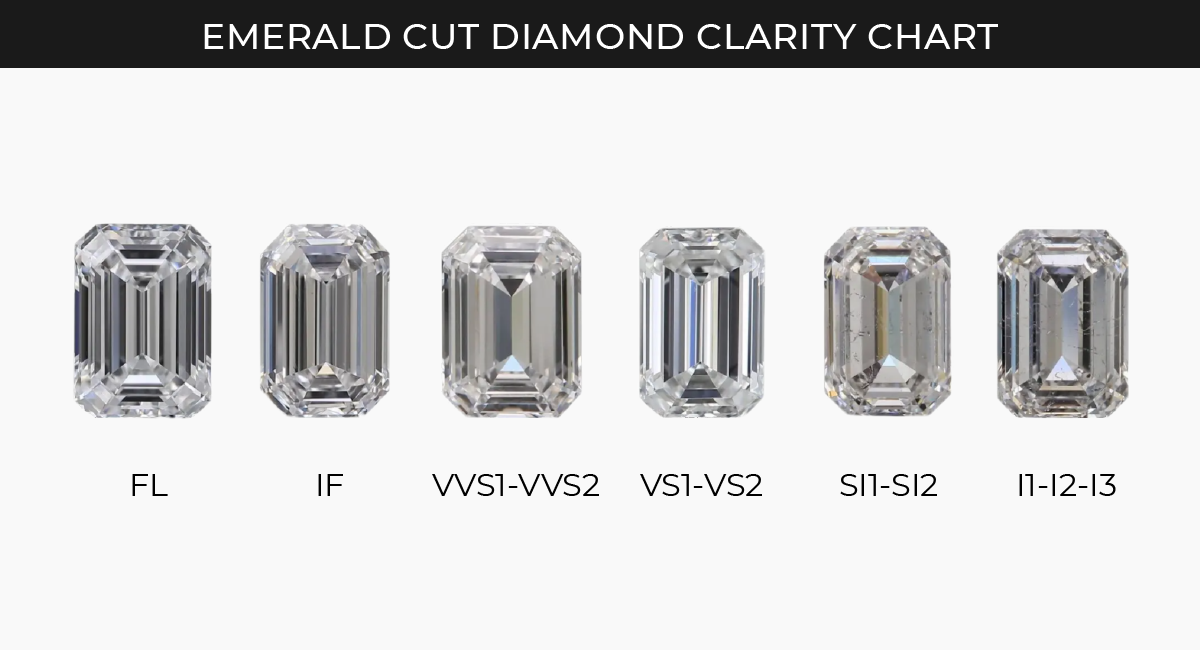
Diamonds gain clarity characteristics–slight imperfections noticeable under 10x magnification–when they are formed deep in the soil. These clear features might not be visible to our eyes, but they do very much exist.
The GIA Transparency scale ranges from the best (no inclusions) to the worst (inclusions). Their titles will be as follows:
When looking at a lab grown emerald cut diamond it is vital to pay attention to what level of clarity is sitting at. The lower the clarity the lower the price and vice-versa.
Emerald Diamond: Cut
The emerald-cut diamond is distinguished by its elongated, rectangular shape and carved step cut, which features straight linear facets aligned parallel down the stone. The emerald cut diamond’s corners are usually trimmed to promote cohesiveness and avoid fissures.
Stack terraces and parallel facets are used in the cutting process to create a sophisticated jewelry pattern that varies from the cutting techniques observed on round and cushion diamonds.
Emerald Diamond: Color
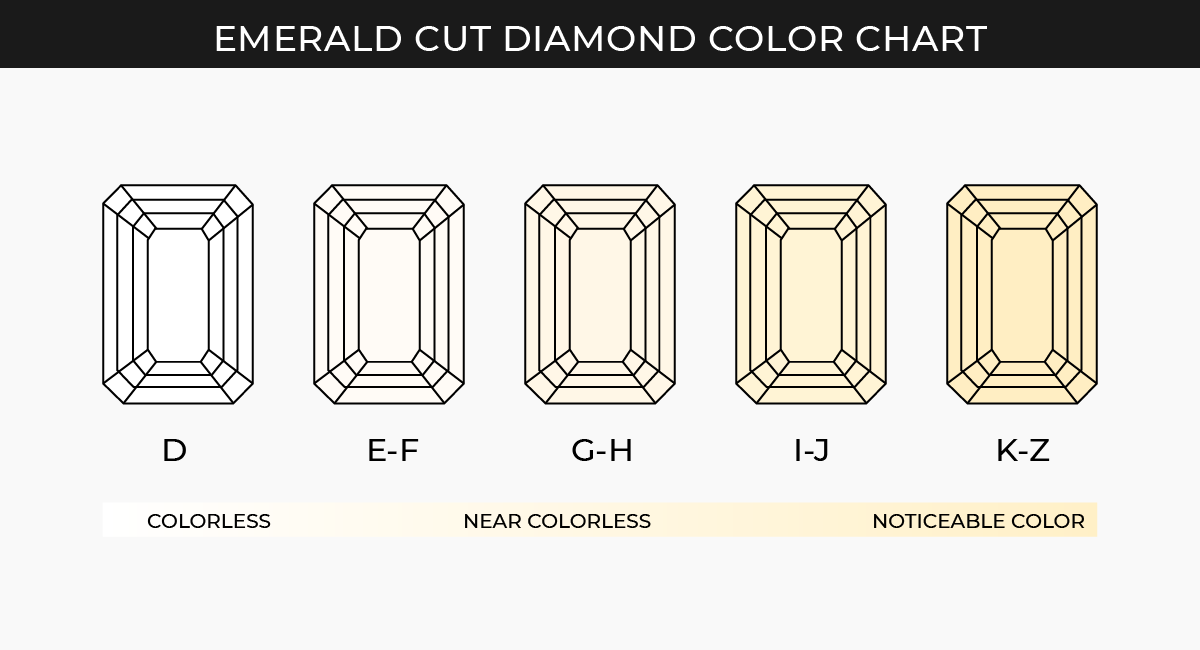
Color will be more obvious in an emerald cut, just like clarity. Color is more simply more visible in the large table and step cuts than in other sophisticated designs.
A yellowish tint will be visible in an emerald cut diamond of color grade I or lower. A tint of color grade G or higher is less likely to be noticed by the human eyes. In an emerald cut, it’s ideal to keep at or above a G color for the finest quality and value.
Finally, think about the metal in your surroundings when it comes to color. A G color grade or better will radiate with a white hue if you choose a more cold tone of platinum or white gold.
Emerald Diamond: Carat
Emerald cut diamonds also have better cutting productivity, which means that when a raw diamond is cut into a polished emerald cut, the least amount of weight is lost. As a result, cutting an emerald cut is less expensive than cutting a round brilliant diamond.
Emerald cuts are frequently accessible, despite their lower demand than the most popular round diamond. It should also be rather easy to find emerald cuts in a number of carat sizes, including larger ones. If you are unsure about diamond carat size, refer to this diamond size chart for a comprehensive guide to help you identify the size accurately.
Large carats are available, and while the quality will vary, you can expect the price to rise substantially with each full carat climb.
Emerald Shape Diamond Length to Width Ratio
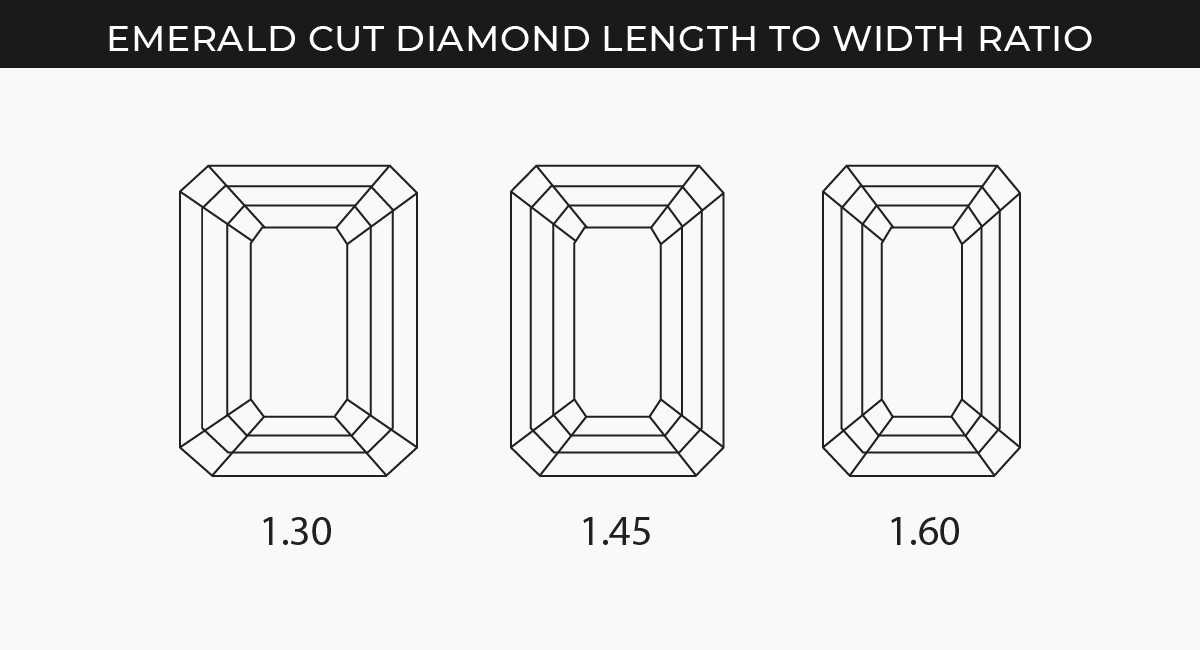
The length to width ratio of a diamond actually tells about how squared or long its shape is. The ratio can be calculated by the division of the length and breadth of the diamond.
The most well-known emerald shape ratio is 1:5, which is the absolute perfect ratio in order to make the stone rectangular in shape, which also embraces the jewelry when it is worn. In green emerald stone finger bands, this ratio is fairly common and most customers demand this ratio for their special jewel.
In this style, women’s fingers appear longer and more graceful. The cut’s form is identical to the diamond’s natural shape. Also, there is a minor reduction in stone. This also makes the emerald very well-known in terms of pricing.
Pros & Cons of Emerald Cut Diamond
Factors that are advantageous or committing towards loss, both play a vital role in the decision-making process for each element in the universe.
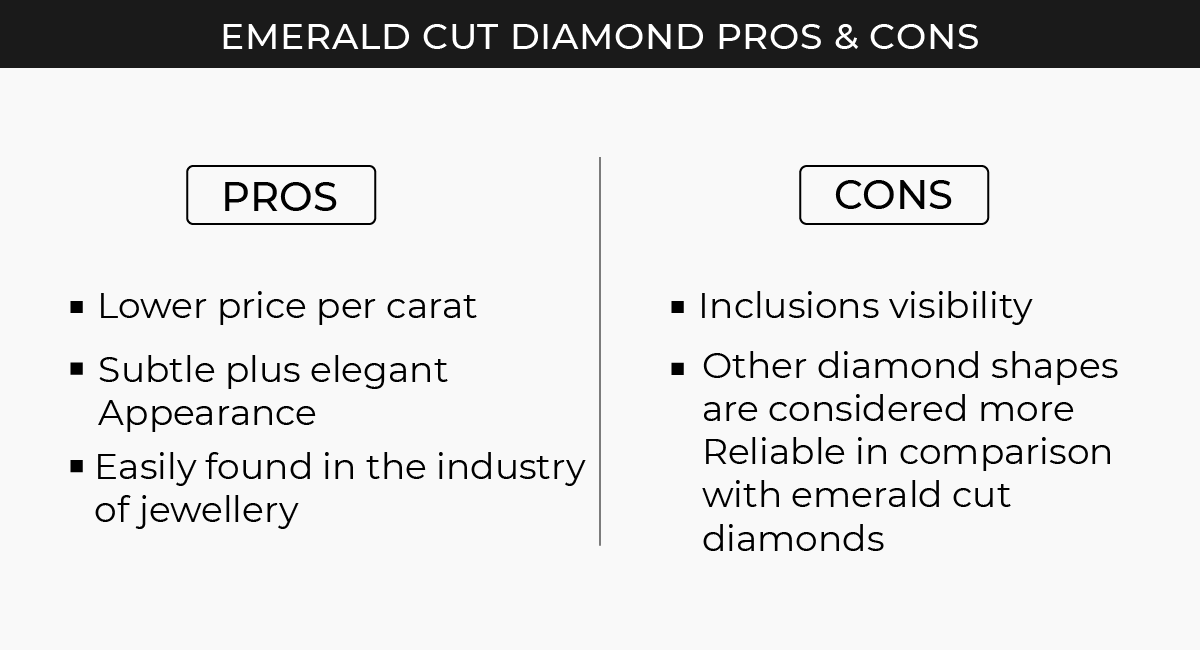
PROS
Lower Price Per Carat: In comparison with other diamond shapes, emerald lab diamond is preferably lower in cost whereas its size is quite compelling. It’s cheaper due to its less demand in the industry and high yield of cutting which reduces its weight. These two factors make this diamond cheaper than others.
Subtle Plus Elegant Appearance: The cuts, proportion, layering, color, clarity, and glassy look, all together make it the most subtle and suitable diamond, prevailing an elegant as well as a classy glance.
Easy to Find: Emerald cut diamond is a popular diamond that can be easily found in the industry of jewelry. It is considered one of the topmost choices of people which assures its availability in the market.
CONS
Inclusions Visibility: As we know, emerald cut diamonds are glassy which gives it a shiny effect but that comes at a disadvantage as well, that is, inclusions in the diamonds are quite noticeable at 10x if it is not of a higher clarity grading.
Comparison: Other diamond shapes are considered more reliable and commendable in comparison with emerald-cut diamonds, due to their long existence and vintage look.
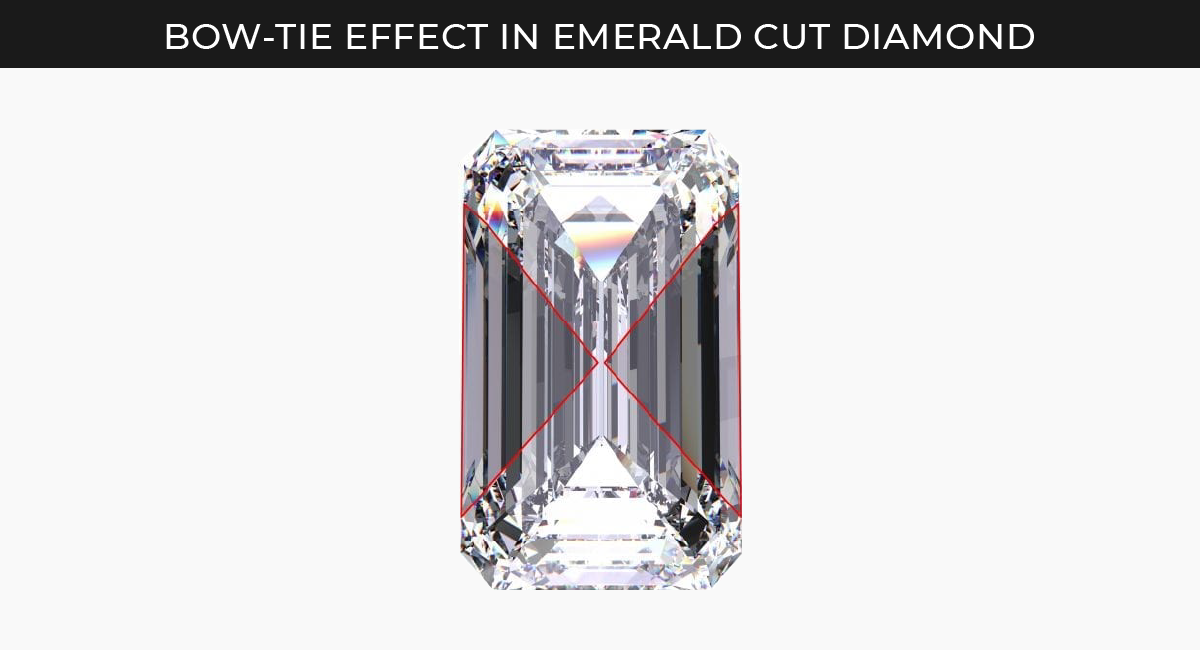
Emerald Cut Bow Tie Effect: As many diamonds cut the “Bow Tie” effect happens in emerald cuts. If a polisher places the facets incorrectly, the light doesn’t reflect in the proper way.
How to Choose an Ideal Emerald Cut Diamond
Emerald-cut diamonds can be judged on a few definite factors for considering them as an ideal diamond for purchase and utilization.
Due to its inclusions and layering, lab-grown emerald cut diamond prevails a bow-tie effect in the middle of the diamond which increases its darkness in the color and the quality seems to deteriorate due to less light reflection through the diamond.
For an ideal shape and size of the diamond, approx. A 1.30 – 1.50 ratio must be chosen or a ratio of 1.40 is considered best which also provides a good square shape likewise. For a rectangular and elongated shape, the ratio can be increased accordingly, which will meet the requirements as necessary.
Emerald cut diamond is an open table with a layering style whereas cushion cut diamond is larger in size and shape as compared with emerald cut, and has a dense structure with confusing incisions in it. Emerald-cut diamonds are less expensive as well as better for the hand due to their usual size and better quality. Cushion cut diamonds are slowly getting the pace of popularity but still need to be reviewed before purchase due to their mystifying structuring.
Similarly, asscher cut diamond is laborious to find due to its aesthetic nature from the Art Deco era, which made it more of a vintage diamond and has less popularity as well. Showing off inclusions under the open table is one of the most similar characteristics adored by both diamonds in their unique ways. Both of them have their personality which makes them a little different from each other and increases their value variously.
These few factors must be considered as the biggest factors for considering the best and ideal emerald shaped diamond.
Emerald cut diamond rings are cheaper than other diamonds even when they are quite valuable. It’s due to two factors: decreasing demand in the market and a higher yield on cutting. The lab grown emerald cut diamonds are not so popular in the market these days due to their vintage look and origination era.
Over that, during the cutting or shaping of a diamond, most of its particles are converted into fine dust which gives the diamond a particular shape and lighter weight which makes it flimsy and reduces the cost value.
While buying an emerald cut, one must be a little careful due to its glassy nature which doesn’t allow it to hide most of its inclusions and makes it appear darker in color, and reduces the effect of light reflection.
These small characteristics of diamonds must not be neglected and should get more attention for better and efficient purchases. Emerald cuts are not a bad choice due to their inclusions but their clarity makes it valuable which also reduces the money value in the market by per carat. It is anyhow a good deal for engagement or casual rings.
What Is the Best Setting for an Emerald Diamond?
Emerald cuts work well in a variety of styles, but they’re particularly well-suited to more subdued settings. Emerald cuts are ideal for three stone settings and suit nicely with solitaire and simple pave settings.
Not every emerald cut diamond is well suited for each design so it is essential to know which design emerald diamond engagement rings is best for your hands.
An emerald-cut diamond wedding band features a continuous row of emerald diamonds set all around the band, creating a unique and elegant design. The choice of metal for the band, such as white gold, yellow gold, rose gold, or platinum, can further enhance the aesthetic appeal of the ring.
Solitaire Setting for Emerald Cut Diamond
Solitaire is one of the most beautiful settings or representations of showcasing a worthy emerald diamond ring. The elegant appearance of an emerald shape diamond is amplified by a solitaire design in a perfect 1:5 ratio proportion.
The reason behind this statement is that the design allows light to get inside the diamond and showcase a beautiful and rich look. It not only showcases a lovely diamond shape but amplifies its beauty by adding a sober touch to the jewel in your fingers.
Pave Setting for Emerald Cut Diamond
Another beautiful setting or jewel design for an emerald cut diamond ring is a paved design. This setting will enhance the appearance of the emerald lab diamond to a great extent. Unlike solitaire, it focuses on the center of the diamond to add a sober and attractive look.
It’s not the diamond itself, but the setting of the ring is called pavé. Each of the small diamonds in a pavé setting is held in place by metal droplets, sometimes called tiny prongs/ beads. A pavé diamond band is essentially a design in which several little diamonds are put closely together with little space between them.
Small amounts of precious metal beads (also called prongs) are used to hold these tiny diamonds in place.
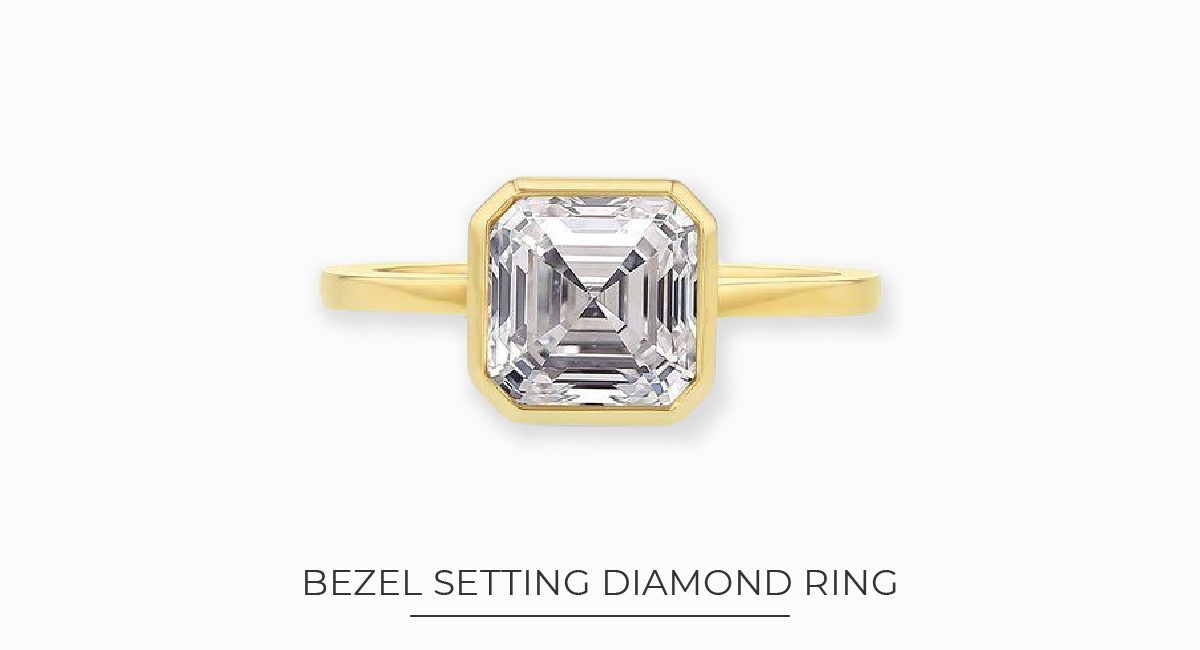
In this style, the metal forms a complete encircle around the diamond, ensuring a secure hold. The bezel setting not only imparts a modern and streamlined appearance but also serves to safeguard the edges of the diamond.
When combined, the bezel setting and emerald shape create a beautiful and harmonious ring design. The bezel adds a touch of contemporary flair, while the emerald cut enhances the diamond’s natural brilliance.
Three Stone Setting for Emerald Cut Diamond
Emerald diamonds look great in a three stone setting as well. The emerald in the center is flanked by two lesser stones that assist bring attention to it and enhancing its beauty.
The 3 stone emerald cut diamond ring is commonly made up of equal-sized stones, but they can also be made up of a larger stone in the middle, bordered by two smaller ones. Three stone rings, also known as trinity or trilogy rings, are a new take on the classic solitaire diamond design.
The side stones may not be the same size as the primary ones, but usually, the stones are relatively smaller in size to bring attention to the larger emerald diamond in the center.
How To Buy An Emerald Cut Diamond?
Know the 4 Cs understand carat weight, cut quality, color grade, and clarity. Determine the size of the diamond based on your preferences and budget. Insist on a diamond certification from a reputable gemological laboratory, such as GIA (Gemological Institute of America) or IGI (International Gemological Institute).
Consider the setting that complements the emerald cut, and don’t hesitate to negotiate the price, whether you’re purchasing in-store or online. We at Loose Grown Diamond want this experience to be special for you. Additionally, if you are confused about determining the price of your selected diamond, you can use our diamond price calculator.
Once satisfied with the diamond, the price, and the terms, proceed to complete the purchase, including the promo code.
Conclusion
The emerald lab diamonds have an exquisite form and distinctive stage cuts. Emerald cuts are a phenomenal option for those searching for a bigger diamond without it being heavy on their pockets. Since emerald-cut diamonds need close attention to the consistency of cut diamonds, we recommend that you have an expert analysis of your diamond prior to buying.
The main symbolism of strength conjoined with its name defines its empowerment and standards in the fashion industry. People buy it less frequently due to the differentiation in the choices, but overall it is a wise selection for experiencing newness in the jewelry inspired by the vintage collection.
FAQs
How much is a 2 carat emerald cut diamond
Generally, you can expect to pay anywhere from $2,000 to $50,000 or more for a 2-carat emerald-cut diamond, depending on market conditions.
How much does an emerald diamond cost?
Generally, expect a range of $800 to $50,000 or more for an emerald cut diamond.
Are emerald diamonds suitable for engagement rings?
Yes, emerald diamonds are a popular choice for engagement rings, offering a classic, unique, and sophisticated look.
Are emerald diamonds suitable for everyday wear?
Yes, emerald diamond rings are suitable for everyday wear, but it’s advisable to choose a durable setting.
Does emerald cut diamonds look bigger?
Yes, emerald diamonds can appear larger than other diamonds of the same carat weight due to their elongated shape and the way they distribute their weight.
Can I customize an 2 carat emerald-cut diamond ring?
Yes, LGD offers customization options, allowing you to create a unique emerald cut diamond ring using lab grown diamonds to suit your preferences and style.
Diamonds have always been many people’s favorite choice of gemstones. While many tend to settle for the flashy and brilliant variations in diamonds like the ones with round cut gems, many others prefer a subtle and sophisticated design like the one that can be observed through the emerald cut or asscher cut diamonds.
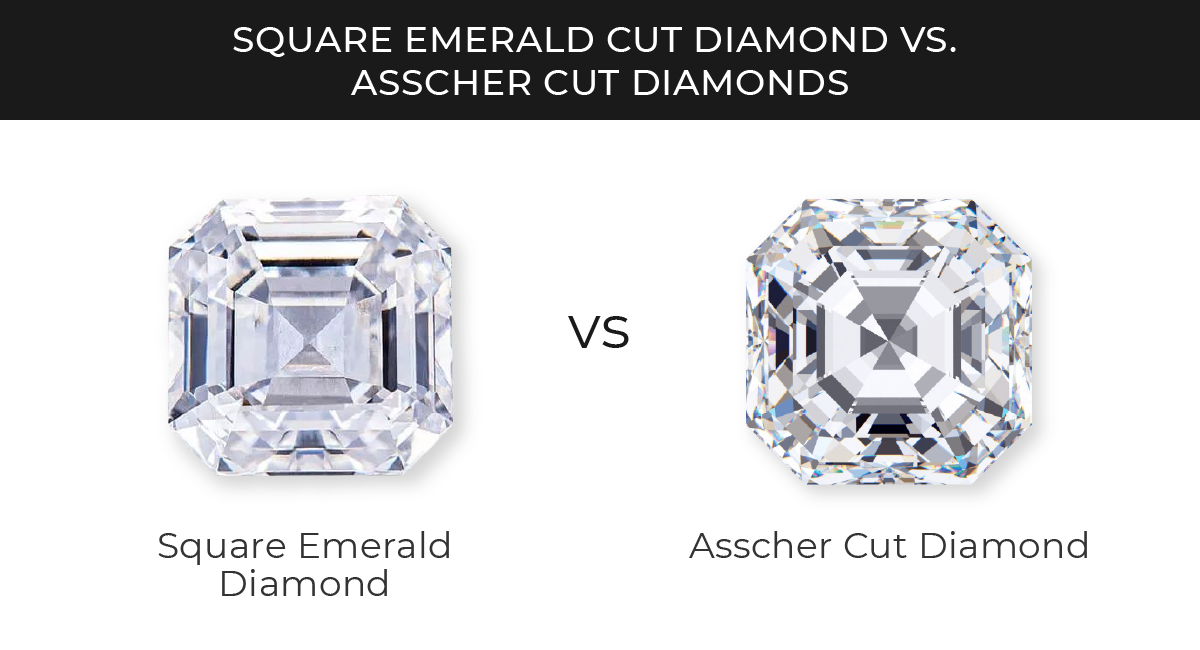
Two nearly identical cuts like the Emerald and Asscher diamonds, hence, make for a great choice for customers who are not attracted by gems that are too flamboyant but would still like to enjoy the radiance and beauty that diamonds exude. The only major difference between the cuts is the variation in the L: W ratio of the diamonds, wherein the length and width vary in such a way that the emerald cut diamond has a rectangular shape whereas the Asscher cut has a square one.
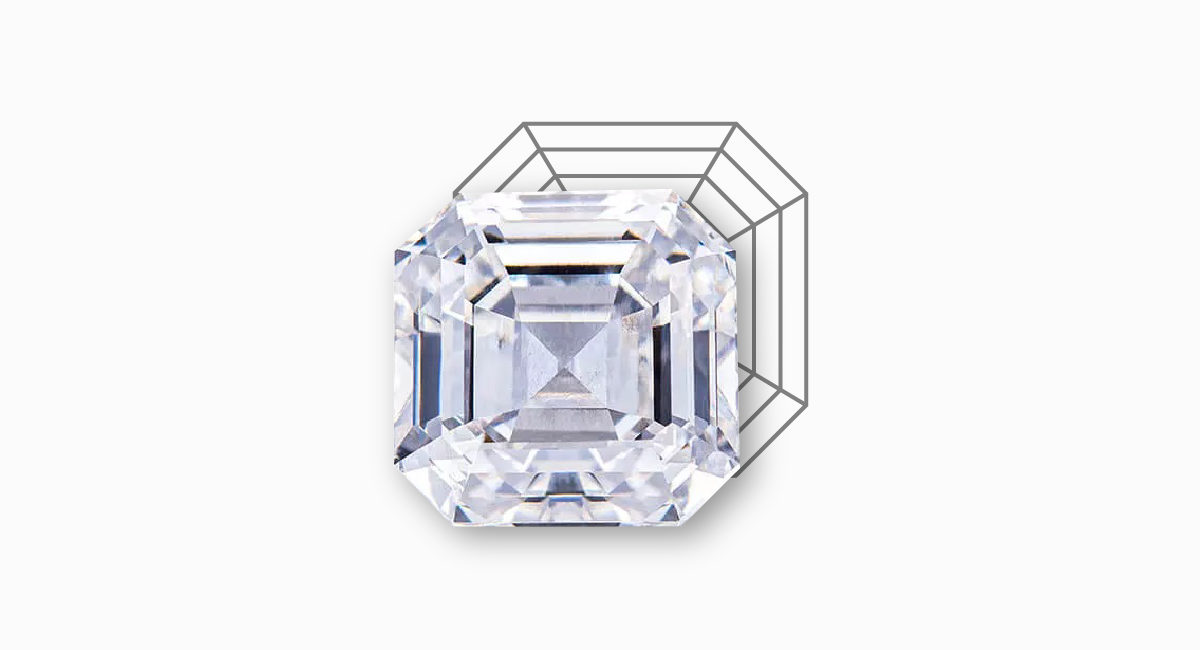
However, the square shaped emerald cut diamonds sometimes manage to create a lot of confusion amongst customers since they resemble both types and are difficult to place within either of the categories. The square emerald cut diamonds can still be included under the umbrella of emerald cuts because of their less truncated corners which are more pronounced in a true asscher cut diamond.
Hence, square emerald cut diamonds can easily be said to be the perfect combination of both worlds and prove to be an apt choice for customers whose personal preferences and styles complement the design exhibited by these diamonds.
However, before making a decision on which cut to choose for one’s jewelry, it is always advised to customers to first look into the general guidelines that must be referred to for the process of evaluating diamonds.
What is a Square Emerald Cut Diamond?
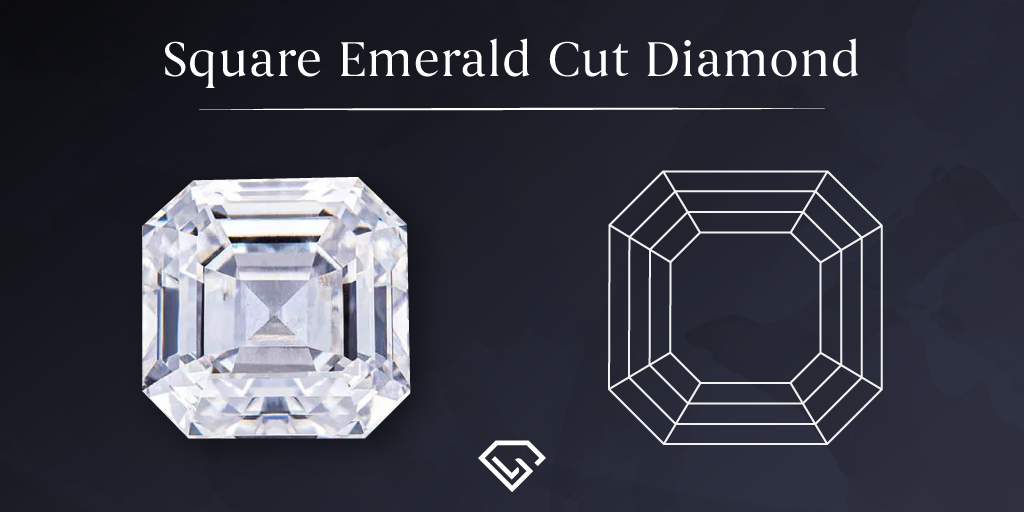
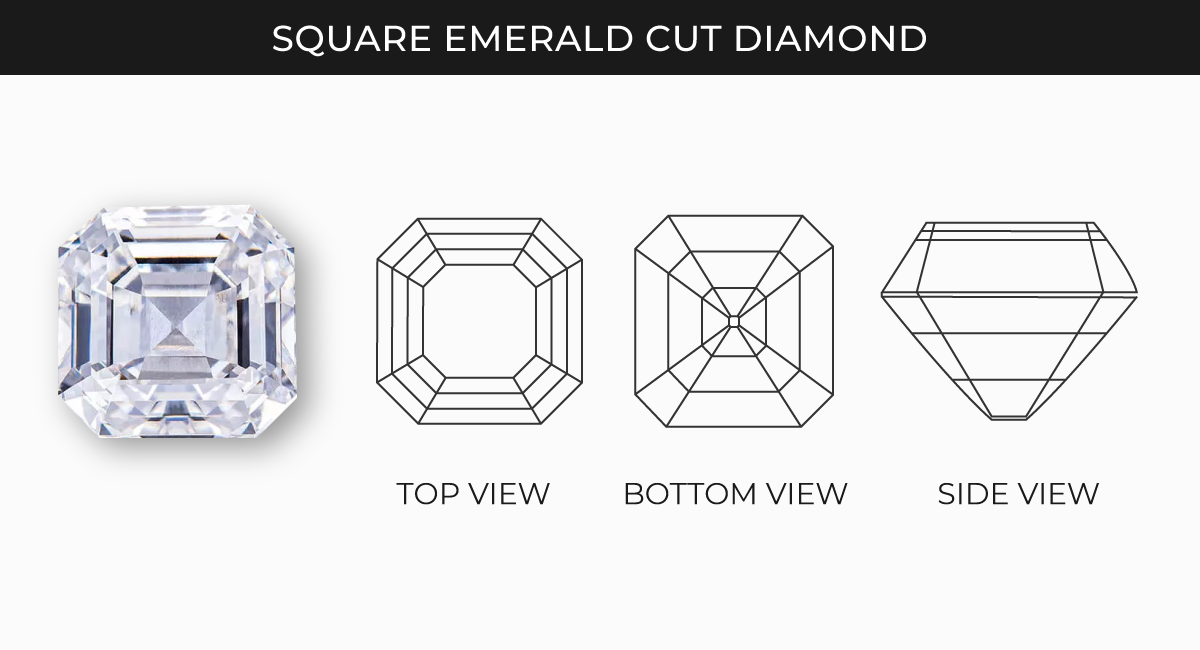
A diamond with an elongated shape molded into the appearance of a square, the square emerald cut gemstone has linear facets that feature chiseled step cuts that are arranged in a parallel manner down the stone. Additional cuts are provided to the corners of the stone to provide the gem with extra security and stability so that it retains its shape and position in a ring and does not get easily fractured.
With a huge surface table, the square emerald cut diamond is one of the largest diamond cuts out there and also provides its wearers with exceptional clarity. It is well known for appearing larger than the actual size and carat weight of other shaped diamonds and hence, makes for a popular option for customers who want to spend their bucks in a budgeted manner but on a large stone. Another effect created by the cut includes its ability to abundantly reflect white and colored light due to the presence of long step cuts.
Although emerald cuts are generally found in rectangular shapes due to better prominence, they are also available in squares for customers who are attracted to the particular shape.
One of the oldest diamond shapes to exist, the emerald cut can be traced back to the table cut of the 1500s from which the emerald cut was further developed. Originally termed as the multi-faceted table cut, the cut was first and foremost used on emeralds as the name suggests and was only a lot later on brought as another variety into the world of diamonds.
With the term ‘emerald cut’ emerged in the 1920s, it has often been associated with the era of Art Deco wherein clean lines and symmetry were in trend amongst the people and enjoyed their own class of popularity. Then in the 1940s, the cut was further more refined and standardized which could be done with the invention of much more advanced and systematic diamond-cutting tools.
Once emerald cuts were refined as much as they could be, they began being designed in shapes other than rectangles by many jewelers and designers and hence, the square emerald cut diamond was conceived.
Facets of Square Emerald Cut Diamond
The square emerald cut diamonds have a square outline and the corners are cut in a particular manner. Depending on the dimensions of the gem, the emerald-cut diamonds can be home to 50 to 58 step-cut facets.
The step cuts are arranged parallelly and this leads to the creation of stunning flashes of light which in turn causes a “hall of mirrors” effect. This cut is known to be slightly more elegant than radiant cut diamonds and also exhibits a more sophisticated sparkle.
Difference Between Square Emerald Cut Diamonds & Asscher Cut Diamonds:
Many times people tend to propose the question “What is the difference between an emerald cut diamond and an asscher cut diamond?”. The reason both of these types of diamonds are put up for comparison is that they both belong to the step-cut family. In this family of diamonds, each diamond has some or the other sort of step-like cutting the ones you see on staircases.
This family consists of emerald cut diamonds, asscher cut diamonds, baguette cut diamonds, and carré cut diamonds. Each of these diamonds has its own specialty and reason to buy. But coming to the emerald and asscher cut diamond.
Firstly, the emerald cut lab diamond is rectangular as it is elongated. The asscher diamond has equal sides and appears as a square and at times when the corners of an asscher diamond are cut thoroughly, the gem appears to take an octagonal shape.
Coming to the length of these diamonds; the length of the sides of both the diamonds vary. The ratio of length for the lab created emerald diamond can be 3:1:1 (length: width: thickness), 6:1:1, and even 4:1:1. This is why when one wears an emerald cut diamond their fingers appear to be elongated, a phenomenon which is seen when wearing marquise, ovals, and pear diamonds.
These are not fixed but rather ratios that will give the diamond an elegant look. The sides of an asscher lab diamond will however be at 1:1. Making this diamond a bulky look and appear to be bigger in general.
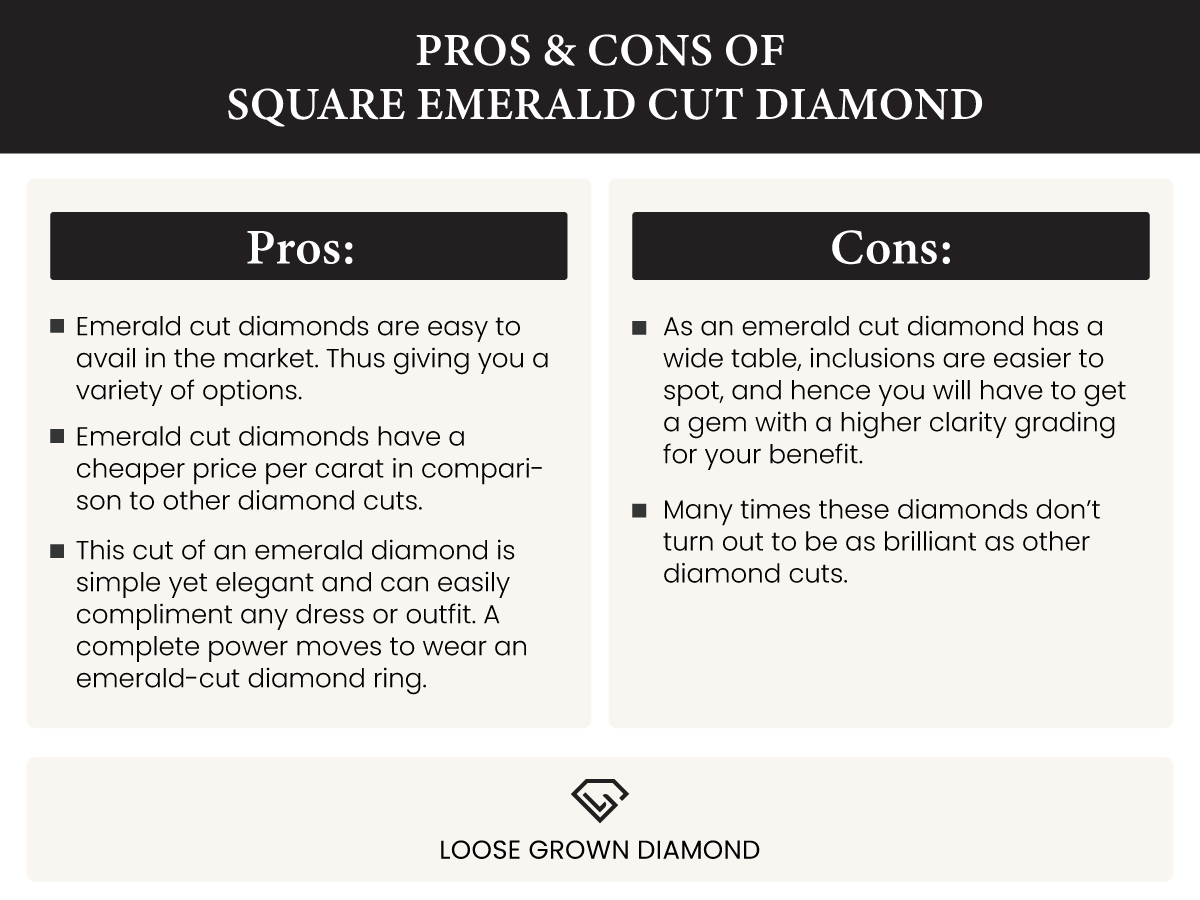
Pros & Cons of Square Emerald Cut diamond
Now that you have got a broad idea about emerald cut diamonds let us mention reasons why you should buy this gem (pros) and reasons why you might back out in buying an emerald cut diamond (cons).
Things to Consider Before Buying a Square Emerald Cut Diamond Ring:
The square cut diamonds are being prominently used in engagement rings by customers who are intrigued by the uniqueness and subtlety expressed by this variation. Even though the guidelines to judge square emerald cut diamonds are pretty much the same as the rules applied to the other diamonds that were mentioned before, it is still essential to keep in mind the few specifications that are characteristic features of the emerald cut gems.
Cut: Since reputed organizations like the GIA do not grade cuts in fancy shapes and only evaluate the polish and symmetry of the surface, customers can only utilize certain ranges in aspects of the cut of an emerald cut diamond to achieve maximum luster. The ranges are given in the following table.
Clarity: Customers are often advised to select a square emerald cut diamond that does not have any inclusions present in the middle of the stone since the clear window on the table surface of the diamond allows observers to directly view the diamond. The most minimal flaw would be clearly visible in a square emerald cut diamond also because of its comparatively shallow pavilion and crown. Hence, it is safe to say that blemishes and imperfections in an emerald cut diamond would be a lot more noticeable and visible than the ones found in a round cut or cushion cut diamond.
Color: Like the other aspects, even color in a square emerald cut diamond is a noticeable factor that customers need to take care of while making the purchase. A diamond with a grade of I or lower is the best option when it comes to square emerald cut diamonds.
The color of the diamond must also complement the setting it will be based within. Hence, customers should also let the setting be an influential factor in the decision-making process regarding the color of the lab grown diamond.
Carat: Described simply as the weight of the diamond, it is an aspect related to the size and physical appearance of a precious stone. A carat that best fits the frame of the customer’s face and also falls within the budget must be kept in mind while making the purchase.
Although a bigger size is sometimes preferred, people should consider the diamond’s cut above the carat weight as most times larger diamonds lack the luster and sparkle because it has been poorly cut. 0.50-carat stones are a preference for many.
If you’re uncertain about which diamond carat size to choose, refer to our diamond size chart for a comprehensive guide to determining the most suitable size for you.
Best Settings for Square Emerald Cut Diamond:
An emerald cut diamond though gives a benevolent and class vibe it tends to have a more gracious appeal when the gem is mounted on a particular setting. Now out of the many settings which are the best? Let us answer this question for you.
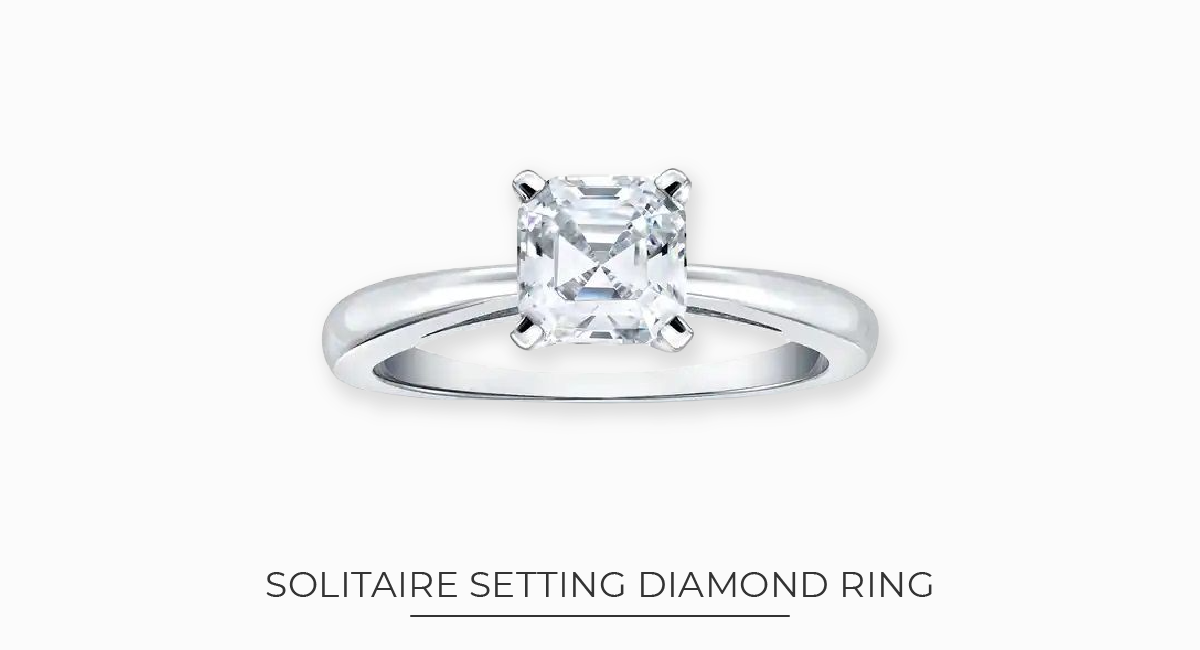
Square Emerald Diamond Solitaire Setting:
A setting in which the dazzling emerald cut diamond will be placed as a center stone without any adjacent stones is termed a solitaire setting.
This setting is recommended for when you are willing to place a diamond that has an appreciable size. As the stone alone will carry the engagement ring, keeping the carat size too small might be the best fit. The solitaire setting is considered to portray how an individual considers themselves powerful enough to stand alone.
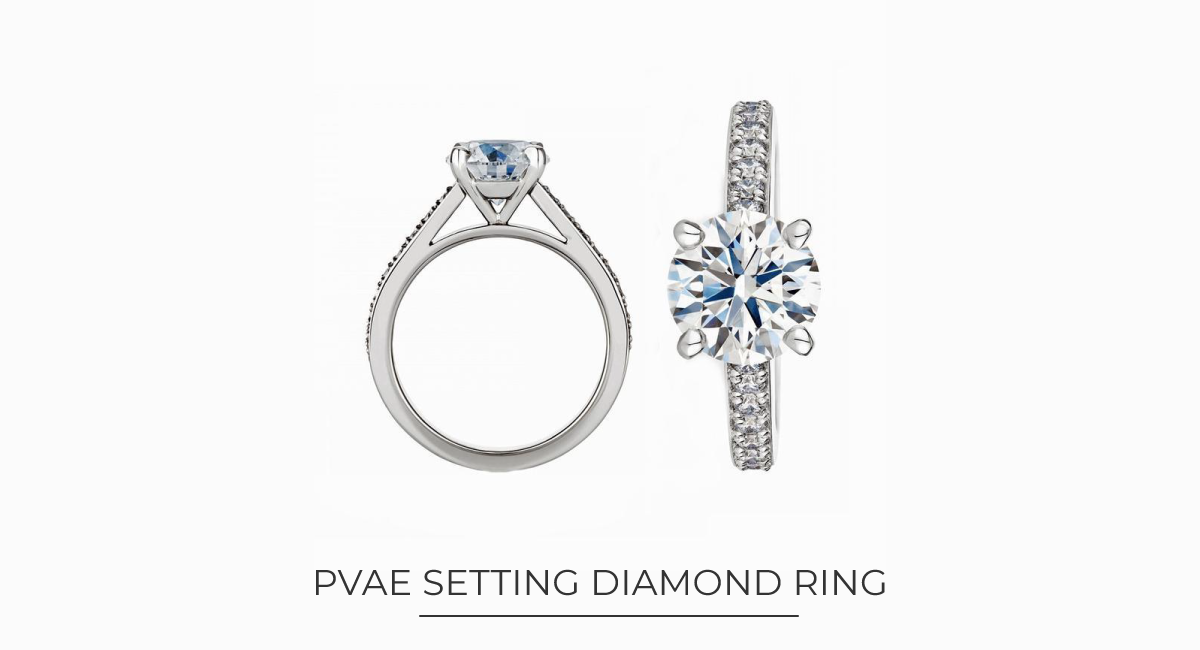
Square Emerald Diamond Pave Setting:
If you are one to flaunt your jewelry as you consider it to be absolutely lovely then this emerald-cut diamond setting will be a treat for your eyes.
Consider a solitaire ring with a metal band consisting of small diamonds lined up adjacent to each other to give the whole ring a more wealthy look. The pave setting may be a bit heavy on your pocket but the happiness it will provide will be so worth it.
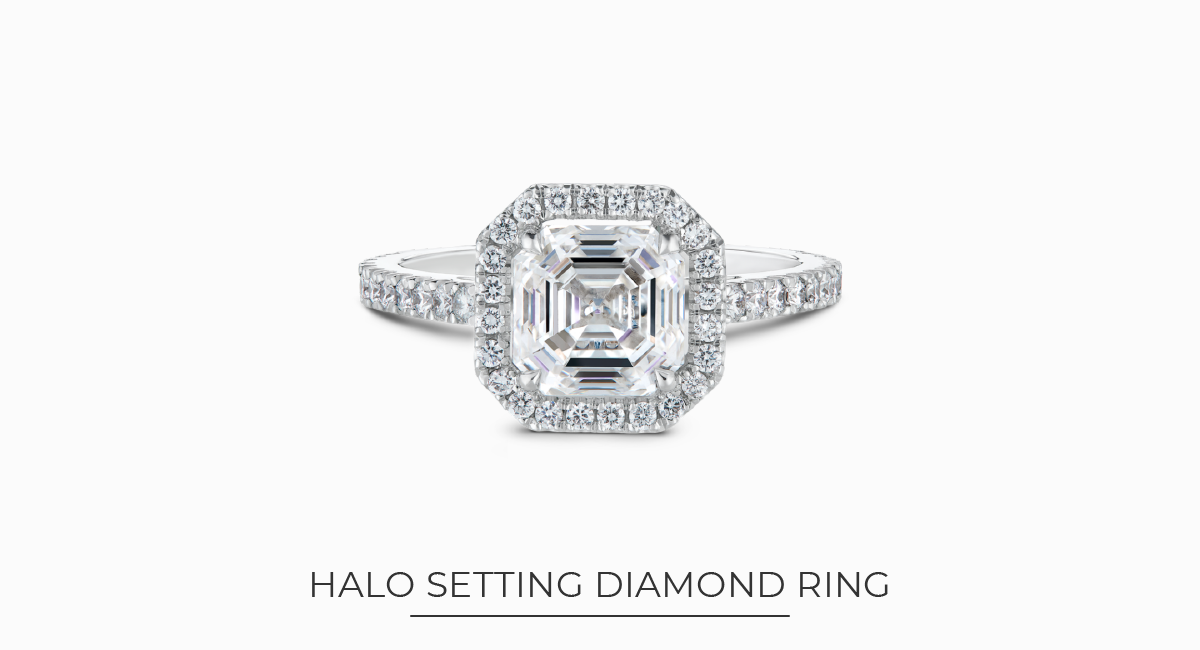
Square Emerald Diamond Halo Setting:
An amazing setting that screams richness and prosperity. The halo setting is one of a kind setting that can be increased, you can have one halo or two.
You can even take it up a notch and have 3 halos, but be sure to note that as soon as you add a halo the price of a ring is bound to skyrocket. An emerald-cut diamond when placed in a halo setting is likely to be good with one or two halos. These halos are metal circular bands placed around the centerpiece (the emerald cut diamond in this case) and they have diamonds studded on them. Thus making the whole ring appear slightly bigger than it actually is.
Square Emerald Diamond Bezel Setting:
The bezel setting for an emerald cut diamond is one of the most secure settings there is. In this setting, the centerpiece diamond is covered from all sides by the metal.
It is basically like a solitaire ring (as there is mostly one diamond) wherein the metal is extended to the side of the diamond. This setting is good for people who want higher durability of their diamond and are planning to keep it in the long run.
Square Emerald Diamond Three Stone Setting:
This type of emerald cut diamond ring is for those people who just love emerald diamonds and want to have more than just one stone.
Three stone setting there are a total of three diamonds in which the centerpiece is bigger than its adjacent side pieces. The square emerald cut engagement ring setting makes the ring look expensive and is, in general, more expensive than the rest due to the use of more than 1 diamond.
Who Should Buy Square Emerald Cut Diamonds?
The square emerald cut diamonds must always be considered by customers who are seeking gemstones that exhibit a perfect combination of two varying cuts in a beautifully subtle manner. When looking to purchase a square emerald cut diamond, you can explore several reputable options both online and in physical stores.
“Loose Grown Diamonds” is known for its vast selection of lab created diamonds. The bonus here is the fact that jewelry made with this diamond is available at affordable prices and hence customers can get their hands on one of the best cuts in diamonds for comparatively lower prices. In more, discover special savings by using our exclusive promo code to enhance your diamond shopping experience. Hence, it is safe to say that the square emerald cut diamond is a real catch for many.
FAQs
How does a square emerald cut differ from a regular emerald cut?
The primary distinction lies in the shape. While both have step-cut facets, a square emerald cut is specifically designed to have a square outline, offering a unique and modern twist to the classic emerald cut.
What is the square cut emerald diamond price?
An emerald cut diamond weighing 1 carat can be obtained within a price range of $1000 – $1500, with the specific cost influenced by factors such as color, cut, and clarity that you choose.
Are square emerald cut diamonds suitable for engagement rings?
Yes, square emerald cut diamonds are a popular choice for engagement rings. Their clean lines make them an elegant and eye-catching option, blending modern aesthetics with a touch of vintage charm.
Can I customize a square emerald cut ring?
Yes, “Loose Grown Diamond” offers customization options for square emerald cut diamond rings. You can choose the metal, setting style, size and even incorporate additional accent stones to create a unique and personalized piece.
Are square cut diamonds more expensive?
Square diamonds, such as princess or cushion cuts, are generally more affordable than round brilliant cuts. This is because the cutting process retains more of the original diamond rough, minimizing wastage and reducing overall costs.