What is Diamond Windowing & Why Should You Avoid It?

What is the Windowing Effect of a Diamond or Gemstone?

When light flows through a diamond or gemstone rather than being reflected into it, it is called the diamond windowing effect. 

Incorrect facet angles or inadequate proportions can cause this. When substantial light leakage is visible through the gem, it is clear that this is the case. 

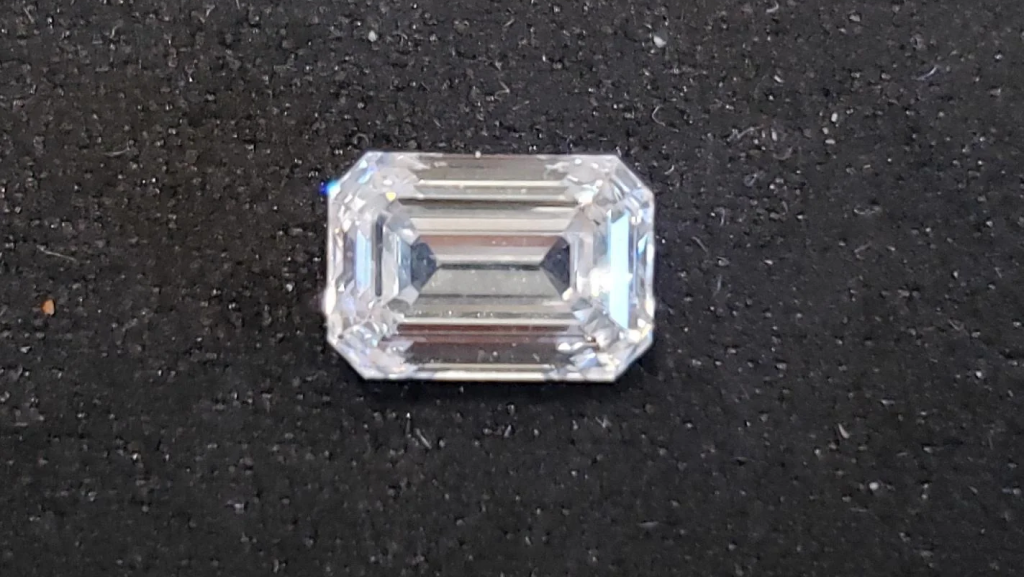
One example is windowing in emerald cuts which is a common thing because of their facet configurations. The angle at which light is refracted back into a gemstone is known as the critical angle, and it depends on the stone’s hardness. 

A gemstone with poor cutting quality could have facet angles that let light through, reducing brilliance. Gem cutting necessitates exact angles to minimize windowing and maximize light reflection. 

Cutters may intentionally create gemstone windowing by prioritizing color preservation or weight retention over brilliance. To remain high-quality and brilliant, windowing must be understood and avoided for diamonds and other gemstones. 

Hold a diamond or gemstone using tweezers to determine if you can see through it quickly. If so, this indicates extensive light leakage, known as windowing. 

As an alternative, look at the stone in various lighting settings. If the top view looks translucent, windowing is probably present.

How to Identify Windowing in Diamonds?

When buying gemstones, it is essential to recognize windowing in diamonds since it can considerably reduce the piece’s value regardless of the stone’s carat weight. 

Look for indicators of leaking light, such as the gemstone’s ability to reflect on tiny texts when placed on a newspaper. 

Furthermore, note whether the stone seems less brilliant in different lighting settings and check the crown facets for lack of light reflection or blackness. Look for unusual proportions because windowing can come from deep or shallow incisions, both. 

Beware of diamond sellers who try to increase brightness through side facets because the top-down light entry should be given importance.

How Vital is Cut Quality in Preventing Windowing?

The main goal of a diamond’s cut is to find a good mix between brilliance, dispersion, and scintillation. 

High cut quality makes the stone look good and maintain its appeal for years to come. In the stone, pavilion facets make the diamond brighter by reflecting light to the eye. While, crown facets make spreading light throughout the stone easier. 

On the other hand, colored jewels value brilliance and scintillation more than dispersion because they usually have less dispersive power. So, the way colored gems are cut emphasizes their brightness for the best visual effect. 

Hence, cutting plays a crucial role in preventing windowing for any type of diamond.

How Does Windowing affect Diamonds? 

Windowing effects diamond’s overall appearance and ability to refract light. Windowing makes a part of the diamond appear see-through. This transparency can reduce brightness and sparkle for any stone, thus making it unappealing. 

Windowing reduces light refraction in traditional brilliant cut, diminishing the diamond’s sparkle and fire. 

Diamond windowing is caused by improper proportions, such as a steep crown and shallow pavilion, failing to reflect light internally, reducing brilliance and increasing transparency. Light escapes through the bottom of a shallow pavilion, producing a window-like illusion when viewed from the top. 

Large table faces increase visibility through the diamond, making windowing more visible as more light travels through rather than being refracted internally and coming back up. 

Windowing helps beautify non-traditional and antique diamonds. As these cuts, with tall profiles, narrow tables, high crowns with extended facets and steep angles, might purposely generate windowing for a distinct look and different light performance.

What remedies are available if my diamond already has a window?

Re-cutting or Re-polishing: Re-cutting or repolishing gemstones fixes windowing. However, it depends on the windowing intensity and gem size. Small diamonds under 1 carat that have severe windowing, will find recutting problematic. As recutting can lower carat weight by 50%, depending on the severity of the cut. Before proceeding, consider factors like carat weight reduction and trimming fees. Repolishing pavilion depth and table size improves brilliance but might also lower weight.

Choosing the Right Setting: The correct setting may hide windowing. A bezel or halo can hide windowing. A bezel with a metal rim and a halo setting with smaller diamonds hide the transparency. Making windowing is less obvious in these settings.

How to Stay Away From Windowing?

Choose light-performing cuts like round brilliant or princess cuts to avoid windowing. Make sure pavilion depth and crown angles are ideal for light reflection. Review diamond grade reports and examine the gem in different lights. For the final test, quality can be assured by consulting a trusted jeweler or gemologist.

Best Setting for Diamond with Windowing

If you have a diamond with windowing, it is suggested you consult your jeweler to find the best setting. The diamond look can be affected by metal color, such as 18k gold. Rhodium plating on the ring may also help avoid the showing of diamond windowing. As mentioned above a bezel and halo setting can also help hide the windowing effect.

Best Tips for Choosing Well-Cut Diamonds 

Try light performance analysis and computerized imaging in addition to typical evaluation methods. These sophisticated technologies can reveal a diamond’s optical characteristics, revealing windowing concerns. Trust your instincts and choose a diamond that shines and vibes with you for a memorable purchase.

How Can I Ensure I Purchase a Diamond Without Windowing?

Consult your jeweler before buying a diamond to avoid windowing. Look for GIA, IGI, or GCAL certifications to verify the diamond’s quality and dimensions. Check diamond transparency under different lighting conditions.

Conclusion

Maintaining the value and aesthetic appeal of diamonds and gemstones requires understanding and attention to windowing. Diamond Windowing can be efficiently minimized or camouflaged by carefully assessing gemstones, consulting with professionals, and considering cutting styles and settings. Buyers can confidently choose diamonds and gemstones if they can identify the lighter center and absence of light flashes in gemstones or distinguish between well-cut stones and those with windowing.

FAQs

Is the emerald diamond windowing issue regular?
Because of its step-cut facets, emerald diamonds are frequently used in windowing; nevertheless, excessive windowing may cause poor quality.

Are windowed Diamonds always of lower quality?
No, windowed diamonds are not always of lower quality. While the brilliance of windowed diamonds may be diminished, other factors also affect quality.

Does a window lessen the value of the stone?
If a window drastically alters a stone’s appearance or light performance, then that stone’s value may be diminished.

What is the difference between Diamond Windowing & Extinction?
In diamond extinction, poorly cut stone prevents light from returning, whereas diamond windowing has light flowing through the stone and leaving without returning to the observer’s eye.

What can be used under the gemstones when setting it on a ring to minimize the effect of the window?
When mounting gemstones on a ring, windowing effects can be reduced by placing reflective materials underneath them, such as aluminum paper, rhodium or gold.
The Lab Grown Diamond Clarity: Things To Contemplate

Also referred to as synthetic diamonds at times, these are man made diamonds that are made in laboratories by various processes. These days the demand for such types of diamonds is increasing due to their similar properties as that of natural diamonds but low cost.

Diamond Clarity

It is usually created by the process known as cutting-edge technology, which is similar to that of the process of naturally growing diamonds. It chemically and optically resembles that of natural diamonds to an extent. They are not fake diamonds as the misconception of certain people leads them to call them fake. They are as real as natural diamonds.

The properties of these diamonds mainly depend on the process which is used for their manufacturing. In Fact, certain diamonds are even harder and their conductivity is also high as compared to natural diamonds.

Clarity of the Lab Grown Diamonds

The clarity of the diamonds plays an important role in the overall look and charm of the diamond. It is determined by various factors such as the amount of inclusion and the blemishes that the diamond has along with various other imperfections. 

They can be internal or external, depending on the type and the extraction process of the diamond. For best results and looks, the imperfections and blemishes should be as low as possible. The value of the diamond also has a direct relation with the clarity the more clear the diamond the more it will shine and the more it will appeal to the human eye. While any inclusions are not visible to the naked human eye but they affect the overall look and charm of the diamond.

There are various methods and techniques by which we can enhance the clarity of the natural diamonds. While in the case of the artificial diamond which is our primary concern here the diamonds are created by high temperature and pressure situations in the labs. The complex structures obtained are then cut into various small pieces depending on the carat weight which one wants. Such processes take weeks and weeks for their completion and to get the desired diamond.

So in the case of a lab grown diamond, the blemishes and inclusions are quite very less as compared to the natural diamonds.

But this does not mean that they don’t exist in this case. They exist and they too vary in amount depending on the process which was opted for the creation of the diamonds. So the GIA certificate is a must before making any purchase in the diamonds.

But it is mostly for the natural diamond. In the case of lab grown diamonds, one should mostly go for the IGI grading scale. This gives us a particular scale for the color and clarity of the diamond which one wants to buy.

The IGI Clarity Grade Scale

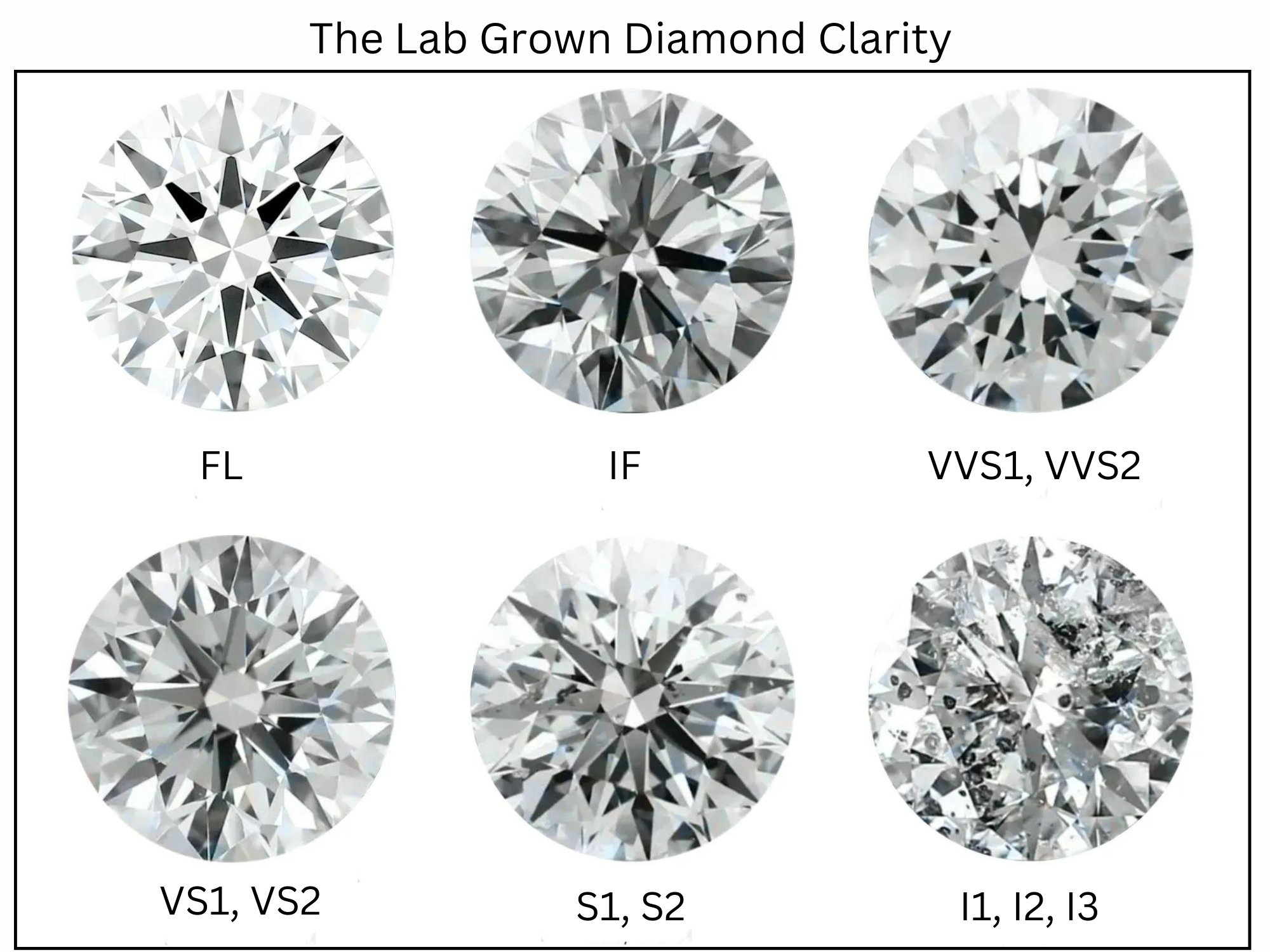
All these are written on the best to the worst range of clarity in the case of lab grown diamonds:

Internally Flawless (IF), Very Very Small Inclusions 1 (VVS1), Very Very Small Inclusions 2 (VVS2), Very Small Inclusions 1 (VS1), Very Small Inclusions 2 (VS2), Small Inclusions 1 (SI1), Small Inclusions 2 (SI2), Small Inclusions 3 (SI3) Inclusions 1 (I1), Inclusions 2 (I2), Inclusions 3 (I3).

Certification of the Diamond

Lab-made diamonds’ certification process is similar to that of natural diamonds. Their grading is done after sending them to the experts in their field in the gem labs. The grading is done based on the popular 4 C’s: cut, clarity, color, and carat.

Mostly all the labs use the same criteria and process to grade the diamonds. They are graded individually by the experts and then the compilation of the individual results is done for the best possible optimum results. The grades are given to the diamonds unbiasedly in the case of this process. 

[blog_page_inventory shape=”Round,Oval,pear,cushion,heart,princess,emerald,radiant,kite,old mine” carat=”2.30,2.60″ cut=”0,4″ color=”0,10″ clarity=”0,11″]
[blog_page_btn title”Buy Now” url=”https://www.loosegrowndiamond.com/inventory/?”]

How to Determine the Clarity Grades of the Lab Grown Diamonds

The clarity grade in the case of diamonds is a must and should not be avoided at any cost. the gradation is done by the professionals and experts in this field with years and years of experience by various processes.

They mostly tend to go for a 10x magnification process and evaluate every aspect of the diamond precisely. The microscope gives a closer and proper look at the diamonds so it also becomes easier for them to take an account of all the blemishes and inclusions present and thus work accordingly to resolve them.

Before allocating any diamond clarity grade of clarity to the professionals generally look for the 5 described factors which include the size of the diamond, its nature, the location where it was located or the process by which it was created, etc. These factors play a vital role in determining the clarity rate of the diamonds.

The Size of Inclusions

The size of the inclusions plays a very vital role, as it has to be clearly determined whether the inclusions are small enough to ignore or worked upon or not. Because the bigger the diamond inclusions, the lower is the look and quality of the diamond. Certain inclusions are also visible to the naked human eye if their size is quite large. So this factor becomes quite important to analyze and resolve.

The Nature of Inclusions

The inclusions can be of various types. They can be either internal or external, depending on the type of diamond. If they are present internally deep inside the diamond, then it becomes quite difficult to resolve them, and the grade and quality of the diamond are also impacted.

The Number of Inclusions

If the number is the most, then the fancy diamond is the prettiest. In lesser the amount of blemishes and imperfections, the greater is the grade and quality of the diamond. A few numbers of inclusions can also be ignored to a level depending on nature and their 

The Location Where they are Located

It has a major role to play while determining the quality and the gradation process. As in if the inclusions are there in the corners or the edges, they are not that visible to the naked human eye and can be ignored or resolved by polishing or cutting. But on the contrary, if they reside deep inside the diamond then they cannot be ignored and thus impact the look and gradation of the diamond.

The Various Types of Inclusions

  • Graining: The internal graining occurs due to the internal growth inside the crystal. It causes white, colored, or reflective lines, thus making the diamond look shabby.
  • Feather: It is a very tiny line or a crack that is observed on the surface and can mostly be ignored. 
  • Cavity: It mostly is colorless and depends on the minerals which are there inside the diamond which as such impacts the number of blemishes and inclusions. But if they are colored they will very much be visible and thus cannot be ignored.
  • Bearding: These types of inclusions are found close to the girdle and make the appearance of the diamond dull.

Why Should One Opt for Lab Grown Diamonds?

  •  Crystallinity: The crystals which are large and clear are mostly used in making gemstones. These diamonds are very pure and highly crystalline and thus are transparent in color. Thus very much desired.
  • Hardness: Synthetic diamonds are even harder than natural diamonds. Their hardness depends on their levels of purity, orientation, and crystallization.
  • Inclusions: Certain levels of blemishes and inclusions are present in all the diamonds. But in the case of synthetic diamonds, they are very less in number.
  • Cost: As they are not mined and extracted deep down from the earth’s surface but are instead made with artificial man-made technologies in the labs, thus the cost of these diamonds is less as compared to the naturally found diamonds.

But this does not apply to the fact that the diamonds which are grown in labs are cheap. The supply chain in the case of natural diamonds as large as they are mined first then are distributed, cut, polished, and then sold accordingly to the jewelry manufacturers. But in the case of lab-grown diamonds, the supply chain is shorter as the process of extraction and mining are skipped, thus making its cost a bit less as compared to natural diamonds.

  • Ethical: Many years ago there was a taboo associated with the mining industry, as many believed that various unethical practices are being carried out in their extraction process. They were even referred to as the blood diamonds as many believed that they are used to fund violence and the miners and their families are overexploited and taken for granted. Also, they promoted child labor in various places. 

So lab grown diamonds are your ideal choice if you are a peace-friendly person and also need reassurance as to how your diamonds were made.

  • Environment friendly: As we all are aware of the fact that during the process of mining, there are various bad and negative impacts on the environment and the surroundings. Although various steps have been taken to reduce and avoid them to a level, they still exist.

But in the case of lab grown diamonds, you will not face such an issue as they are quite environment friendly and take less energy for their creation. They also are pocket-friendly and can save a few bucks which can be used elsewhere.

The Types of Diamond Clarity Scales

ab-grown diamonds are typically graded using the same clarity grading scale as natural diamonds, which ranges from Flawless (FL) to Included (I3). The clarity grade is determined based on the size, nature, position, and number of inclusions present in the diamond.

The Lab Grown Diamond Clarity: Things To Contemplate

IF/ FL (Internally Flawless)

This is the best type of grade and is flawless, as the name itself suggests. If in case any particular thing is observed on them that can for sure be ignored as in, it is the best gradation of them all. This is the most preferred and searched-for grade when people tend to buy diamonds as it is a one-time investment that lasts nearly a lifetime.

VVS1 (Very Very Slightly Included 1st Degree)

If this clarity grade is given to the diamond, that means it is nearly close to flawless. As in the small number of inclusions and the blemishes which are present can only be seen under a microscope and thus these can be ignored as they are for sure not visible to the naked human eyes. 

Many couples who are on budget buying go for this grade of diamonds as it is similar to the first one but the cost of these diamonds is less than the above-mentioned ones.

VVS2 (Very Slightly Included 2nd Degree)

In this type of gradation, one needs an expert or a gemological microscope to find out the blemishes. The number and amount of inclusions are not that much but are present at scattered points and are not that much visible. As in they are very tiny in size one needs a microscope to find them out.

SI1 (Slightly Included 1st Degree)

The location of the blemishes has a major role to play while determining the quality and the grade of the diamond. As in if the inclusions are there in the corners or the edges, they are not that visible to the naked human eye and can be ignored or resolved by polishing or cutting. 

But on the contrary, if they reside deep inside the diamond then they cannot be ignored and thus impact the look and gradation of the diamond.

If a diamond is of this grade, it means that the imperfections are very less and are not that visible on the surface of the diamond. So they can be ignored to a level.

SI2 (Slightly Included 2nd Degree)

They are not that much visible to the naked human eye if seen casually. But if one tends to observe them keenly then a few of the blemishes might pop up but then also they do not impact the look of the diamond to a bigger extent.

Conclusion

These diamonds are the future and are revolutionary because of their pocket-friendliness, sustainability and are also conflict-free in nature. 

They have the same clarity, color, and composition as compared to the natural ones and are also nearly 50 percent less in cost, thus making us save a few bucks which can be saved and invested upon for future use.

There are various methods by which their color can be checked and improved so one should always keep them into account. As in the color plates an important role in the overall look of the diamond.

The more clear the color and the best grade it is, the more beautiful and flawless the diamond looks. One can go for a bit lower grade if on a budget but should never neglect the grade of the color as it is a one-time investment that lasts for years and nobody wants to invest in something which does not yield good results.

FAQs

What is lab grown diamond clarity?
Lab-grown diamond clarity refers to the degree to which a lab created diamond is free from internal and external imperfections or inclusions that may affect its appearance and value.

How does clarity affect the value of lab grown diamonds?
Clarity is one of the factors that influence the value of lab grown diamonds. Diamonds with higher clarity grades are generally more valuable because they are rarer and more visually appealing.

What diamond clarity should I get?
For optimal value aim for a diamond with clarity grades ranging from, VS1 to SI1 and for beauty VVS1 to IF.

What are inclusions in a diamond?
Inclusions in a diamond are internal or external imperfections, such as minerals, fractures, or other materials, that affect the clarity and appearance of the diamond.

What is the best diamond clarity?
The best diamond clarity is Flawless (FL), which means the diamond has no internal or external imperfections visible under 10x magnification.