CVD Diamonds: All That You Need to Know

CVD diamonds, This come may be met with a blank if you mention it to someone outside the diamond industry. There are not a lot of people who know what the acronym stands for or what exactly these diamonds look like. This is unfortunate because, for anyone who wants a diamond without the ethical and environmental issues that come with mined diamonds, these stones are perfect. Not to mention the fact that they caused a fraction of what natural diamonds do.

To help you understand the manufacturing process, properties, cost, and a lot more about these diamonds, we have curated this handy guide. Before buying a CVD diamond ring or an engagement ring, it might be worth looking into lab grown CVD diamonds.

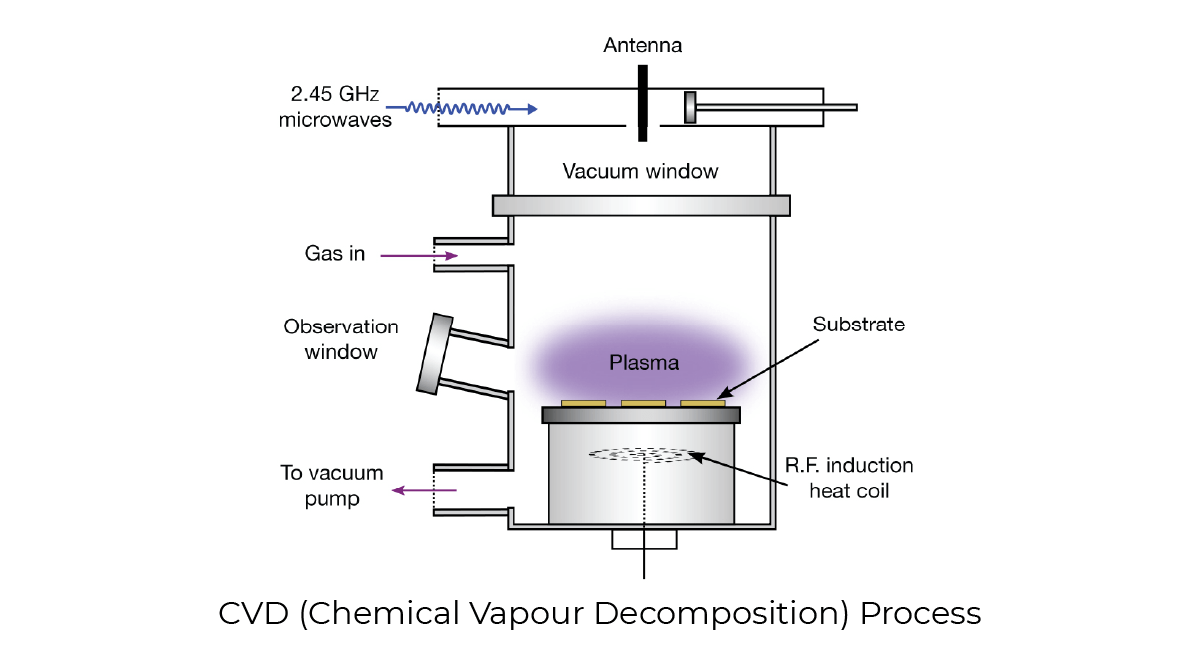
CVD is an acronym for chemical vapor deposition. Essentially, it refers to the process in which certain materials are deposited when a gas acts upon a substrate. The process involves some chemical reactions that lead to the deposition of the material.

What is CVD Diamond?

Diamonds can be classified into two types depending on the formation process. They formed under the earth’s surface and took billions of years of heat and pressure to form, they are known as natural mined diamonds.
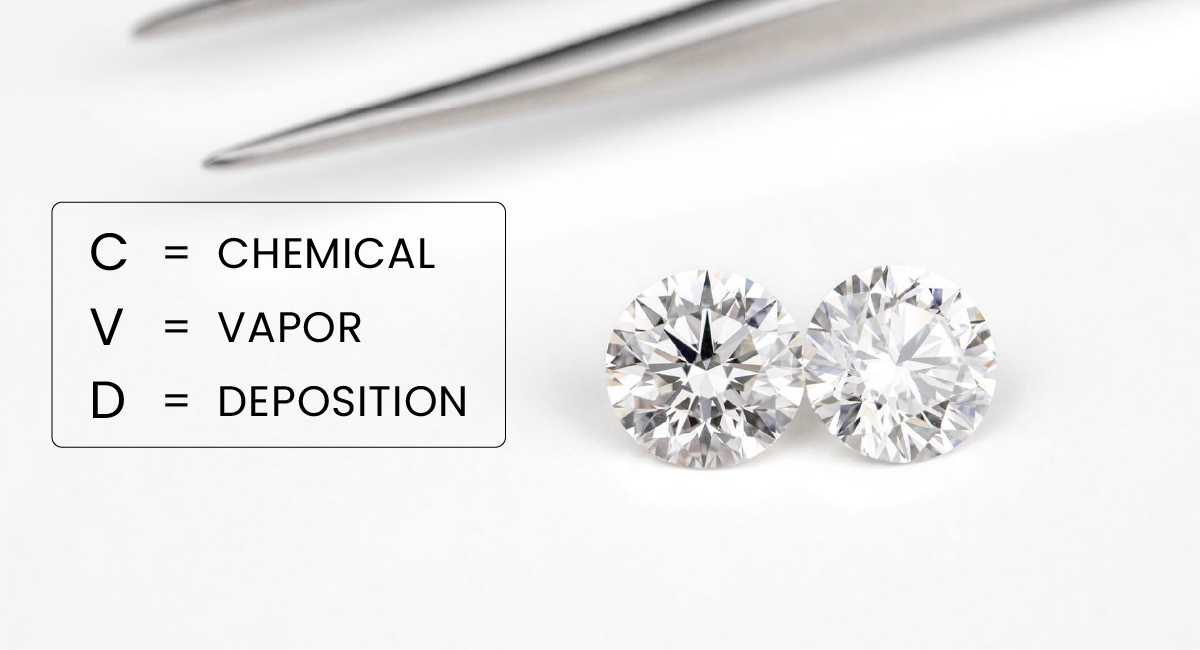
what is cvd diamond

On the other hand, man-made diamonds are formed on the surface of the earth, and as the name indicates, synthetically. One type of man-made or lab-grown diamond is the diamond’s CVD, which is made in labs by using a special process called chemical vapor deposition.

Characteristics of a CVD Diamond

CVD diamonds mirror the precise attributes of natural diamonds, sharing identical internal structure, chemical composition, and captivating luster. Just like their natural counterparts, CVD diamonds boast remarkable durability, scoring a perfect 10 on the Mohs scale of hardness, and exhibit stunning brilliance and sparkle.

Although distinguishing a lab-created CVD diamond from a natural diamond of similar quality is nearly impossible, it’s crucial to be aware that CVD diamonds may sometimes exhibit less desirable traits such as brown tints and internal graining, necessitating post-growth treatment. In comparison, HPHT lab-created diamonds tend to be of higher quality than CVD diamonds.

[blog_page_inventory shape=”Oval,Emerald,Princess,Radiant,round,pear,cushion,kite,rose cut,old mine,marquis,hexagon” carat=”1.80,3.10″ cut=”0,4″ color=”0,10″ clarity=”0,11″ dtype=”CVD”]
[blog_page_btn title=”Buy Lab Grown Diamonds” url=”https://www.loosegrowndiamond.com/inventory/”]

Similar to natural diamonds, CVD diamonds undergo grading based on cut, color, clarity, and carat weight. Despite being engineered by humans, CVD diamonds share vulnerabilities with natural diamonds, potentially acquiring color tints and internal flaws during growth. Finding flawlessly clear CVD diamonds is exceptionally rare – some may be heavily included and poorly colored, while others may be nearly colorless with only minuscule imperfections, much like their natural counterparts. Opt for diamonds graded between SI1 and VS1 for clarity, and D to F for color, ensuring top-notch quality and value for your investment.

Remarkably, even seasoned gemologists struggle to differentiate between CVD diamonds and natural diamonds because CVD diamonds possess identical chemical, physical, and optical properties, including the same flaws. When purchasing a CVD diamond, its origin is specified on the GIA, GCAL, or IGI certification. Beyond this certification, specialized laboratory equipment is necessary to distinguish a CVD diamond as a product of human creation.

Chemical Vapour Deposition (CVD) Diamond Making Process:

  • Diamond Seed Selection:
    • Choose a thin diamond seed, typically a 300-micron thick, 10x10mm slice known as a ‘diamond seed.’
    • Thoroughly clean the diamond seed to prevent crystallization of trace elements or imperfections during growth.
  • Sealed Chamber Setup:
    • Place the cleaned diamond seed into a sealed chamber.
    • Heat the chamber to approximately 800°C.
  • Carbon-Rich Gas Influx:
    • Flood the sealed chamber with carbon-rich gas.
    • Ensure a completely sealed chamber to prevent the entry of other gases, disrupting diamond growth.
  • Ionization and Attachment:
    • Under intense heat, the carbon-rich gas ionizes, breaking down into pure carbon molecules.
    • These pure carbon molecules attach to the original diamond seed.
  • Crystallization Process:
    • Repeat the process, allowing the carbon molecules to bond and build upon the existing diamond seed.
    • Continue until a fully formed, rough diamond is created.
  • Efficient Growth:
    • CVD diamond creation employs a highly specialized scientific process perfected over decades.
    • Adapts the chemical vapor deposition process, commonly used in the semiconductor industry, to efficiently produce jewelry-quality diamonds in two to four weeks.
  • Potential Traits and Post-Growth Treatment:
    • Rapid CVD diamond growth may lead to less desirable traits such as graining, spotty inclusions, and brown tints.
    • Post-growth High-Pressure High-Temperature (HPHT) treatment can remove or improve these traits, enhancing the diamond’s overall appearance but may cause milkiness.
    • Ideal to seek a CVD diamond without post-growth treatment, as indicated on the diamond’s certificate.

CVD vs HPHT Diamonds

When it comes to creating diamonds, there are two main methods: HPHT (High-Pressure High Temperature) and CVD (Chemical Vapour Deposition).

HPHT diamonds mimic the natural diamond formation process that takes millions of years in the earth’s depths, using high pressure and temperature. This method, unlike CVD, doesn’t involve gas. While both HPHT and CVD diamonds take only a few weeks to form, HPHT requires more energy. Generally, experts note that HPHT diamonds tend to have higher quality and less often need additional treatments after growth.

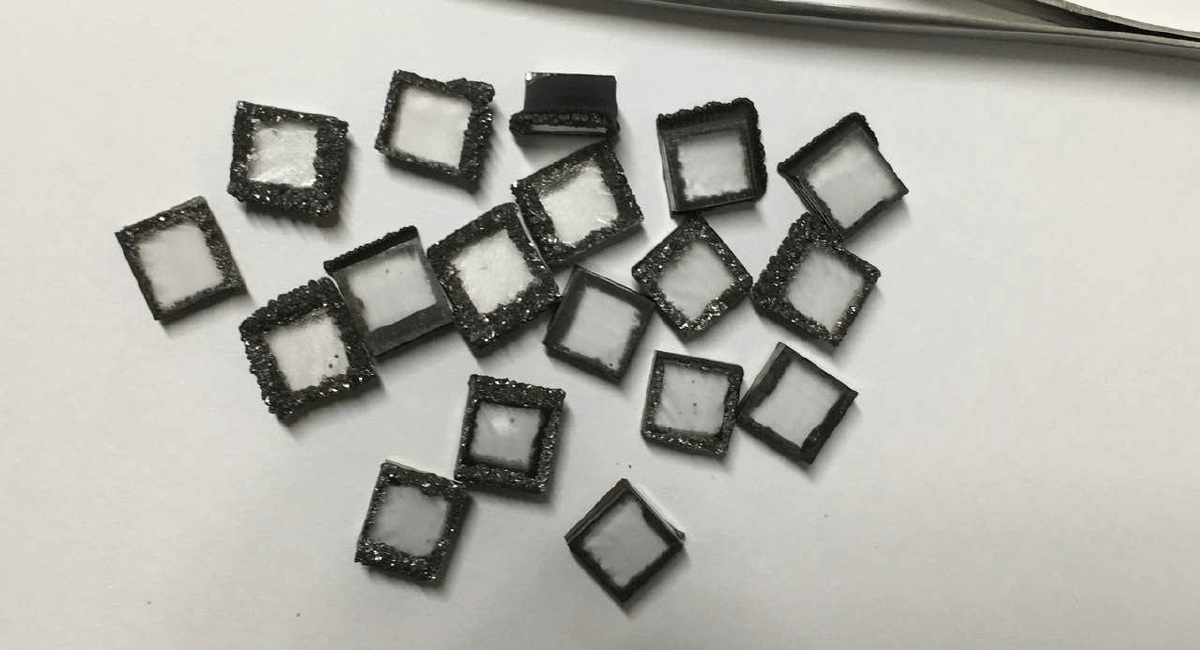
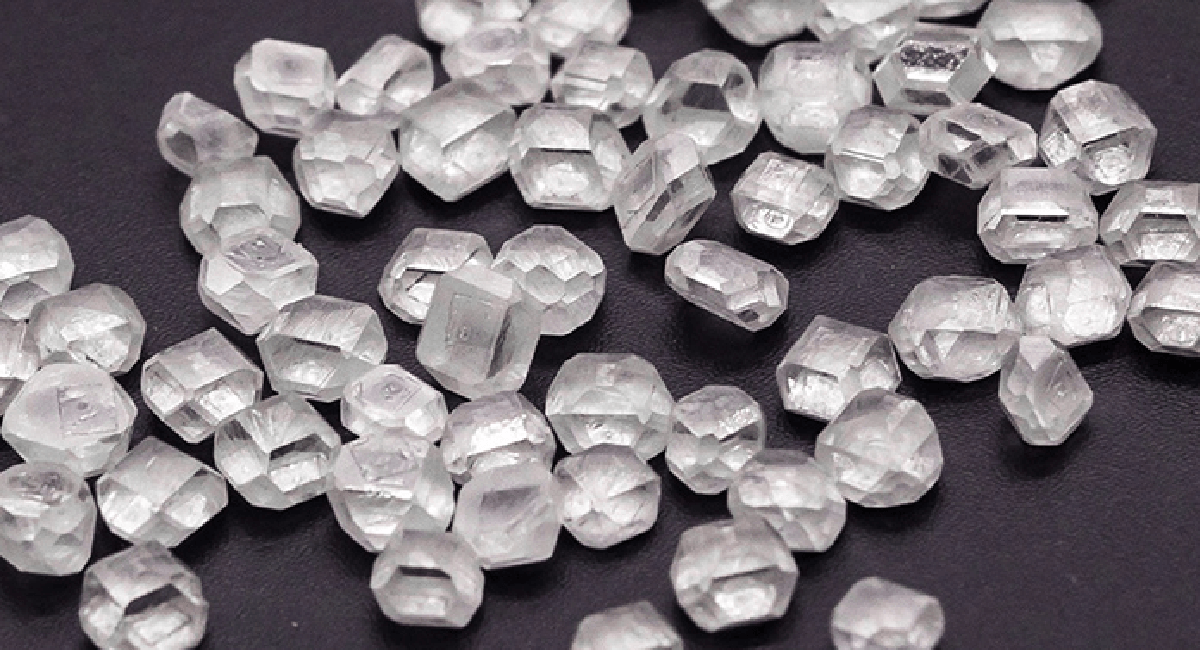
The key dissimilarity between rough CVD and HPHT diamonds lies in their shapes. CVD diamonds grow in a cubic shape, whereas HPHT diamonds take on a cuboctahedral form. Although distinguishing between the two requires a trained eye, this difference in structure is noteworthy.

Some laboratories adopt a combined approach, starting with the less energy-intensive CVD process and finishing with HPHT. This hybrid method is chosen because HPHT can enhance clarity and color. Importantly, chemically, physically, and optically, both CVD and HPHT diamonds are identical to natural diamonds.

Are CVD Diamonds Affordable?

In the realm of diamonds, affordability is a relative concept. Generally, lab grown CVD diamonds come with a lower price tag compared to mined diamonds—around 20–30% less.

For the amount you’d invest in a 1.5-carat mined diamond, you could opt for an upgraded 2-carat CVD diamond instead. This cost difference can be attributed to three main factors:

  1. The substantial expense is tied to excavating deep holes in the Earth.
  2. The extensive supply chain involved in dealing with mined diamonds.
  3. The historical manipulation of pricing within the industry.

The journey of natural diamonds involves intricate processes: locating and extracting them from the ground or seabed floor, shipping them to cutters, wholesalers, and jewelry fabricators, and distributing them through various channels, including independent retailers and large diamond chains with hefty rents and advertising budgets.

In contrast, CVD diamonds sidestep much of this complexity, resulting in a more budget-friendly price. Despite their lower cost, it’s crucial to recognize that CVD diamonds still hold significant value—they are, after all, diamonds in every sense of the word.

If you’re curious about specific pricing comparisons for CVD and other lab-grown diamonds, you can explore how Clean Origin stacks up against other brands below for a clearer understanding of what to expect in terms of cost.

Frequently Asked Questions (FAQs)

Why is it Difficult to Synthesize Diamonds in the Lab?

Diamonds are made up of carbon, just like coal and graphite. The only difference between these materials is the arrangement of the carbon atoms command which is also known as the crystal lattice. It is difficult to synthesize CVD diamonds because graphite is one of the most stable forms of all types of carbon. That is why diamonds also occur very rarely in nature.
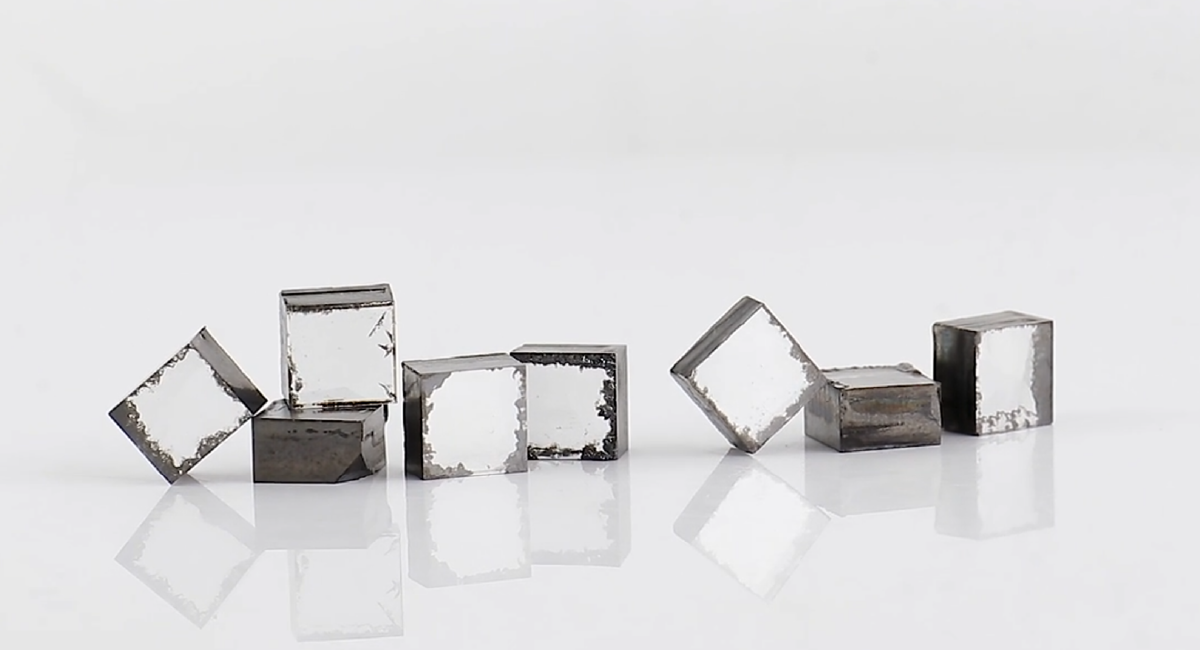
rough cvd diamonds

Earlier, in the 1950s, graphite was converted into diamonds using the high pressure and high temperature technique, also known as HPHT. This was a very difficult way to synthesize diamonds in the lab as the stability of graphite would prevent the formation of diamonds using this technique. However, with the introduction of the CVD technique, it was possible to deposit carbon atoms on a surface using a gas that contained carbon.

If proper techniques are used, it is possible to enhance the growth of diamond crystals and suppress the growth of graphite crystals.

How are CVD Diamonds Made?

This technique involves using atomic hydrogen on graphite to turn it into diamonds.

Hydrogen is usually found in nature as hydrogen molecules, which are formed by combining two atoms of hydrogen together. To make CVD diamonds, we first need to break the molecular hydrogen into atomic hydrogen. This is done by using a gas activating agent, which could be an intense plasma or a hot filament.

After hydrogen gas is dissociated into its atoms, the next step is to slowly apply it to the substrate, that is graphite. Hydrogen selectively etches the surface of graphite and breaks up the double bonds. This converts the graphite bonds into diamond bonds.

This is done by first placing a thin seed diamond in a sealed chamber and subjecting the seed to high temperatures, usually around 800 degrees Celsius.

After that, hydrogen, or a mixture of carbon-rich gases which includes hydrogen and methane, is introduced into the chamber. Using the methods stated above, the gases are ionized and their molecular bonds are broken. This results in the attachment of pure carbon to the diamond seed. As more and more carbon atoms are formed, they develop atomic bonds with the same diamond.
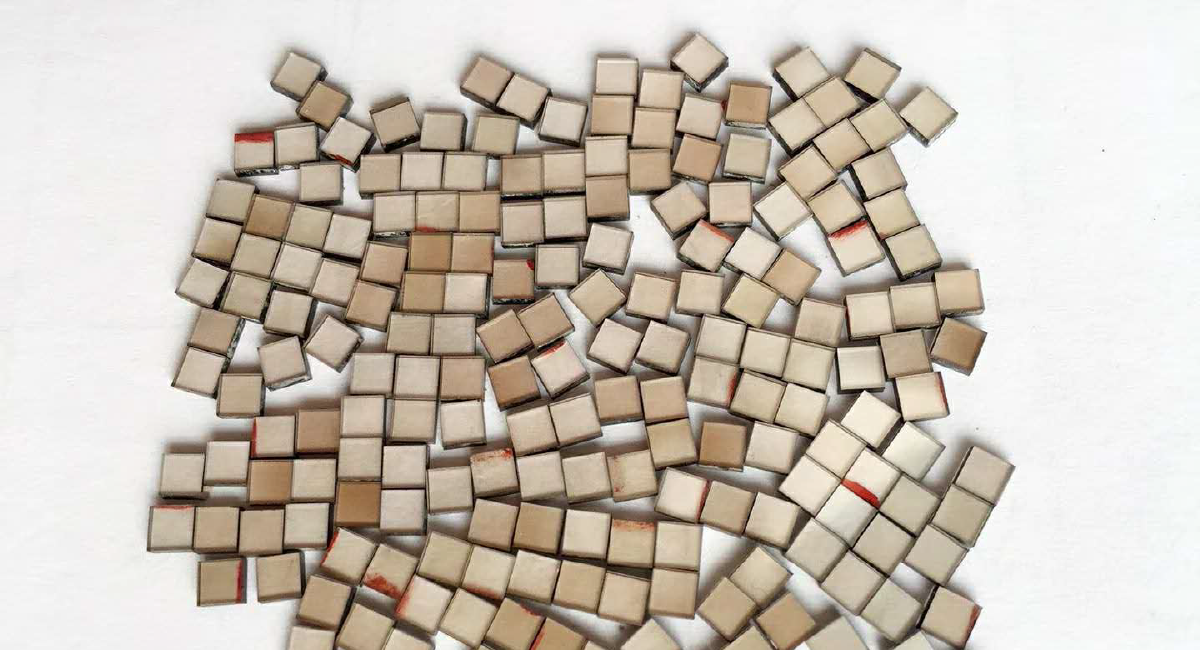
How are CVD Diamonds Made

What are the Substrate Materials that can be Used?

Diamond can be deposited on various types of materials. Most of the time the seed used is a piece of the diamond itself, but other materials like tungsten, silicon, molybdenum, silicon nitride, silicon carbide, quartz glass, cemented carbide, etc. Can also be used. The most important feature that the substrate material must have is that it should be able to withstand high temperatures and when it is attacked by the activated gas, it should not dissolve the deposited carbon.

Why are CVD Diamonds Brown?

The brown color of CVD diamonds can be attributed to carbon inclusions within the stone that may be non-diamond in nature. These inclusions may be formed during the process of treating the substrate with carbon gases.
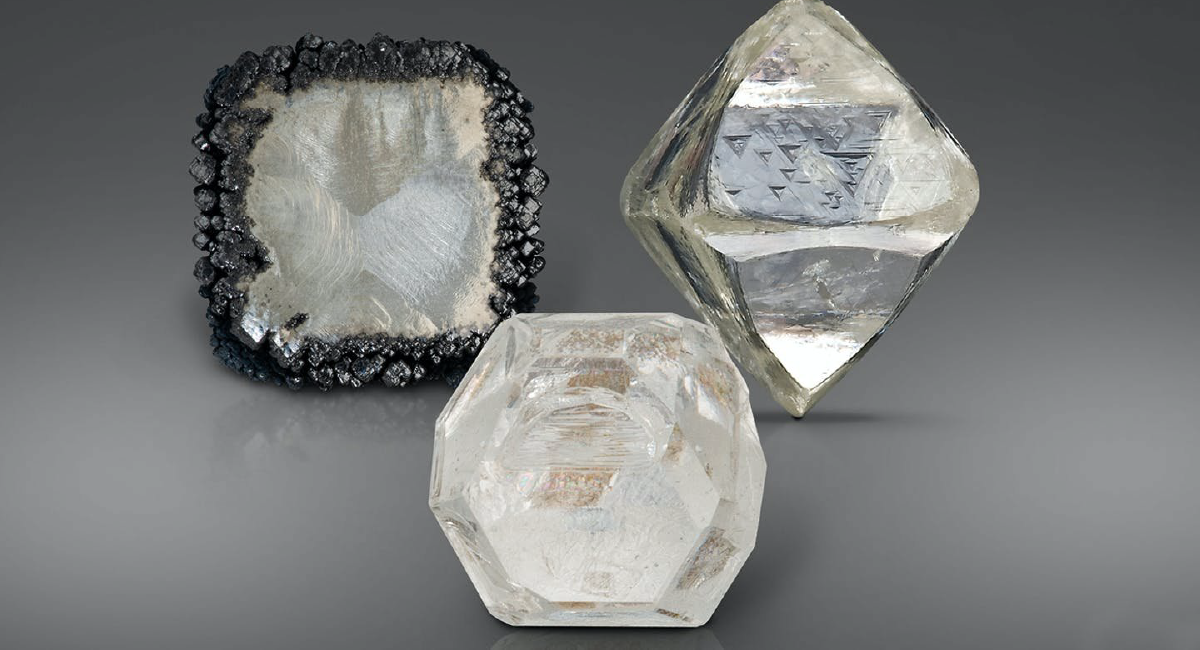
cvd diamonds are brown
Moreover, it is also believed that the brown coloration can also be a result of internal defects such as dislocations within the stone. However, unlike natural diamonds, the brown discoloration in CVD diamonds is not due to plastic deformation, as is the case when it comes to natural diamonds.

According to the CVD diamond review by GIA, it is possible that the brown hue in CVD diamonds is seen in the case of mass-produced CVD diamonds which are manipulated by adding nitrogen or oxygen to the gas mixture. However, this defect is easily correctable by using high pressure and high-temperature treatment after the formation of the diamond.

How to Identify CVD Diamonds?
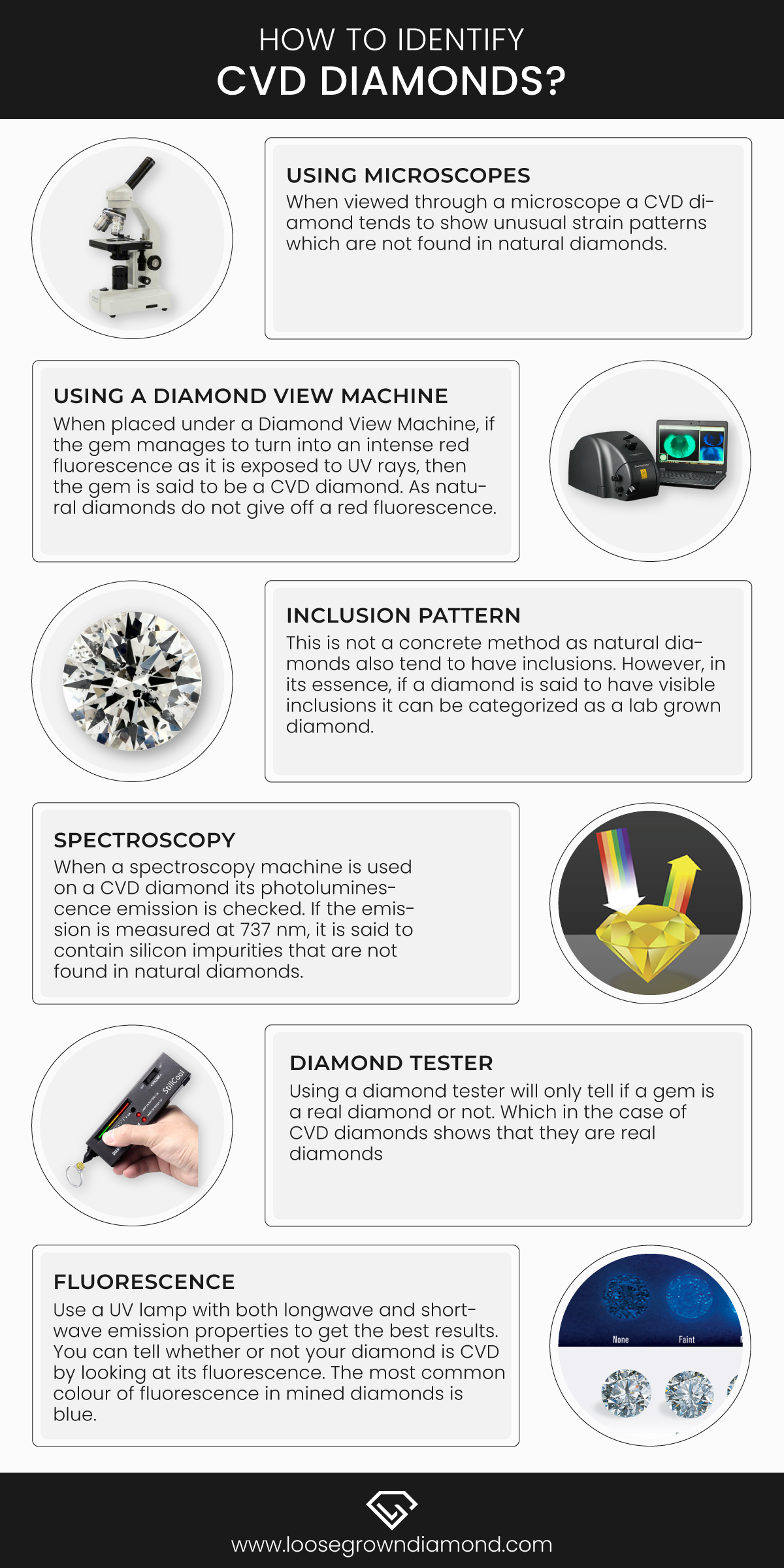
identify CVD diamonds

Here are seven ways to identify CVD diamonds:

  1. Using microscopes – If you place the diamond under the microscope, you will see that CVD diamonds have characteristic strain patterns which are different from the patterns seen in natural or mined diamonds.
  2. Using a Diamond view machine – This machine uses high-energy UV radiation to identify synthetic diamonds from natural diamonds. When placed under this machine, CVD synthetic diamonds show a strong red fluorescence, which is not visible in naturally formed diamonds.
  3. Inclusion pattern – Inclusions, especially when seen under a microscope, are present even in natural diamonds. However, the difference is that in CVD diamonds, these inclusions are less dispersed compared to natural diamonds.
  4. Spectroscopy – This process refers to placing the diamonds under a spectroscope instrument. These instruments usually emit light at 737 nm. When exposed to this light, CVD diamonds show strong photoluminescence emission due to the presence of silicon in them, whereas this is not seen in natural diamonds.
  5. Diamond tester – This instrument is used to check if the stone in your hand is a diamond or not, but it cannot maybe reveal whether it is a natural diamond or a man-made one. The dual electronic diamond tester uses thermal and electrical conductivity to check whether a stone is a diamond or not.
  6. Fluorescence – Use an ultraviolet lamp that has both longwave and shortwave emissions. If the diamond shows a fluorescence of blue, it is confirmed that it is not a CVD diamond. Mined diamonds can show fluorescence in many colors, but the most common is blue.

Also, it should be noted that natural colorless diamonds show fluorescence typically under long-wave ultraviolet light, whereas the fluorescence becomes weaker when seen under short-wave ultraviolet light. On the other hand, synthetic diamonds are reversed, they show the strongest reaction under shortwave light.
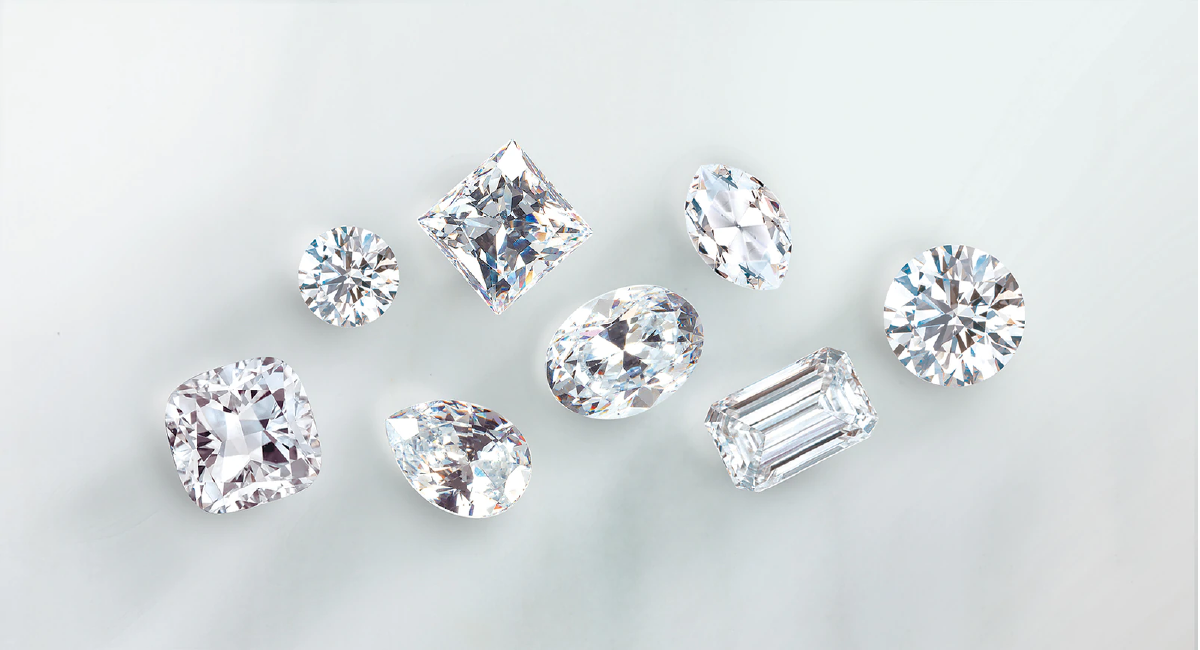
fancy shape cvd diamonds
Moreover, CVD diamonds show dark brown, almost red fluorescence under long-wave UV, which becomes moderately strong and turns yellowish-green in color under shortwave light. This is a positive confirmation of the presence of a synthetic diamond.

Do CVD Diamonds test the same as Real Diamonds?

Really diamonds have the same crystal structure as natural diamonds, and the chemical composition of both types of diamonds is the same. When we use the term synthetic diamonds or manufactured diamonds, these terms do not actually refer to the diamonds themselves, but rather the process of manufacturing them. Chemically speaking, the lab diamonds are indistinguishable from real diamonds.

However, there are some chemical properties that may be a little different. For instance, the testing methods mentioned above, like the inclusion pattern, fluorescence, and spectroscopy may show some difference between the two types of diamonds. However, this does not mean that the stones behave differently entreated two chemical, thermal, electrical, or any other kind of treatment.

What to Look for When Buying CVD Diamonds?

When you’re buying, or for that matter any type of lab ground diamond, it is necessary that you take some precautions to get the best value for your money. There are two things you need to remember before buying a CVD diamond.

The first is to avoid diamonds that have a brown color hue. There are many concede attacks that can cause the appearance of brown color in CVD diamonds. This affects the optical properties of the diamond. Look at the two pictures shown below.
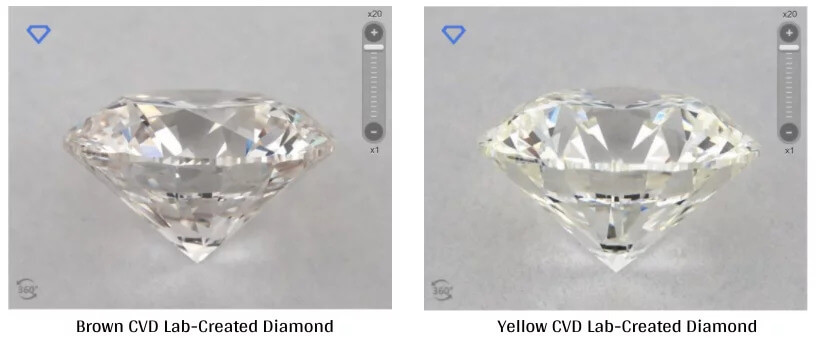
brown vs yellow cvd diamond

The brown hue of the elaborated diamond is usually apparent when you see the diamond in the profile view. When you compare the two diamonds above, you will be able to see the difference quite clearly. The 2.03 H VS1 CVD diamond looks brown, while the 1.24 H VVS1 diamond appears yellow, just like a natural diamond.

It is recommended to avoid buying diamonds that have this hue or to go up in color to D, E, or F to minimize the appearance of the brown hue.

The second thing you need to consider is strain-induced birefringence, which gives the lab-created diamond a fuzzy appearance. This happens when there is a mismatch between the crystal lattices when the diamonds are grown layer by layer.

The result is that the diamond looks fuzzy and has strain lines.
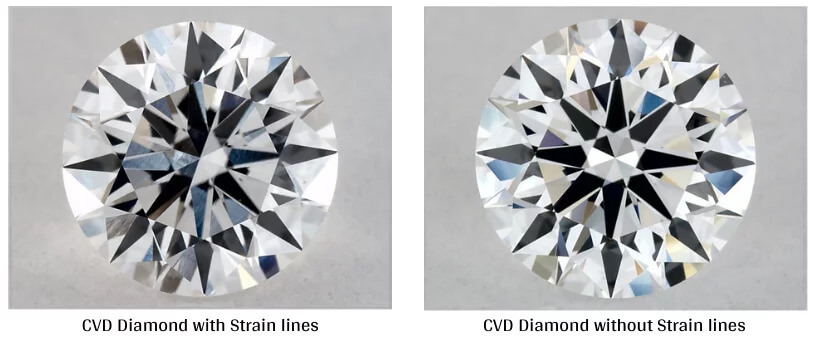
cvd diamond with strain lines

It is recommended to avoid this type of diamond entirely. It should also be noted that train lines are not evaluated when grading the diamond for clarity, which is why sometimes they can still receive a vs1 grading even if the diamond is fuzzy.

What is the Cost of CVD Diamonds?

It is impossible to make a sweeping statement about whether or not CVD diamonds are costly or not, but it is true that they generally cost less than natural diamonds, usually, 20 to 30% less.

The amount of money you will pay for a 1.5-carat natural diamond can easily fetch you a 2 carat CVD diamond. This is because of several reasons. Mined diamonds required more physical labor, a long supply chain, and manipulation of pricing to ensure regular supply and demand. However, for CVD diamonds, this is not true. This is not to say that CVD diamonds are somehow cheap or less valuable, it is just that they are less expensive compared to their mined counterparts.

You can get CVD diamonds at the best price on loosegrowndiamond.com where their prices start from $300-$500.

What is the Temperature at Which CVD Diamonds Grow?

The temperatures at which optimum growth is obtained are between 700 to 900 degrees Celsius. It is also possible to grow diamonds at lower temperatures, but in this case, the growth rate will be extremely slow.

Are all Lab Grown Diamonds CVD Diamonds?

No, all lab-grown diamonds are not CVD diamonds. CVD is a relatively recent process and before it was introduced, lab grown diamonds were created using the HPHT approach. However, in the modern world, CVD is a more effective method for growing diamonds in the lab.

Where to Buy CVD Diamonds?

You can buy CVD diamonds at loose grown diamond worldwide shipping and a guarantee for all of their products. Moreover, we are a CVD diamond manufacturer and sell diamonds at wholesale prices so you are guaranteed to save a lot of money as well.

Whether you should choose a natural diamond or a CVD diamond is a question you should ask yourself before buying any kind of diamond jewelry. After all, of course, way less and does not have any of the complications that natural diamonds do.

[blog_page_btn title=”Buy Lab Grown Diamonds” url=”https://www.loosegrowndiamond.com/inventory/”]

What are the Benefits of Buying CVD Diamonds?

Here are some benefits of buying a CVD diamond over a natural diamond:

Mining Free

“NO MINING” is required for Lab-created diamonds.
Elevate your jewelry with mining-free Lab Grown Diamonds


Quality

Lab-created diamonds have the same quality
and optical properties as natural diamonds.


Valuation

Lab-created diamonds contribute excellent value
and are more affordable than natural diamonds

  1. The cost of manufacturing a CVD diamond is less than that of mining and transporting a natural diamond.
  2. There is no environmental damage when it comes to manufacturing CVD diamonds, whereas mining natural diamonds causes a lasting negative effect on the earth. Moreover, lab-created diamonds do not create any mineral waste either.
  3. There is no ethical issue when it comes to lab-created diamonds. On the other hand, natural diamonds are often called conflict diamonds or blood diamonds because they are known to be used for illegally funding conflict in war-torn countries. Moreover, diamond miners and diamond polishers work in terrible working conditions and are often prone to injuries and human rights violations.
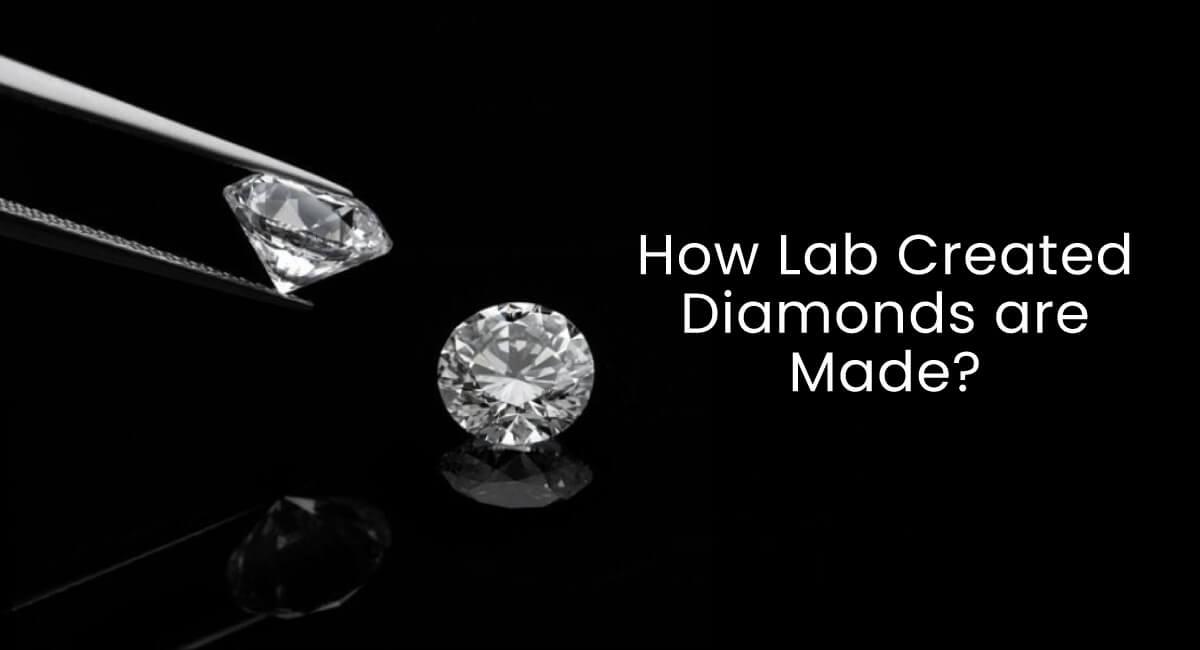
How Lab Created Diamonds are Made?

Natural diamonds are made by precise and perfectly bonded carbon crystal lattices. Due to this, they gain immense strength. According to scientists natural diamonds are created under extreme pressure and high temperature, they take about 1 billion to 3 billion years to form depending on the conditions.

how lab grown diamonds are made

Man made diamonds, on the other hand, are created within six to eight weeks. These lab grown diamonds are created in a controlled environment, with the help of advanced technology. It is like a chamber in which the material is put which will later be converted into a loose diamond. The chamber replicates the conditions of the earth’s crust, which are needed to create a man made diamond.

But have you ever stopped to wonder how these dazzling gems are made? In this comprehensive guide, we’ll take a deep dive into the intricate process behind lab grown diamond creation, uncovering the science and technology that makes it all possible.

After a man made diamond is created it is cut into different shapes, polished, and graded just like a normal natural diamond. A man made diamond has the same physical, chemical, and optical properties as that of a natural loose diamond. Due to this, it becomes nearly impossible to tell the difference between a lab grown diamond and a natural loose diamond, with the naked eye.

How Lab Created Diamonds are Made

To tell the two apart special types of equipment and a professional is needed to inspect them. Man made diamonds are a revolutionary discovery that reshaped the whole diamond market. These loose diamonds have many benefits and somewhat more benefits than natural diamonds.

There are Mainly Two Main Methods that Opted to Create Man Made Diamonds:

1. CVD Diamond Method
2. HPHT Synthetic Diamond Method

Now let us briefly explain both of these methods, and how they are used to create loose, white, and fancy diamonds.

CVD Diamond Method

CVD stands for Chemical Vapour Decomposition, it is used to create high-quality loose diamonds. In this method, a material is put inside a chamber in the presence of a pure rich carbon plasma. As soon as the process starts, carbon atoms get deposited on the material, and with time it forms a man made diamond.

cvd diamond method
To get colored fancy diamonds, specific trace elements are inserted into the carbon crystal lattice during the growing phase. Depending on the amount of trace element and type of trace element inserted, does the fancy diamond get its color.

CVD Diamond method also has some types, which are:
• Plasma Enhanced Chemical Vapour Decomposition (PECVD)
• Microwave Plasma Chemical Vapour Decomposition (MPCVD)
• Low-pressure Chemical Vapour Decomposition (LPCVD)
• Ultra-High Vacuum Chemical Vapour Decomposition (UHVCVD)

cvd diamond

HPHT Synthetic Diamond Method

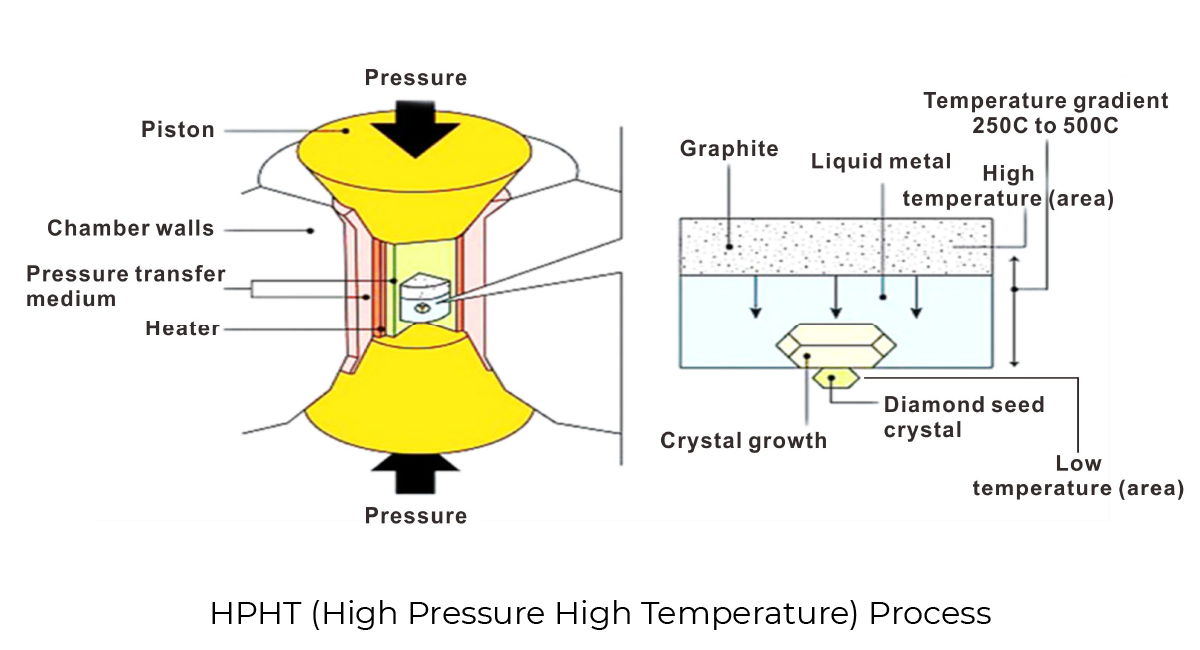
HPHT stands for High-Pressure-High-Temperature, which is also the procedure used to create man made diamonds. An HPHT Synthetic Diamond making machine is able to generate 60,000 ATM (atmospheric pressure) and 2500°C temperature. Thus forming an environment similar to that under the earth’s crust, which assists the formation of a man made diamond.

There are Mainly Two Main Methods that Opted to Create Man made Diamonds

The elements and materials used to create lab-grown loose diamonds are:

  1. A tiny diamond seed
  2. Highly refined graphite
  3. A high-quality catalyst mixture containing metals and powders

When the machine is turned on, due to high pressure and high temperature, the catalyst mixture turns into a molten form. Which then causes the refined graphite to dissolve in it, and form various layers over the diamond seed. Then after the cooling is done, an HPHT synthetic diamond has been formed.

To carry out the HPHT Synthetic Diamond making method, and apply the required conditions, two types of machines or press designs are used.

hpht lab diamond

Cubic Press- Creates high temperature and pressure with the help of pistons, which are located throughout the machine and provide pressure from different directions.

Belt Press- In this machine high pressure is formed by two strength pistons. These pistons apply equal pressure in opposite directions.

[blog_page_inventory shape=”Round,Oval,pear,cushion,heart,princess,emerald,radiant,kite,old mine” carat=”2.30,2.60″ cut=”0,4″ color=”0,10″ clarity=”0,11″]
[blog_page_btn title”Buy Now” url=”https://www.loosegrowndiamond.com/inventory/?”]

Should You Buy Lab Created Diamonds?

Whether or not you should buy lab grown diamonds depends on various factors, including your personal preferences, ethical considerations, and budget. Here are some points to consider:

To start, let’s explore the benefits of diamonds produced in laboratories.

Lab grown diamonds are created in controlled environments, eliminating the need for environmentally destructive mining practices and reducing the risk of exploitation associated with traditional diamond mining.

Lab created diamonds often come at a lower price point than natural diamonds, making them accessible to a broader range of consumers.

Like mined diamonds, lab grown diamonds can be certified by reputable gemological laboratories.

Lab grown diamonds are virtually identical to mined diamonds in terms of appearance and chemical composition. They exhibit the same brilliance, sparkle, and durability as natural diamonds. If you’re concerned about quality, rest assured that lab grown diamonds can be just as beautiful and durable.

Ultimately, your choice to purchase lab grown diamonds hinges on your priorities and principles. If you prioritize ethical and environmental considerations while seeking a more budget-friendly option, purchasing certified lab created diamonds from LGD at the best available price might be appealing.

Why Lab Grown Diamonds?


Mining Free

“NO MINING” is required for lab created diamonds.
Elevate your jewelry with mining free Lab Grown Diamonds


Quality

Lab created diamonds have the same
quality and optical properties as natural diamonds.


Valuation

Lab created diamonds contribute excellent value,
and are more affordable than natural diamonds

[blog_page_btn title=”Buy Lab Grown Diamonds” url=”https://www.loosegrowndiamond.com/inventory/”]

Conclusion

Hence to create a man made diamond a controlled environment and specific conditions are needed. Lab grown diamonds are more eco-friendly than natural white diamonds or natural loose diamonds. Lab grown diamonds do not require intense mining, which degrades the environment, soil, and vegetation.

Lab grown diamonds are preferred over natural diamonds. And, with the ability to create any type of loose diamond or fancy diamonds these man made diamonds have gained immense popularity.

FAQs

Are lab created diamonds real diamonds?
Yes, lab created diamonds possess the same chemical composition, physical properties, and optical characteristics as natural diamonds. They are real diamonds in every sense of the word.

Are lab created diamonds less expensive than natural diamonds?
In general, lab created diamonds are more affordable than their natural counterparts, as the production process is more cost-effective and less resource-intensive. However, prices can vary depending on factors such as size, quality, and market demand.

Are lab created diamonds environmentally friendly?
Yes, lab created diamonds are a more sustainable and eco-friendly alternative to traditional diamond mining. By eliminating the need for mining, they help reduce the environmental impact associated with land disruption, water usage, and carbon emissions.

Everything About VS Diamond vs VVS Diamond You Can’t Afford to Miss

In the public eye, diamonds are forever, but this belief often lacks the finicky caution required to tell apart those diamonds that are a cut above the rest. Outwardly, diamonds are just pure carbon turned to a transparent crystalline form, but the quality of these gems can differ widely when the level set by the (Gemological Institute of America) through the 4Cs of clarity, cut, color, and carat weight is taken into consideration.  

Uniting these factors, however subtle, has the power to significantly sway the worth of lab diamonds, particularly when comparing gems of equal size. 

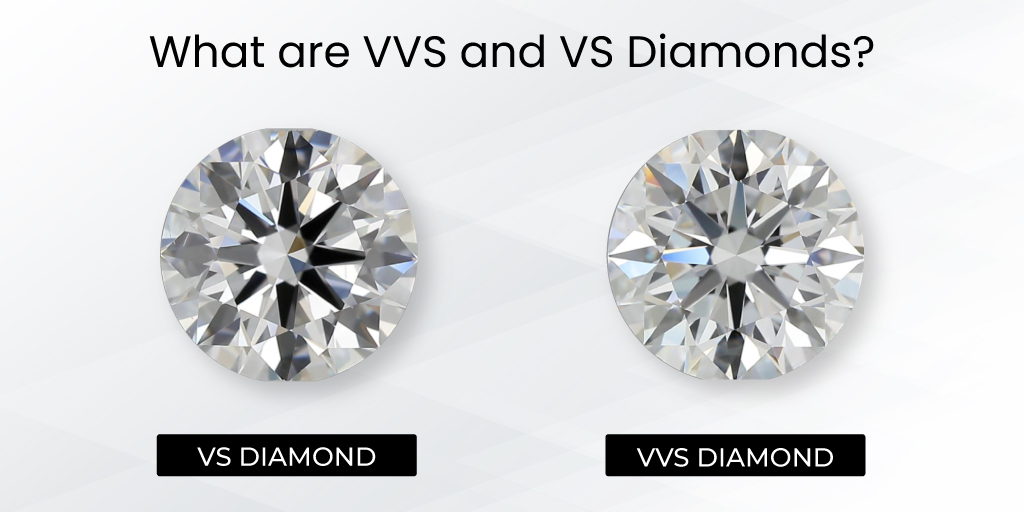
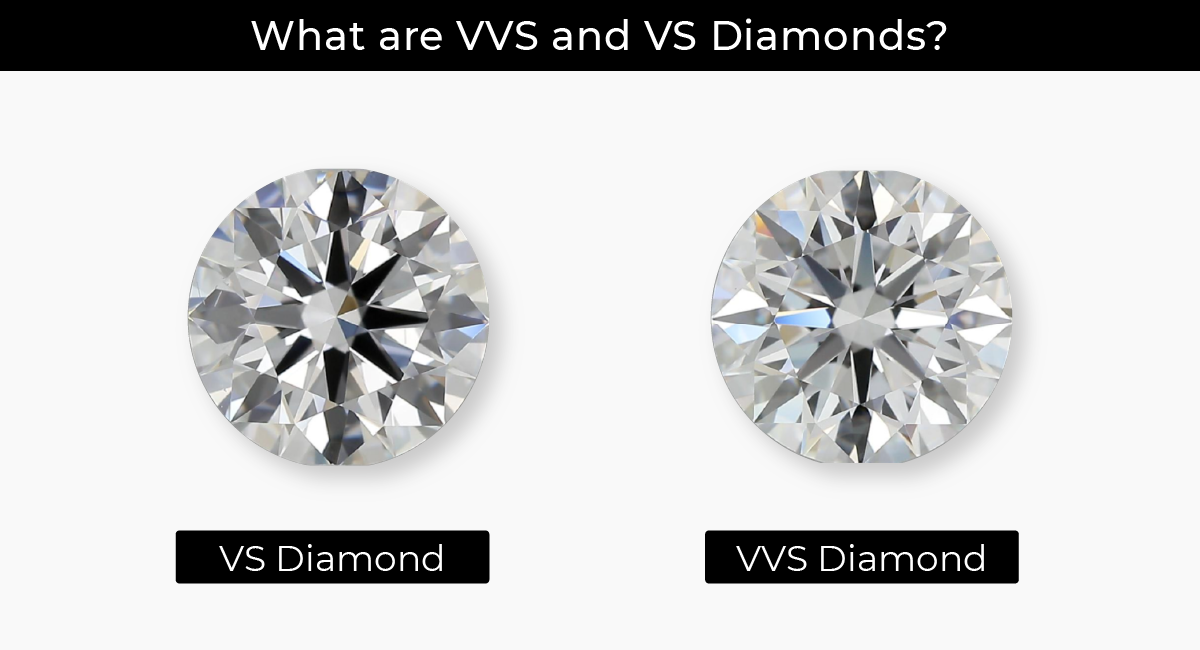
What are VVS Diamond and VS Diamond?

VVS Diamond versus VS Diamond 
At the outset, a little background on how diamonds are created and how that, in turn, affects the clarity of the stone is important. Real or natural diamonds are created deep within the earth when carbon is compressed under immense heat and pressure.

During this process, diamonds inherit certain features that may be internal, known as ‘inclusions’, and external, meaning ‘blemishes’. Inclusions are confined to the interiors of a diamond and develop when small crystals get trapped in a diamond during its formation, affecting the gem’s appearance from within. On the contrary, blemishes turn up on the surface of the diamond through abrasions, polish lines, etc.

Ascertaining the clarity of a diamond, especially with respect to the VVS and VS grades, requires a meticulous approach towards recognizing the size, position, number, relief, and nature of these features as well as the effect it has on the overall appearance of the lab diamond. 

As a thumb rule, it must be remembered that no diamond is absolutely pure, however the higher its clarity, the closer it comes to purity and the more expensive its price. Such consequences make it impertinent to evaluate the clarity of a diamond with the help of a predetermined grading system before deciding to make a purchase. 

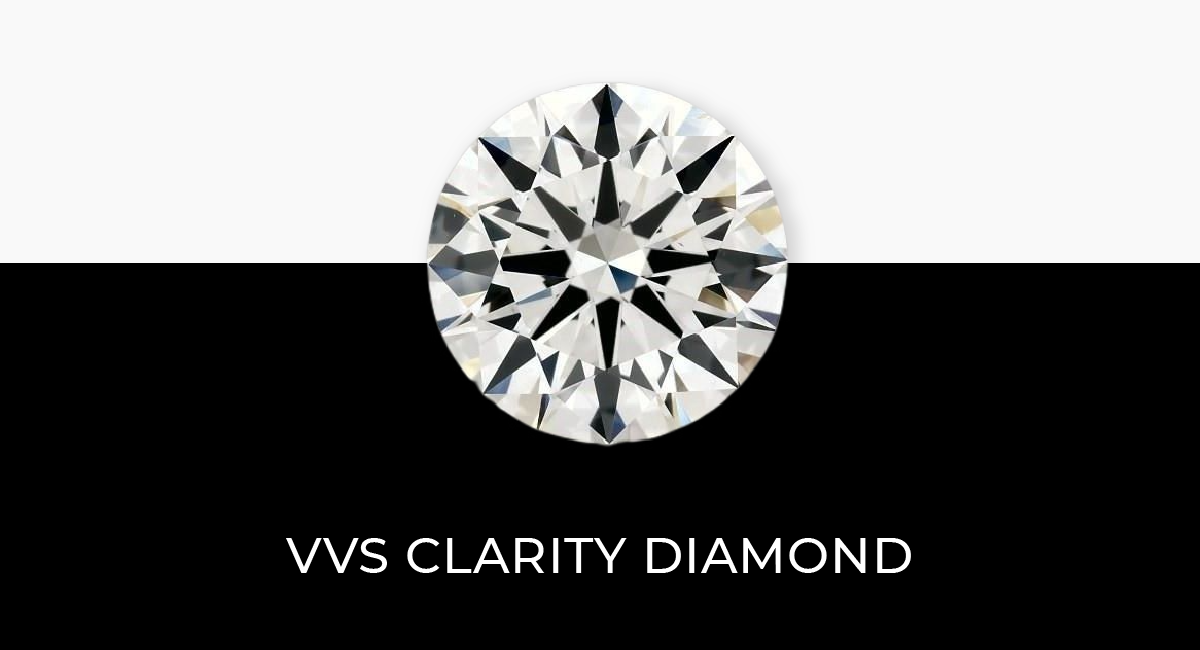
What is VVS Diamond?

vvs diamond

The inclusions in a VVS diamond are so tiny that they become difficult to view by the naked eye and can only be detected with the help of a microscope. For this reason, VVS diamonds are known to be eye-clean. Common inclusions, that can either be extremely difficult (VVS1) or fairly difficult (VVS2) to find, can include the following:

  • Cloud pinpoints, needles or internal graining are unnoticeable from the table of the diamond but can be spotted through the pavilion, or the commonly found “V” shape at the base of the diamond. These inclusions are extremely difficult to find face-up, or from the top facet of the diamond, at 10x magnification (VVS1).
  • Clouds pinpoints, needles, or internal graining that are fairly difficult to spot face-up at 10x magnification (VVS2). The difference between these two subcategories remains virtually insignificant.
  • Negligible inclusions that reach the surface from within in the form of a chip, bruise, feather, abrasion, indented nature, bearding, etc. These can show up in both subcategories.

It is important to note that any diamonds with inclusions visible to the naked eye cannot be granted the clarity grade of  VVS1 and VVS2.  You will notice that even though VVS diamonds do not look any different from Flawless or Internally Flawless.

[blog_page_btn title=”buy VVS diamond” url=”https://www.loosegrowndiamond.com/inventory/?clarity=7.00,9.00″]

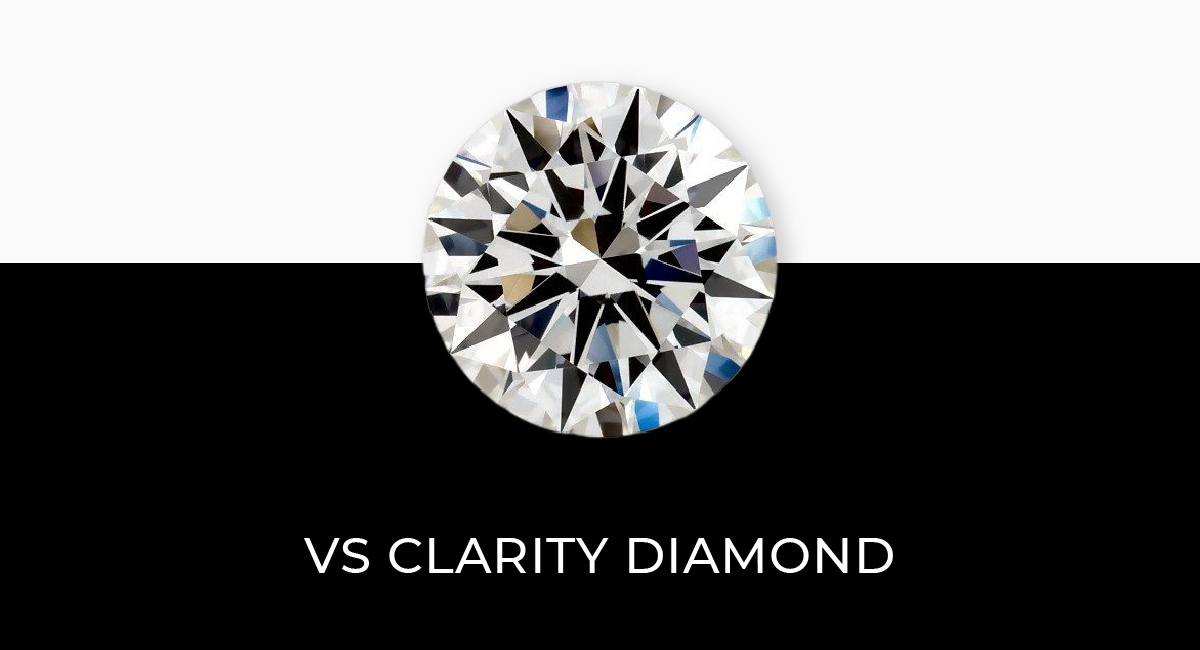
What is a VS Diamond?

Vs lab diamond

A VS diamond has minute inclusions that vary from very difficult (VS1) and somewhat easy (VS2) to find with 10x magnification. No matter what the features of the inclusions are, their size must be relatively small to that of the lab diamond.

The VS designation refers to Very Small inclusions in a diamond. These inclusions can vary from crystals, clouds, knots, or small abrasions reaching the surface like feathers or cavities. Despite not being Flawless, inclusions are rarely noticeable under bright light or even magnification (VS1). In rare circumstances, a large enough VS stone may have inclusions that were visible to the naked eye in bright light (VS2), but they are usually eye-clean.

We would suggest you explore VS diamonds as they can be a great and adjustable alternative that might suit your budget and requirements better than VVS clarity diamonds.

[blog_page_btn title=”buy VS diamond” url=”https://www.loosegrowndiamond.com/inventory/?clarity=5.00,7.00″]

Also Read: The Different Cuts of Diamonds: A Guide to Choosing the Best One in 2022

GIA and its Diamond Clarity Scale

Certificate

In devising its clarity grading scale, the GIA uses 10x magnification as a standard measure for each grade. It takes a jeweler’s skilled eye and microscope with increased magnification of 10x loupe to determine the clarity grade of a diamond. During this process, the grader must keep five factors in mind:

  • Size: With all factors being otherwise equal, the relative size of the inclusion or blemish in comparison to the size of the diamond, meaning if the same is easily visible, the clarity grade allotted will be lower.
  • Number: With all factors being otherwise equal, the number of inclusions or blemishes visible at 10x magnification will have a positive relationship with the clarity grade.
  • Location: The closer the inclusion or blemish is to the table of the diamond or the facet that is visible when the stone is viewed face-up, the lower the clarity grade.
  • Nature: This refers to the overall effect the blemish or inclusion has on the appearance of the diamond, something that only the grader can ascertain.
  • Color: In some cases, the color of the inclusions can affect the overall appearance of the diamond. Dark-colored inclusions, like black carbon spots, maybe more noticeable and potentially impact the clarity grade.

It’s important to note that each factor is evaluated in conjunction with the others, and the overall assessment leads to the assignment of a specific clarity grade on the GIA Diamond Clarity Scale.

[blog_page_inventory shape=”cushion,round,heart,pear,oval,cushion,princess,emerald,radiant,marquise” carat=”1.30,2.60″ cut=”1,4″ color=”1,10″ clarity=”1,6″]
[blog_page_btn title”Buy Now” url=”https://www.loosegrowndiamond.com/inventory/?”]

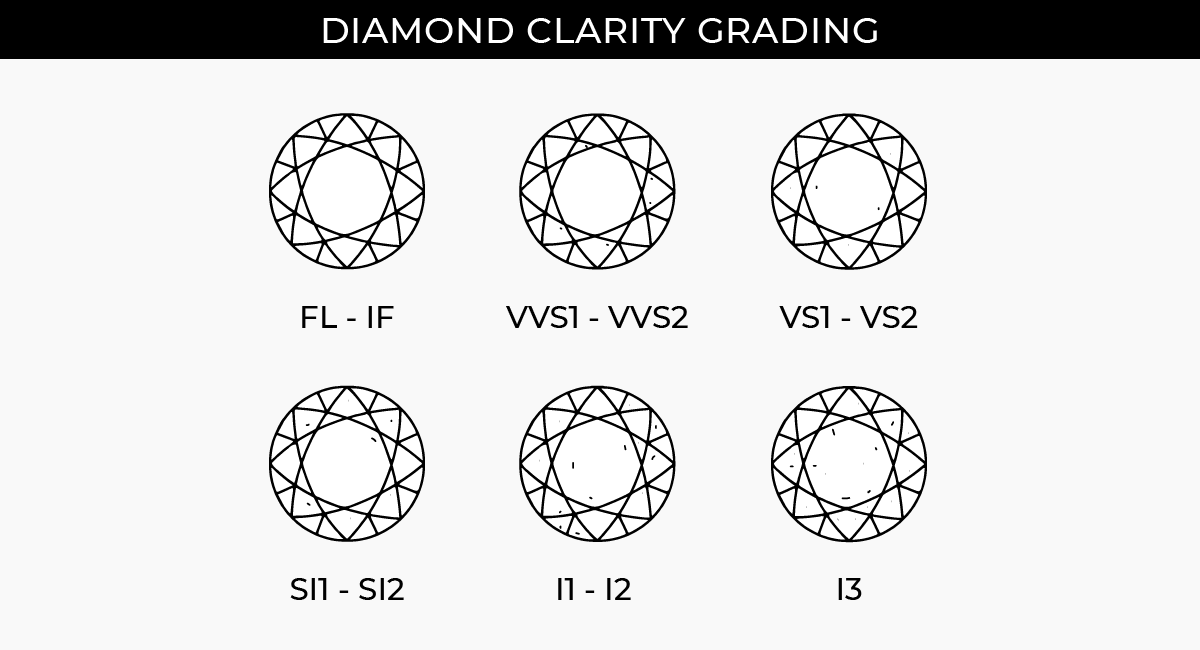
Diamond Clarity Grading

diamond clarity

Founded on these five clarity characteristics, the GIA grading scale for diamond clarity can be divided into 6 main categories, ranked according to their descending price value, as follows:

[su_table responsive=”yes”]

Flawless (FL)
No inclusions or blemishes upon examination under 10x magnification.
Internally Flawless (IF)
Under 10x magnification, no inclusions are detectable.
Very Very Slightly Included (VVS1 and VVS2)
Such negligible or undetectable inclusions that vary from extremely difficult (VVS1) and very difficult (VVS2) to detect that even a skilled grader will find it difficult to find them under 10x magnification. VVS1 denotes slightly higher clarity than VVS2.
Very Slightly Included (VS1 and VS2)
With considerable effort, the inclusions can be discovered either with considerable effort (VS1 ) or easily (VS2), however, they still remain minor in nature.
Slightly Included (SI1 and SI2)
Inclusions that are easily discoverable (SI1) or apparent in nature (SI2)­ under 10x magnification.
Included (I1 clarity, I2, and I3)
Inclusions are so apparent that they are not only evident under 10x magnification but also affect the brilliance and transparency.

[/su_table]

Each diamond is individually assessed and assigned a clarity grade based on the GIA Diamond Clarity Scale.

The GIA Clarity Scale provided uniformity in diamond evaluation for jewelers across the globe, hence, these grades have become a common measure despite the nationality of the jeweler. Since blemishes only affect the top two categories, it is only about inclusions that we will continue the discussion on VVS and VS diamonds.

Difference between VVS Diamonds and VS Diamonds

While it is obvious that VVS diamonds are rank superior to VS diamonds, outlining the exact point of difference before deciding to purchase either is extremely important. Before all else, let’s understand the typical inclusions that may be found in both the diamonds-

  • Pinpoints– A tiny inclusion in the form of a crystal trapped inside the diamond that is noticeable under 10x magnification.
  • Clouds– Groups of minute inclusions that cannot be spotted individually but can make the appearance of a diamond hazy.
  • Internal Graining– Lines, angles, or curves during the process of crystal growth in the formation of a diamond.
  • Needles– These are elongated crystals that appear as thin, needle-like inclusions.
  • Knots– Knots are external crystal growth that has extended into the diamond.

Here’s a comparison table highlighting the differences between VVS (Very Very Slightly Included) diamonds and VS (Very Slightly Included) diamonds:

It is with reference to these inclusions that we differentiate between VVS and VS diamonds as follows-

[su_table responsive=”yes”]

Parameters

VVS Diamonds

VS Diamonds

Definition
VVS diamonds have very few and very small inclusions
VS diamonds have minor inclusions that are noticeable under 10x magnification
Clarity Grade
VVS1 and VVS2
VS1 and VS2
Brilliance
VVS diamonds tend to have exceptional brilliance and sparkle due to their high clarity
VS diamonds also have good brilliance and sparkle, but it may be slightly lower compared to VVS diamonds
Inclusion Visibility
Inclusions are extremely difficult to see with the naked eye
Inclusions are relatively easy to see under magnification but may be barely visible to the naked eye
Inclusion Size
Inclusions are usually very tiny and microscopic
Inclusions are slightly larger than VVS diamonds but still small and not easily noticeable
Eye-cleanliness
VVS diamonds are considered eye-clean, meaning they appear flawless to the naked eye
VS diamonds are often eye-clean, but some inclusions may be visible to a keen observer without magnification
Price Range
VVS diamonds are more expensive, with prices typically higher compared to VS diamonds
VS diamonds are relatively more affordable compared to VVS diamonds
Setting Options
VVS diamonds offer more flexibility in terms of setting options due to their smaller and less visible inclusions
VS diamonds also provide a wide range of setting options, but certain designs may need to consider the placement of inclusions
Investment potential
VVS diamonds, especially larger sizes with exceptional clarity, have high investment potential
VS diamonds can also hold investment value, particularly if they possess other desirable attributes like exceptional cut or color
Certification
VVS diamonds are certified by gemological laboratories to ensure accuracy and guarantee the quality
VS diamonds also come with certifications, providing assurance of their authenticity and characteristics

[/su_table]

Despite the numerous differences, both these clarity grades will defeat the observation of a naked eye. In addition to this, they also share one characteristic of having flaws that are closer to the periphery of the stone, meaning they will look more or less the same from face-up. The choice between VVS and VS diamonds often depends on personal preferences, budget considerations, and the specific characteristics of the individual diamond being evaluated.

What to Choose: VVS Diamonds or VS Diamonds?

Since buying diamonds is inherently an expensive affair, it is well reasoned to be money-conscious while deciding what to purchase. The key question to ask here is- Will a higher clarity grade prove worth of the expense? There are two ways to go about it, both resting on personal preference. 

On one hand, the flaws of a VS diamond will not be evident to the naked eye and, on the other hand, VVS diamonds represent a more unique, closer to perfect, stone. A choice between convenience and rarity will always dominate the decision to purchase either, where the former may weigh lighter on the pocket but the latter can symbolize the purity of a big romance.

There are also other factors at play here, where a selection may be made solely on the basis of the cut and shape of a diamond. Usually, rectangular cuts, heart shapes, emeralds, round brilliant, asscher cut, princess cut, and marquise suit higher clarity grades the best, making a purchase of VS diamonds in these cuts more desirable.

VS-&-VVS-Ring

It must be kept in mind that clarity cannot be the sole determinant for any selection, and multiple choices have to be made with respect to the cut, carat weight, and color that make diamonds so dynamic.

For instance, it is better to buy a VS diamond for engagement rings, where the size and clarity of the diamond are customarily mutually exclusive since one might get a bigger diamond of better color and cut for a lower price. You can check the diamond size with our diamond size chart.

Where to Buy VS or VVS Diamonds?

You can get your hands on the VVS and VS diamonds at the best price at Loose Grown Diamonds. A diamond wholesaler who cuts out the middleman and sells directly to you. Elevate your lab grown diamond purchase with our exclusive promo code for added savings.

We will guide you all the way to help you purchase the best quality VVS diamond within your budget. Additionally, if you are confused about determining the price of your selected diamond, you can use our Diamond Value Calculator.

[blog_page_btn title=”buy certified lab diamonds” url=”https://www.loosegrowndiamond.com/inventory/”]

Conclusion

The difference between VVS and VS diamonds will always be obvious only to a handful of people with the required expertise. To an average consumer, choosing the “best” diamond has to be a choice made pragmatically as the difference will mostly go unnoticed by the naked eye. 

In such circumstances, it is always better to pay attention to the budgetary restraint every consumer exercises on themselves and focus on buying an eye-clean diamond. Buying a diamond of a higher clarity grade will not always prove to be a smart purchase or a better investment, instead, it is more prudent and profitable to buy diamonds of lower clarity grade that are clean to the naked eye. 

In the end, one must go back to the original saying that all diamonds will last forever no matter what the grade.

FAQ

Which is better VS or VVS diamond? 
VVS diamonds are considered higher in clarity and generally more desirable than VS diamonds.

How much is a vvs diamond? 
The price range of a VVS diamond starts from almost $149 to hundreds of dollars. The price of a VVS diamond can vary significantly based on factors such as carat weight, cut, color, and other quality characteristics.

How do you tell if you have VVS diamonds?
To determine if you have a VVS diamond, a professional gemologist would examine the diamond under magnification to assess the presence of very minute inclusions that are difficult to see even at 10x magnification.

Round Cut Diamonds: Everything You Need to Know

They say that size doesn’t matter but does shape? A case must be made for round cut diamonds here, for they are both traditional and everlasting and are generally the cut that comes to mind when people think of diamonds. 

From time immemorial in the history of the diamond, permutations of this famous sphere-like form have been tried and tested. Round cut diamonds have a glimmering radiance like no other, making them ubiquitous, and the round cut is regarded as the common currency in diamond cuts for investors, jewelers, and consumers.

round lab grown diamond

Coming into the 21st century the round cut saw a few modifications and the already shiny cut now had enhanced brilliance due to technological advancements. The Round brilliant cut is now a timeless classic diamond cut.

Surprisingly, a round cut sheds most of its carat weight during shaping and polishing as compared to other cuts, making it comparatively more expensive as well.

The brightness of a round diamond is boosted when decided by refinement techniques conducted by professional diamond shapers.

What is a Round Cut Diamond?

The round cut is the most famous diamond of all and is commonly called the ideal cut. It can fit into engagement rings, earrings, necklaces, and anything else.

The lab grown round diamond has been refined to have 58 facets. Its round design accentuates all of these 58 various glittering facets by optimizing and capturing light coming from all directions. Being the most common design is the circular cut, the cut can not only be effortlessly spotted, but also adapt to every occasion’s needs, daytime or nighttime, and the bearer, youthful or aged, modern or antique.

round cut lab diamond

The quest for the perfect cut to highlight all the facets of the gemstone’s stone’s luminosity and brightness has resulted in the development of several unique cuts over the years.

Round cut diamonds are the only gems having a separate grading system on its GIA diamond grading report is the round brilliant cut. Since GIA is the largest and most successful diamond certifying laboratory, it has considerable power in the business.

[blog_page_inventory shape=”Round” carat=”2.00,2.10″ cut=”1,4″ color=”0,10″ clarity=”0,11″]
[blog_page_btn title”Buy Now” url=”https://www.loosegrowndiamond.com/inventory/?shape=Round”]

History of Round Cut Diamonds

Over many centuries, the expertise or technological apparatus needed to make a round lab diamond was nowhere to be found and practised. 

The round brilliant diamond cut was made a reality with the development of the bruting machine at the close of the 19th century.

Due to the ‘Diamond Design Thesis’ by Marcel Tolkowsky, the round cut underwent another change in 1919 through his carefully calculated mathematical formula to angle the facets in a way that reflects the most light.

Since Tolkowsky’s work, the round brilliant cut has become the most popular and widely used diamond cut in the world. Its timeless elegance and unparalleled sparkle have made it a favourite choice for engagement rings and other fine jewelry.

What Do You Call a Round Cut Diamond?

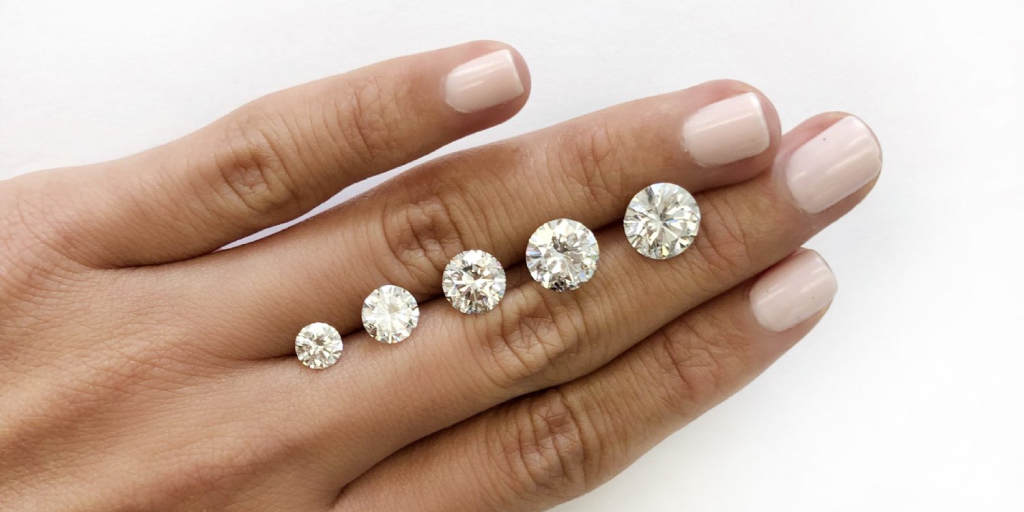
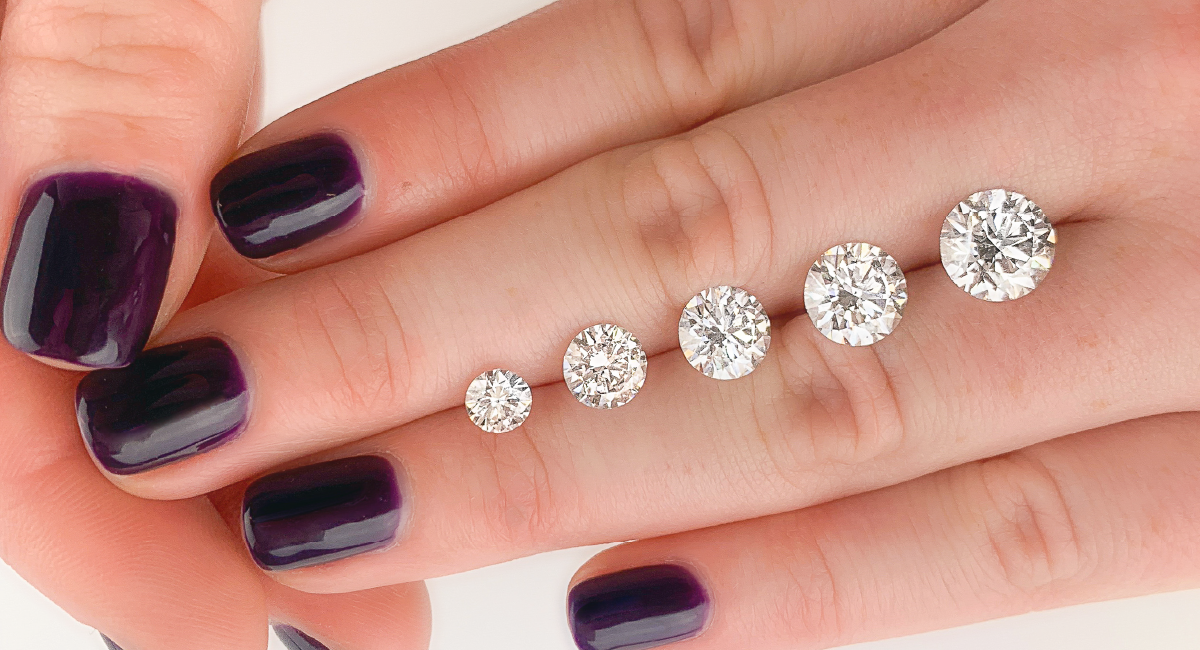
round diamonds on hand

A round cut diamond has 57 or 58 facets on the sides depending on whether it has a culet or a flat face at the bottom of the diamond. The facets of an evenly cut diamond would simply converge at a critical location, making no space for a culet.

There are Two Types of Round Cut Diamonds:

  • Brilliant Cut Round Diamonds

This cut makes excellent use of its edges to reflect not absorb but throw out infinite flashes of light. Contours and dimensions interact with each other to refract spectacularly and be the brightest. The brilliant cut round diamonds have a culet that ranges from average to big and an underside holds up 65% of the diamond’s total durability and strength.

Brilliant cut round diamonds are a fantastic selection for contemporary jewelry with stunning glitter.

  • Old European Cut Round Diamonds

The antique European cut round diamond was prevalent before the twentieth century as well as meticulously manufactured before contemporary diamond processing. As a result, these cuts have greater depth in dimensions than brilliant cut round diamonds. Diamonds of the Old European cut were principally fashioned due to their hue. 

The fundamental distinction between brilliant cut and old European cut diamonds pertains to their facets since the old European cut had facets with triangular frames, whilst the round brilliant diamond has narrower kite or ace-shaped facets. Both the cuts have their own special way of reflecting light.

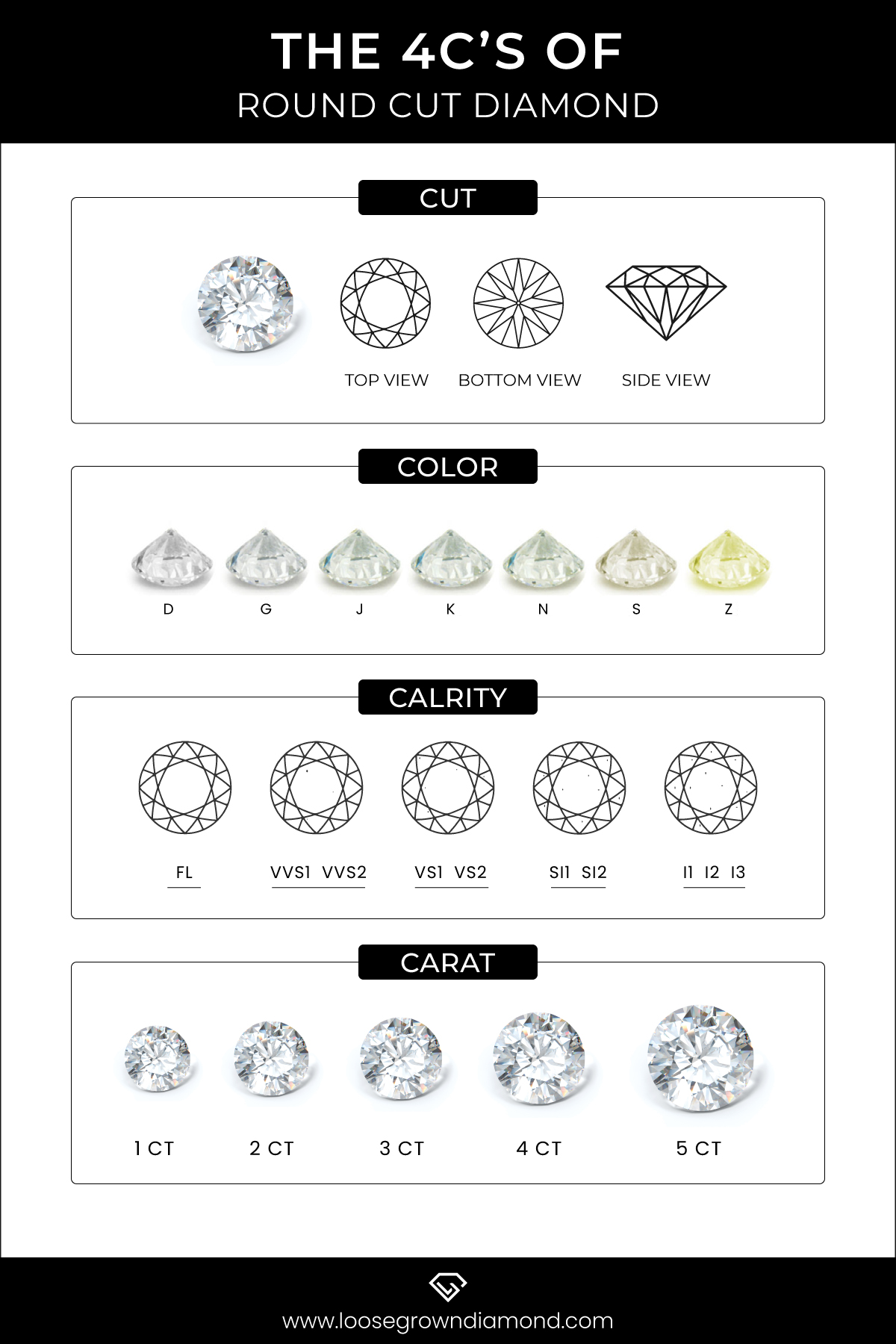
4cs of The Round Cut Diamond

The 4Cs of diamond quality measurement have not only become a globally understood vocabulary among jewelers, but also a handy checklist for any customer lacking expertise in picking the perfect diamond for their requirements. The Gemological Institute of America (GIA) created the Cs as an official grading method in 1953.

It encompasses Color, Clarity, Cut, and Carat Weight, to provide an objective, effective, and reliable appraisal of diamond excellence and cost. These aspects interact and might be reliant on each other within a diamond, needing a holistic examination rather than a concentrated inquiry of one feature.

4cs round cut diamond infographic

  • Carat Weight

Mostly, people who prefer round-cut diamonds will be benefitted as these stones will always seem to be more carat weight than the other cuts. Moreover, unlike other cuts that require a minimum carat size to maintain the integrity of their shape, round cuts can go as small as possible without making their shape obscure. 

  • Clarity

The GIA divides clarity into 11 key subcategories, which are mentioned below from highest to lowest-

  • Flawless (FL)
  • Internally Flawless (IF)
  • Very Very Small Inclusions (VVS1)
  • Very Very Small Inclusions (VVS2)
  • Very Small Inclusions 1 (VS1)
  • Very Small Inclusions 2 (VS2)
  • Small Inclusions 1 (SI1)
  • Small Inclusions 2 (SI2)
  • Inclusions 1 (I1)
  • Inclusions 2 (I2)
  • Inclusions 3 (I3)

The most crucial factor in determining a diamond’s clarity is whether or not the diamond appears to be clear to the naked eye. Many imperfections may be apparent only to a trained specialist using highly sophisticated equipment.

For round diamonds, most of the decision-making procedure depends on the onlooker since some individuals might want to know that their stone is confirmed as perfect, while some are fine with the idea of slight defects that are not easily observable. 

  • Color

Diamond color grading is the accepted practice for classifying round diamond tints as a scale that starts from a D grade (translucent) and progresses to a Z grade. Diamonds are tested to match specified color categories all of which are carefully selected and tested before usage.

The hue of the diamond tends to be directly related to the size and setting of the round cut. Small variances in the color of the cut are harder to identify with the naked eye, yet they can constitute a significant change in the diamond’s cost. Furthermore, the color and substance of the rough diamond chosen can create a significant impact on the finished stone.

  • Cut

The cut quality of the diamond must be considered too. The dimensions of a round cut dictate how vividly it will sparkle. The cut of a diamond is graded by assessing its edges and gloss. The purpose of achieving a decent cut is to pick the one with all the proper proportions to have the greatest passage of light, giving the stone a gorgeous glitter that your companion shall adore.

The cut of each diamond is graded as Ideal, Excellent, Very Good, Good, Medium, Fair, or Poor. A good round cut will have measurements that permit ideal reflectivity through the crown and table, resulting in a stunning, bright shine.

Round Cut Diamond Price

Loose Grown Diamond has an extensive inventory of round-cut diamonds with half-carat round-cut diamonds, beginning at $600 and fluctuating according to cut, clarity, color, and carat weight preferences.

The industry benchmark for elegant 1-carat round diamonds is around $900. 2-carat round diamonds certified by the Gemological Institute (GIA) are scarce and worth a starting price of $1500.

These 2-carat round cut diamonds on hand are a charming scene. Now, coming to more significant pieces, these stones display genuine brilliance, priced at $2000 for a 3-carat round diamond and $3,000 for a 4-carat round diamond option.

If you’re stuck, you can use our ‘diamond price calculator‘ to help with pricing.

Why Should You Choose a Round Cut Diamond?

There are certain advantages that a Brilliant round cut diamond has and why you should prefer buying it. Here are the pros of buying a lab grown round cut diamond.

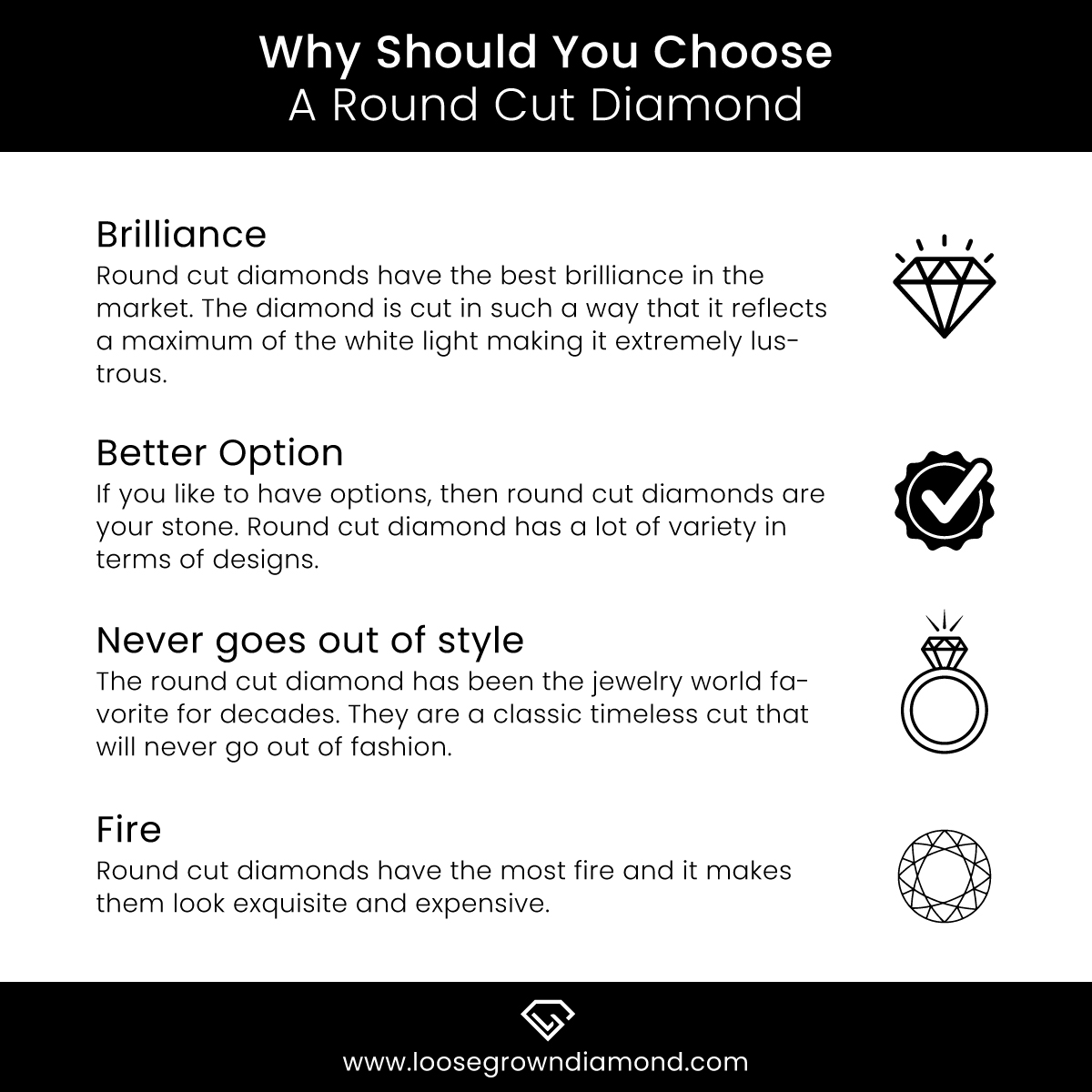
round cut diamond infographics-2

Brilliance: Round-cut diamonds have the best brilliance in the market. The diamond is cut in such a way that it reflects a maximum of the white light making it extremely lustrous. As the name suggests, brilliance is the top priority of the round cut.

Better Option: If you like to have options, then round-cut diamonds are your stone. Round cut diamond has a lot of variety in terms of designs. They can be adjusted and added to any jewelry design and this is one of the reasons why they are so widely used.

Never Goes Out of Style: The round-cut diamond has been the jewelry world favourite for decades. They are a classic timeless cut that will never go out of fashion. Your jewelry piece will always be in trend if you buy a round-cut diamond.

Fire: Have you ever looked inside a diamond? If you have, chances are you would have seen a rainbow-like light inside the diamond. This is known as the fire of the diamond, one of the beauty factors the stone has. Round-cut diamonds have the most fire and it makes them look exquisite and expensive.

Round Diamond Ring Settings

A diamond setting in a lab grown diamond ring can be anything from a plain band to a complex design with several diamonds or other jewels placed onto the ring. It’s the style of the ring that secures the diamond. Choosing one that compliments personal taste in addition to the diamond’s shape and size is crucial as it dramatically affects the ring’s overall appearance and beauty. Herein, let us explore the different settings for round cut diamond rings.

Solitaire Round Diamond Ring:

The solitaire setting is a popular option for round-cut diamonds since it showcases the stone by mounting it on a thin band. Classic and beautiful patient settings range from simple to ornate.

Bezel Set Round Diamond Ring:

Another option is a round diamond ring with a bezel setting, which encases the stone in a metal rim for further security. The diamond’s brightness may be slightly diminished but offers additional protection.

Pave Round Diamond Ring:

Another alternative is the pavé setting, which involves intricately arranging little diamonds or gemstones around the center diamond. This technique enhances the ring’s brilliance and gives it a more contemporary look.

Three-Stone Round Diamond Ring:

[su_youtube_advanced url=”https://www.youtube.com/watch?v=5EGzKuu8TF0″ width=”1600″ controls=”alt” autohide=”yes” autoplay=”yes” mute=”yes” loop=”yes” rel=”no” modestbranding=”yes” theme=”light” playsinline=”yes” title=”round diamond three stone engagement ring”]

A round diamond band with Three Stones features three diamonds, one slightly larger than the others, placed in a three-stone setting. The center stone adds sentimental value to the round cut engagement ring. These 3 diamonds symbolize the past, present, and future.

Halo Round Diamond Ring:

round diamond ring with halo style makes the center diamond look larger by encircling it with a circle of lesser diamonds or gemstones. It has a romantic, vintage vibe and is perfect for those who love diamonds.

Vintage Round Diamond Ring:

This ring style is perfect for the one you love, with its classic round stone and delicate filigree or milgrain settings that will always stay classic. A halo or pavé setting may be added to set the stone off.

Celebrity Round Diamond Engagement Rings

The round cut diamond engagement rings are popular among many famous people. Quarterback Tim Tebow presented Demi-Leigh Nel-Peters with a flawless 7.5-carat round diamond, while Brittany Snow showed off a round diamond set in a pave band.

Felicity Jones chose a timeless circular cut on a band of golden metal. A halo-encircled round diamond is the focal point of Alison Brie’s rose gold ring.

Jamie Bell proposed to Kate Mara with a classic round cut diamond engagement ring back in 2020. The round diamond on Meg Ryan’s yellow gold band and the one on Rosie Huntington Whitley’s equally astonished viewers.

So, celebrities equally invest in the diamond saga, with each of them gifting/selecting a unique ring.

Conclusion

Round diamonds were the most favoured diamond cut in the marketplace for generations, notably for engagement rings, pendants, and studs. This magnificent diamond cut is designed to match new artistic principles while maintaining an ageless and traditional appearance.

Round cuts have remarkable brightness and flare, which flashes under lighting, thanks to stringent rules for optimal dimensions. To define the quality of a round diamond, these rules look at its facet shapes, girdle breadth, culet, luster, and evenness.

The appropriate ratios of round cuts give universality, grace, and superb sparkle, proving a traditional yet attractive diamond alternative.


FAQs

How many facets in a round brilliant cut diamond?
A round brilliant cut diamond has 58 facets, optimizing brilliance and sparkle for exquisite beauty.

How much is a 3 carat round diamond worth?
The value of a 3 carat round diamond varies widely depending on its quality and characteristics, but it could range from $5,000 to $70,000 or more.

Does a round diamond sparkle the most?
Yes, a round cut diamond typically sparkles the most due to its symmetrical shape and faceting pattern, which maximize light reflection and brilliance.

Why do round diamonds look bigger?
Round diamonds often appear bigger than other shapes of the same carat weight due to their unique cutting style, which maximizes the stone’s surface area visible from the top, known as the table. This optical illusion makes round diamonds appear larger than other shapes of equal weight.

Princess Cut vs Cushion Cut: Which One to Choose?

When it comes to diamonds, each cut has its charm and beauty that make them unique. No two diamond cuts are alike hence it all comes down to the diamond. Finding a diamond that not only suits your tastes but also your budget can be quite a hard task.

Princess Cut vs Cushion Cut: Describing the both diamonds

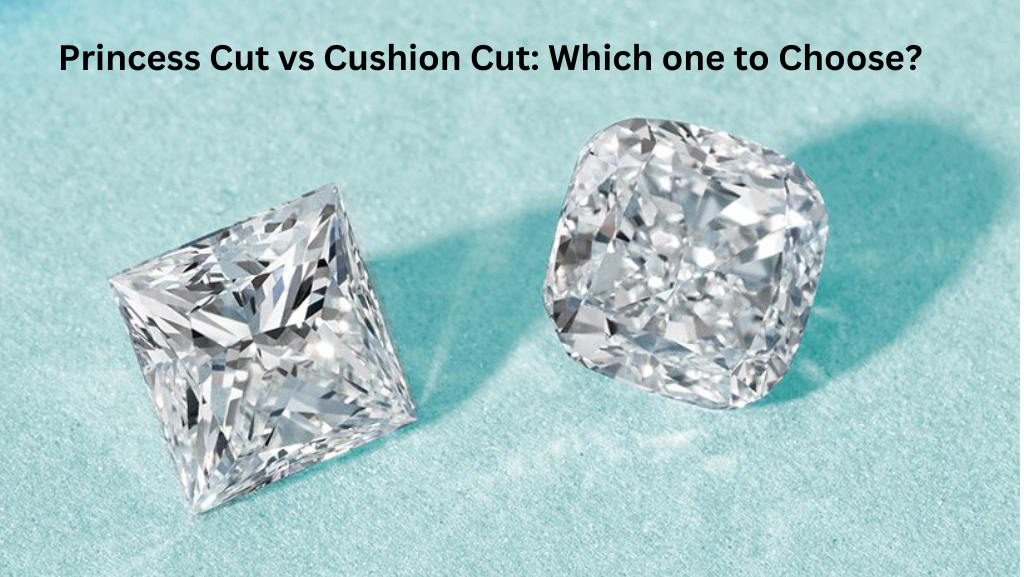
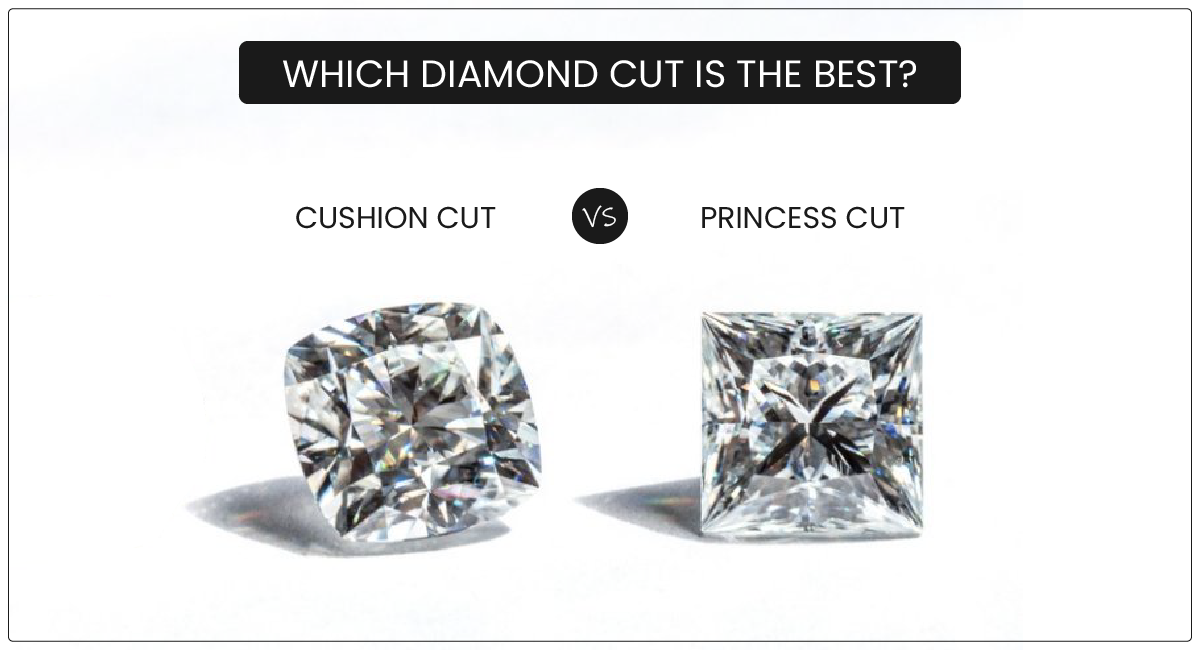
Princess cut vs cushion cut diamonds are two of the very famous and popular diamond cuts in the market. Princess cut and cushion cut both have a geometrical appearance that pleases a lot of minimalistic and contemporary people with varying differences.

Each has a different fan following for different reasons.

Princess Cut Diamonds

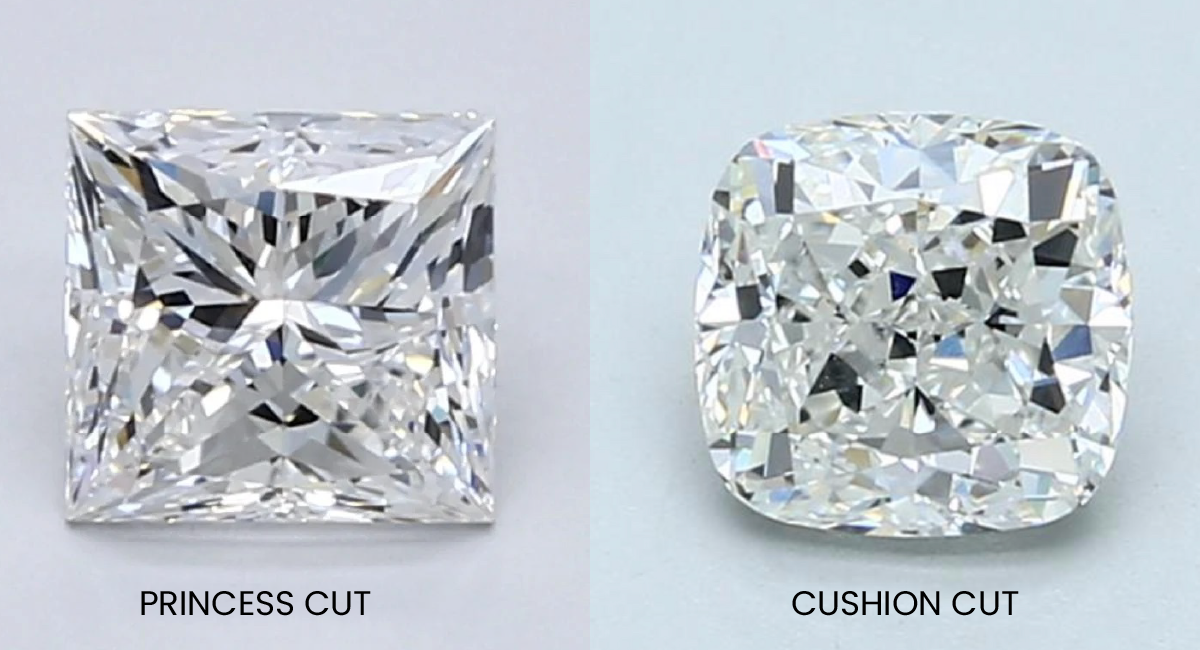
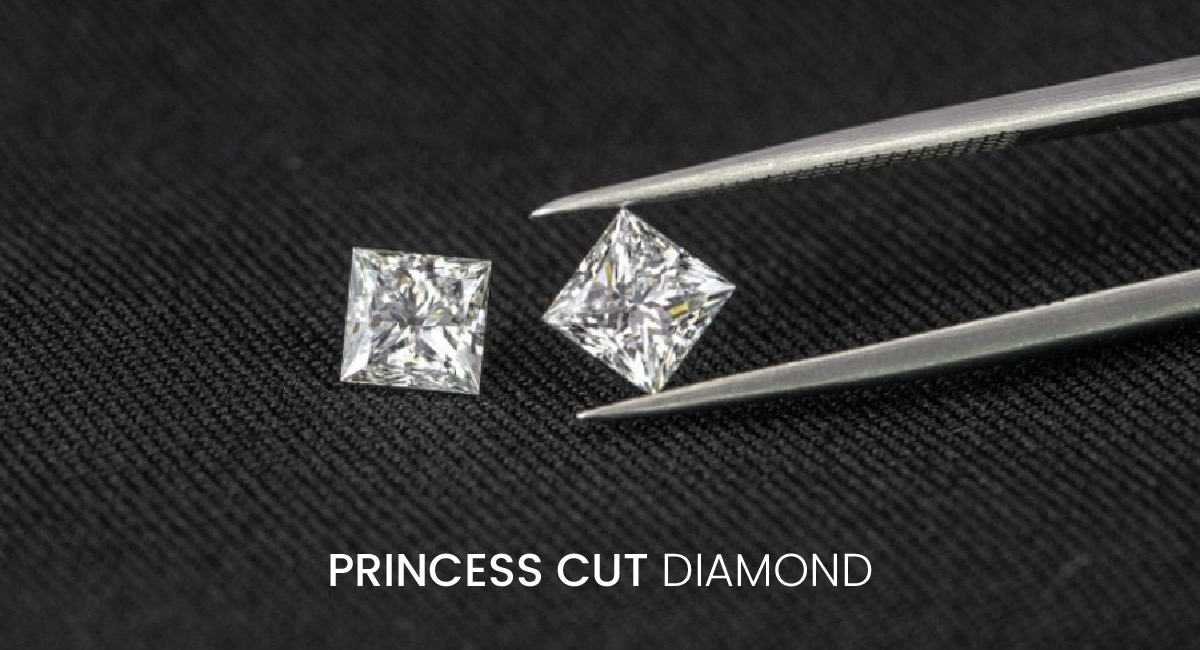
Princess cut diamonds are perfectly square diamond cuts that sparkle with brilliance and fire. The second most popular diamond cut, princess cut diamonds feature straight edges with sharp corners. These square cut diamonds are as brilliant as round brilliant diamonds.

Princess shape diamonds first made an appearance in 1961. They were also called ‘square modified brilliant’ and ‘profile cuts’ based on their cut and similarity to round brilliant diamonds. With up to 76 facets around them, princess cut diamonds are full of brilliance and sparkle that is bound to grab everyone’s attention.

princess cut diamond: what they are and Pros and cons of the cut

Since these diamonds are more about sparkle and brilliance, they make an excellent case for not showing their true colors. Most of their colors are concentrated at the corners, making it hard to tell the difference between two diamonds of consecutively different grades when kept side by side. This also works in the favor of the buyer lower color grades are quite acceptable when it comes to princess cuts. 

Princess cut diamonds refract up to 70% of the light that enters within them. That percentage not only makes them highly refractive and reflective but also gives them an upper hand over cushion cut diamonds.

Pros and Cons of Princess Cut

Pros:

  1. Sleek Appearance: Princess cut diamonds offer a sleek and elegant look, making fingers appear longer.
  2. Versatility: Looks great in various settings, enhancing the overall appeal of your jewelry.

Cons:

  1. Sparkle: Slightly less sparkle compared to cushion cut diamonds.
  2. Price: Can be relatively higher due to high demand.

[blog_page_inventory shape=”Princess” carat=”1.00,2.10″ cut=”1,4″ color=”0,10″ clarity=”0,11″]
[blog_page_btn title”Buy Now” url=”https://www.loosegrowndiamond.com/inventory/?”]

Cushion Cut Diamonds

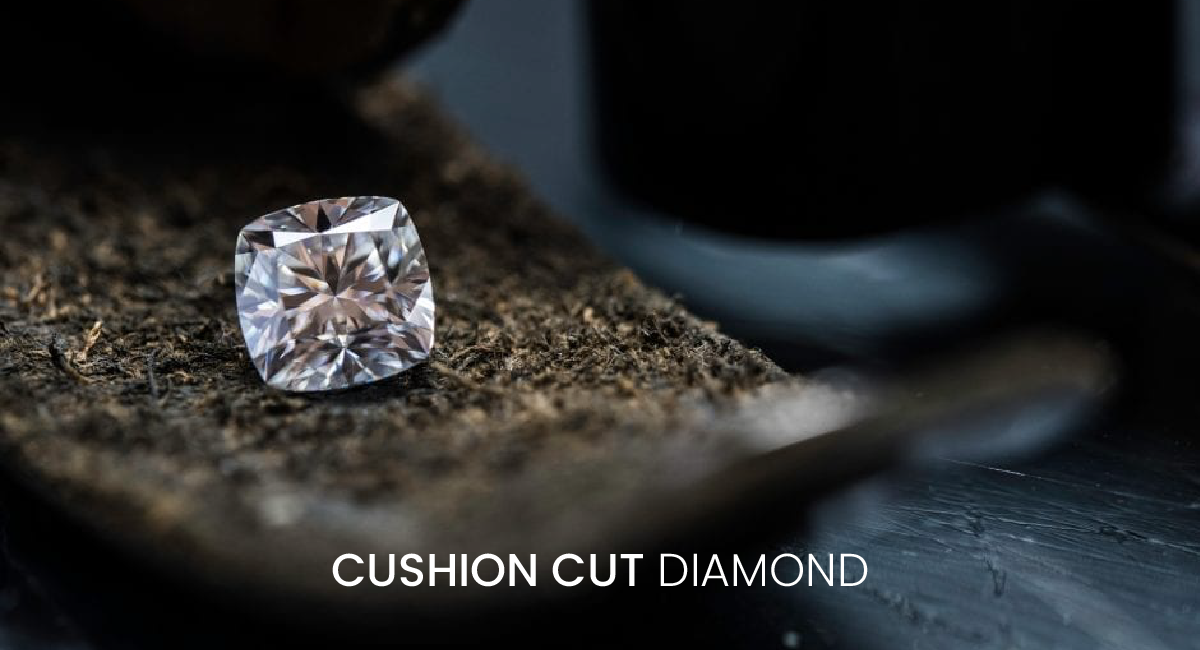
Cushion cut diamonds or old mine cut diamonds, are soft square or rectangle diamond cuts that sparkle with soft gleam and elegance. One of the most popular diamond cuts, cushion cut diamonds have rounded edges with blunt curved corners. They might be as brilliant as princess cut diamonds but they do have an unparalleled sophistication that is highly unique.

Cushion diamonds first made their appearance in the 1700s. They were also called ‘old mine cuts’ due to them being the way old mined diamonds were cut. They are one of the oldest cuts of diamonds. They were the standard diamond cut until the 19th century when new and modified diamond cuts started making their appearance.

Cushion cut diamonds have 58 facets which gives these diamonds a less sparkly nature compared to princess cut diamonds. 

cushion cut Diamond: Describing the cut and pros and cons
Cushion lab diamonds have subpar color retention, which makes colors within them quite visible. They retain their natural color best. Because of their comparatively less brilliance than princess cuts, it is easier to spot inclusions and blemishes inside a Pillow cut diamond.

Due to their rounded blunt corners, their color doesn’t tend to accumulate at the corners. Hence it is not suggested to go for a lower grade of a diamond, not below H when it comes to color. But these colored influences can be nullified if yellow gold or rose gold is chosen as the metal for the same. 

Due to their variety of sizes, choosing the wrong cushion cut diamond may either end up looking way similar to the round brilliant diamond or radiant cut diamond. The preferable ratio of L-W happens to be 1.00-1.30. Elongated cushion cuts have their unrivaled charisma.

[blog_page_inventory shape=”Cushion” carat=”1.00,2.10″ cut=”1,4″ color=”0,10″ clarity=”0,11″]
[blog_page_btn title”Buy Now” url=”https://www.loosegrowndiamond.com/inventory/?”]

Pros and Cons of Cushion Cut

Pros:

  1. Brilliant Fire: Resembles a round diamond, providing excellent fire and brilliance.
  2. Size: Makes a strong visual impact due to its shape.

Cons:

  1. Bulkier Appearance: Creates a bulky impression on the finger.
  2. Versatility: While still versatile, may not suit all settings as seamlessly as princess cut diamonds.

Princess Cut vs Cushion Cut Diamonds

Cushion cut vs princess cut: shape, history, facets, prince, popularity, color

Difference Between Princess and Cushion Cut

[su_table responsive=”yes” fixed=”yes”]

Aspect Princess Cut Cushion Cut
Shape Geometric, sharp square with four beveled sides Distinctly rounded square, reminiscent of a pillow
History Invented in 1980 by Betazel Ambar and Israel Itzkowitz Dates back to the 1700s, with a resurgence in popularity
Fire and Brilliance High brilliance, comparable to round or cushion cut diamonds Intense sparkle and fire, especially in modified cushion cuts
Facet Patterns Contains 57 or 76 facets, with variations in pavilion and crown facets 58 facets, with classic and modified patterns, creating ‘hearts and arrows’ or ‘crushed ice’ effects
Ratio Variations Slightly rectangular, ratio typically 1.00-1.05 Square or elongated options, ratios vary for different preferences
Price More affordable, up to 30% less than round brilliant cut diamonds Lower demand makes them 15-20% cheaper than round cuts per carat
Size Perception Appears larger face up due to bigger face-up surface area May look smaller per carat due to the smaller table and depth
Versatility Versatile, suitable for various settings and styles Combines antique feeling with modern performance, adaptable to different designs
Vulnerability Sharp corners may be prone to chipping if not protected Generally less vulnerable, but girdle thickness should be considered
Colour Display Tends to display more color due to the large table May have a slight tint, but usually not highly noticeable

[/su_table]

Which Diamond Cut is Best: Princess Cut vs Cushion Cut Diamond?

Neither is truly superior to the other; it is simply a question of taste. If you want a more contemporary style, a princess cut diamond is the way to go. The cushion cut, on the other hand, works nicely in a variety of situations if you prefer a more classic look. 

Cushion cut diamonds are excellent at illuminating color, and the soft, round edges lend a classic touch, particularly when used in a halo arrangement. However, they can make a diamond appear smaller than it is, so if you choose a cushion cut, you may want to go with a greater diamond to compensate.

Princess cuts are more architectural in structure than cushion cuts, providing it with a sleek, sophisticated, regal feel. They have the most vivid brilliance of any cut, following only the round cut, making them a popular option for engagement rings.

Cushion Cut Diamonds Ring Setting

THREE STONE SETTING:

[su_youtube_advanced url=”https://www.youtube.com/watch?v=87yET2796Pc” width=”1600″ controls=”alt” autohide=”yes” autoplay=”yes” mute=”yes” loop=”yes” rel=”no” modestbranding=”yes” theme=”light” playsinline=”yes” title=”cushion diamond engagement ring”]

A cushion three-stone diamond ring typically features a central cushion cut diamond flanked by two smaller diamonds on either side. This style of ring is known for its elegance and versatility.

SOLITAIRE SETTING:

cushion solitaire ring

Due to its soft gleam on top of its symmetrical shape, solitaire settings work amazingly with pillow-cut diamonds. Combining a warmer cushion cut diamond with yellow gold or rose gold gives it a very vintage vibe. Also using a combination of two metals can make it very unique and enhance its antique charm.

HALO SETTING:

cushion diamond halo ring
If the vintage charm of the cushion cut is not enough as it is, adding a halo around it may work for you. Since cushion cut diamonds aren’t the sparkiest diamonds, the halo might just make the center diamond appear more dazzling and bolder.

Princess Cut Diamonds Ring Setting

SOLITAIRE SETTING:

princess diamond solitaire ring
Due to its rectilinearity, solitaire settings work great with diamonds having princess cuts as these diamonds shine bright all by themselves. Placing a square cut diamond with white gold or platinum will provide an utmost chic and sophisticated look that would be unrivaled.

HALO SETTING:

princess diamond halo ring
If you feel like enhancing the beauty of the princess cut diamond, then do get a halo around the center diamond. A halo has small accent diamonds in the periphery of the center stone. They refract and reflect part of their light into the center stone making it sparklier.

Halo settings are also great since they make the center diamond appear bigger by giving an illusion of increased surface area.

THREE STONE SETTING:

Princess three stone ring
Opting for side stones on either side of the center stone can make your diamond look gorgeous. Side stones can be half-moon diamonds, triangles, trillions, baguettes, and even small princess cut diamonds as well. Timeless elegance meets modern allure in this symbol of everlasting love exquisite princess cut three stone engagement ring.

Buy Best Lab Created Princess Cut and Cushion Cut Diamond

Transform your engagement ring ideas into reality with Loosegrowndiamond.com beautiful princess cut vs cushion cut diamonds. Our certified lab grown diamonds are the epitome of sophistication, and they are unrivaled in both price and quality.

We provide a user-friendly Diamond Price Calculator on our website. This tool helps you make informed decisions based on your budget and preferences.

You can check out LGD’s specialized “Diamond Size Chart” guide for measuring diamond sizes and check out the “Printable Ring Size Chart” guide for measuring ring sizes.

Save an extra 2% off already low pricing when you use our promo code at checkout. Pick Loose Grown Diamonds for a classic token of your affection because of superior craftsmanship and moral standards.


Conclusion

When it comes to the argument of what is better: Princess cut or Cushion cut? There is no explicit winner. Neither is superior or finer than the other. It all comes down to personal choices; of what you like. However, if you are going for a charm of modern, then Princess cut diamonds are the best choice. But if it is a vintage and minimalistic look for you, then it is a cushion cut.

Cushion cut diamonds. And if you are still having issues with choosing between them, go for something that has both stones in it. It might be slightly expensive but it will look gorgeous with a perfect combination of modern and vintage.

FAQs

Can I customize rings from LGD?
Absolutely! Loose Grown Diamonds offers a personalized touch, allowing you to create customized rings tailored to your preferences. Our expert craftsmen bring your unique vision to life.

Is a cushion cut diamond better than a princess cut?
Both cuts have unique appeal; a cushion cut offers a softer, romantic look, while a princess cut exudes modern elegance. The choice depends on personal preference and style.

What are the disadvantages of princess cut diamonds?
Princess shape diamonds may be prone to chipping at the corners due to their sharp edges. Choosing protective settings can mitigate this risk, ensuring durability.

Which diamond cut has the most sparkle?
The round brilliant cut is renowned for maximum sparkle, thanks to its numerous facets that enhance light reflection and brilliance. Explore more about this diamond shape’s ring in our carefully advised blog here.

Is a princess cut diamond more expensive?
Generally, princess diamonds are more affordable than round cuts, offering a budget-friendly option without compromising on elegance and beauty.

Calibrated Diamonds: Everything you need to know

Two jewels are almost indistinguishable. Things being what they are, how could it be that goldsmiths can make multi-stone plans that convey the dazzling appearance of consistency? Regardless of whether the completed piece is an astonishing tennis armband, multi-stone jewel wedding band, studs, or something different, its ability to choose adjusted jewels directs the cycle.


The unmistakable contrasts shown in free jewels are by and large not apparent to the unaided eye. This empowers goldsmiths with the capacity to choose jewels that show up completely coordinated for use in settings. From two precious stones entirely combined for the jewel to orders for many little jewels expertly chosen depending on their similitudes for use in an intricate mounting.

Calibrated diamonds have revolutionized the jewelry industry with precise measurements and consistent quality. These diamonds are meticulously crafted to exact specifications, offering unparalleled uniformity in size and shape. This article delves into the world of calibrated diamonds, exploring their manufacturing process, advantages, and much more.

What are Calibrated Diamonds?

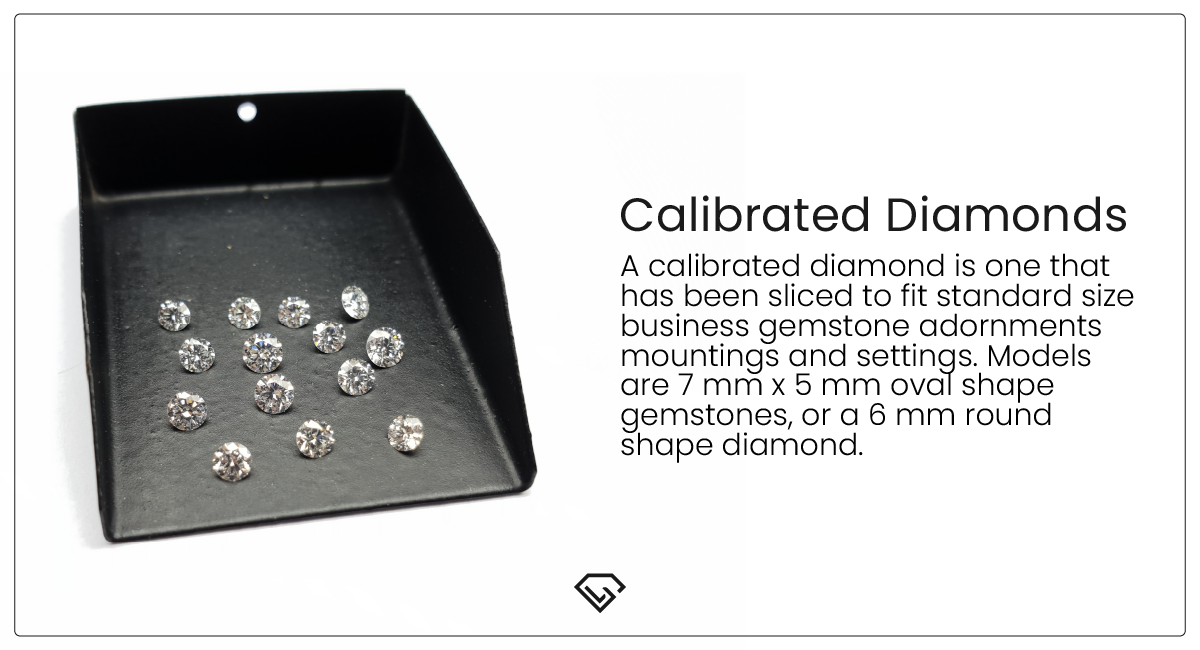
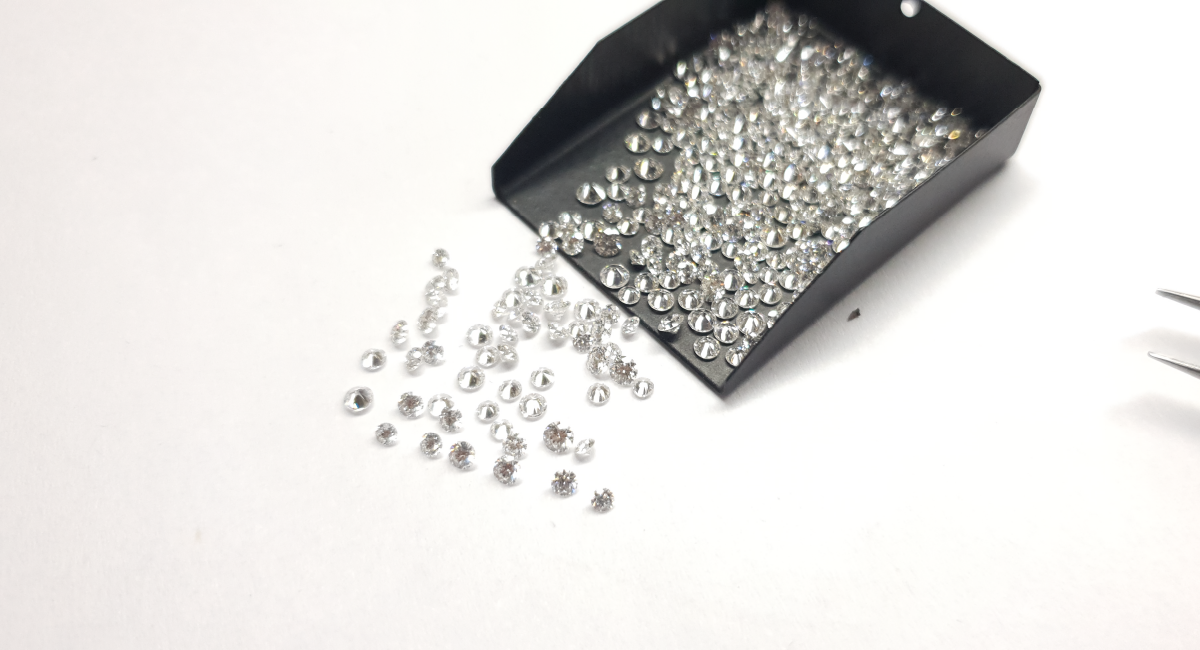
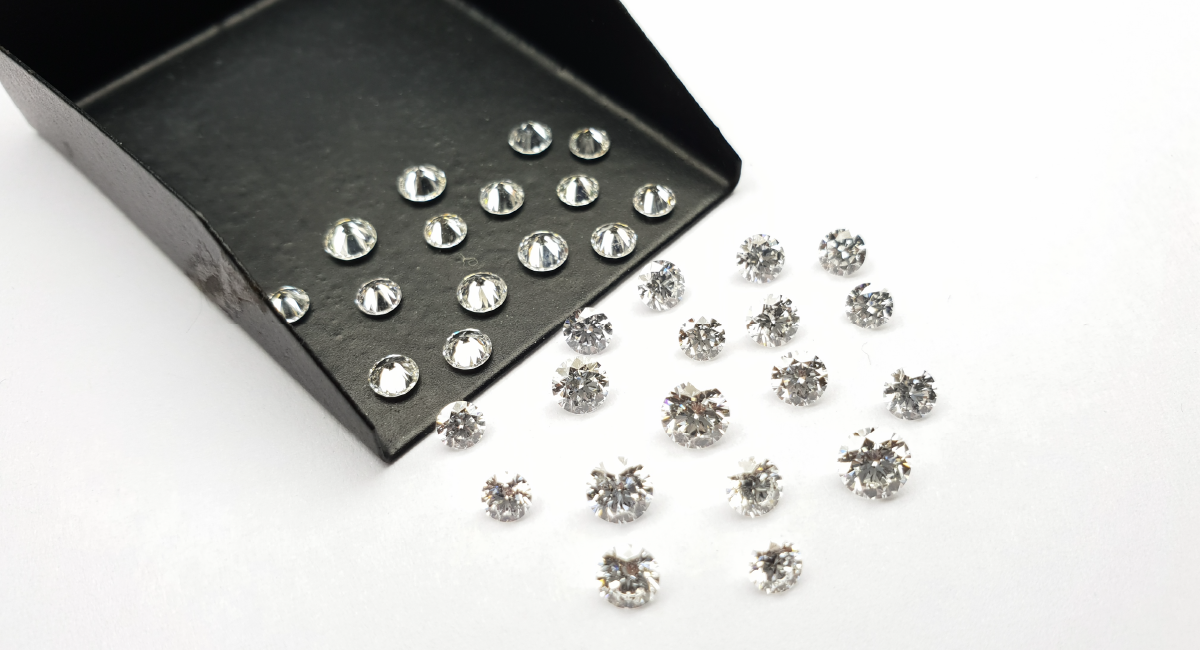
A calibrated diamond is one that has been sliced to fit standard-size business gemstone adornments mountings and settings. Models are 7 mm x 5 mm oval shape diamonds, or a 6 mm round shape diamond. Aligned gemstones are not sliced to correct estimations, however, they are sliced to sizes that most standard-size mountings can oblige.

What Are Calibrated Diamonds

There will consistently be some change; ordinarily, for gemstones more than 1 carat in weight, a size difference inside 0.04% is worthy, contingent upon the specific adornments configuration obviously.

Above in the photograph are two 6 mm round distances across stones, yet the jewel is practically a large portion of the heaviness of the sapphire. This is the reason gemstones ought to be purchased by size as opposed to weight.

The production of calibrated diamonds begins with the selection of high-quality rough stones. Skilled craftsmen then meticulously cut and polish each diamond to precise measurements using advanced machinery and techniques. Quality control measures ensure that every calibrated diamond meets stringent standards for symmetry, clarity, and brilliance. Lab created calibrated diamonds adhere to standardised measurements, unlike traditional diamonds, which may vary in proportions.

Purpose

Mass-created gemstone settings come in standard sizes. On the off chance that a jewel will not fit in a standard setting, one should be uniquely designed. This includes substantially more work and accordingly cost. Remember this when purchasing a diamond, or choosing a cut for a gemstone.

There are conditions where the estimation of a stone makes it worth cutting for the most extreme yield, afterwards paying for a uniquely designed setting. In different conditions, the expense of a custom setting isn’t legitimized by the estimation of the diamonds.

Sizes

A diamond shouldn’t be the exact size of the setting. A talented gem dealer can alter a setting to oblige a wide assortment of jewel sizes. Any round pearl can be placed in a standard setting. With different shapes, there are different components to be thought of.

When in doubt, jewels under one carat can be inside 0.1 mm of the setting size. More than one carat, a 0.2 mm difference can generally be obliged and some of the time more.

Weights

The loads given are for precious stones sliced to ideal extents. Colored stones are generally cut with a more prominent volume than jewels; subsequently, they will gauge more than the outline sizes. The thickness of the material will likewise influence the weight. For instance, a 6.5 mm round jewel, sapphire, and opal, all cut to similar extents will all have various loads.

The jewel (with a particular gravity of 3.52,) will gauge 1 carat. A sapphire (explicit gravity 4,) will weigh 1.14 carats. The opal (explicit gravity 2.15) will just gauge .61 carats. There are unobtrusive varieties to this rundown. For instance, some rundown a .25 carat jewel as estimated 4.1 mm. The fact of the matter isn’t to take these figures too in a real sense, but to utilize them as a beginning stage for assessing loads.

Calibrated Small Diamonds

With exceptionally few precious stones, a gem specialist will put in a request for 1.3 mm stones, as opposed to alluding to their size as 0.01 ct or 1 point. A 1 pt jewel that is cut exceptionally profoundly may not be actually 1.3 mm in measurement, which turns into an issue when the plan requires a line of consistently estimated stones.

Also Read:  WHY CVD DIAMOND PASS TESTER AND HPHT CAN’T?

Advantages of Calibrated Diamonds

  • Calibrated diamonds are widely used in the production of fine jewelry, including rings, earrings, pendants, necklaces, and bracelets.
  • One of the primary advantages of calibrated diamonds is their uniformity in size.
  • Jewelry designers can easily match multiple diamonds for symmetrical arrangements, creating visually appealing compositions.
  • Calibrated diamonds streamline the setting process, allowing jewelers to work more efficiently.
  • This efficiency translates to lower production costs and competitive pricing for consumers.

Things to Consider When Choosing Calibrated Diamonds

Things to Consider When Choosing Calibrated Diamonds

  • Estimations – When coordinating jewels for use in multi-stone settings, estimation assumes a basic part. Adjusted precious stones should seem equivalent to the unaided eye. Slight carat weight deviations are conceivable, yet the precious stones should seem uniform, making millimeter size a state of thought.
  • Shading – Color attributes are likewise imperative when choosing coordinating precious stones. Since jewels structure normally in an assortment of tones, it is significant for adjusted precious stones to coordinate in this regularly entirely observable trademark. Dull or close to vapid precious stones, for instance, can’t be combined with those showing a yellow or earthy colored color if a uniform introduction is wanted in the last setting.
  • Lucidity – This significant precious stone trademark tends to interior considerations and outer imperfections an individual jewel shows under 10X amplification. Aligned jewels are likewise chosen with this significant trademark considered to guarantee general consistency in quality.
  • Shape – Jewelers likewise select adjusted precious stones dependent on this vital appearance factor. Round cut jewels are combined or coordinated with other round-cut precious stones, for instance. In settings where various shapes may be utilized, jewels may be coordinated by shading and quality elements.

Also Read: MISTAKES TO AVOID WHEN BUYING A LAB GROWN DIAMONDS

Where to Buy Lab-Created Calibrated Diamonds?

You can purchase lab-created calibrated diamonds from loosegrowndiamond.com which offers a wide selection of lab-created diamonds in calibrated sizes. You can browse them, compare prices, and select the diamond that meets your specifications.

Additionally, consider factors such as cut, color, clarity, and carat weight to find the perfect diamond for your needs.

[blog_page_btn title=”Shop Calibrated Diamond” url=”https://www.loosegrowndiamond.com/product/round-shape-calibrated-diamonds/”]

Conclusion

Diamond sellers frequently have records accessible of the adjusted sizes that their stock is accessible in. It is consistently helpful to have a duplicate close when planning and giving a duplicate to deal with staff with the goal that they can manage a client effectively, both regarding the accessibility of specific sizes and their expense.

FAQs

Can calibrated diamonds be customized for specific jewelry designs?
While calibrated diamonds adhere to standardized measurements, they can still be customized for specific jewelry designs by skilled artisans and jewelers. Custom settings and arrangements can enhance the overall aesthetic appeal of calibrated diamond jewelry.

Are calibrated diamonds more expensive?
Generally, calibrated diamonds are priced lower than non-calibrated diamonds due to their standardized measurements and mass production capabilities. However, factors such as cut, color, clarity, and carat weight still influence the overall cost.

What makes calibrated diamonds different from regular diamonds?
Calibrated diamonds are specifically cut to precise measurements, ensuring uniformity in size and shape, whereas regular diamonds may vary in proportions and dimensions.

Emerald Cut vs Radiant Cut Diamond: Clear Cut Distinction

Diamonds have always been available in a wide variety of qualities, cuts, colors, shapes, etc. to customers around the world. While the diamond has many important features, one of its most important aspects includes how the diamond has been cut by the jeweler or designer. Hence, every piece of diamond is available to the customers in various cuts such as the round cut, radiant cut, emerald cut, princess cut, etc.

One such example is the emerald cut and the radiant cut made in diamonds. Although similar from many perspectives, both cuts signify different things and are suitable for different kinds of diamond wearers. Hence, customers should choose according to their personal preferences and what they think would accurately symbolize the situation for which the diamond jewelry is being bought.

radiant vs emerald cut cut diamonds
The emerald cut and the radiant cut are very similar in their outward appearance and hence might tend to confuse people when seen from afar. They are cuts that stay unique and individual in their appearance. Emerald cut diamonds have been a classic cut that imparts a vintage feel to the jewelry. While radiant cut diamonds have a more modern twist and give off an aesthetic vibe.

What is an Emerald-Cut Diamond?

An emerald-cut diamond is shaped like a rectangle with accurately cut corners. Owing to their step-cut facets, a term coined due to their staircase-like ascending cuts, emerald diamonds feature numerous long, beautiful dashes of light. The paralleled cuts form the iconic hall-of-mirrors appearance of the diamond.

Emerald lab diamond-1
The Emerald Cut became rather prevalent during the period of Art Deco (1920-30). The cut gradually became more complex as it was given more facets by jewelers around the world, and became the contemporary cut as we know it today. Currently, the emerald cut is primarily used to emphasize the clarity and purity of the color of the gem.

The cut is unforgiving to diamonds with the slightest of inflictions as blemishes are easily susceptible to the naked eye. The name was coined due to the sequential arrangement of its 57 facets, which are separated into 24 facets on the base, 8 facets on the girdle, and 25 facets on the table. The flat tabletop does have a broad and dazzling width.

[blog_page_inventory shape=”Emerald” carat=”2.05,2.1″ cut=”1,4″ color=”0,10″ clarity=”0,11″]
[blog_page_btn title”Buy Now” url=”https://www.loosegrowndiamond.com/inventory/?shape=Emerald”]

What is a Radiant Cut Diamond?

Having merely ten more facets and a cubical shape similar to the emerald cut diamond, one can argue that the radiant cut diamond might have a similar outline as the former. However, there are crucial differences that help people choose between the two. 

Invented by Henry Grossbard, a renowned diamantaire during World War II, in 1977, the radiant cut is a stunning square geometry of the gemstone that incorporates every one of the biggest outlines seen in the round cut and emerald cut. Hence, it has flashes of a rainbow and bright white light.

radiant cut diamond
Square cuts hold an innate beauty within themselves that stands out among the other varieties of diamond cuts. The radiant cut is a middle ground between the emerald cut and a round brilliant diamond.

The 70 facets transport the light to the center of the stone and help it bounce back, giving the stone incomparable sparkle. It is commonly believed that radiant cut is the only cut that comes close to outperforming brilliant cut in terms of dazzle and brilliance.

Radiant cut diamonds seem bigger than other diamond cuts having similar carat weight owing to their oblong form. Also, because of its oblique edges, the radiant-cut diamond is immune to the damage and ravages of time, making it far more durable.

To help customers get a better idea about the differences that lie between an emerald cut and a radiant cut diamond, here are some of the factors that cause the variations between the two.

[blog_page_inventory shape=”Radiant” carat=”2.05,2.10″ cut=”1,4″ color=”0,10″ clarity=”0,11″]
[blog_page_btn title”Buy Now” url=”https://www.loosegrowndiamond.com/inventory/?shape=Radiant”]

Difference Between Emerald Cut and Radiant Cut

The basic distinction between the Emerald cut vs radiant cut is the appearance of the diamond’s brilliance. The emerald-cut diamonds have straight cuts and light can be seen in the form of strips through the diamond. Whereas, the radiant cut diamond is seen sparkling with flashes of light here and there.

infographic emerald cut vs radiant cut

Emerald Cut vs Radiant Cut: History of the Diamond Cuts

Emerald Cut 

One of the oldest diamond shapes to exist, the emerald cut can be traced back to the table cut of the 1500s from which the emerald cut was further developed. Originally termed as the multi-faceted table cut, the cut was first and foremost used on emeralds as the name suggests, and was only a lot later on brought as another variety into the world of diamonds. 

With the term ‘emerald cut’ emerged in the 1920s, it has often been associated with the era of Art Deco wherein clean lines and symmetry were in trend amongst the people and enjoyed their own class of popularity. Then in the 1940s, the cut was further more refined and standardized which could be done with the invention of much more advanced and systematic diamond-cutting tools. 

Radiant Cut 

Unlike the emerald cut which is a design of the olden times, the radiant cut is a much more modern style that was an invention made by Henry Grossbard in the 1970s. The term ‘radiant cut’ has been patented by Grossbard so generally on the laboratory certificates provided by GIA or AGS, the cut is referred to as a “rectangular brilliant” or “cut-cornered square”. 

The radiant cut was created as a hybrid wherein the cut has many facets that have been designed in a manner to maximize the brilliance and beauty of the diamond. One of the sparkliest varieties in cuts for the diamond industry, the radiant cut diamond is made with a brilliant faceting pattern that is present in both the crown and pavilion of the gemstone. 

Emerald Cut vs Radiant Cut: Facets

The number of facets on an emerald cut diamond is 57, whereas in a radiant cut diamond is 70. In an emerald diamond, one can see that the facets are created in a ‘stepped manner’ (one step after another like a staircase) that adds a mirror effect to the diamond cut. The facets are all elongated and hence we can see that the inclusions are very evident if any. The diamond appears very sleek and classy.

In a radiant cut diamond, one can observe the facets to be triangular or kite-shaped. These angular facets add more character to the rectangular diamond and mask a lot of inclusions that the diamond might possess. The cuts of the diamond make it appear shiny and brilliant. A lab-grown emerald-cut diamond will be as stunning and brilliant as a naturally extracted diamond.

Emerald Cut 

The emerald-cut diamonds have a rectangular outline and the corners are cut in a particular manner. Depending on the dimensions of the gem, the emerald-cut diamonds can be home to 50 to 58 step-cut facets. The step cuts are arranged parallelly and this leads to the creation of stunning flashes of light which in turn causes a “hall of mirrors” effect. This cut is known to be slightly more elegant than radiant cut diamonds and also exhibits a more sophisticated sparkle. 

Emerald-Cut diamond facets

Radiant Cut 

The major difference in the radiant cut is that although it is rectangular in shape much like the emerald cut, it does not have step cuts and is instead home to 70 triangular or kite-shaped facets which originate from the center and do an excellent job of maximizing the brilliance and sparkle of the stone.

Radiant Lab Diamond Facets

Emerald Cut vs Radiant Cut: Carat Weight vs Visible Size

The difference between carat weight and the visible size between the emerald and radiant cuts is almost the same, with both the cuts appearing larger than their actual carat weight. You can use our Diamond Carat Size Chart to determine the right size for your diamond. 

When comparing a round brilliant cut diamond with an emerald and radiant cut diamond, all of the same carat weight, it can be easily noticed that both these diamonds appear larger. In the case of emerald cuts, they appear larger due to the top surface is bigger than the one found in round cuts.

Radiant cuts are also created in an elongated manner and hence appear bigger than the round cut diamonds, even though they have a slightly smaller face-up measurement when compared with the round cuts of the same weight.

With radiant diamonds, it was within Grossbard’s interest to create a diamond that would appear as large as possible by investing not too much. And so, he paired a broad and shallow design with a highly brilliant faceting pattern. This gave rise to an excellent optical illusion wherein the radiant cut diamonds truly felt like they were radiating brilliance and shimmer. 

Emerald Cut vs Radiant Cut: Clarity and Inclusions

Emerald cut diamonds emphasize clarity, with their step-cut faceting style making inclusions more visible. It’s essential to prioritize high clarity when choosing an emerald cut. In contrast, radiant-cut diamonds are more forgiving with inclusions due to their brilliant-cut facets that disperse light, making flaws less noticeable.

This allows for flexibility in selecting a slightly lower clarity grade while still achieving a brilliant appearance. Your choice should depend on your preference for clarity and the balance between clarity and brilliance in your diamond.

When choosing between the two cuts, consider how you prioritize clarity in your diamond and your willingness to balance it with other factors such as brilliance and sparkle.

Emerald Cut vs Radiant Cut: Which is Better?

The choice between an emerald cut and a radiant cut diamond ultimately depends on your personal preferences and the specific qualities you value in a diamond. If you value a classic, understated look and are willing to prioritize clarity, the emerald cut might be the better choice. On the other hand, if you’re drawn to a more brilliant, contemporary, and versatile option with exceptional sparkle and are open to various clarity grades, the radiant cut could be the ideal choice for you.

Radiant cut diamonds are known for their exceptional brilliance and fire. The emerald cut is often associated with a classic and timeless look. Both radiant-cut diamond and emerald-cut diamond have their strengths and beauty. The radiant cut vs emerald cut diamond is a tough choice, wherein the radiant cut is more modern and the emerald cut is more vintage.

Emerald Cut vs Radiant Cut: Valuable Tips for Choosing Diamonds

Different diamond cuts have varying degrees of leniency in relation to the 4C categories. Two particular cuts, the Emerald Cut and the Radiant Cut, exhibit significant differences in how they showcase flaws.

When opting for an emerald-cut diamond, it is advisable to prioritize a higher clarity grade. This is because the large table of an Emerald Cut tends to highlight any visible inclusions. Due to the lower concentration of color in this cut, you can compromise on the color grade and instead focus on securing a higher clarity grade.

On the other hand, Radiant Cut diamonds feature a faceting style that is more forgiving of internal flaws, effectively concealing inclusions with intense brilliance. It is possible to find a stunning Radiant Cut diamond with an SI1 or SI2 clarity grade. With this cut, you can consider upgrading to a higher color grade, as the faceting style tends to reveal a more pronounced concentration of color.

Regardless of the chosen cut, you have some flexibility in sacrificing a bit on the color grade if your ring is crafted from yellow or rose gold, as opposed to white gold or platinum.

Where to Buy Emerald Cut and Radiant Cut Diamonds?

An emerald-cut diamond or a radiant-cut diamond can be bought at Loose Grown Diamonds. We offer the best in class diamonds which can be shipped anywhere on the globe. Additionally, if you are confused about determining the price of your selected diamond, you can use our Diamond Value Calculator.

From customizations in pieces of jewelry to the availability of a specific type of stone we have it all. You can have a look at our inventory and also get a discount by using our promo code.


Ending Remarks

Emerald cut vs radiant cut diamonds have seen some similarities and some differences. The beauty of these diamonds is most enhanced in diamond rings and that is when the diamond tends to individually stand out within themselves.

The emerald cut engagement rings have had the vintage touch and hence the huge demand for this classy style. The radiant cut diamond ring has its own fan following. But as a diamond ring has an amalgamation of classy and modern styles you can choose which stone favors your personality. Both of these cuts have their own strongholds and hence both stay as beautiful and stunning, evolving through the test of time.

FAQs

How much is a 2 carat emerald cut diamond?
A 2 carat emerald cut diamond can cost starting from around $600 and increases based on the other 3 C’s that are chosen.

Which is the more expensive emerald cut and radiant cut?
A radiant cut diamond is slightly more expensive than the emerald cut diamond as we see the number of facets increase and so does the effort to add those facets.

Which cut is more suitable for an engagement ring?
Both the radiant cut and the emerald cut look absolutely stunning in an engagement ring.

Can I customize the ratio of length to width for emerald and radiant cuts?
Yes, the ratio of length to width can be customized. For an emerald cut diamond, the ideal ratio is 1.3- 1.6 and for a radiant cut diamond is 1-1.35.

Difference Between Clarity Enhanced and Lab Created Diamonds

Buying a diamond may seem an easy thing, but what’s the reality? Many people think that buying a diamond is the equivalent of going shopping, whereas it is a tough job. It requires a lot of research if you want to make the best choice. Proper knowledge and advice can be very helpful to you as there are a variety of diamonds in the market.

Clarity enhanced diamonds, as the name suggests are mined diamonds enhanced for their clarity by professionals. The natural imperfection and flaws are shaved off from that of a natural diamond to make it free from any inclusion or any flaws that it might have.

Difference Between Clarity Enhanced and Lab Created Diamonds

As you might be familiar with, diamonds that have been developed in a facility in a brief period are known as lab grown diamonds. Lab grown diamonds are considered to be identical to that mined diamonds. Both the diamonds have the same properties optically, chemically as well as physically.

Some of the major factors to look for when buying a diamond you like: are shape, quality, size, brand, price, and many more. One major factor is how the seller impacts you, here is where you need to be aware of the type of diamond you are going to buy.

What are Lab Grown Diamonds?

The lab grown diamonds are different from mined diamonds in the way they occur and are processed. Where mined diamonds occur naturally, on the other hand, lab-grown diamonds are created by imitating similar natural conditions but inside a lab. These are created inside certified labs that provide you with the best quality of diamond that is worth buying.

lab grown diamond

The process involves the use of a natural diamond seed which is then put under certain conditions that mimic those under the earth’s surface. The resulting environment leads to the formation of lab-grown diamonds. These diamonds are just as real as naturally mined diamonds, possess the same optical, chemical, and refractive properties.

[blog_page_inventory shape=”Round,Oval,pear,cushion,heart,princess,emerald,radiant,kite,hexagon,Asscher,Marquise,Triangular,Baguette” carat=”2.30,3.60″ cut=”0,4″ color=”0,10″ clarity=”0,11″]
[blog_page_btn title”Buy Now” url=”https://www.loosegrowndiamond.com/inventory/?”]

What is a Clarity Enhanced Diamond?

Although diamonds are the strongest they can have visible imperfections that need to be treated at times. Those small cracks and creaks can be seen even in the mined diamonds, they need a final touch to enhance their shine and brightness. Which is done with the help of a process called clarity enhancement.

clarity enhanced diamond

Two Treatments Used in the Clarity Enhancement of Diamonds

Fracture Filling
Small cracks are healed under this process with the help of glass-like resin material. This filing is done in a way that no loop is left to detect any flaws. Moreover, the filling has similar refractive and optical features as naturally mined diamonds so it is difficult to find the repaired sections of the diamond.

But, this process is not a permanent solution to the diamonds as with time the sunlight and also heat from future repairs affect the filling. This way it can deteriorate the filler or even change its color.

Laser Drilling
Laser drilling is a process that is used to remove minor inclusions to enhance the diamond. Tiny lines are created in this process that resemble tiny trails. Some chemicals may also be injected in some instances to change the color of the diamond.

In comparison to fracture filling, this process is more stable and has more permanent effects on the diamond. Still, many experts argue that this process reduces the quality and purity of diamonds.

These treatments are typically done to make the diamond appear clearer and more valuable.  It’s important to note that while clarity enhancement can improve the appearance of a diamond, it may affect its long-term durability and value. Clarity enhanced diamonds are typically sold at lower prices compared to untreated diamonds, as they are considered less desirable by some consumers and may have reduced resale value.

Pros and Cons of Lab Made Diamonds and Clarity Enhanced Diamonds

Price
The price of clarity enhanced diamonds is considerably cheaper (around 30%) than those diamonds that aren’t clarity-enhanced. And the price of lab-grown diamonds on the other hand is comparatively cheaper( around 40-30%) when compared to natural diamonds. 

Origin
Clarity enhanced diamonds are diamonds that are mined from the earth’s core and have been known as ‘real diamonds’ and lab-produced diamonds are diamonds grown in a laboratory.

Effects on the Environment
As clarity enhanced diamonds are mined from the earth’s core they are very toxic for the environment because of huge emissions of carbon released in the environment whilst extracting them. On the other hand, lab-grown diamonds do not produce as much carbon emissions as mined diamonds. Lab created diamonds are manufactured in controlled facilities and are considered an eco-friendly option in comparison to natural diamonds.

Resale Value
We already know that the resale value of the diamonds is low but when we compare clarity-enhanced and lab-grown diamonds together, the resale value on clarity-enhanced is much more than those of lab-grown diamonds.

Investment Option
While diamonds might seem like a good investment option, both lab-grown, as well as clarity-enhanced diamonds, shouldn’t be considered as an investment option. There are many reasons for the above statement such as none of them provide good resale value, clarity enhanced diamonds are weak compared to those which aren’t clarity-enhanced. Nor are they fully certified.

Uniqueness
Lab-grown diamonds are less likely to be unique because all the diamonds produced look very similar to each other, on the other hand, clarity diamonds that are mined are unique in their own way.

The Major Difference Between Lab Made and Clarity Enhanced Diamonds

Lab created diamonds are made in certified labs under an artificial atmosphere similar to those of natural circumstances in which a natural diamond occurs. High pressure and temperature conditions are built inside the laboratories themselves. The methods used to create them are Chemical Vapour Decomposition (CVD) and High-Pressure-High-Temperature (HPHT) methods.

The Major Difference Between Lab Made and Clarity Enhanced Diamonds

These have similar chemical, physical and optical properties to a real diamond. Most of the lab made diamonds are Type II diamonds that are the purest form of diamonds.

Whereas clarity-enhanced diamonds are the enhanced form of mined diamonds. Since they have imperfections in them, the process of clarity enhancement helps in concealing the diamond with the help of different treatments. Small cracks and inclusions are treated in this process.

This imperfection in the diamond is invisible to the naked eye as they are available in different colors, shapes, clarities, and sizes. Clarity enhanced diamonds cost less in comparison to mined diamonds.

The Durability of Lab Made and Clarity Enhanced Diamonds?

Durability is one of the important factors. Clarity enhanced diamonds are an enhanced form of mined diamonds. So, they contain glass-like pieces inside them that were used to bind the cracks in them. This affects their durability and makes them less durable.

Whereas, Lab made diamonds are created under labs with similar natural phenomenon to that of a real diamond. So, they have gone through tough processes and are more durable as compared to clarity-enhanced diamonds. Since they do not need any enhancement they are in pure form and thus they are more stable. They do not need to go under any alteration and can sustain over a longer period of time.

Should you Buy, Clarity Enhanced or Lab Made Diamonds?

There are different opinions of the buyers and the experts on this. People look for real diamonds, and for them mined diamonds are the only real diamonds. They think of lab made diamonds as artificial diamonds, this thought is there due to the lack of complete knowledge. 

They are ready to buy mined diamonds whose clarity is enhanced. They do not think of flaws and imperfections in them that were hidden or concealed since they can not see them through their naked eyes. This way they pay for a diamond that is enhanced with the help of some treatments.

Whereas lab made diamonds are the ones that are completely made inside the lab with proper conditions and procedures.

Many facts related to clarity enhanced vs lab made diamonds have been presented before you. Prior knowledge is always helpful. Know about what you buy and choose the diamond that is best and perfect for you.

[blog_page_btn title=”Buy Lab Grown Diamonds” url=”https://www.loosegrowndiamond.com/inventory/”]

Conclusion

Clarity improved stones are considerably less expensive than genuine or synthetic gems, but they can be just as spectacular. There is a tiny price to pay in terms of complete legitimacy, but they are still genuine diamonds.

Similarly, lab grown diamonds are the best alternative, budget-friendly, and environmentally safe as well as being very up-to-date and trendy. In the above article, we compared both diamonds while mentioning their pros and cons.

A clarity-enhanced diamond may be the right choice for you but if you’re looking for a gorgeous, clear, and affordable diamond then opts for a lab-grown diamond. As they are a budget-friendly and environmentally safe option.

FAQs

How is a clarity enhanced diamond different from a lab-created diamond?
A clarity enhanced diamond is a natural diamond that undergoes treatment to improve clarity, while a lab-created diamond is a diamond grown in a laboratory setting using advanced technological processes, with the same chemical and physical properties as natural diamonds.

Are there any drawbacks to clarity enhanced diamonds?
One potential drawback of clarity enhanced diamonds is that the enhancements may affect the stone’s durability and long-term stability. Additionally, some people may prefer untreated diamonds for their natural integrity and value.

Which option is better: clarity enhanced or lab-created diamonds?
The choice between clarity enhanced and lab-created diamonds ultimately depends on individual preferences, budget, and ethical considerations. Some may prefer the natural origin of clarity enhanced diamonds despite the treatments, while others may prioritize the eco-friendly and potentially higher quality aspects of lab-created diamonds.

Are clarity enhanced diamonds considered natural or synthetic?
Clarity enhanced diamonds are considered natural diamonds because they originate from the earth like other natural diamonds. However, they undergo enhancement processes to improve their visual appearance.

Should I buy an enhanced diamond for an engagement ring?
Enhanced diamonds undergo treatments to enhance their appearance, potentially affecting long-term durability and value. They are often more budget-friendly but may raise ethical concerns regarding their environmental and social impact.

Lab-created diamonds typically have excellent clarity. They often have higher clarity grades compared to natural diamonds, including clarity enhanced ones. It’s essential to weigh these factors carefully before making a decision.

Why lab created diamonds are called eco friendly diamonds?

In today’s world, any type of production process or manufacturing of goods leads to extreme environmental degradation. The big factories and industries pollute the environment with their methods of production. From gathering raw materials to creating the final product, all these methods cause harm to the environment in one way or the other.

As environmental concerns have arisen over the years, so have people’s preference for eco-friendly products over conventionally made products. An international survey by Unilever revealed that 1 in 3 people prefer to buy from companies and brands, that contribute to the replenishment, maintenance and have an eco-friendly approach towards the environment.

Why lab created diamonds are called eco friendly diamonds
A somewhat similar condition holds true for the emerging diamond industry. Many buyers are aiming for man-made diamonds and eco-friendly diamonds. This is due to the alarming destruction caused by obtaining natural diamonds. Mined diamonds have been looked down upon in recent years.

When mined out of deep caves and diamond mines, these natural diamonds take a deadly toll on the environment. These effects may be soil erosion, water pollution, air pollution, carbon emission increase, deforestation, and much more.

These lab grown diamonds have paved the way, to a more sustainable and eco-friendly output in the diamond industry. These man-made diamonds do not cause environmental degradation, produce reduced amounts of waste, and regulate waste disposal making them an eco-friendly alternative to mined diamonds.

lab-created diamonds have gained significant traction as an environmentally friendly alternative to traditional mined diamonds. These diamonds, also known as synthetic or cultured diamonds, are produced in controlled laboratory environments, mimicking the natural processes that occur beneath the Earth’s surface. But what exactly makes lab created diamonds eco friendly?

Here are the Advantages of Man Made Diamonds, also known as Eco Friendly Diamonds

lab grown diamond eco friendly infographics

[blog_page_btn title=”Buy Lab Grown Diamonds” url=”https://www.loosegrowndiamond.com/inventory/”]

Less Harm to the Environment

These lab-grown fancy diamonds aren’t cultivated through mining but rather are made by scientific methods in a laboratory. These methods create negligible waste and are much more efficient than mining.

The mining of diamonds on the other hand has been taking a deadly toll on the environment. According to stats, to mine 1 carat of rough diamond, more than 1 ton of land needs to be mined. Some companies do nothing about this. While, many companies though do follow environmental restoration codes, which ensure that the amount of land dugout will be refilled.

The same concern doesn’t arise with man made diamonds. As these are eco-friendly diamonds that are grown in labs they cause negligible harm to the earth. These lab grown diamonds are created in controlled habitats that follow environmental regulations.
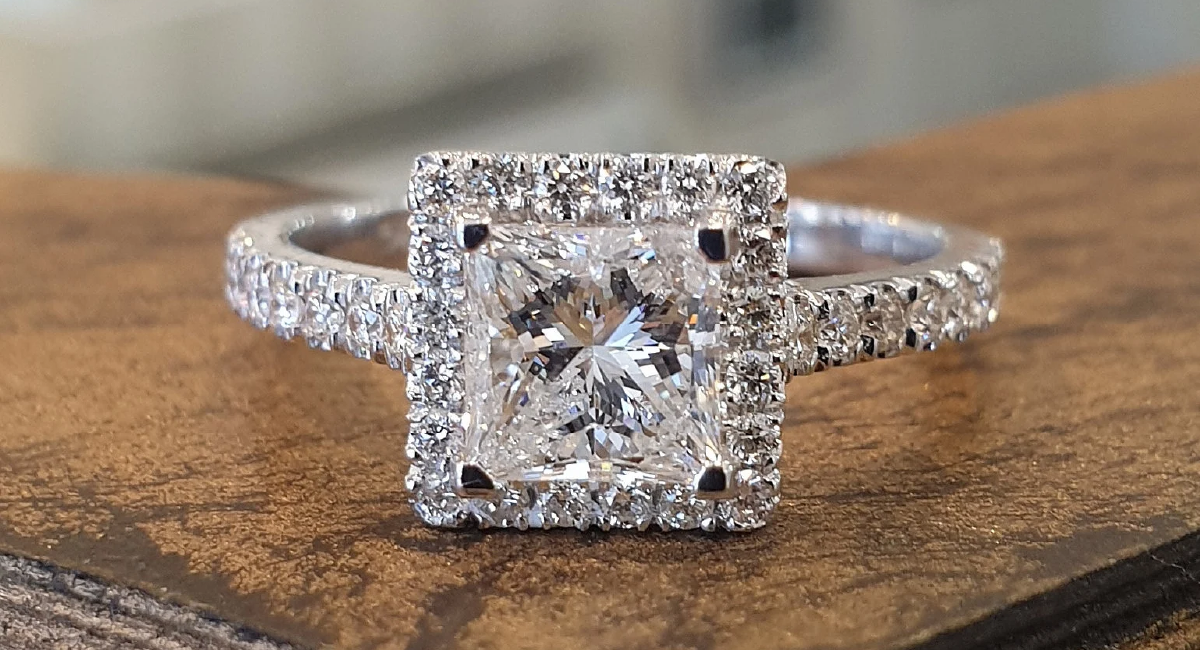
Do Not Cause Air or Water Pollution

In the whole process of creating HPHT Synthetic diamonds or CVD diamonds, there is negligible air or water pollution. These man made diamonds are created in closed chambers in controlled environments.
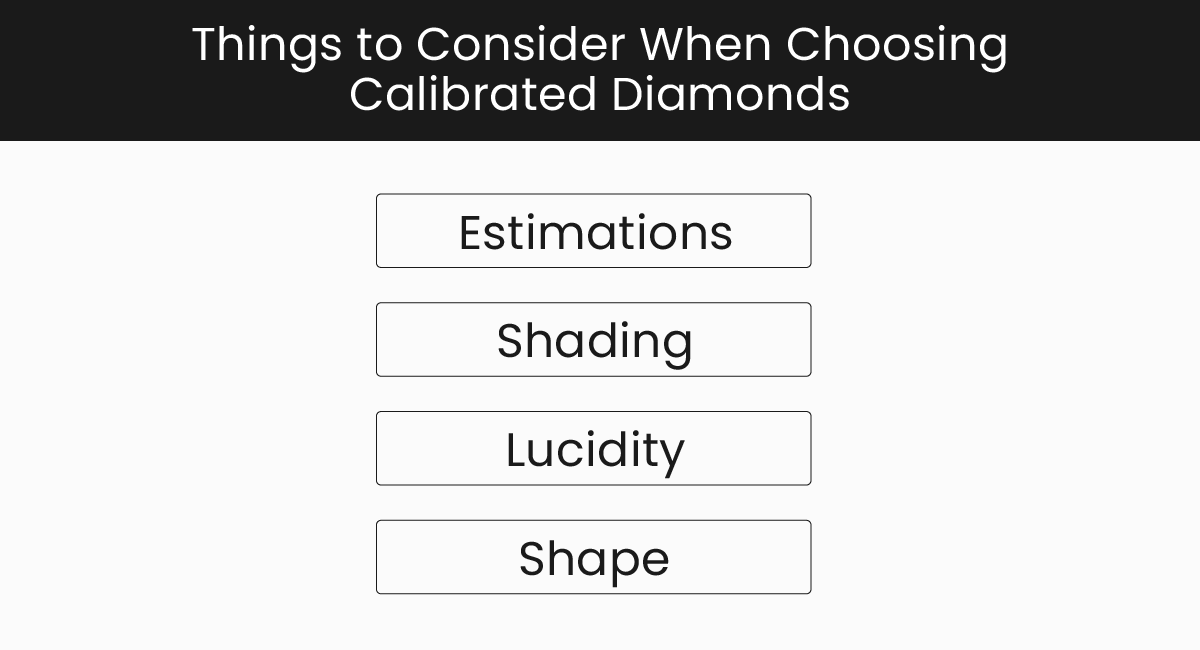
lab grown diamond

These lab grown diamonds produce negligible waste, which is treated and disposed of in an environmentally friendly manner. Along with this, the usage of energy and emission of carbon footprint is relatively less when creating man made diamonds.
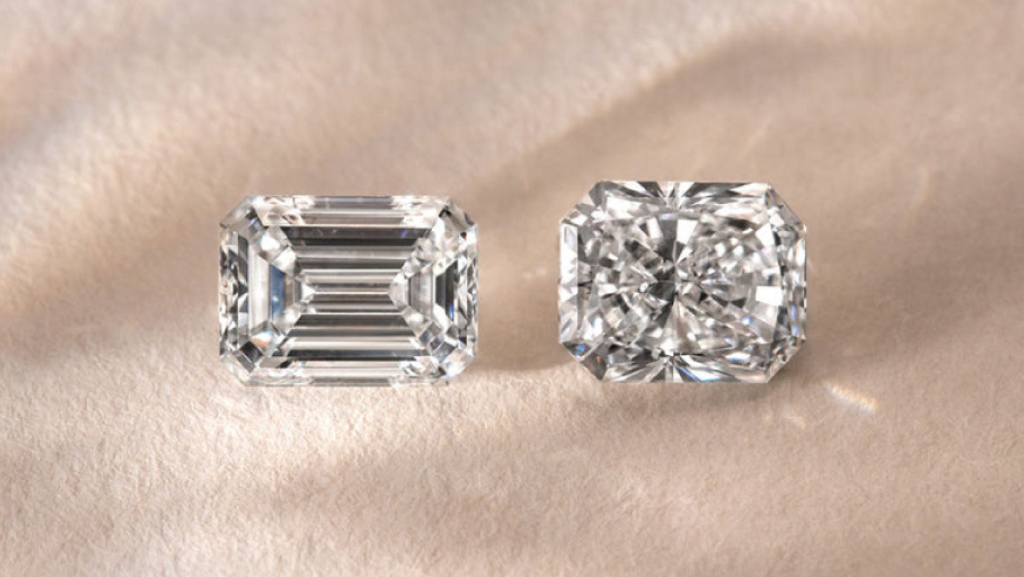
Natural diamonds, on the other hand, are mined from deep diamond mines and caves. During the mining process, a ton of dust covers the whole sky causing air pollution, the dust and various chemicals released from the mine make their way to water sources and contaminate it causing water pollution. People going inside mines or living in that area tend to develop many respiratory diseases.

Energy and fossil fuels used in the mining process cause an increase in carbon emissions, greenhouse gases, and chemical substances for that particular area. Such factors lead to a rise in temperature near those areas, smog, degraded air quality, and many other harmful environmental impacts.

Man Made Diamonds are Sustainable

With the growing population and the ever-increasing demands of fancy diamonds, vigorous mining of diamonds is being carried out. Diamonds are an amazing investment opportunity and are adored by many. This has resulted in experts believing that the supply won’t be able to meet the demands. So how will we overcome this problem?

These diamonds which were created in labs by the CVD diamond method and HPHT synthetic diamond method are the solution to sustainability. These eco-friendly diamonds are created in labs and depend on how much raw material you can provide.

The production of man made diamonds is basically in the hands of humans and not nature. An unlimited supply can be obtained of man made diamonds, which will then help in satisfying the demand for white diamonds, loose melee diamonds, fancy diamonds, color diamonds, etc.

And many buyers nowadays have concerns regarding the production process, and whether or not it is eco-friendly. Lab created diamonds follow the environmental regulations, and pose as the best solution. Man made diamonds are contributing to creating a sustainable diamond industry.

Also Read: Why are Lab-created Diamonds called blood-free diamonds?

Natural Habitats Remain Intact

As these man made diamonds are created in labs inside small chambers, they barely have an effect on the outside environment. The creation of lab grown diamonds in no way harms plants, animals, the surrounding area, or the overall vegetation. The ecology and purity of nature remain intact when lab grown diamonds are made.

While in mining, companies end up harming the natural vegetation nearby, contaminating nearby water reserves and harming the flora & fauna of that area. In such cases opting for lab created diamonds is considered the best option.

Man Made Diamond Use Less Energy

These lab grown diamonds are created by laboratory methods: CVD diamond making methods, and HPHT synthetic diamond making methods. Both of these methods involve the use of a tiny diamond seed, and the creation of carbon layers over this seed, which in the end produce a man made diamond.

These processes to produce loose diamonds are carried out in labs, under a controlled environment. The energy required is almost reasonable, and the electricity supply also comes from renewable resources like the sun or wind.

While in the mining of diamonds, there is extensive use of electricity and fuel. Both lead to excess pollution over time and an increase in the emission of carbon footprint. Man made diamonds are a better alternative that is eco-friendly.

In addition to their environmental benefits, lab created diamonds address ethical concerns associated with traditional diamond mining.

[blog_page_inventory shape=”Round,Oval,pear,cushion,heart,princess,emerald,radiant” carat=”2.30,3.60″ cut=”0,4″ color=”0,10″ clarity=”0,11″]
[blog_page_btn title”Buy Now” url=”https://www.loosegrowndiamond.com/inventory/?”]

Comparison Between Lab Created and Mined Diamonds

  • Mined diamonds contribute to deforestation, soil degradation, and water contamination, whereas lab-created diamonds mitigate these environmental concerns by minimizing land disturbance and pollution.
  • Contrary to common misconceptions, lab-created diamonds exhibit the same chemical composition, physical properties, and brilliance as their natural counterparts.
  • Lab created diamonds are increasingly gaining acceptance in the market, particularly among environmentally conscious consumers and those seeking affordable alternatives.
  • Lab created diamonds are generally more affordable than mined diamonds due to lower production costs and less labour-intensive processes.

What Makes Lab Created Diamonds Eco Friendly?

One of the primary reasons lab created diamonds are hailed as eco-friendly is their minimal environmental impact. Unlike mined diamonds, which require large-scale mining operations, lab created diamonds are produced in laboratories using advanced technology. This process significantly reduces the need for land excavation, thereby preserving natural habitats and ecosystems.

Lab created diamonds are also lauded for their energy-efficient production process. While traditional diamond mining consumes substantial energy resources, lab grown diamonds require comparatively less energy to produce.

Conclusion

Lab created diamonds offer a compelling solution to the environmental and ethical challenges associated with traditional diamond mining. By opting for lab created diamonds, consumers can ensure that their purchase is free from such ethical dilemmas.

Thanks to their low environmental impact, ethical sourcing practices, and comparable quality to mined diamonds, lab grown diamonds are rightfully seen as eco friendly alternatives. As consumers become more conscious of their purchasing decisions, the demand for sustainable and ethically sourced diamonds is expected to continue growing.

Additionally, discover the brilliance of lab-grown diamonds with our special friendly diamonds promo code, offering you an affordable choice in luxurious jewelry. Buying exquisite eco friendly diamond rings is not just a statement of style but a commitment to sustainability. Happy Shopping!

FAQs

Do lab created diamonds have flaws or imperfections?
Like natural diamonds, lab created diamonds may have inclusions or blemishes, but these are typically minimal and do not affect their beauty or durability.

Are lab created diamonds considered sustainable?
Yes, lab created diamonds are considered sustainable due to their minimal environmental impact and ethical production practices.

Are lab created diamonds ethically sourced?
Yes, lab created diamonds are ethically sourced as they eliminate concerns related to human rights abuses and conflict financing often associated with mined diamonds.