What Diamond Shape Looks Bigger for an Engagement Ring?

Choosing an engagement ring is one of the most important and meaningful decisions of your life. It requires keen attention to detail and a proper understanding of some factors while making the decision. While factors like the 4Cs, budget, metal style, and setting matter, diamond shape also plays a significant role in enhancing the overall appearance of the ring.

In this guide by Loose-Grown Diamond, you will get to understand which diamond shape looks bigger for your engagement ring.

Why Does Shape Matter in Perceived Diamond Size?

Generally, not all diamonds are created equal in shape and size, differing in visuals. The shape of the diamond influences the overall appearance and how large or small the diamond can appear. The difference in visuals is due to the factors, including surface area, length-to-width ratio, and reflection effect of light on the diamond facets. The elongated shape of the diamond also enhances the look of your finger. The longer and more slender your finger, the longer and longer it appears.

Understanding the influence of shapes and the perception of how they enhance the overall look is essential to get the best deal.

How to Choose the Right Diamond Shape for an Engagement Ring?

How to Choose the Right lab Diamond Shape for an Engagement Ring

Choosing the right diamond shape for your engagement ring is essential and requires a proper understanding of some factors. Looking for rings that suit well with your fingers, like long and slender fingers, often pairs well with elongated diamond shapes, including oval, emerald, or marquise cuts. However, if you are a fan of a bold, classic look, a round cut or princess cut diamond engagement ring can be an ideal choice to go for.

The other advantage of the right diamond shape is that some shapes offer the best value per carat, making your purchase easier without pinching your pocket and compromising the quality. So, the answer to the question “How much should an engagement ring cost?” mainly depends on the shape of the diamond you choose.

Some Diamond Shape Looks Bigger For an Engagement Ring

Some Diamond Shape Looks Bigger For an Engagement Ring

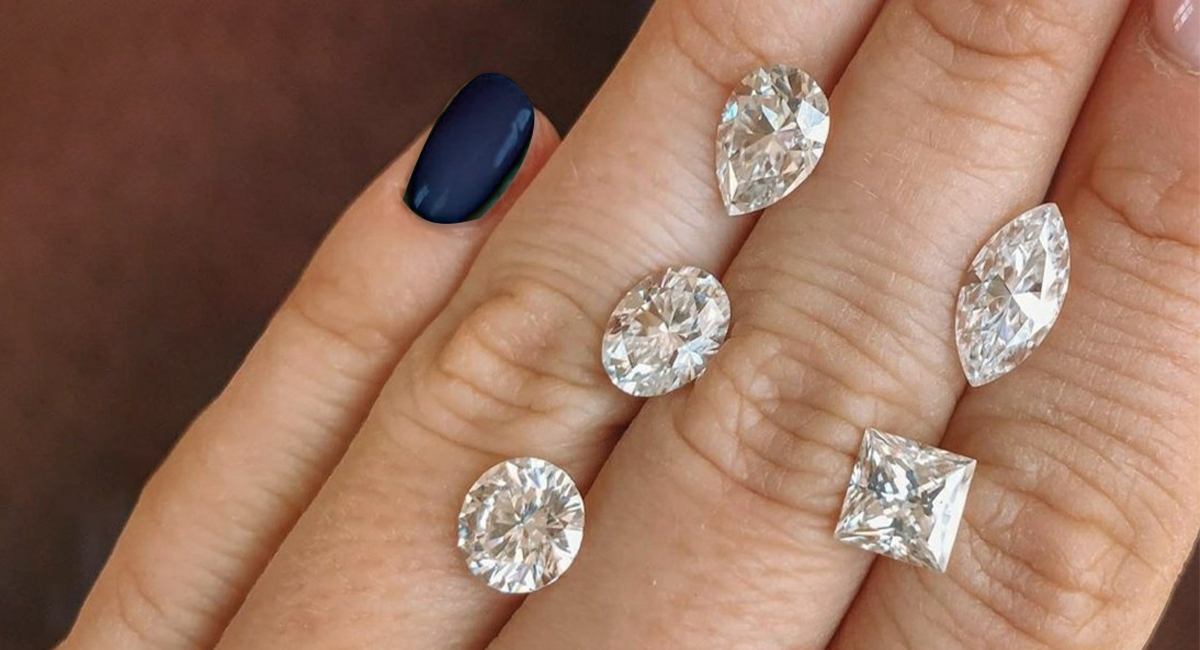
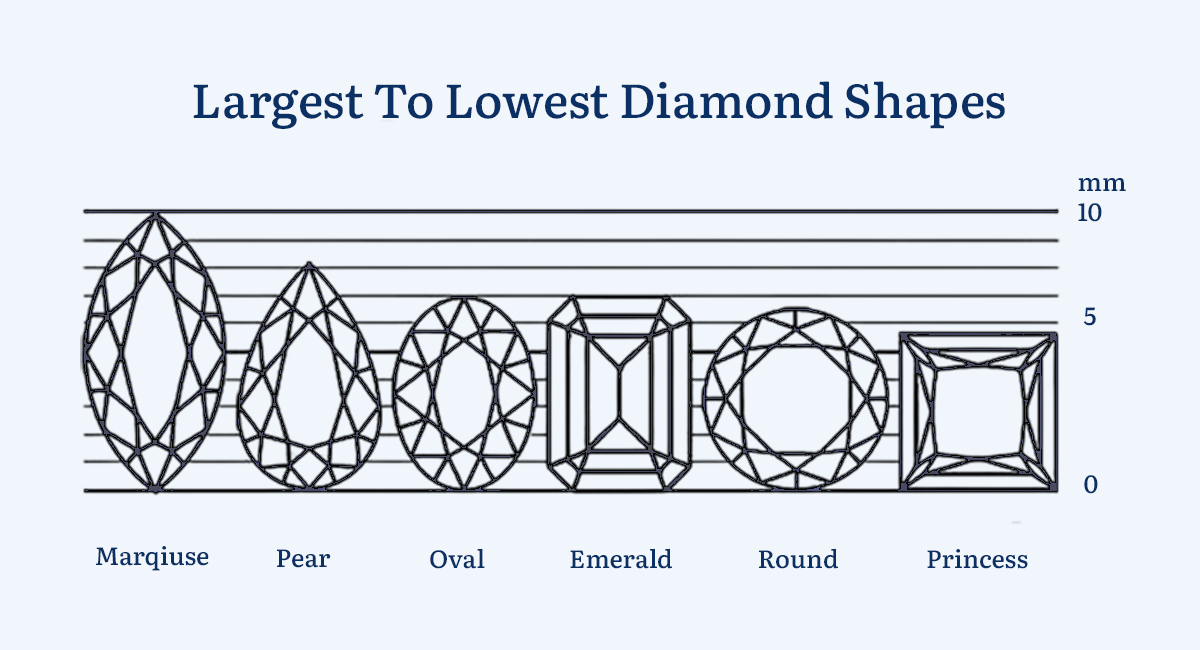
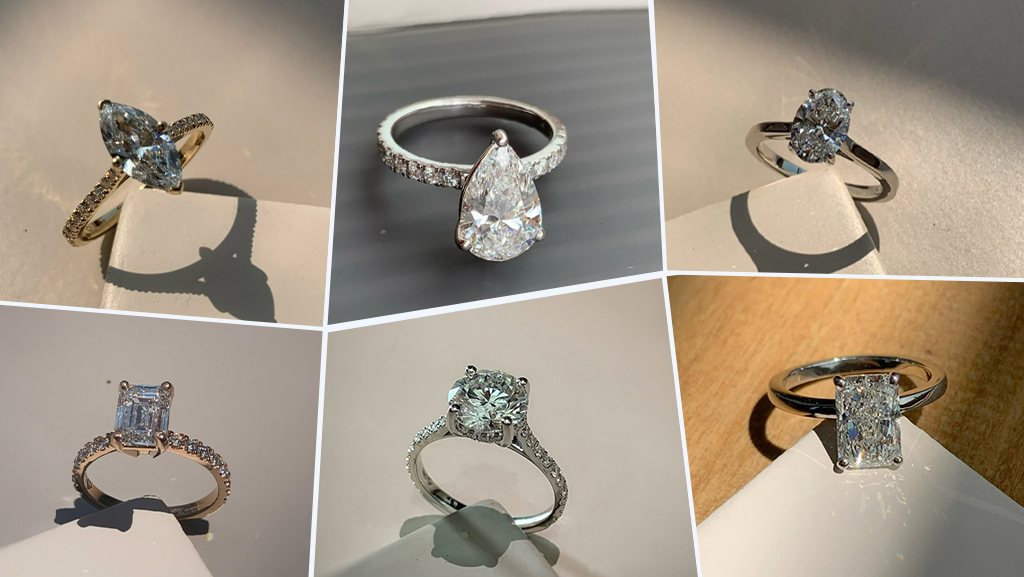
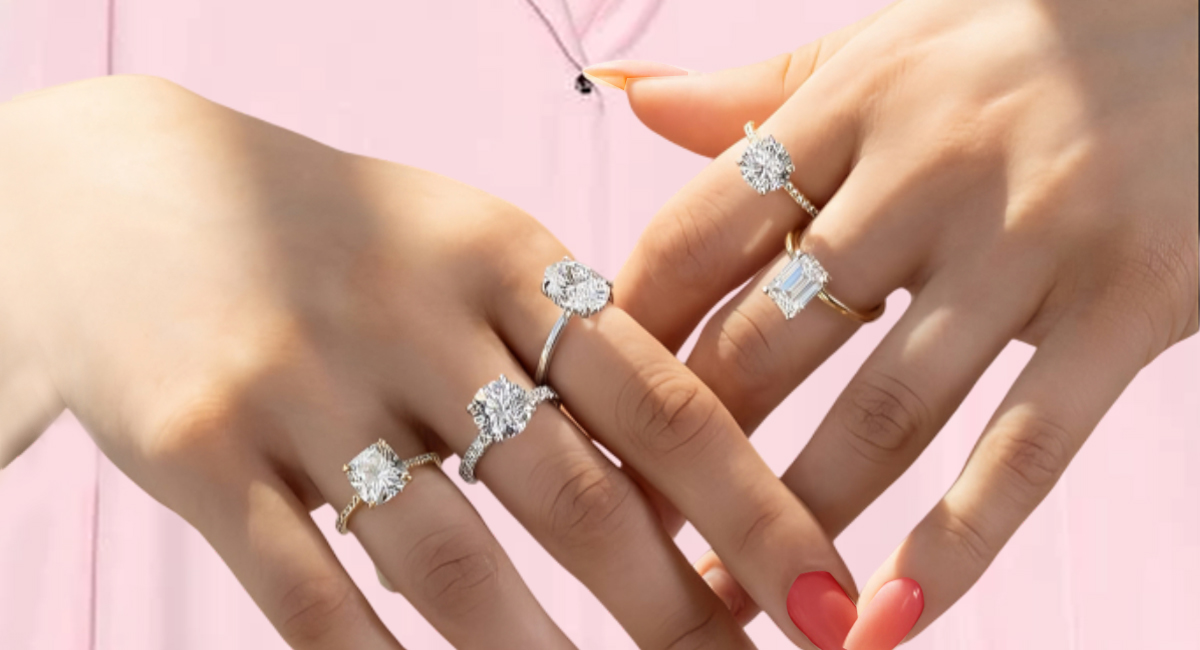
There are certain diamond shapes that naturally create an illusion of appearing larger, enhancing the overall look of your engagement ring. Below are the top diamond shapes that look bigger at a similar carat weight.

Marquise Cut Diamond

Marquise Cut Diamond

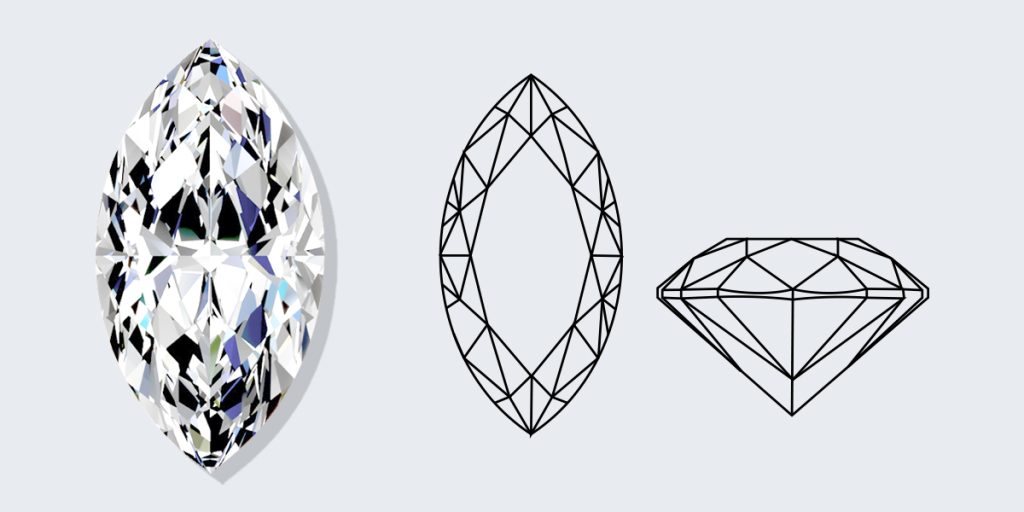
The marquise cut diamond is a vintage-inspired shape well known for its elongated shape and pointed ends. It covers the maximum area of your finger, making it appear larger than other shapes of the same carat. It creates a slender effect on your finger, adding beauty to the visual appeal.

Pear Cut Diamond

Pear Cut Diamond

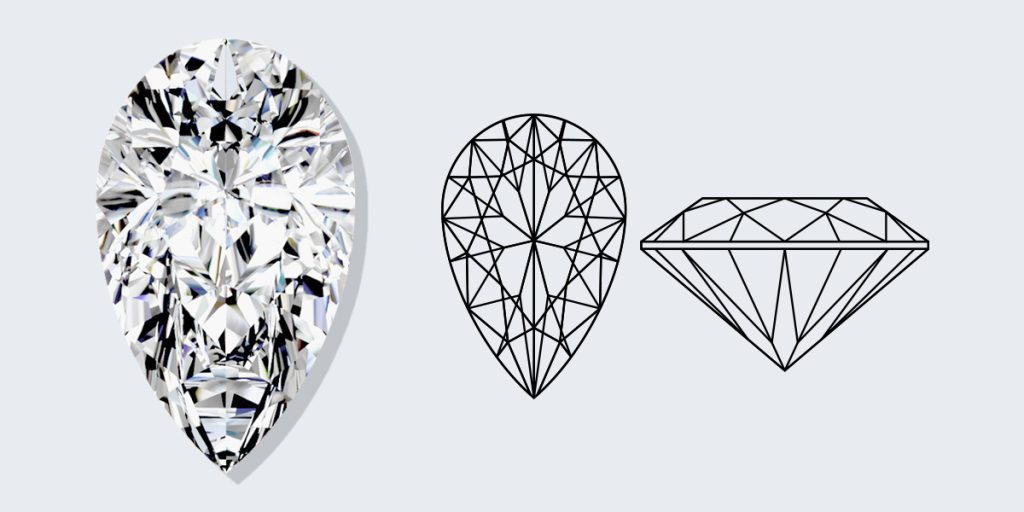
Pear diamond shape resembles a teardrop with an elongated shape and one end pointed. It exudes a beautiful combination of round cut and marquise shape, giving a unique appearance.

Oval Cut Diamond

Oval Cut Diamond

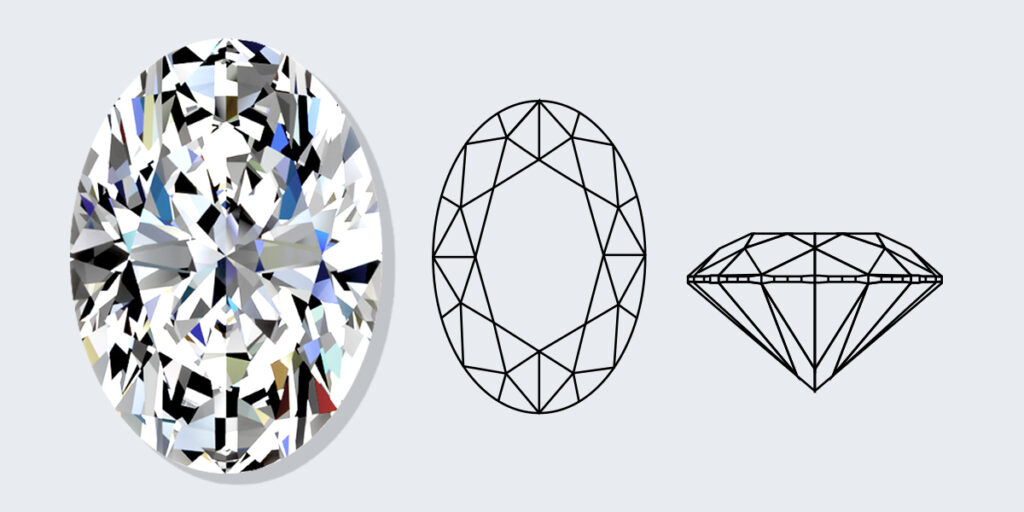
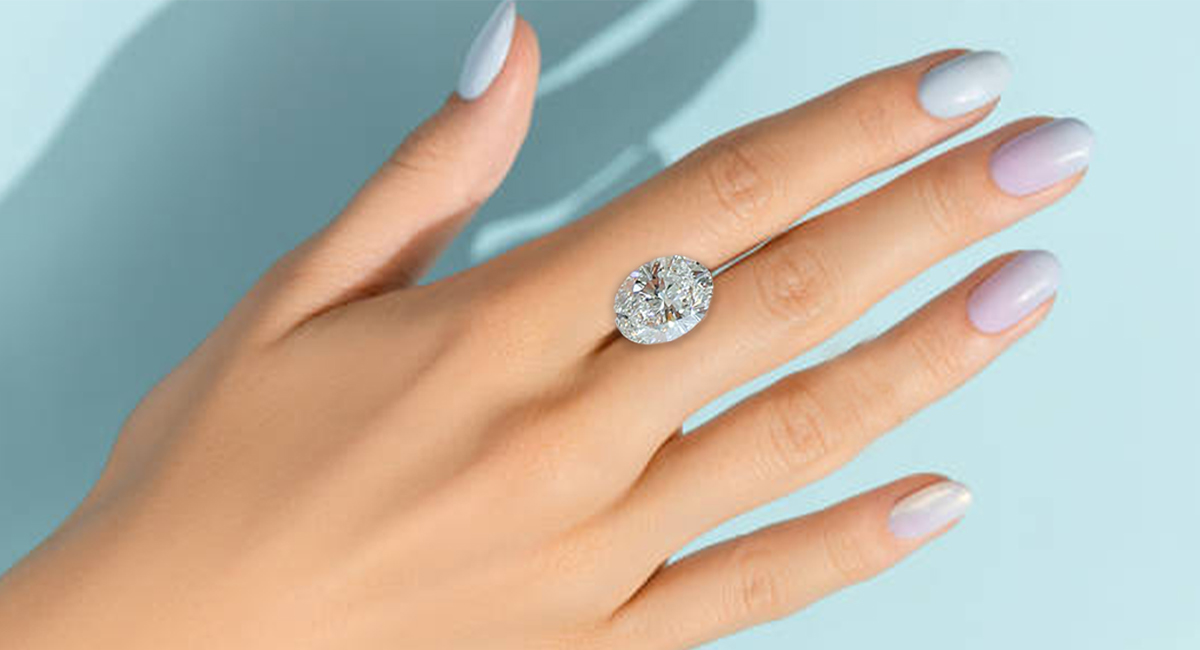
The oval cut diamond is the traditional beauty with an elongated body and curved corners, giving a soft and elegant appeal. The shape of this diamond maximizes the surface area, tending to appear larger than a round cut of the same carat weight. This feature makes an oval-cut diamond a popular choice and a budget-friendly option.

Emerald Cut Diamond

Emerald Cut Diamond

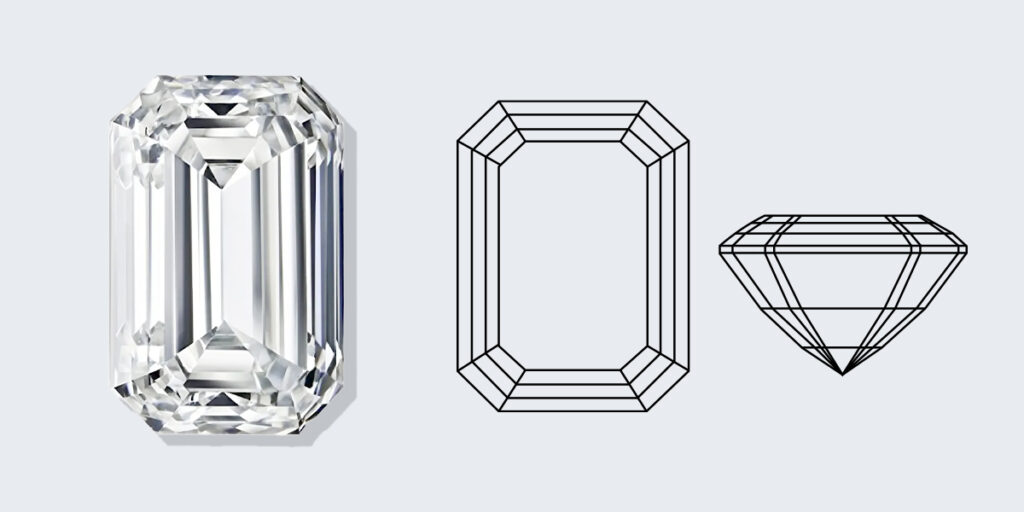
The emerald shape diamond is known for its vintage and versatile look. This shape features a stretched rectangular body with step-cut facets creating a hall-of-mirrors illusion. The larger table top look gives a luxurious appeal to the diamond, making it a great choice for a sophisticated and bold style.

Round Cut Diamond

Round Cut Diamond

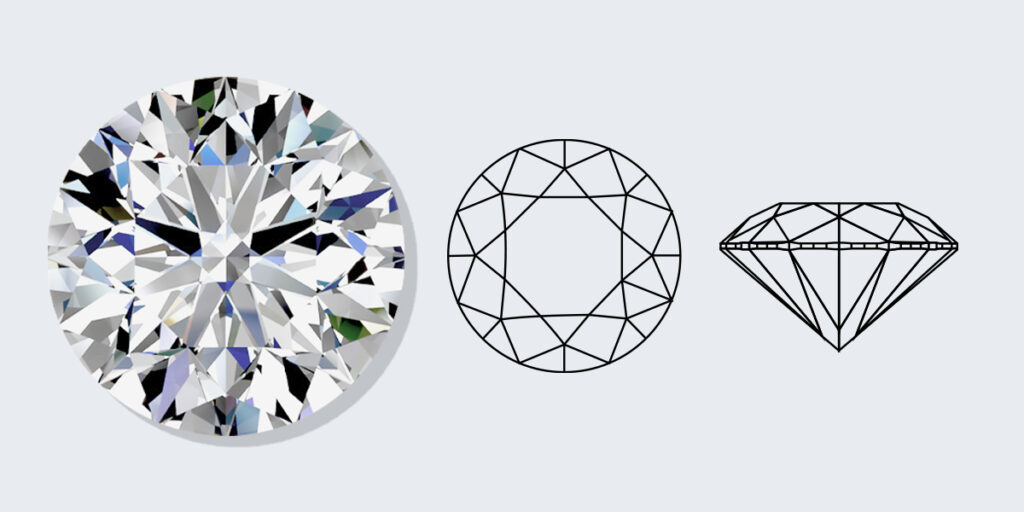
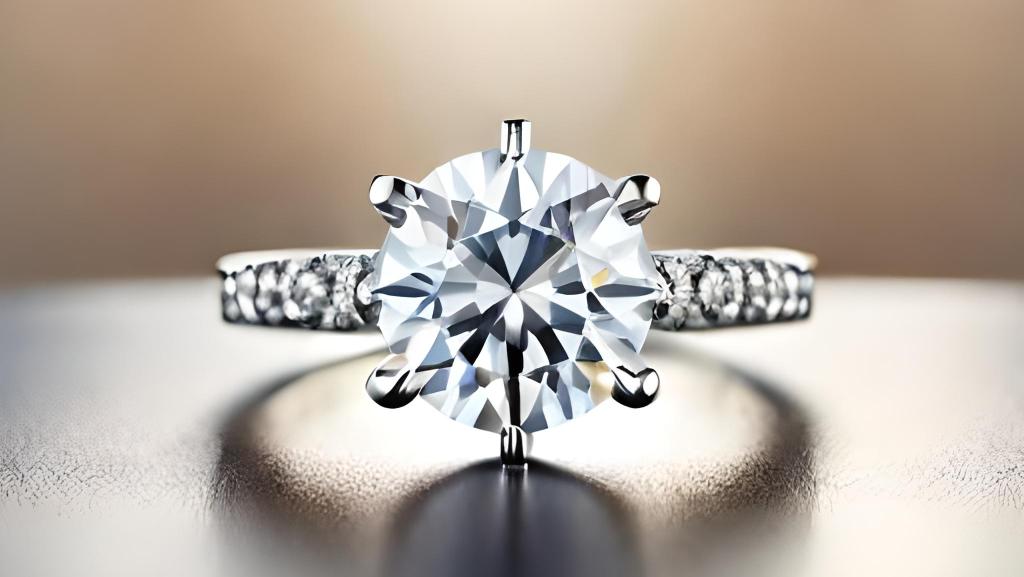
The traditional, classic, and versatile diamond shape is the round-cut diamond. This shape does not always appear larger but often attracts attention due to its sparkling and symmetrical brilliance. This cut is mostly in demand due to its everlasting shine and timeless beauty that combines sophistication and luxury.

Princess Cut Diamond

Princess Cut Diamond

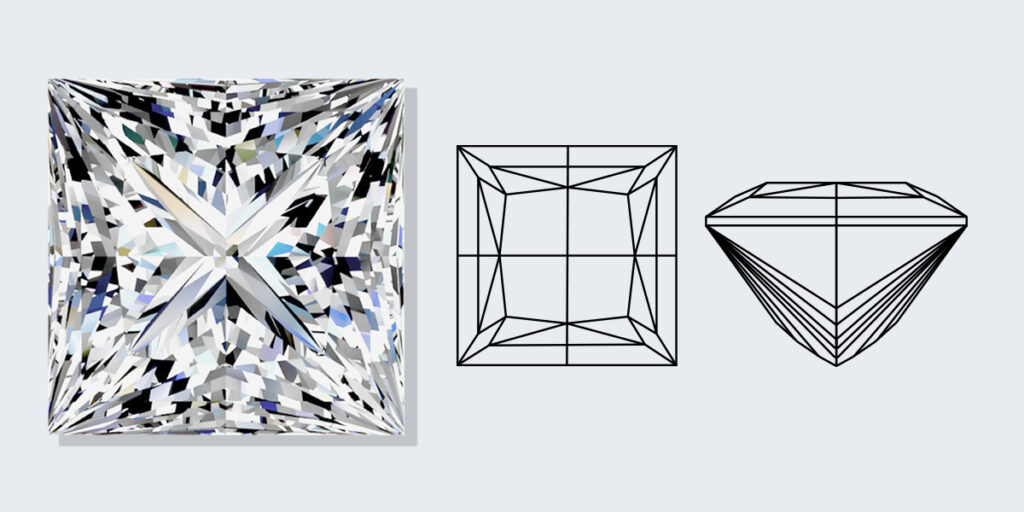
A modern touch to diamond shapes exudes princess cut diamonds. This shape features a square body with sharp edges, giving out a bold appearance with exceptional fire and brilliance.

What Are the Tips to Maximize the Appearance of Your Diamond?

What Are the Tips to Maximize the Appearance of Your Diamond

Not satisfied with the shape of the diamond and want it to look even bigger? A few smart ideas and design options can help in enhancing the overall appearance of your diamond engagement ring.

Selecting a thin band for your engagement ring can make the center diamond look bigger. Look for a metal setting like a prong that lifts the diamond, allowing more light to enter, exuding more sparkle. Lastly, look for certain shapes that create an illusion of bigger diamonds, like oval, marquise, emerald, and pear cut diamonds. These shapes elongate the finger, making it appear slender and stretching the diamond’s visual appeal.

Conclusion

Shopping for an engagement ring can be hectic, but with a better understanding of the right diamond shape that enhances the overall harmonious look of the ring can make it easier. Looking for the factors while choosing the ideal diamond shape can help you get the best deal. Whether looking for elegance to luxurious style shapes like marquise, pear, oval, or emerald might be suitable options.

Can You Scratch a Diamond? Discovering About Their Durability

Diamond have always been known for their unmatched durability, quality, and elegance. They are considered one of the hardest materials on Earth, scoring 10 on the Mohs scale of hardness.

This indestructible feature of diamonds makes them a symbol of forever love. However, it is a common curiosity among people: can you scratch a real diamond? In this article, we will explore the reality behind the diamond’s actual hardness, whether they can really be scratched, and what factors harm the diamond. Let’s get into the details.

Understanding Diamond Hardness

The hardness of any material is measured by the Mohs scale of mineral hardness. The hardness of a diamond determines how resistant they are to scratching. The diamond scores 10 on Mohs scale, which is the highest possible score.

Measuring the hardness of diamond is significant to understand how it will react to any sharp objects and how durable they are. The extreme hardness of diamond is due to the tightly bonded carbon atoms creating a strong and rigid structure.

Can Diamonds Get Scratched?

While diamonds are the hardest material, they are not completely indestructible. A diamond’s hardness refers to being resistant to scratches, but they can be prone to the risk of breaking or chipping.

The answer to the question, Can you scratch a diamond? Is that it can only be scratched by another diamond or material with equal hardness.

However, a diamond can face minor surface damages, chipping of corners due to improper handling, storage, and low maintenance. Loose Grown Diamond is the best option for buying diamonds.

Some Factors That Can Harm Diamond

Despite being considered one of the toughest substances, diamonds are not untouched by damage. There are some factors that can affect the diamond over a long time due to wear and tear.Below are some of the points to consider maintaining the brilliance and shine of the diamond forever.

Store Separately

Diamonds can scratch any other diamond jewelry. To avoid getting scratches on the gemstone, it is advisable to store them separately in a soft pouch or compartmented jewelry boxes. This will help in maintaining their shine and keeping them safe for life.

Clean Regularly

Daily wear and tear of diamond jewelry can cause accumulation of dirt, oil, and grime on them, leading to dulling their sparkle. Cleaning them regularly with a mild soap solution and warm water can loosen the dirt. Remove the dirt by gently scrubbing the stone with a soft brush and then pat dry with a soft cloth. Ensure to avoid the use of any harsh chemical or material that can damage the stone.

Avoid Impact

As discussed earlier, diamonds are hard, but they are not completely indestructible. Any sudden impact pressure or extreme temperature can weaken the diamond’s edges, causing chipping and fracture on them. It is better to remove diamond jewelry while practicing any physical activity like sports, weightlifting, swimming, or gardening.

Regular Inspections

Ensure to conduct regular inspections of your diamonds by a professional jeweler. These inspections can help to identify any loose settings or minor damages, if there are any, to avoid any further damage. It is advisable to go for frequent inspections at least every six months.

Use Protective Settings

A well-designed and protective setting can help keep them in place and prevent the risk of losing it. Some of the famous and secure settings, like Bezel, Halo, and Pave settings, provide protection, expanding the lifespan of a diamond, and also add some extra elegance to your jewelry.

What Is The Myth About The Durability Of Diamonds?

The most common myth about a diamond’s durability is that they are not destructible. Diamonds are a highly durable substance, but they still are prone to damages under certain serious conditions.

Diamonds are able to tolerate scratches from other materials but are vulnerable to sudden immense pressure, extreme temperature, and scratches from a diamond itself. Understanding these myths can help in taking proper care of your precious gemstone.

How To Protect Diamonds from Damage

Protecting your diamond requires consistency and systematic care. Follow the below-mentioned tips to understand the proper methods to maintain your gemstone:

  • Proper storage is one of the most important tips to follow. Keep your diamonds separate from other jewelry to avoid scratches.
  • Regular cleaning with a soft brush and warm water solution can maintain shine.
  • Avoid wearing diamond jewelry while doing any physical activities.
  • Check for any loose settings that can be a risk to damage. If there are any, get them repaired with professional assistance.
  • It is best to opt for secured settings like Bezel and Halo, providing extra protection and enhancing the overall look.

Conclusion

Diamonds are one of the hardest natural materials and highly resistant to scratches. However, it is not completely indestructible and can be prone to scratches or damage due to certain critical conditions. A sudden impact pressure, improper storage, or weak settings can be a factor for the damage of a diamond.

It is crucial to understand how to care for your diamond, ensuring its longevity and maintaining the sparkle. By following some of the basic and preventive measures, like regular cleaning, proper storage, frequent inspections, and opting for a secured setting, you can keep your diamond flawless forever.

FAQs

Can a real diamond be scratched?
A real diamond can only be scratched by another diamond or a substance with similar hardness as mined diamonds. However, poor maintenance and handling can make them prone to chipping.

Is it okay to wear a diamond every day?
Yes, with proper care and maintenance, one can wear diamonds every day. Diamonds have high grading on the Mohs scale, which makes them daily wearable.

Can daily wear cause scratches on a diamond?
While diamonds are often considered a hard material, making them scratch-proof, wearing them daily can cause some scratches that are visible under a microscope.

What is the only thing that can break a diamond?
Despite being the hardest material on Earth, sometimes diamonds get brittle. A little high pressure on it can cause them to risk chipping, especially from the sharp planes.

Everything You Need to Know About Hearts and Arrows Diamonds

Decades preceded the creation of Heart and Arrow Diamonds in the history of diamond design. American diamond cutter Henry D. Morse put aesthetics first in the 1870s. It was in 1919 that the Belgian mathematician Marcel Tolkowsky defined angles that were essential to the GIA’s “Ideal Cut.”

The year 1980 marked a turning point in Japanese history, as the 3D vision made possible by Kazumi Okuda’s Firescope gave rise to Super Ideal cuts such as those of Kioyishi Higuchi, which had optical symmetry and strict tolerance. Before the Heart and Arrow Diamond era, the Firescope revealed an eight-rayed star, revolutionizing the aesthetics of diamonds.

Super Ideal cut brands like Eightstar and Apollon 8 were among the first to appear in the mid-1980s. By chance, it was found that an amazing pattern of eight symmetrical “hearts” emerged through the pavilion when these diamonds were turned face up in the Firescope.

The idea of Hearts and Arrows in diamonds was born out of this groundbreaking discovery. These diamonds were named Hearts & Arrows by Japanese Gemological Laboratories, who made a sweet reference to the Roman and Greek myths’ Cupid’s arrow. Today, Heart and Arrow Diamonds are all certified.

Heart and Arrow Diamonds: What is the Pattern All About?

Heart and Arrow Diamonds: What is the pattern all about?

Hearts and Arrows Diamonds, which make up the top 1% of round cuts, are the pinnacle of optical accuracy.

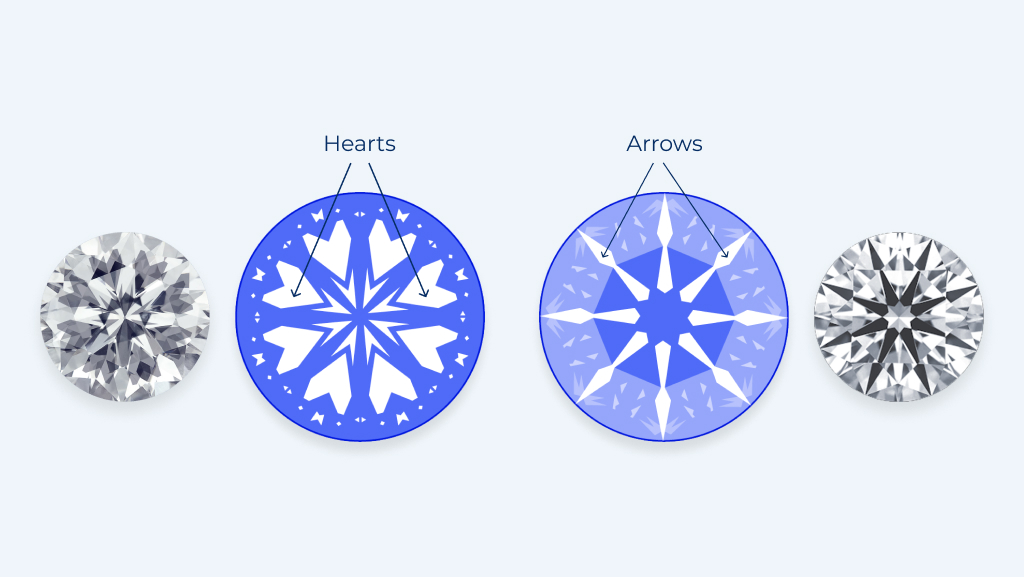
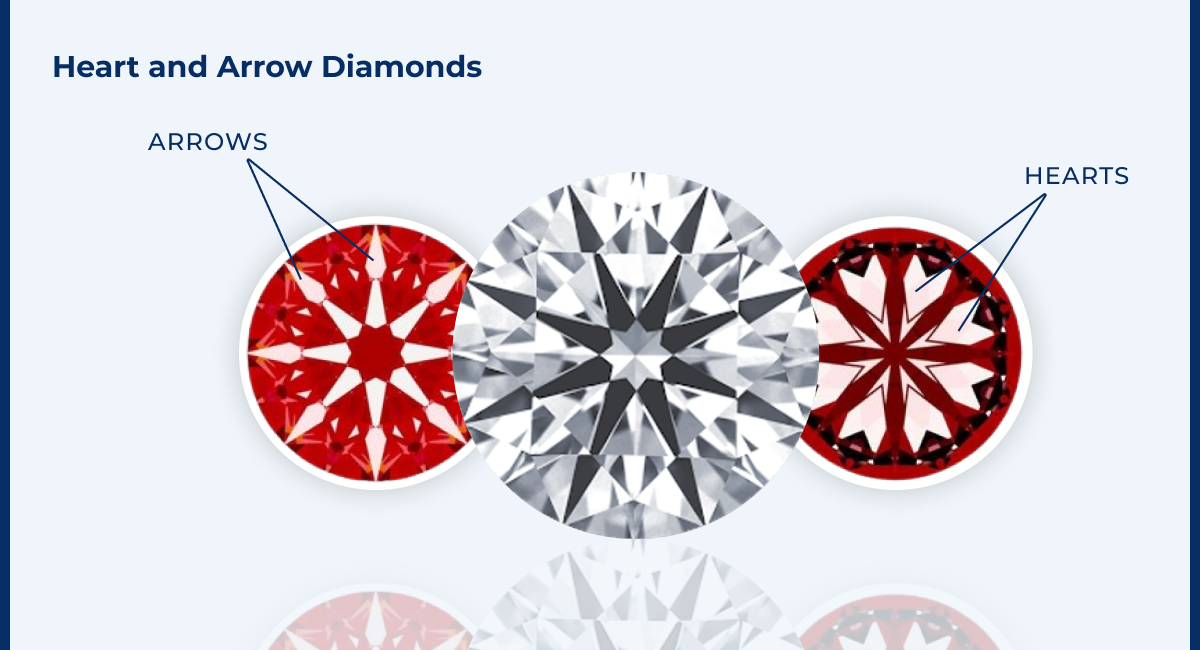
Possessing the Cupid symbolism, this superbly cut round H&A diamond displays eight hearts when viewed through the pavilion and eight arrows when viewed from the angle above. It must be noted that a magnifying viewer is needed to see this detail.

The above illustration illustrates this: when viewed from the table up, the right image displays eight arrows, and when viewed from the table down, the left image displays eight hearts.

When it comes to round brilliant-cut diamonds, Diamond Hearts and Arrows stand out thanks to this exceptional visual display that has unmatchable optical precision.

Things You Should Know About Hearts and Arrows Diamonds

Optical precision is a frequently disregarded feature of diamond performance that is rarely emphasized because it is difficult and expensive. Optical accuracy refers to the consistency of facet size, shape, and alignment across the diamond’s three-dimensional model when viewed from all angles.

Unlike ASET and Ideal Scopes made for other uses, the Hearts and Arrows Scope assesses optical precision in cushion and round Heart and Arrow Diamonds cut. The degree of optical precision can be ascertained by looking at the heart pattern when the diamond is placed upside down on a circular disc.

It is a myth that all perfect-cut diamonds include hearts and arrows, emphasizing that not all diamonds with Heart and Arrow Diamond GIA or AGS perfect-0 certification have this feature.

These designs are inevitably displayed in excellent grades. Optical precision is not taken into account in the evaluations made by GIA or AGS, even though these grading standards indicate the highest cut grades. For a thorough assessment of a diamond’s optical accuracy, it is imperative to utilize a Hearts and Arrows Scope.

Hearts and Arrows Diamonds

The highlighted Heart-Arrow Diamond GIA, which is shown in the attached figure, has dimensions that are exactly in the middle of the target range for a zero ideal cut grade.

This diamond is positioned to provide an abundance of light return with a pavilion angle of 40.8 degrees.

In addition, the 34.5-degree crown angle strikes a pleasing balance between dispersion, which appears as colored sparkle and fire, and brightness, which is represented by white sparkle.

Specifically, the 50% star facet length helps create well-rounded hearts, and the 75% lower girdle facet length brightens the diamond’s brilliance in a wide range of light conditions.

Because of the careful attention to optimal specifications, this diamond is set up for an amazing dazzle show. You may view the detailed proportion size in the table below.

In addition to these details please note that when it comes to lab diamonds, IGI Heart and Arrow Diamond certification is the most reliable one.

Buying Round Heart and Arrow Diamonds?

Excellent cut and symmetry diamonds have great advantages. They allow greater reflection and refraction thereby creating an effect which produces multiple small mirrors in 3-D.

These diamonds exhibit remarkable workmanship, with their unique Hearts and Arrows pattern created by skilled diamond cutters. Light reflection is maximized by optimal symmetry, which goes beyond conventional lab-reported symmetry.

Better light interaction is provided by the diamonds’ greater brightness and brilliance throughout their surface, which makes them appear larger.

Consistently brilliant, these diamonds function admirably, which makes them a standout option for individuals looking for exceptional quality and eye-catching appearance.

If you are looking forward to buying a Heart and Arrow engagement ring or a diamond ring, choose a diamond with clear and symmetrical heart and arrow patterns for a stunning look.

Prioritize excellent cut quality to maximize brilliance in your Heart and Arrow engagement ring.

Ensure the diamond’s overall quality aligns with your preferences and budget.

How Much Does a Heart and Arrow Diamond Cost?

The creation of Hearts and Arrows diamonds requires extreme precision, requiring master-level abilities from diamond cutters to polish each facet to precise angles.

The procedure, which costs between $100,000 and $185,000 requires a lot of work and extra diamond rough.

Depending on where the diamond is bought, the resulting premium cost might vary from 10% to 30% more than less ideally cut diamonds. This cost is determined by marketing.

You can purchase Heart and Arrow diamonds from reputable sources such as online retailers. Loosegrowndiamond.com platforms offer lab created diamonds at the best price. You can enjoy a special discount when buying the diamond by using a promo code.

Additionally, if you are confused about determining the price of your selected diamond, you can use our Diamond Value Calculator. We will guide you all the way to help you purchase the best quality Heart Arrow diamond within your budget.

Conclusion

In conclusion, the Heart and Arrow Diamonds have a great optical precision. This quality coupled with the romantic ‘cupid’ symbolism adds to the charm.

The evolution of this diamond has a historical relevance as well due to the years of labor and the meticulous craftsmanship to create this masterpiece design.

Hence, next time you think about buying diamonds, take an informed decision and allow the timeless beauty of Hearts and Arrows diamonds to reflect your own feelings.

FAQs

What do hearts and arrows mean in a diamond?
Hearts and arrows in a diamond refer to a specific pattern visible under magnification, showcasing eight hearts when viewed from the bottom and eight arrows when viewed from the top.

Do hearts and arrows sparkle more?
Yes, hearts and arrows diamonds tend to sparkle more due to their precise cut and alignment, maximizing light performance and brilliance.

Are hearts and arrows diamonds real?
Yes, hearts and arrows diamonds are real diamonds, distinguished by their specific cut pattern that reflects superior craftsmanship and optical precision.

Should I buy a hearts and arrows lab diamond?
Yes, hearts and arrows lab diamonds can exhibit the same optical precision and brilliance as natural ones, offering an ethical and potentially more affordable choice.

How do I view the hearts patterns in hearts and arrows diamonds?
To view the hearts pattern, use a specialized viewer designed for hearts and arrows diamonds, placing the diamond upside down to reveal the hearts through the pavilion.

Can Heart & Arrow diamonds be customized into different ring/Jewelry designs?
Yes, Heart & Arrow diamonds can be personalized into a variety of ring designs, allowing you to create a unique and custom engagement ring and jewelry that showcases the exceptional beauty and clarity of the diamond.

Elevate Your Style The Most Fascinating with Kite Cut Diamond

The kite shaped diamond is traditionally renowned because of its prolonged and angular structure. Without question, the dark hue of this form has caught the attention of many since the stone appears to be stunning and unique.

The shape, size and colors, everything is so glorious that the kite cut diamond is undoubtedly magnificent. It features a striking and distinctive aesthetic that highlights its notable and original shape.

What Do Kite Cut Diamonds Look Like?

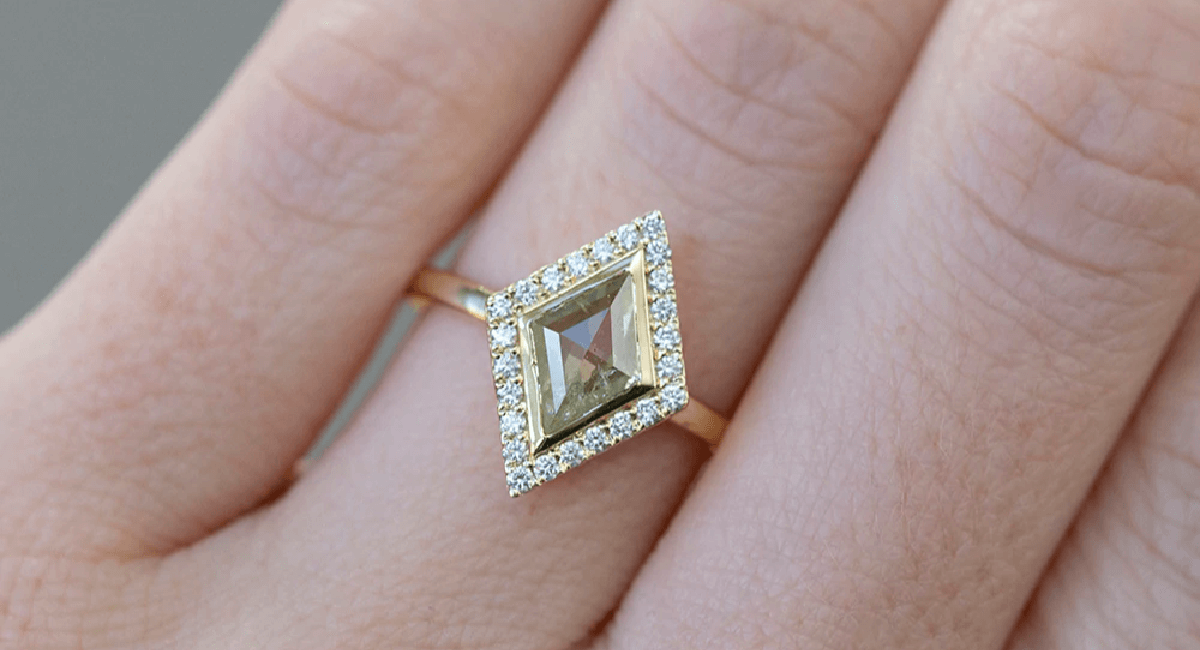
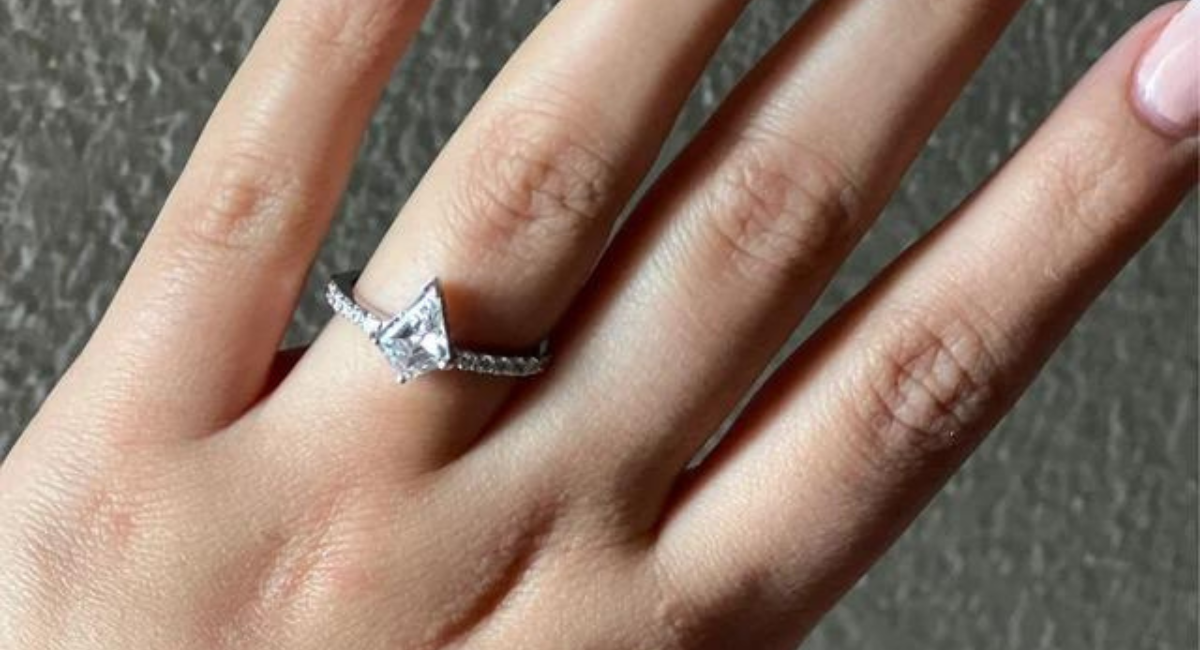
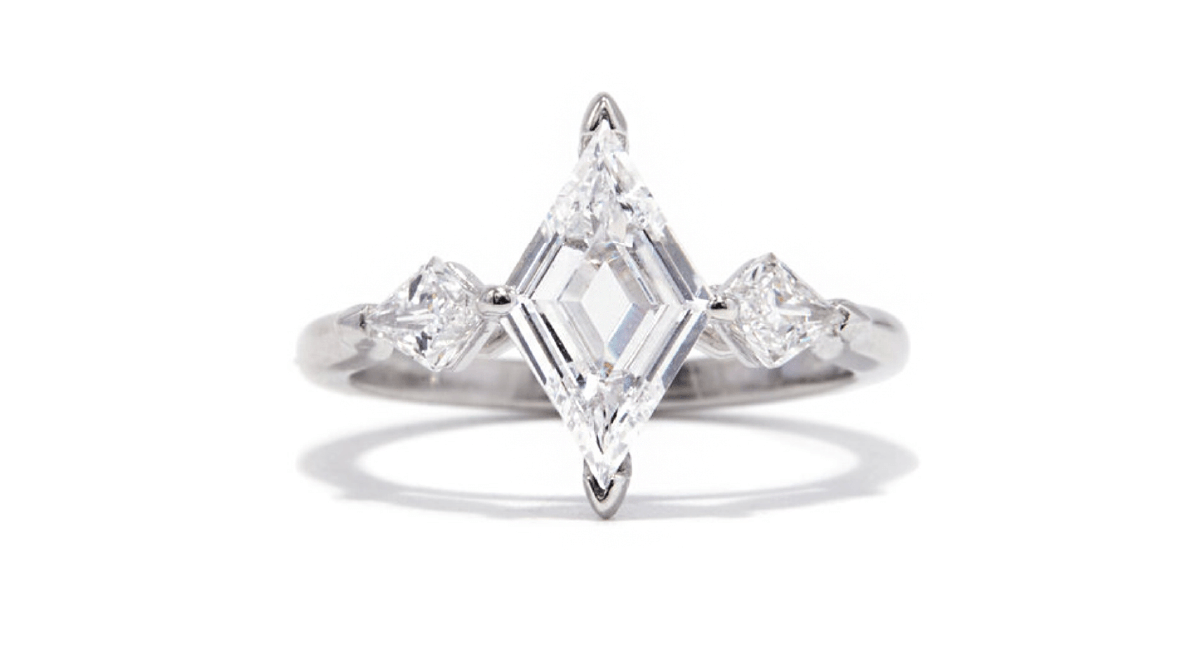
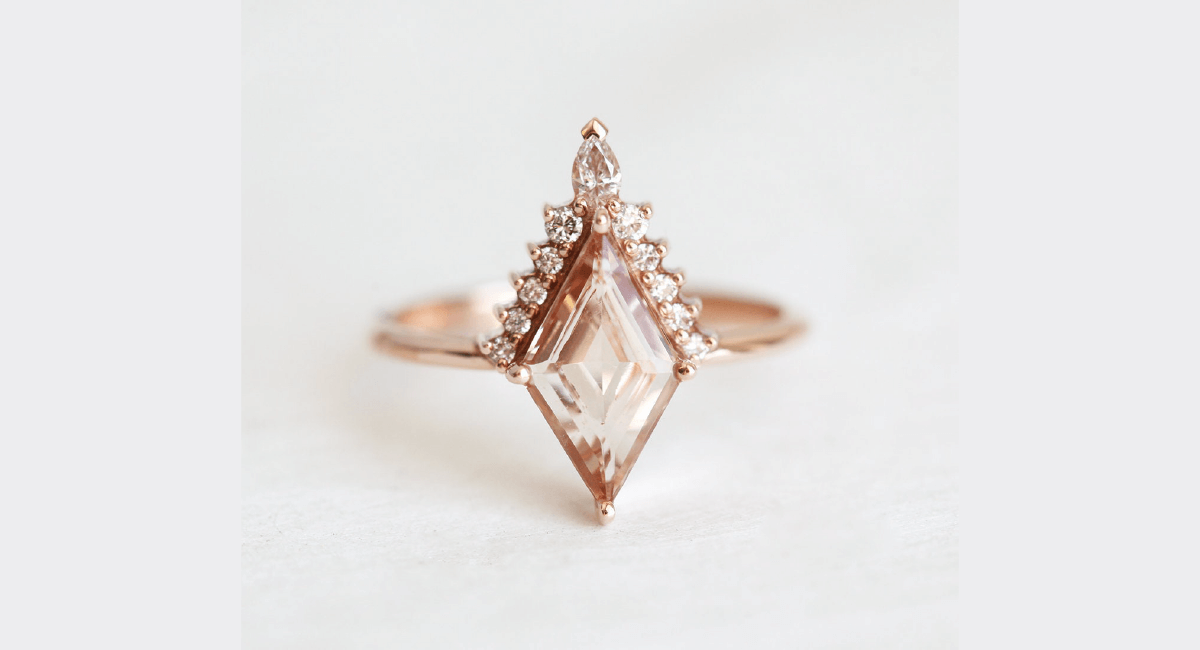
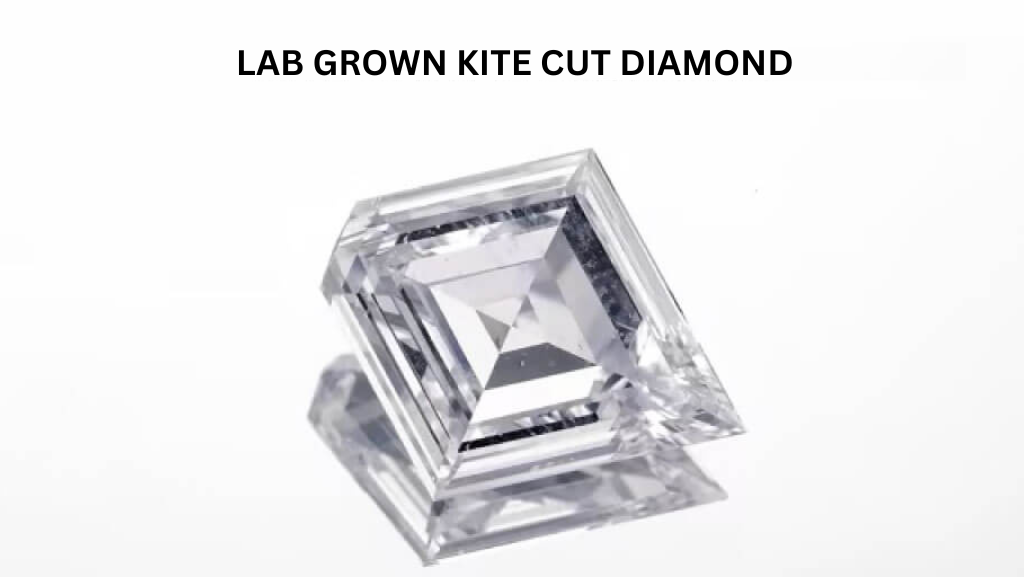
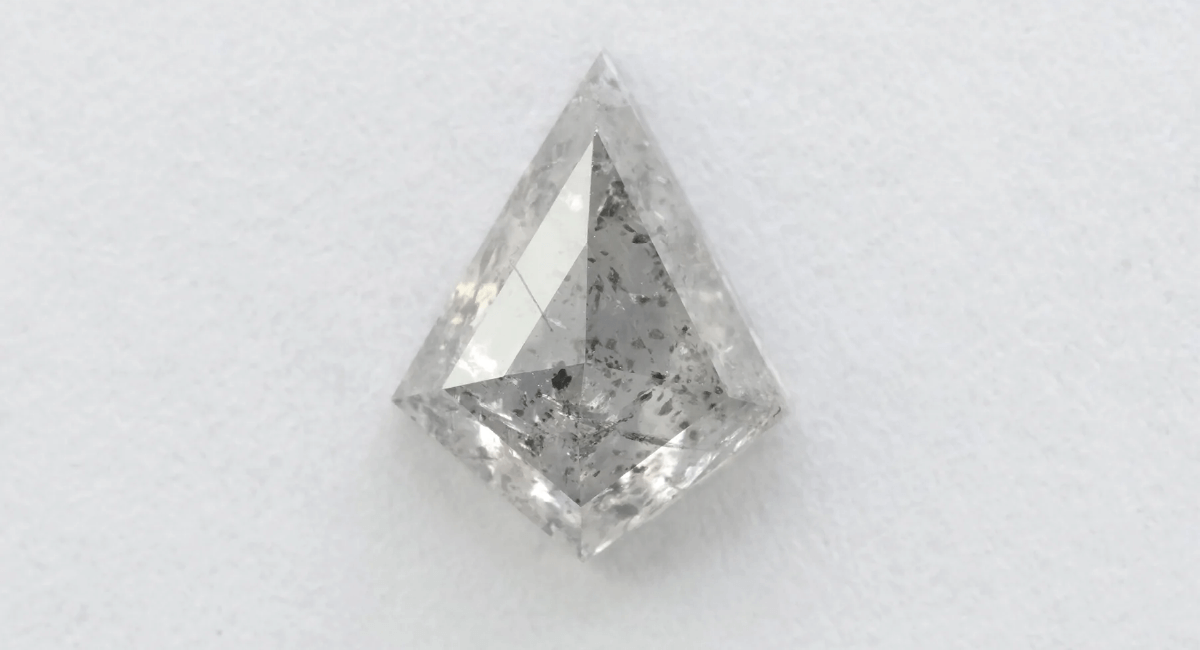
A kite-shaped diamond emanates a vibrant, geometric, rhombus-like cut. It has a brilliant shape similar to a princess-cut diamond and a step cut similar to an emerald-cut diamond.

The kite shape has been referred to informally as “the diamond cut diamond” due to its elongated length and four prominent features. These gems feature very precise cuts making them a fantastic option.

Elevate Your Style The Most Fascinating with Kite Cut Diamond

Additionally, because of its narrow step cut, it sparkles less but yet has a peculiar aura of its own. This gem makes excellent decorative stones and is frequently used in earrings and necklace pendants.

Additionally, a kite lab diamond may be used to create a design that, if they were fashioned in a manner to represent a single huge diamond, would be priceless.

For illustration, you can create a star form by joining the tips of five distinct kite diamonds. Doesn’t this make them fascinating? To know more about this shape of a diamond, read till the end because in this article we are going to cover every aspect of a kite cut diamond.

Kite Shape Diamond
What are Kite Shaped Diamonds

Since the Art Deco era, which was in the 1920s and 1930s, kite cut diamonds have been a popular extravagant cut among those looking for an unconventional yet contemporary gem for their jewelry.

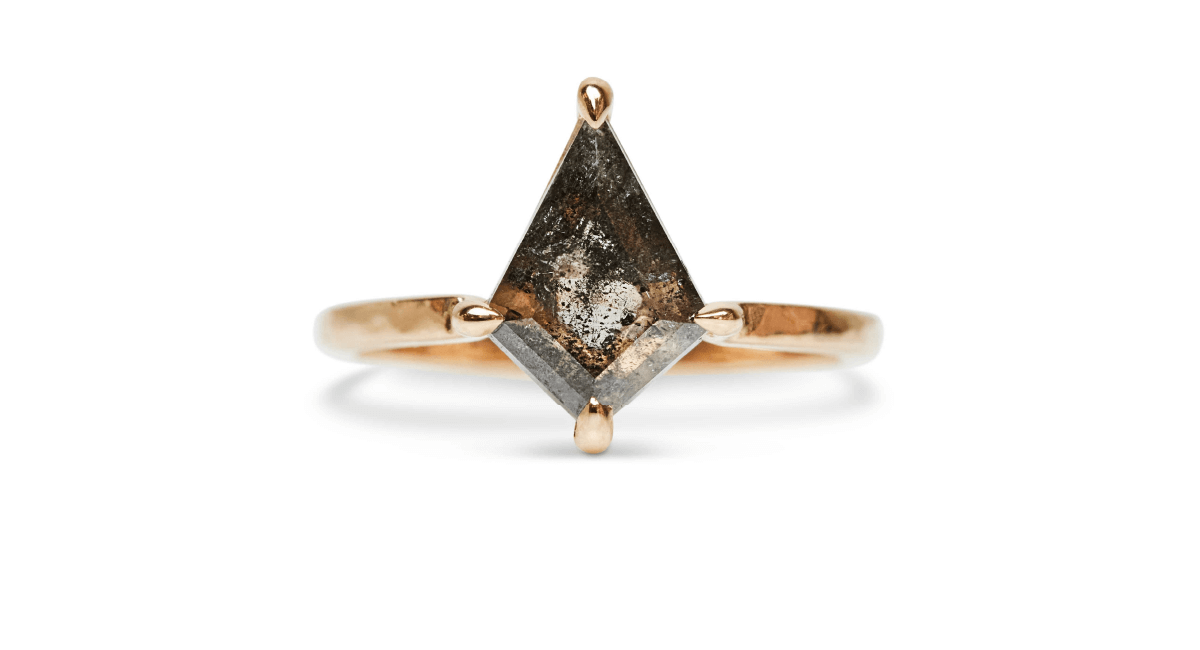
Regardless of the widespread use of dazzling white gems, kite-shaped diamonds are more widely available than other unusual gems like salt and pepper, gray, and black diamonds.

Colored kite shape diamonds can give you a celestial view as these gems seem to contain tiny cosmos inside their facets. They are the ideal option for kite diamonds due to their uniqueness and how they seem after this particular cut. They have a stunning quality that isn’t overtly obvious in their beauty and originality.

Secondly, they might be utilized to make a structure that would be far more expensive if it were made of one enormous diamond. For instance, you might combine the points of five separate kite patterns to produce a star shape.

The form is starting to gain traction as a center stone. Due to its step-cut characteristics, the kite diamond still sparkles subtly, resembling stars in the night sky. People still use it as a side-stone by placing it on both sides of a round brilliant, cushion cut or princess cut diamond.

Price of Kite Shape Diamond

Price of Kite Shape Diamond

Since the kite shape outshines other shaped diamonds, the price of this type of diamond will surely have a vast range. The price for a kite cut diamond starts at $600. So, for an average price that you should consider beforehand, a kite-cut diamond should buy for $1,200 per carat.

Talking about the ceiling price of such a kite diamond engagement ring tops out at $3000 to $5,000+ per ring. A traditional kite diamond ring can serve as both a basic engagement ring and a wedding band.

Also, if you are looking for a rustic kite shaped diamond, it will cost you roughly $2500 per carat, with the size being 2-10 mm (diameter).

We hope you have gotten a rough estimate about the pricing of kite diamonds. You can use our diamond pricing calculator to determine the right price for your diamond.

For the exact details, it is advised to visit an online store’s inventory so that you can compare the prices along with the designs and choose the best option available.

We at Loose Grown Diamonds have a vast inventory of numerous lab grown kite diamonds. Have a look and if you need any help feel free to contact us.

[blog_page_inventory shape=”kite” carat=”0.50,5.60″ cut=”0,4″ color=”0,10″ clarity=”0,11″]
[blog_page_btn title=”buy kite diamond” url=”https://www.loosegrowndiamond.com/inventory/?shape=Kite”]

Clarity of Kite Shaped Diamond

The GIA’s qualitative metric called diamond clarity assigns a grade to each diamond’s appearance. A diamond’s clarity grade will be higher if it has fewer inclusions or blemishes. 

A small high-clarity diamond will shine and sparkle with greater intensity than a bigger lower-clarity diamond. This goes for all diamonds including kite cut diamonds.

Clarity of Kite Shaped Diamond

Compared to VS2 clarity, which is a lesser grade, VVS1 is a greater clarity rating. At VVS, the grade is determined by pin-like inclusions which are impossible to look at with the naked eye. The value of a kite cut diamond’s clarity is influenced by its size and shape as well as other diamond qualities.

A Flawless (FL) grade diamond is without a doubt the clearest type of diamond, even for kite diamond cut. Minor inclusions are more noticeable in VS diamond grades than in VVS diamond grades, although at 10X magnification, even they are visible. 

Under magnification, SI grade inclusions are bigger and easier to see, but if the diamond is eye-clean and the flaws are strategically placed, SI clarity grading may frequently be a buyer’s greatest friend. These are some characteristics that will aid in your search for a kite cut diamond with the best clarity grade.

Should You Buy a Kite Shaped Diamond?

A diamond in the shape of a kite! Yes, a kite cut diamond ring may be the unique yet stunning engagement ring you are searching for. 

These gorgeous jewels have a heavenly appearance that is sometimes disregarded because of their imperfections. Despite the imperfections, kite-shaped diamonds are uncommon and may create a unique and beautiful engagement ring. 

These stones have a galaxy-like form, with each of their facets containing a distinct component of the galaxy. The pointy shape gives it an elongated look which makes it a preferred choice among buyers.

This stone fits people’s design ideas despite not being a conventional shape. Simply because it makes a stunning setting for an engagement ring. 

A kite cut diamond has two sides, one which is flat and has a big table while the other has a step-cut. The jeweler typically chooses the step-cut side since it has a more geometric appearance. 

So, if you are searching for something different yet want a diamond, you can go out for a kite cut diamond because it is not mainstream but is still glamorous and surely it will add beauty to any piece of jewelry it is placed on.

Our Top 6 Kite Shape Engagement Ring Settings

This shape in itself has a unique design, but there are different settings available which can enhance the beauty of a kite shape diamond engagement ring. The choice of setting is vital to determine the vibe of the ring. Let’s talk about the different settings a kite lab diamond can be placed in: 

  1. Halo Setting

Halo Setting Kite Shape Diamond Ring

A ring type known as a halo setting has a central stone encircled by several side stones. Regarding the halo effect in a kite-shaped diamond, a single layer of extra stones on the halo setting can increase the appearance of the main diamond’s size by up to a half carat.

It provides a less expensive alternative to a solitaire setting where the item’s total carat weight (CTTW) is contained in a single diamond since it divides the CTTW of the piece across many jewels. 

The single, double, and triple halo effects are only a few of the variations available within the halo effect. In a single halo ring setting, a kite-shaped diamond will be encircled by one layer of stones.

Two layers of jewels surround the center diamond in a double halo, comparable to a single halo. The triple halo effect goes the same. When choosing a type of halo effect for your kite cut diamond ring, you must first decide if you want the jewel levels to complement or contrast one another.

  1. Pave Setting

Pave setting Kite Shape Diamond Ring

In a pave setting, small diamonds or gemstones are implanted into the base or circle of a ring and secured by tiny hooks or beads, giving the impression of a continuous line of sparkling. The stones will be positioned so tightly together that the metal below them won’t be visible. 

This setting’s ultimate objective is to give the impression that glittering, freestanding stones are covering the whole surface of the ring. Talking about the pave setting in a kite cut diamond ring, if you think your ring could ever need to be resized, the best option is a semi-pave band rather than a complete one. 

Diamonds can be placed in rows on a broader band, a thinner, more delicate band, a split shank, or even a crisscross pattern. Whatever pave you select will provide a field of glitter that is amplified.

  1. Prong Setting

Prong setting Kite Shape Diamond Ring

A prong setting secures the diamond while letting light easily travel through metal prongs that are used to keep it aloft. There are two alternatives for the number of prongs in a kite-shaped diamond ring: 4 or 6. The prongs can be flat, rounded, pointy, or v-shaped. Your gorgeous kite cut diamond’s characteristics can be enhanced by using prong settings. 

The diamond’s fire and brightness are increased by the prongs’ large openings for light. On the other hand, you don’t want prongs that are too big or thick since they would obscure the center’s lovely kite form. In a perfect world, you would strike a balance between prongs that securely hold the diamond while yet allowing it to take center stage.

  1. Bezel Setting

Bezel setting Kite Shape Diamond Ring

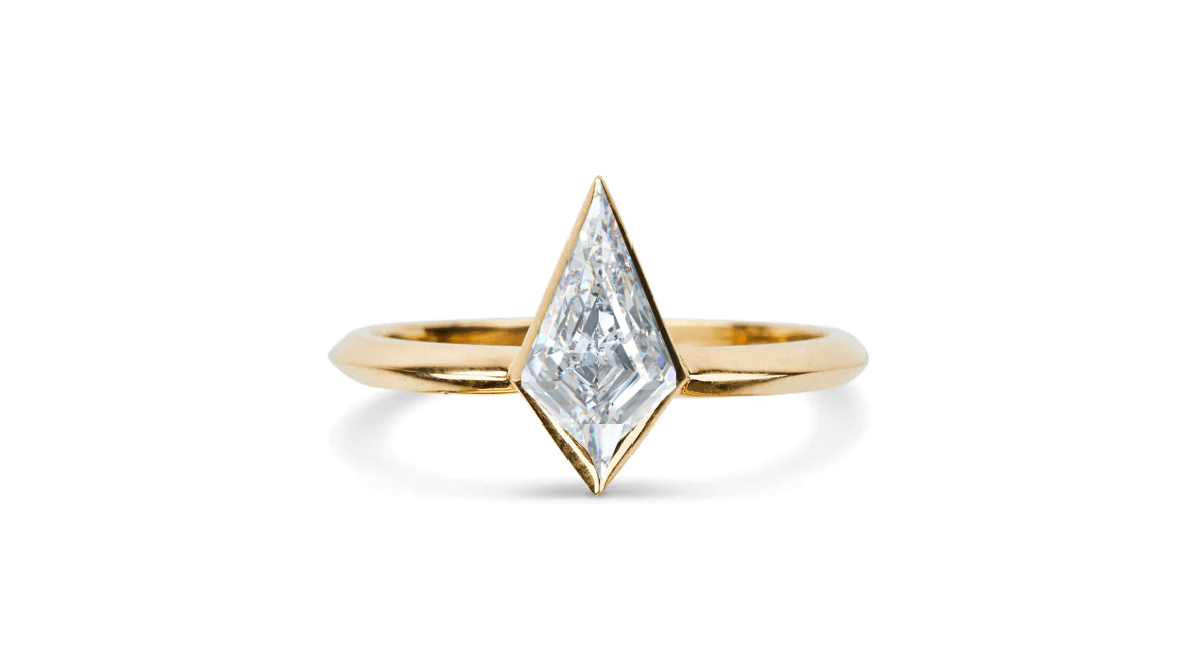
It is referred to as a bezel setting when the diamond or gemstone is encircled by an arc with a thin metal rim. 

The gem is held in place by a metal collar that is formed around it. In addition to being useful, this setting gives the jewelry piece a touch of elegance. 

There are three bezel setting styles available for kite cut diamonds: complete, partial, or ornamental. 

For a kite diamond, the extra metal creates a streamlined form that looks good and goes well with the kite’s central shape. The bezel offers outstanding protection, even though it could lessen brilliance. 

Light from the sides cannot enter the diamond since the bezel setting surrounds the gem’s periphery. Bezel rings might cost more than other settings due to the weight of the metal and the difficulties of making the setting.

  1. Three-Stone Setting

Three-stone setting Kite Shape Diamond Ring

The three-stone setting, also known as the trilogy ring setting, is a well-liked option for a variety of events, particularly when purchasing engagement and anniversary rings. 

As you have undoubtedly guessed, there are three diamonds arranged side by side in this setting. As the three gemstones or diamonds stand for the kid and the parents, couples frequently purchase them for the birth of their first child. 

In essence, a three-stone kite cut diamond ring will just have three diamonds set one after the other in the center, giving the band this name. 

The three stones are frequently seen as a symbol of the past, present, and future, and this arrangement is considered romantic because of its eternal appeal. There is no doubt that the three-stone setting has exquisite symbolism, but how you choose to interpret it is all up to you.

To get all you want out of a three-stone engagement ring, you’ll need to do a little more study and budgeting, but if you strike a balance, you’ll love your brilliant trio for years to come!

  1. Sunburst Setting

Sunburnt setting Kite Shape Diamond Ring

Smaller diamonds are arranged in a sunburst pattern so they look like one bigger diamond. A huge center stone or a collection of stones of different sizes can be found in a sunburst ring.

In a sunburst kite diamond ring, the diamonds frequently take the form of an original pattern, like a flower or starburst, or a geometric shape like a square.

Additionally, this setting looks wonderful with a kite shaped diamond. These rings often cost less than solitaire rings since they don’t include as large of a diamond. The price of a ring is influenced by the precious metal, diamond grade, and carat weight.

Conclusion

Without a doubt, the kite cut diamond is a superstar in the diamond market. It shines into light more quickly than other cuts because of its expanded form, which would be greatly facilitated by four distinct lines. 

The final two columns, which are the longest, triumph at the end of the composition while the other two lines are angled to finally meet at their highest point. 

Most of us choose to keep things simple by calling it Kite Cuts instead of Diamonds since calling it Diamond might be deceptive. Have a look at kite cut diamond engagement rings today and select one for your significant other!

FAQs

What are the advantages of choosing a kite cut diamond?
Kite cut diamonds offer a contemporary and elegant look that sets them apart from more conventional diamond shapes. They also tend to appear larger for their carat weight due to their elongated shape, making them an excellent choice for those looking for a unique and eye-catching engagement ring.

What factors should I consider when purchasing a kite diamond?
When buying a kite cut diamond, consider the 4Cs: carat weight, cut, color, and clarity. Pay attention to the diamond’s proportions and symmetry to ensure optimal sparkle and brilliance.

Are kite diamonds rare?
Yes, kite shape diamonds are rare because of their shape and brilliance. Asymmetric cut along with different silhouettes is what makes it unique. Due to their distinctive hue, most kite-shaped diamond rings are in high demand yet rare.

Which diamond shape has the most sparkle?
Although theoretically, round diamonds will dazzle the brightest, various other elements might enhance a diamond’s brilliance. 58 facets make up the facet design of the round brilliant cut, which guarantees that light can flow through it in a way that produces the ideal brilliance.

What is kite diamond ring?
A kite cut diamond ring features a diamond that has been cut into a kite shape, and set into a ring as the central stone or accent stone.

What makes a kite diamond engagement ring unique?
kite shape, with its elongated appearance and pointed corners, sets these rings apart from more traditional diamond ring designs.
All About H Color Diamonds: Is H Color Diamond Good?

Following our previous blog on diamond color grades for lab grown diamonds, this article delves deep into the characteristics and allure of the ‘H color diamond.’

These diamonds can offer a good balance between quality and value, as they appear relatively colorless while being less expensive than higher color grades.

What is an H Color Diamond?

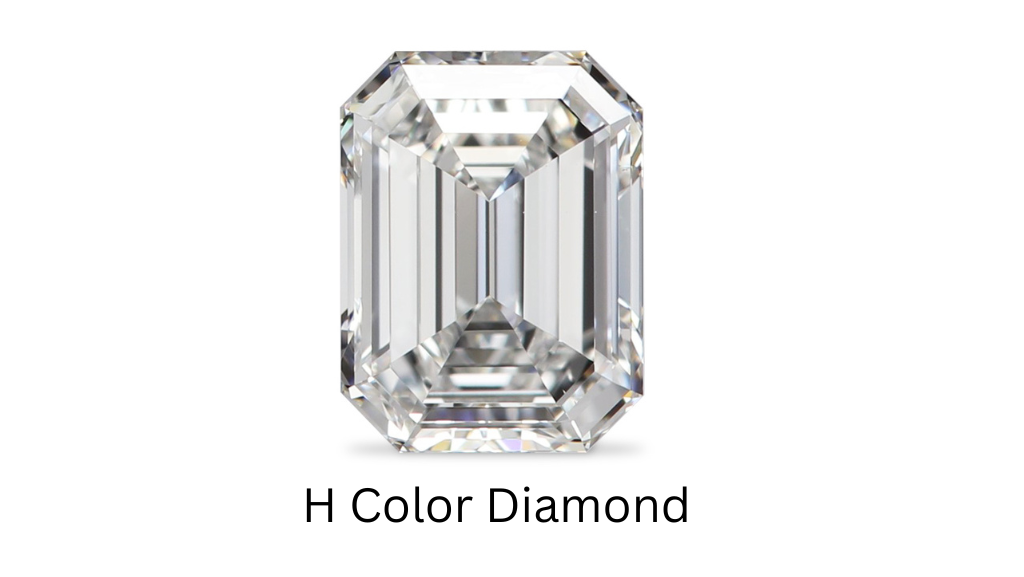
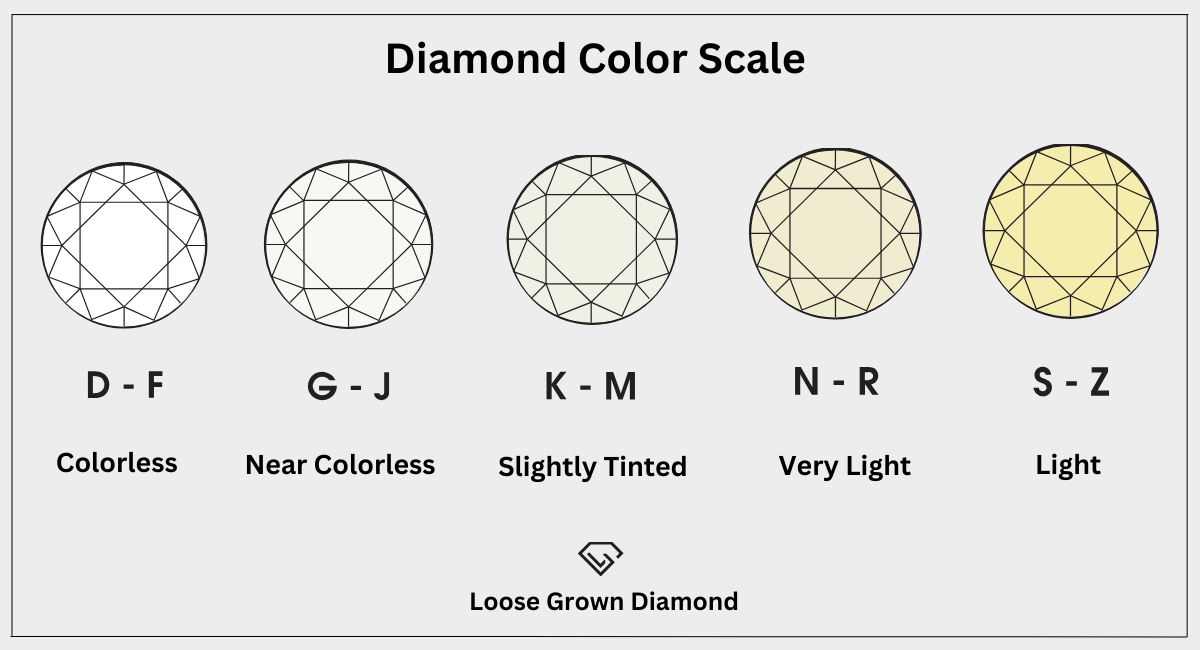
H color diamonds are a rating of color diamonds on a scale of D to Z, and they are valued for the way they strike a balance between color quality and cost. They are a more affordable option than their colorless equivalents, such as D, F, or G diamonds, and especially for bigger carat sizes.

A keen eye is needed to see even the slightest color variations in H color lab diamonds, which increases their value. H colored diamonds are aesthetically pleasing since they also retain their white tint, especially when set in platinum or white gold.

H Color Diamond

In the realm of gem-grade diamonds, they provide an alluring blend of quality and affordability.

How Much Do Color H Diamonds Cost?

The best option is the H-color diamond, which strikes the ideal mix between cost and quality. Approximately starting from $200 and going up to at least $5,500 for a 1 carat stone puts it in the affordable range when compared to more expensive D, E, or F color diamonds by up to 20%.

When taking into account parameters like cut, clarity, and carat weight, the H color diamond maintains its high value due to its nearly colorless appearance. Selecting a good or optimal cut might result in H colored diamonds that offer remarkable value.

If you opt for a lab grown H colored diamond it will cost you 20% less than a natural diamond. Whilst, giving your jewelry the same level of shine and elegance.

[blog_page_inventory shape=”emerald,round,princess,asscher,marquise,heart,pear,oval,cushion” carat=”1.20,3.10″ cut=”1,4″ color=”6,6″ clarity=”2,9″]
[blog_page_btn title”Buy Now” url=”https://www.loosegrowndiamond.com/inventory/?”]

Color H Diamond Certification Guide

The International Gemological Institute (IGI) uses cutting edge technology to differentiate between lab grown, synthetic, and naturally occurring diamonds. Professional gemologists evaluate stones under controlled circumstances and record permanent treatments in accordance with stringent international standards.

Within the gemological world, their genuine IGI laboratory reports are a reliable mark of quality. The certification helps determine the color grade H diamond.

Based on exact comparisons with known color stones, the Gemological Institute of America (GIA) sets industry standards with its diamond color grading scale, which goes from D (colorless) to Z (light yellow or brown). VS1 color H diamond stands for the best possible quality level.

The independent Gem Certification and Assurance Lab (GCAL) puts the needs of the customer first through a careful procedure that involves three professionals and cutting edge facilities. They carefully examine thousands of diamonds to produce a single Precision Master color set, only choosing Precision Master color stones for grading comparisons.

About Color H Diamond Ring

[su_youtube_advanced url=”https://www.youtube.com/watch?v=9R-CFJh-VZM” width=”1600″ autoplay=”yes” mute=”yes” loop=”yes” modestbranding=”yes” theme=”light” playsinline=”yes” title=”H color diamond ring “]

An H color diamond falls in the near-colorless range of the scale. It means that the diamond has a slight hint of color, typically a faint yellow or brown tint. However, this coloration is subtle and often not easily visible to the naked eye, especially when the diamond is set in a ring.

H Diamond Ring

An H color diamond ring offers timeless elegance, balancing quality and affordability. Its near colorless beauty adds character and versatility, making it a popular choice for engagement and fine jewelry.

Where to Buy H Color Diamonds?

Due to their balanced aesthetics and affordability—they look almost colorless and cost less than D, E, or F diamonds—our guide suggests H-color diamonds. H colored round diamonds, which have significant light reflection, look best set in white metal; lower grades look better set in yellow or rose gold.

H color works well with a variety of forms and metals, but circumstances and personal tastes may call for modifications. We will guide you on the way to help you purchase the best quality H color lab grown diamond within your budget. You can use our diamond price calculator to determine the right price for your diamond.

You can go to our inventory page and filter it based on your preferences. Our professional gemologists are at your service to answer any questions you may have while browsing our inventory. Explore exclusive savings with our promo code when elevating your diamond shopping experience.

[perfect_ring_box title=”Ready to find your perfect diamond and ring?” btn1ttl=”H color diamond” btn1url=”https://www.loosegrowndiamond.com/inventory?color=5.00,6.00″ btn2ttl=”H color diamond ring” btn2url=”https://www.loosegrowndiamond.com/build-a-ring”]

Conclusion

H color diamonds are a wise option for individuals looking for value in gem-grade diamonds since they provide a superb mix between quality and price.

H color lab grown diamonds are a flexible and affordable choice in the world of fine jewelry because of their nearly colorless beauty and timeless elegance that appeals to a wide variety of consumers.

FAQ

Is color H good for a diamond?
Yes, H color is considered good, offering quality and affordability.

Should I buy an H color diamond?
Buying an H color diamond can be a wise cost-effective choice.

Will an H color diamond sparkle?
Yes, an H color diamond can sparkle beautifully, especially in well-cut stones.

How much is an H diamond worth?
1 carat H color diamond prices range from $245 to $14,000 and 2 carat diamond prices range from $353 to $4900.

What color are most engagement ring diamonds?
Most engagement rings feature G or H color diamonds, which appear nearly colorless.

What is the diamond color scale?
A quality chart called the diamond color scale is used to quantify how colorless a diamond is.

Do H color diamonds look yellow?
No, H color diamonds typically do not look yellow.

Will an H color diamond look too yellow if it’s set in yellow gold?
An H color diamond set in yellow gold may show a slight warm tint, but it’s a matter of personal preference.

The Timeless Beauty of the Lab Grown Diamond Tennis Necklace

The diamond tennis necklace is a piece of jewelry that has been in trend for a long haul and continues to be a timeless piece that enhances and fits in with all styles. Even in its subtlety, we see the round diamond necklace standing out like no other piece of jewelry. Its origin dates long back, but the beauty of the chain sustains the test of time.

We see the tennis diamond necklace being inspired by the tennis diamond bracelet. The top tennis player in the 1970s wore the tennis diamond bracelet. This inspired the rise of a necklace pattern from the bracelet style. Necklaces are such unique jewelry pieces that one would love to have a special piece for themselves.

What is a Diamond Tennis Necklace?

What is a Diamond Tennis Necklace

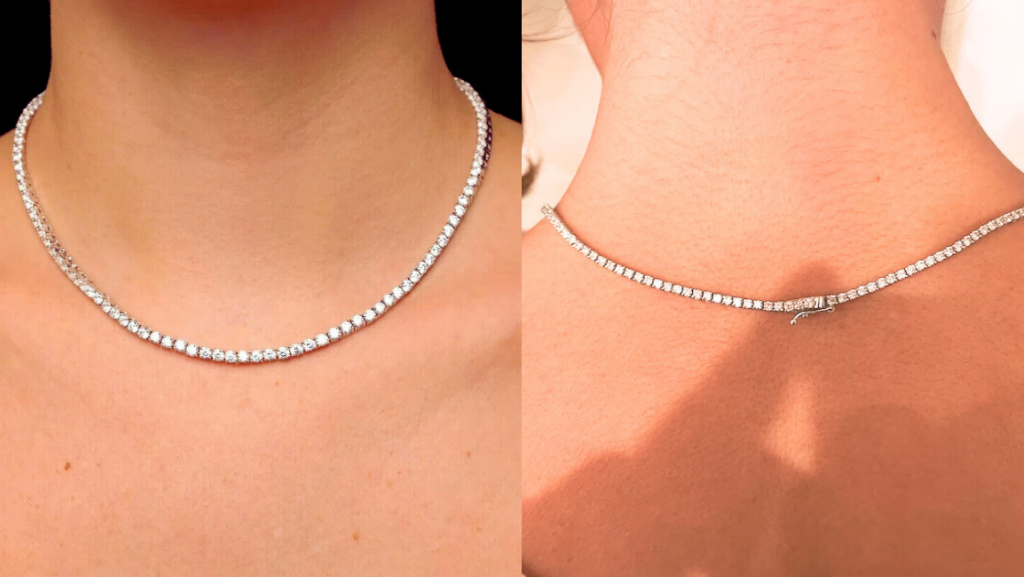
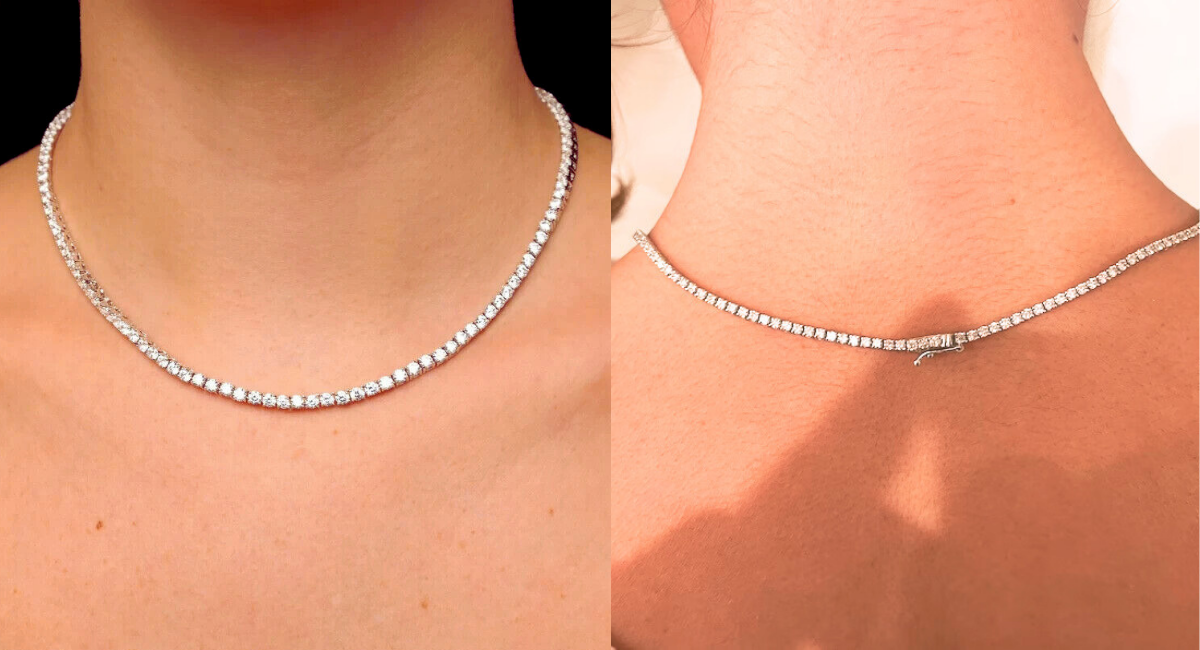
A diamond tennis necklace is a piece of jewelry that is subtle yet quite impactful when worn correctly. This particular style is said to fit in with all fashion and enhances the fashion sense with each style it is paired with.

The tennis necklace has continuous diamonds placed next to one another. The necklace is conventionally known to have diamonds lined of the same size, but in recent times, we have seen experimentation with varying sizes too.

The diamonds are set into metal that is chained together. In simpler words, one can call this a chain of diamonds. The diamond tennis necklace is something one can wear from casual outings to a high-end fashion outfit.

How Do I Choose a Diamond Tennis Necklace?

Choosing a tennis necklace can seem like an easy task due to the simplicity of the design, but we see that the beauty is in the details. The details enhance the beauty of this subtle necklace design, and hence even the tiniest details matter.

The main thing can be, what to look for when shopping for a lab grown diamond tennis necklace, and the answer is straightforward. As you get cleared one by one on these questions, you will start building up your beautiful necklace piece.

One can prefer a lab grown tennis necklace or a natural diamond necklace, with the previous option having more budget and clarity advantages too. Since the diamonds are lab-created, the diamond constituents are the same, with fewer inclusions, making the diamond appear more transparent and shine better.

Diamond carat: As you build up the design of the necklace, you can see that determining the carat weight of the diamond is a crucial aspect. Once the overall weight of the diamond tennis necklace is decided upon, you can put together the diamonds and determine a uniform carat weight of the diamonds themselves.

Length: The length of the diamond tennis necklace helps us figure out the approximate cost depending on the carat and number of diamonds one has decided. Tennis necklaces are available in a variety of sizes, right from 14, to a length of about 26. The best length of a tennis necklace ranges from 16 to 18 inches, wherein it does not completely create a choker effect, nor does it hang from the neck and we see it sit comfortably on the collarbone. The length can be an important factor once one determines the style they are going for in the necklace.

Metal: the metal in which one chooses to place a diamond changes the impact of the diamond. A diamond tennis necklace in yellow gold can add a warm tone to the diamonds and can make the diamonds in the necklace seem yellow-toned. Another option is the rose gold diamond necklace, which makes the diamond necklace appear dreamy. Rose gold is also a tone that appears very mystical when worn, hence a beautiful twist to a diamond necklace.

The most conventional way to wear it is usually when the diamonds are placed in white metals. One can choose from different metals in white metals; there is platinum and white gold. A white gold diamond tennis necklace is an ideal option since platinum is a little expensive.

Price: You need to keep an idea of the budget they are looking for in the tennis diamond necklace to form a baseline and work around all the above factors to create the desired output in the chosen budget. This will require some exploration to get an idea of the necklace one is looking for. Loose Grown Diamonds gives the best price there is in the market to offer to an individual.

The Advantages of Choosing a Lab Diamond Tennis Necklace

Choosing a lab grown diamond tennis necklace has considerable advantages compared to a natural diamond necklace. A lab diamond tennis necklace will have diamonds created in the manner a natural diamond is formed but in a slightly controlled format.

The nature of these diamonds is such that it does not harm the environment as much as mining a natural diamond does. The lab grown diamond tennis necklace will be available at a price considerably less than naturally occurring diamonds.

Sparkling Celebrity Diamond Tennis Necklace Moments

The glam of the industry is something we always look up to. So, if you are looking for inspiration, these celebrity diamond tennis necklace inspirations are what you might be looking for.

Check out some of the iconic looks from the Golden Globes, Cannes and the never-failing Met Gala. Zendaya and Lady Gaga can be seen adorning a timeless piece of the diamond tennis necklace at one of these events.

Where Can I Buy a Diamond Tennis Necklace?

You can always look online for options and customizations; offline stores can cater to your needs. You can go to the website of Loose Grown Diamonds and check out the choices you can avail as you indulge in our premium customer service. You can avail a discount by using a promo code.

If you want a design we do not have, click here you can send us its picture, note or reference. We will then create a custom setting and send a CAD3D design for you to see and that for you can contact us by filling up our custom form.

[blog_page_btn title=”Buy Diamond Tennis Necklace” url=”https://www.loosegrowndiamond.com/product-category/necklaces/”]

Conclusion

Finding the right lab grown tennis diamond necklace is not a hefty task, but choosing the details you prefer can get a little challenging. With the premium quality of lab-grown diamonds, your tennis necklace will surely catch any eye in a glimpse, all while shining in its subtlety. The tennis necklace women have been wearing has continued to create history.

FAQs

What is a diamond tennis necklace called?
Multiple names call a diamond tennis necklace, some being line, infinite, classic necklace, or unique necklaces.

How much is a diamond tennis necklace?
Depending on the details of the necklace one has chosen, the price ranges from $3000 as a base price and reaches up to $12,000, depending on the diamond clarity, color, carat, and the metal in which it has been set.

What is the best setting for a diamond tennis necklace?
Prong and bezel are the best diamond settings that one can choose from. Prong enhances the beauty of the diamond necklace to a maximum level, but the bezel offers a more stable and safer option for the diamond to be set in.

What is the length of a tennis necklace?
Tennis necklaces are available in a variety of sizes, right from 14 to 26. The best length of a tennis necklace ranges from 16 to 18 inches, which is the choker variety of necklaces.

Can you wear a diamond tennis necklace every day?
Yes, one can certainly wear a tennis necklace every day.

How many carats should a tennis necklace be?
The carat weight of a tennis necklace can only be decided after the whole design process, but an individual diamond chosen can be from 0.05 to 0.5 carats each. The smallest necklace would be around 6ct, whereas the largest 16 carats.

What metals are generally used for diamond necklaces?
The metals commonly used for diamond necklaces are white gold, yellow gold, rose gold and platinum.

Do lab diamond tennis necklaces come in different styles?
In recent times, we have a variety of patterns ranging from prong tennis necklaces to bow-tie diamond tennis necklaces that can be matched beautifully to other metals for added style.

Is a lab grown diamond necklace a good gift?
A lab grown diamond necklace is a beautiful gift that one can gift to their loved ones on special days like birthdays, anniversaries, and graduation days, or even to your loved one for simply existing.

Unveiling the Ethical Elegance of Lab Grown VVS Diamond Rings

In the realm of diamonds, a new revolution has taken place, presenting an extraordinary alternative to natural stones: lab grown VVS diamonds ring.

We have already discussed their exceptional clarity and unrivaled brilliance in our previous blog, where we mostly focused on lab grown VVS diamonds that have emerged as a testament to scientific innovation and ethical beauty.

Unveiling the Ethical Elegance of Lab Grown VVS Diamond Rings

Cultivated through advanced technological processes that mimic the conditions of the Earth, these diamonds possess the same remarkable characteristics as their natural counterparts, but with a traceable origin and a reduced impact on the environment.

As a result, they offer an exquisite option for those seeking sustainable, ethically sourced, and visually stunning gemstones that encapsulate the true essence of elegance and luxury. Today, we discuss how lab grown VVS diamonds and engagement rings are a match made in heaven for your own nuptials.

Ethical Brilliance: The Allure of Lab Grown VVS Diamond Rings

VVS Diamond rings

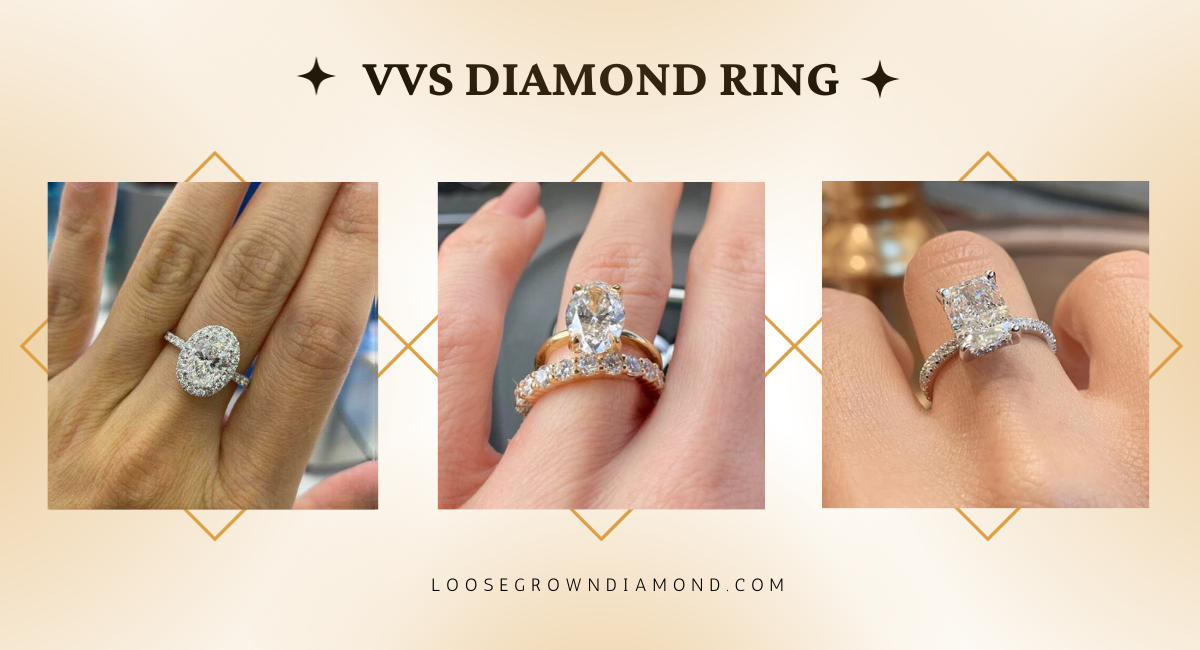
When it comes to selecting an engagement ring that combines breathtaking beauty with a commitment to ethical sourcing, lab grown VVS diamond ring shine as a remarkable choice.

These exquisite rings showcase the remarkable clarity and brilliance of VVS diamonds, while being cultivated through sustainable and responsible means.

Lab grown VVS diamonds offer an ethical alternative to traditional mined diamonds, as they are created in controlled laboratory environments. With their near-flawless clarity, lab grown VVS diamonds exhibit the same exceptional quality as their natural counterparts, but without the environmental impact and ethical concerns associated with traditional diamond mining.

Choosing a lab grown VVS diamond ring not only guarantees a stunning symbol of love and commitment but also reflects a conscious decision to support sustainability and responsible practices. Discover the simplicity of finding your ideal ring size with our accurate ring size chart.

A Guide to Choosing the Perfect VVS Diamond Ring

When it comes to selecting an engagement ring that exudes unparalleled beauty and exceptional quality, a VVS diamond engagement ring stands in a league of its own. VVS, which stands for Very, Very Slightly Included, refers to the diamond’s remarkable clarity grade.

These diamonds possess an incredible level of clarity, with nearly imperceptible inclusions that enhance their brilliance. So, what should you look for when purchasing a VVS diamonds ring?

Ethical Sourcing: Lab grown VVS diamonds offer a conscientious alternative to traditional mined diamonds. Ensure that the diamond you choose is certified as lab grown, guaranteeing its origin and minimal environmental impact. By selecting a lab grown VVS diamond, you can embrace an engagement ring.

Exceptional Clarity: The hallmark of a VVS diamond lies in its clarity. Look for diamonds with a VVS clarity grade to ensure they have minimal imperfections and display remarkable brilliance. The absence of visible inclusions allows the light to pass through the stone unimpeded, resulting in a dazzling sparkle that will captivate everyone’s attention.

Expert Craftsmanship: VVS diamond rings require skilled craftsmanship to highlight the stone’s brilliance. Pay attention to the setting and design of the ring, ensuring it complements the diamond’s beauty while securely holding it in place. A well-crafted ring will showcase the VVS diamond’s magnificence to its fullest potential.

Personal Preferences: While VVS diamonds are known for their exceptional clarity, it’s essential to consider your personal preferences. Factors such as diamond shape, cut, color, and carat weight all contribute to the overall appearance of the ring. Choose a VVS diamond engagement ring that aligns with your unique style and preferences to create a cherished symbol of love and commitment.

Remember, choosing a lab grown VVS diamond ring not only ensures a ring of extraordinary beauty and clarity but also reflects a commitment to ethical and sustainable practices. With their exquisite brilliance and responsible sourcing, lab grown VVS diamond rings represent a love that shines brightly and conscientiously.

Where to Buy Lab Grown VVS Diamond Engagement Rings?

With our commitment to ethical sourcing, exceptional craftsmanship, and personalized assistance, Loose Grown Diamonds is a premier destination for those seeking lab grown VVS diamond rings. Embrace the elegance and ethical beauty of these remarkable gemstones, knowing that your purchase supports responsible practices.

At LGD, your journey to finding the perfect lab grown VVS diamond engagement ring will be guided by our experts so you get the best deal there is and get access to an exclusive discount on the diamond ring of your dreams by receiving a personalized promo code.

[perfect_ring_box title=”Ready to find your perfect diamond and ring?” btn1ttl=”Buy VVS diamond” btn1url=”https://www.loosegrowndiamond.com/inventory/?clarity=5.00,9.00″ btn2ttl=”Buy VVS diamond ring” btn2url=”https://www.loosegrowndiamond.com/build-a-ring”]

Conclusion

In conclusion, VVS diamond clarity defines the highest standard of perfection in the diamond world. Whether lab grown or natural, VVS diamonds showcase impeccable clarity, resulting in breathtakingly beautiful engagement rings.

While opinions on the best diamond may vary, we maintain a firm answer to what is VVS diamonds and how they hold a special place due to their nearly flawless clarity, making them a top choice for those seeking exceptional brilliance and elegance in their engagement rings.

FAQs

Where can I find the best VVS diamond for a ring?
For the best VVS diamond for your ring, look no further than Loose Grown Diamond, renowned for their exquisite selection of VVS diamonds and commitment to ethical practices.

Can VVS diamonds be customized into different ring designs?
Yes, VVS diamonds can be customized into a variety of ring designs, allowing you to create a unique and personalized engagement ring that showcases the exceptional beauty and clarity of the diamond.

Can I wear a VVS diamond ring every day?
Absolutely! VVS diamond rings are durable and suitable for everyday wear, ensuring that you can enjoy the stunning beauty and brilliance of your ring as you go about your daily activities.

Are VVS diamond engagement rings considered high-quality?
Yes, VVS diamond engagement rings are considered high-quality due to their exceptional clarity and brilliance. The VVS clarity grade signifies a very high level of diamond clarity, making them highly desirable and sought after.

Can I insure my VVS diamond engagement ring?
Yes, you can insure your VVS diamond engagement ring. It is recommended to obtain comprehensive insurance coverage to protect your investment and provide peace of mind.

Can I choose a VVS diamond ring in different metal settings?
Absolutely! VVS diamond rings are available in a variety of metal settings, including popular options like platinum, white gold, yellow gold, and rose gold, allowing you to select the metal that best complements your personal style.

Do VVS diamond rings come with a warranty or guarantee?
Many reputable jewelers offer warranties or guarantees on their VVS diamond rings. It’s important to inquire with the jeweler about their specific warranty or guarantee policy before making a purchase.

Can VVS diamond engagement rings be resized?
Yes, VVS diamond engagement rings can be resized by professional jewelers to ensure a perfect fit. It’s advisable to consult with a skilled jeweler who specializes in resizing to maintain the integrity and beauty of the ring.

Discover the Captivating World of F Color Diamonds

Welcome to our sparkling world of F color diamonds! In this blog, we delve into the mesmerizing beauty and allure of these exquisite gems in continuation of our previous blog about diamond color grade.

Join us as we explore the unique characteristics, craftsmanship, and fascinating stories behind these diamonds, making every moment truly unforgettable. Get ready to be dazzled!

What are F Color Diamonds?

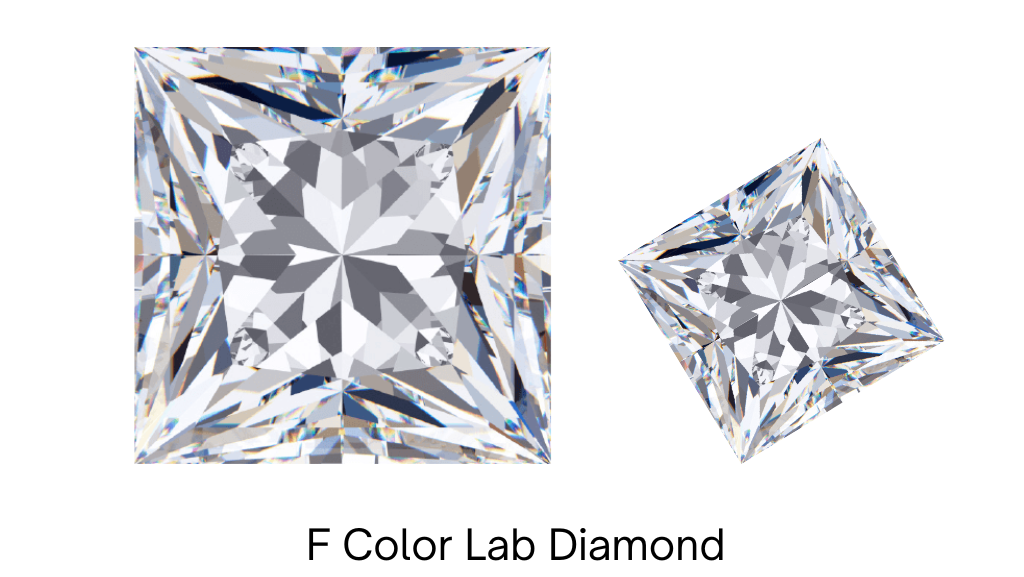
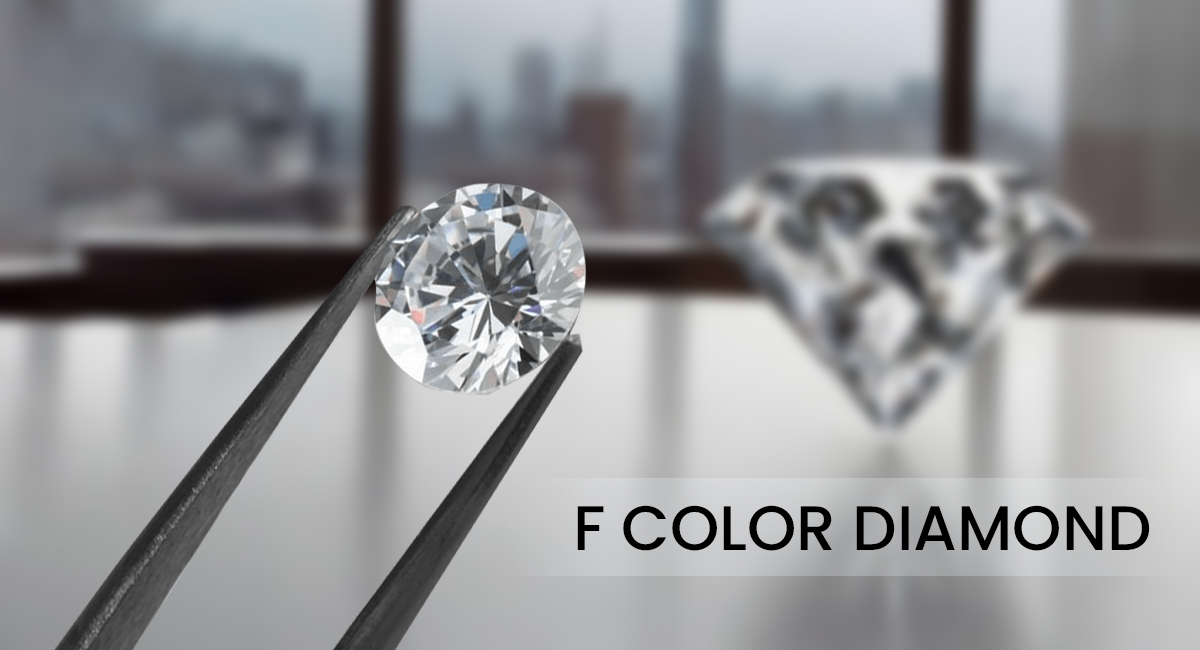
When it comes to diamond color, F color diamonds stand out as a true testament to perfection. With their pristine white hue, these certified diamonds give out unparalleled radiance and sophistication. F color lab diamond reminds the ultimate of a coveted choice.

F Color Diamonds

Are F Color Diamonds Good? Unlocking the Beauty and Value of F Color Diamonds

When it comes to evaluating the quality of a diamond, color plays a crucial role. F color diamonds, with their near colorless appearance, are considered an excellent choice for those seeking exceptional beauty and value.

With a color grade of F, these diamonds exhibit a pristine white hue, showcasing minimal to no presence of yellow or brown tones. This remarkable color grade allows F color lab grown diamonds to radiate a breathtaking brilliance, captivating all who behold them.

Are F Color Diamonds Good

Diamonds F color are highly sought after for their rarity and desirability. Graded on a scale from D to Z, F color falls within the upper range of near colorless diamonds. This means they possess one of the highest color grades achievable, making them an excellent investment for those seeking top-tier quality.

[blog_page_inventory shape=”pear,round,heart,oval,cushion,princess,marquise,emerald,asscher,radiant” carat=”1.90,2.10″ cut=”0,4″ color=”8,8″ clarity=”0,11″] [blog_page_btn title=”buy lab diamond” url=”https://www.loosegrowndiamond.com/inventory/”]

Why Should I Invest in a F Color Diamond?

Choosing to buy an F color lab grown diamond offers a range of benefits. From the exquisite near colorless appearance that enhances its brilliance to the rarity and prestige associated with high-quality diamonds, diamond f color truly stand out. With their enduring beauty and value, these diamonds are a testament to exceptional craftsmanship and an investment that can be cherished for a lifetime.

Where to Buy F Color Diamond?

When it comes to acquiring F color lab diamonds, one exceptional option to consider is F color diamonds. These diamonds, created through advanced technology that replicates the natural diamond formation process, offer a sustainable and ethically conscious alternative to mined diamonds.

Among the various companies in the market, Loose Grown Diamond stands out as a leading provider of lab grown F color diamonds. With our commitment to excellence, we offer a wide range of meticulously crafted lab grown diamonds in F color, ensuring the highest quality and exceptional beauty.

These are certified diamonds by reputable gemological laboratories (GIA or IGI), assuring authenticity and providing peace of mind.

Make your diamond purchase even more delightful by acquiring a personalized promo code from the knowledgeable gemologist at Loose Grown Diamonds.

The Elegance of F Color Engagement Rings

[su_youtube_advanced url=”https://www.youtube.com/watch?v=HnC-I_2kw08″ width=”1600″ autoplay=”yes” mute=”yes” loop=”yes” modestbranding=”yes” theme=”light” playsinline=”yes” title=”F color enagagment ring “]

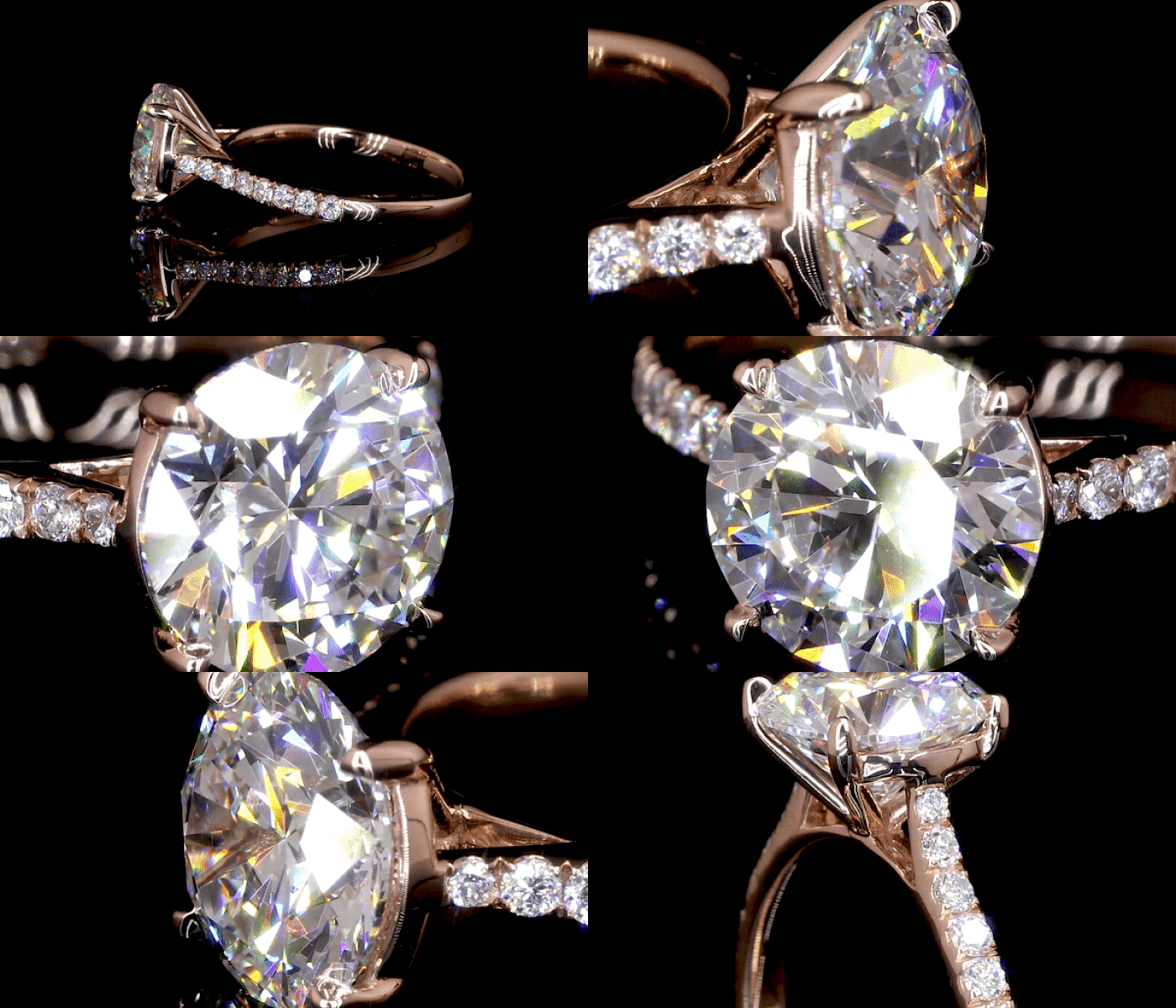
This color grade is highly desirable as it strikes a balance between colorlessness and affordability. F color diamond engagement rings are an excellent choice for those seeking a balance between quality, beauty, and value. The versatility of F color diamonds enables them to complement a wide range of metal choices, including gold, platinum, yellow gold or rose gold.

F Color Engagement Ring

Be it round brilliant cut, princess cut, emerald cut, or any other shape for that matter, F color lab diamonds will showcase a near colorless quality and shine through regardless.

[perfect_ring_box title=”Ready to create your perfect ring?” btn1ttl=”Build a Ring” btn1url=”https://www.loosegrowndiamond.com/build-a-ring/”]

Conclusion

In conclusion, F color diamonds hold an undeniable allure with their near colorless appearance and exceptional brilliance. Whether you choose a natural F color diamond or a lab grown alternative, these gems radiate timeless elegance and value. From engagement rings to stunning jewelry pieces, F color diamonds make every moment truly unforgettable.

FAQ

What are F color diamonds?
F color diamonds are diamonds that have been graded with the color grade “F” on the GIA scale. They exhibit a near colorless appearance with a pristine white hue, showcasing minimal to no presence of yellow or brown tones.

Do F color diamonds look yellow?
No, F color diamonds do not look yellow. On the GIA color scale, F color diamonds are considered near colorless and display minimal color, making them appear brilliant and white.

What is the price of 1 carat F color VS1 diamond?
The f color diamond price of a 1 carat VS1 diamond can vary depending on various factors like cut and overall quality. Generally, F color VS1 diamonds are considered to be of high quality and can command a premium price of around $800 per carat.

Which is a better diamond color F or G?
Both F and G color diamonds are considered excellent choices, as they both fall within the near colorless range. The difference between them is subtle, with F color being slightly higher on the color scale than G color. The choice ultimately depends on personal preferences and budget.

Are F color diamonds expensive?
Yes, F color lab created diamonds are typically more expensive than diamonds with lower color grades due to their superior color quality and desirability in the market.

Will an F color diamond show any tint?
F color lab created diamonds are graded as near colorless, and they should not show any noticeable tint of yellow or brown. Their near colorless appearance allows them to showcase exceptional brilliance and whiteness.

What causes the color in an F color lab diamond?
The color in an F color lab grown diamond is influenced by the presence of trace elements and structural defects during the diamond’s formation process. In the case of F color diamonds, there are minimal impurities that result in the diamond’s near colorless appearance and its exquisite white hue.

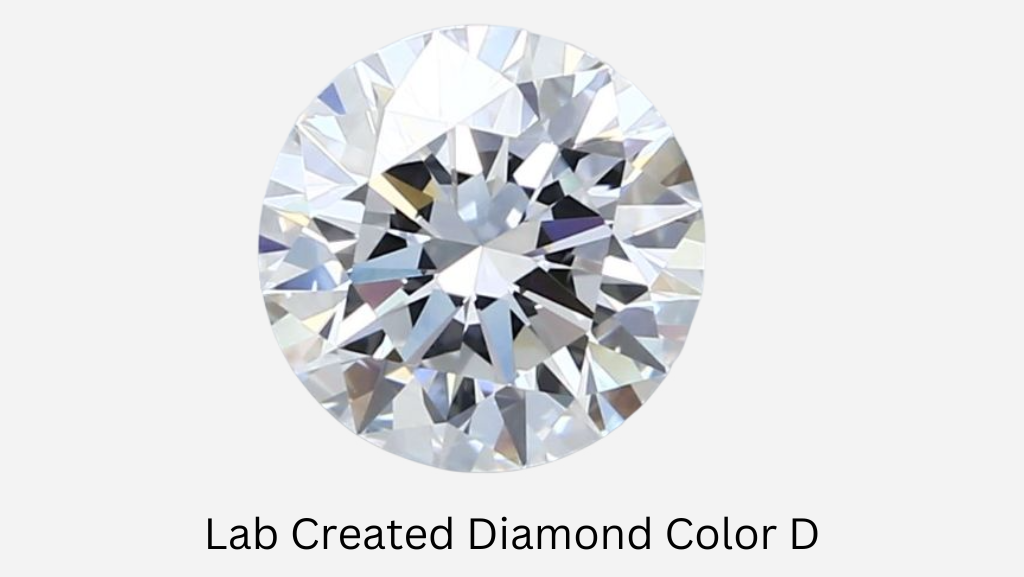
Exploring the Brilliance of Lab Created Diamond Color D

In continuation of our previous blog, diamond color grades are used to assess the presence of color within a diamond. D color diamonds, also known as “colorless” diamonds, are among the highest grades in the diamond color scale. They are extremely rare and highly sought after for their exceptional lack of color.

Exploring the Brilliance of Lab Created Diamond Color D

D color flawless diamonds display a pure, icy-white appearance, allowing them to maximize the reflection and refraction of light. With their remarkable brilliance and rarity, D color diamonds are favored for their unparalleled beauty.

Their pristine color grade signifies a top-tier diamond that exudes timeless elegance and luxury, making them a coveted choice for those seeking the epitome of diamond perfection.

Why Diamond Color Start From D?

In the 1930s, when the Gemological Institute of America (GIA) was developing the comprehensive 4Cs system, existing color grading methods were often ambiguous and inconsistent. While diamonds were traditionally categorized as A, AA, or AAA, this approach was not precise enough for diamonds.

To establish a more precise and objective standard, GIA decided to create its color grading scale, starting with the letter D. The diamond color scale starts at D to avoid confusion with previous grading systems.

Elegance Redefined: Embracing Lab Created D Color Diamonds

Lab created D color diamonds are chemically and optically identical to natural diamonds. Their exceptional color grade, coupled with their ethical and sustainable origins, makes them a desirable choice for conscious consumers.

With certifications available to verify their authenticity, lab created diamond color D offers a range of sizes, cuts, and shapes to suit various jewelry preferences. Whether for an engagement ring or a special occasion piece, these diamonds provide a brilliant and affordable option without compromising on quality or beauty.

[su_youtube_advanced url=”https://www.youtube.com/watch?v=3OILwnZbt2Q” width=”1600″ controls=”alt” autohide=”yes” autoplay=”yes” mute=”yes” loop=”yes” rel=”no” modestbranding=”yes” theme=”light” playsinline=”yes” title=”D color diamond ring”]

Diamond color D is incredibly versatile, complementing any setting or metal choice. Whether set in platinum, white gold, yellow gold, or rose gold, the colorless nature of these diamonds allows them to seamlessly integrate into any design, making them a perfect choice for those who appreciate both tradition and contemporary style.

Whether you opt for a timeless solitaire or a more intricate design, the diamond’s sheer brilliance captures the very essence of your love story, creating a proposal that will be etched in your memories forever.

Embrace the allure of a diamond color D while making an environmentally responsible choice by considering lab created options.

Unveiling Diamond Purity: The Mesmerizing Allure of Flawless D Color Diamonds

Diamond color grades start from D because they represent the highest level of colorlessness. Color D diamonds are exceptionally rare and exhibit no detectable color.

Diamond Color D

As the first grade on the color scale, D signifies the purest and most coveted diamond color. Diamond color D are highly sought after for their brilliance and ability to reflect light with unmatched radiance. When combined with flawless clarity, D color flawless diamonds or loose diamonds represent the epitome of diamond perfection.

The Amazing Aesthetics and Value of Diamond Color D

D color diamonds exhibit a mesmerizing icy-white appearance, reflecting light with dazzling brilliance. These diamonds are truly colorless, making them highly sought after for their rarity and exceptional beauty.

While they come with a higher price tag due to their scarcity, their unmatched radiance and prestige make them a worthwhile investment for those seeking the pinnacle of diamond perfection.

[blog_page_inventory shape=”Cushion,round,heart,pear,oval,cushion,princess,emerald,radiant” carat=”1.30,2.60″ cut=”1,4″ color=”10,10″ clarity=”1,6″]
[blog_page_btn title=”buy best price D color diamond” url=”https://www.loosegrowndiamond.com/inventory/?”]

A Dazzling Choice: Why Investing in D Color Diamonds Reigns Supreme

Celebrities like Beyoncé, Jennifer Lopez, and Angelina Jolie have embraced the allure of D color diamond rings, solidifying their status as the epitome of luxury.

D Color Diamond Ring

Their timeless elegance effortlessly enhances any style or occasion, while their high resale potential ensures a future-proof investment. With color D diamonds, you can bask in the beauty of a rare treasure that transcends trends and shines with unmatched radiance.

Understanding the Price of D Color Diamonds

When it comes to answering whether a D color diamond is good, its price reflects its rarity and exquisite beauty. Being the highest grade on the diamond color scale, diamond color D commands a premium due to their exceptional colorlessness.

D color diamond price is influenced by various factors such as carat weight, cut, clarity, and overall quality. While they may come with a higher price tag, diamond color D are valued for their timeless allure, breathtaking brilliance, and the prestige associated with owning a top-tier diamond.

Diamonds with a color grade of D can be priced anywhere from $200 to several thousand dollars, depending on various factors such as carat weight, cut, clarity, and other considerations.

You can get your hands on the diamond color D at the best price at Loose Grown Diamonds. A diamond wholesaler who cuts out the middleman and sells directly to you. You can use our diamond price calculator to determine the right price for your diamond. Explore exclusive savings with our promo code when elevating your diamond shopping experience.

[perfect_ring_box title=”Ready to find your perfect diamond and ring?” btn1ttl=”D color diamond” btn1url=”https://www.loosegrowndiamond.com/inventory?color=10.00,10.00″ btn2ttl=”D color diamond ring” btn2url=”https://www.loosegrowndiamond.com/build-a-ring”]

FAQs

When is a D color diamond a good choice?
A diamond D colors are ideal for individuals who value rarity, prestige, and a timeless aesthetic in their diamond jewelry.

How much does a D diamond cost?
Diamond color D Prices can range from $500 to tens of thousands of dollars.

What is the best diamond color?
The best diamond color depends on personal preference and the desired aesthetic. While diamonds color D are considered the highest grade and prized for their colorlessness, diamonds in the near-colorless range (G to H) can also offer excellent value and beauty.

Why is a D color grade diamond the most expensive?
D color grade diamonds are the most expensive due to their exceptional rarity. They are considered truly colorless, reflecting maximum light and exhibiting unmatched brilliance.

Are D color diamonds rare?
Yes, color d diamonds are incredibly rare. Being absolutely colorless, they are the rarest of all color grades. Their scarcity adds to their desirability and contributes to their higher price in the market.

Is color more important in a diamond?
Yes, color is an important factor in determining the quality and value of a diamond. The importance of diamond color depends on personal preference and individual priorities.

Is it worth buying a lab created diamond color D?
Buying a D color diamond can be a worthwhile choice if you prioritize colorlessness and desire a diamond with maximum brilliance.

How are diamond colors graded?
Diamond colors are typically graded by gemological laboratories, such as the Gemological Institute of America (GIA).

How much does a 1 carat D diamond cost?
1 carat D color diamond deemed of excellent cut and clarity will cost a purchase anywhere from $350 to hundreds of dollars.

Why buy D color diamond?
Buying a lab created diamond D color is a popular choice because D color diamonds are considered the highest grade on the color scale, representing exceptional colorlessness and maximum brilliance.