Pear Shaped Diamond: Everything You Need to Know

A cut of a diamond is the way a diamond has been shaped and formed to suit a particular variety of styles. When a diamond is cut, it is decided upon a form, which is the outline of the diamond. The cut of a diamond is the 3D form and the primary aspect that affects and determines the brilliance of the stone. 

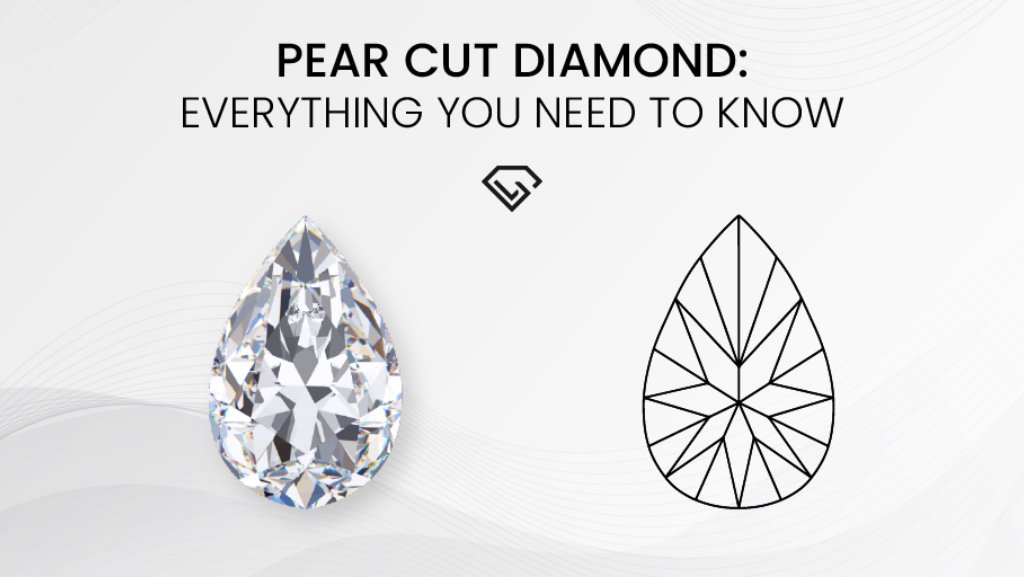
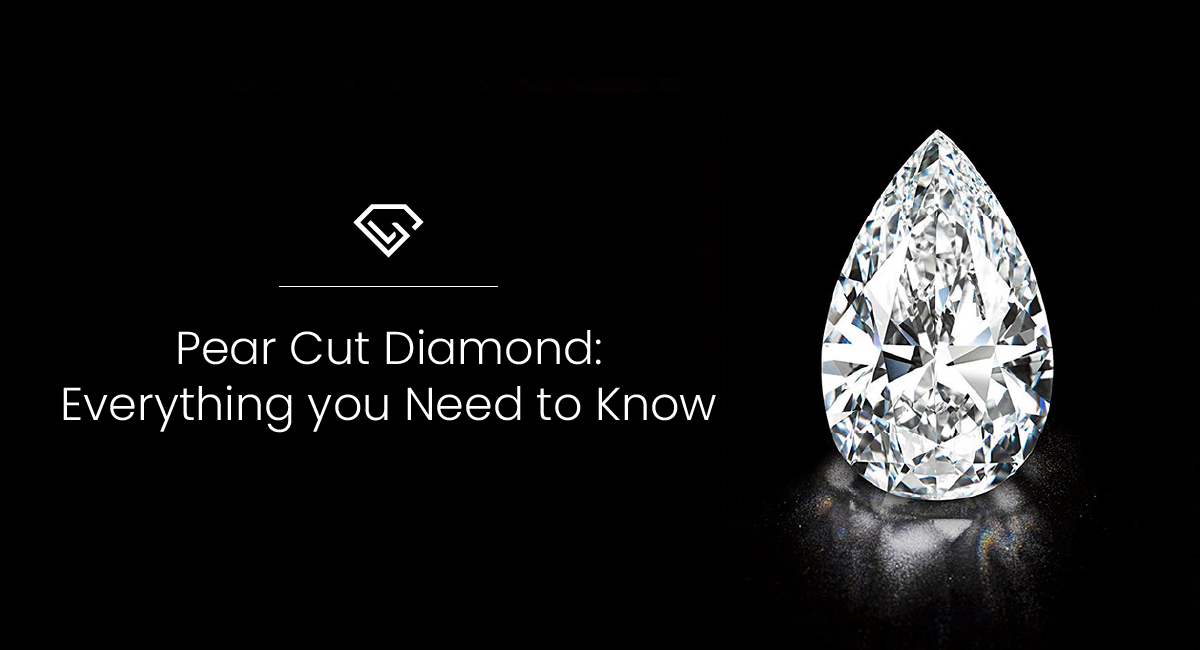
The pear cut is a gorgeous cut diamond that is a replication of a teardrop/pear shape, thus calling it either a ‘pear cut diamond’ or ‘teardrop diamond’. The cut is a combination of a smooth round diamond with an extension of a pointed formation of the stone. This makes it a subtle flux of delicateness and strength, something which is represented by the respective combination.
Pear Shaped Diamond: Everything You Need to Know

The pear cut is a rather uncommon cut of the diamond, which is an elegant form. The elongated design of the pear gives a rather classy look when worn on the fingers. It is a vintage yet romantic style that gives a timeless look to the wearer of a pear cut diamond ring.

History of Pear Shaped Diamond

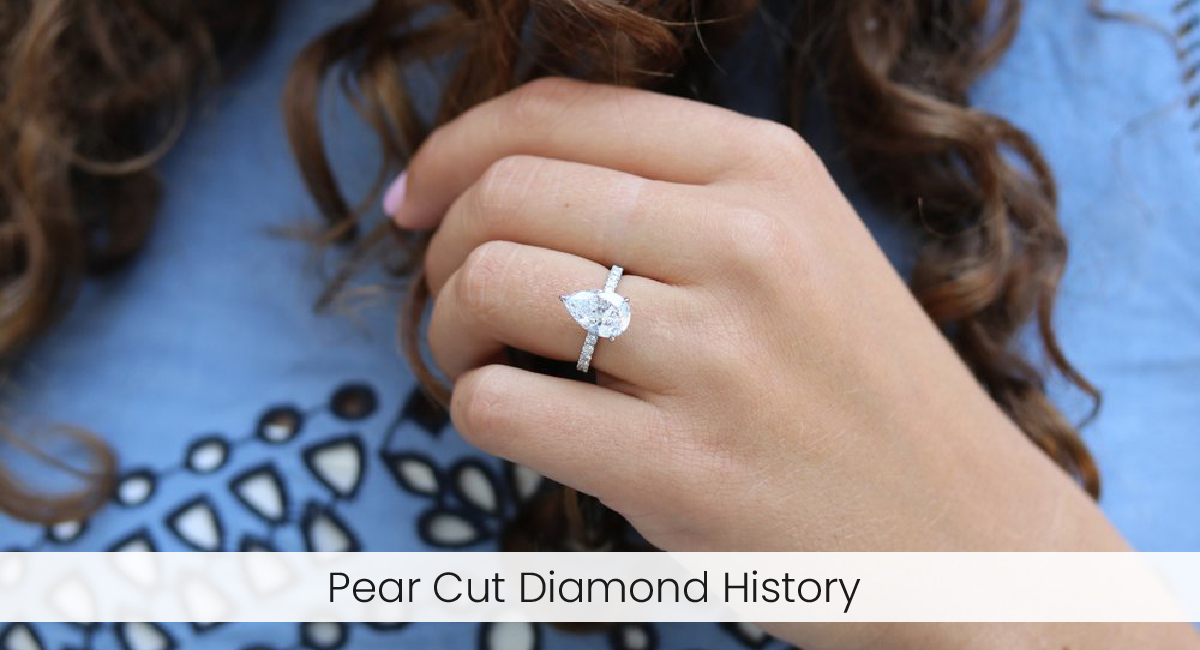
Despite having a modern look and touch in the pear cut diamond shape it is not that new in age. It ranges back to the fourteen hundreds. It was created by Lodewyk van Bercken nearly around the 1460s. The creator of these diamonds is a very famous name in the diamond industry even today as he was the one who introduced the concept of symmetry in diamonds and that the diamonds should be cut in a certain way in shape and size so as they yield us the best possible optimum results.
History of Pear Shaped Diamond

He also created the Scaife which is a type of wheel used to polish diamonds which is made with olive oil and the dust of the diamonds. It was a rebelling discovery that changed the entire diamond industry. Such was the greatness of this discovery that even to date the same Scaife is used for polishing the diamonds and making them even more beautiful and appealing.

It was this invention that allowed Lodewyk to create and implement new cuts and designs and during one such experiment, he created the famous pear shaped diamond design which to date is loved and appreciated by many out there.

[blog_page_inventory shape=”Pear” carat=”0.5,2.90″ cut=”1,4″ color=”0,10″ clarity=”0,11″]
[blog_page_btn title”Buy Now” url=”https://www.loosegrowndiamond.com/inventory/?”]

How To Buy a Pear Shaped Diamond?

The need to have a clear guide as to how to purchase a pear shaped diamond is quite vital to get the best stone worth your money. A few things that you need to keep in mind before buying the same are mentioned below.

  1. Cut

If you’re signing up for a pear shaped diamond, in the most flawless instance it should have perfect symmetry. The point and the rounded end’s tip should be well aligned. On all sides of the diamond, the bottom and the top cut should have uniform cuts.

The top of the pear shaped diamond should be like a semi-circle and not be narrower than that. Many times the cutters add more weight to the diamond, and adding more unfinished stone to the final cut might make it look like a square rather than pear shaped, which should be avoided at all costs. 
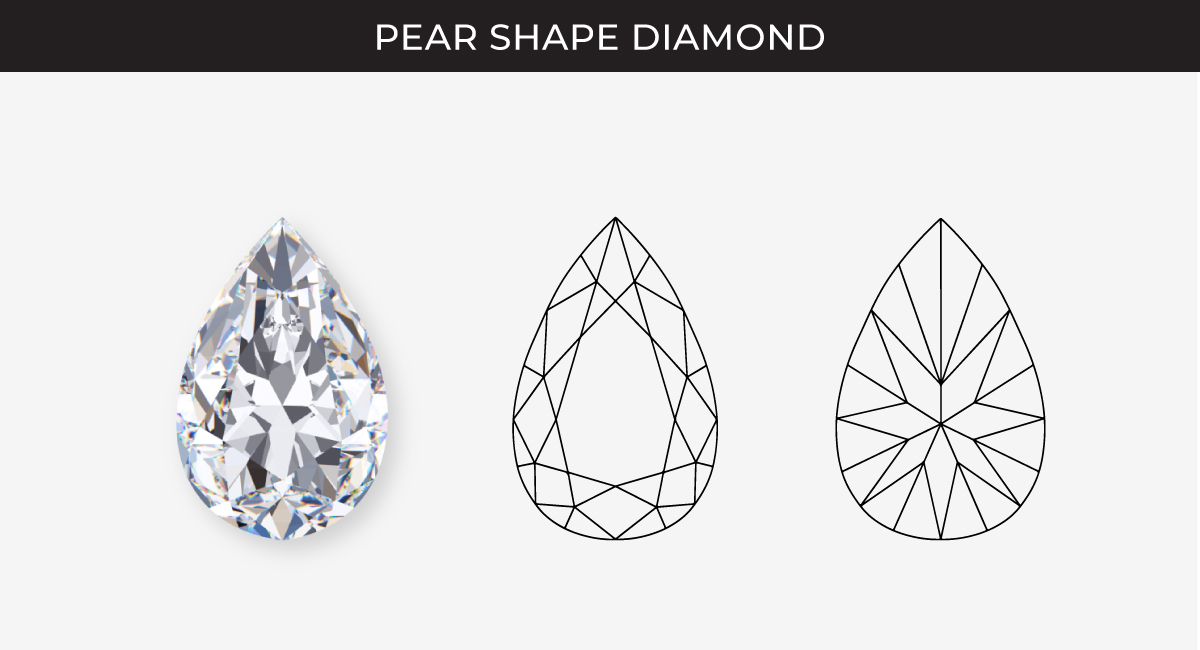
pear cut diamond

A prong should always be placed at the tip of the pear cut diamond because there is a high chance of chipping from this area. Natural flaws or extra facets also known as man-made flaws, or other inclusions may be found here since this point was formerly closest to the rough stones outside the border.

However, these imperfections will be hidden once the diamond is set because the tip is covered by a prong. The only remaining question is if the faults are large enough to compromise the diamond’s stability, which happens very rarely. 

  1. Clarity

Clarity evaluation in pear diamonds is subjective, just like color evaluation. If you want to check clarity grades, Gemological Institute of America (GIA) reports on the same are very efficient. It’s crucial to remember that everyone who is investing in a pear shaped diamond would have their ideal idea for clarity and hence its choice is subjective.

GIA clarity scale:

  • Flawless (FL)
  • Internally Flawless (IF)
  • Very Very Small Inclusions (VVS1)
  • Very Very Small Inclusions (VVS2)
  • Very Small Inclusions 1 (VS1)
  • Very Small Inclusions 2 (VS2)
  • Small Inclusions 1 (SI1)
  • Small Inclusions 2 (SI2)
  • Inclusions 1 (I1)
  • Inclusions 2 (I2)
  • Inclusions 3 (I3)

For some mixing in the diamond can be okay, as long as it can’t be seen at all. Whereas, others might demand a technically flawless and clear appearing diamond. Sticking to Slightly Included (SI) chart, which is the chart for clarity for slightly included diamonds by the GIA, SI1 and SI2 clarity are for the best monetary value.  
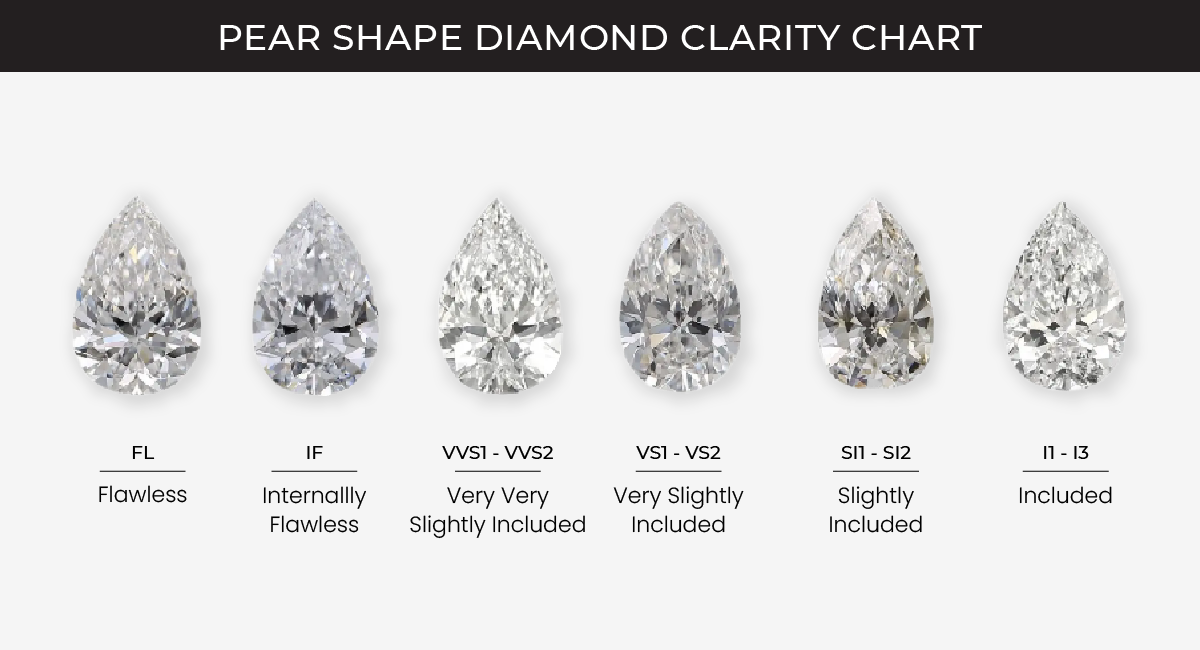
Pear shape diamond clarity chart

Pear shaped diamonds are brilliant at concealing inclusions because of their inherent round character. At the circular end of the stone, the incorporations are shadowed because of the circular shape. On the other hand in the pointed tip, it is even better to hide inclusions due to its narrow appeal which makes it impossible to see any imperfections.

Even yet, a concentrated black SI2 in the stone’s center will be apparent to the naked eye, so you shouldn’t be believing a site/seller that states that there’s nothing visible to the naked eye.

  1. Color

Color assessment of pear shaped diamonds is again subjective like the clarity assessment. It may be so, that many customers could prefer the somewhat warmer tones on their diamond rather than a completely colorless diamond.

Actually, in the supply and demand drivers, the premium price is attached and paid by buyers to a warm-toned diamond rather than colorless ones. Looking for the authentic color difference is something that is practiced in the diamond market with the only color grading system that is available.
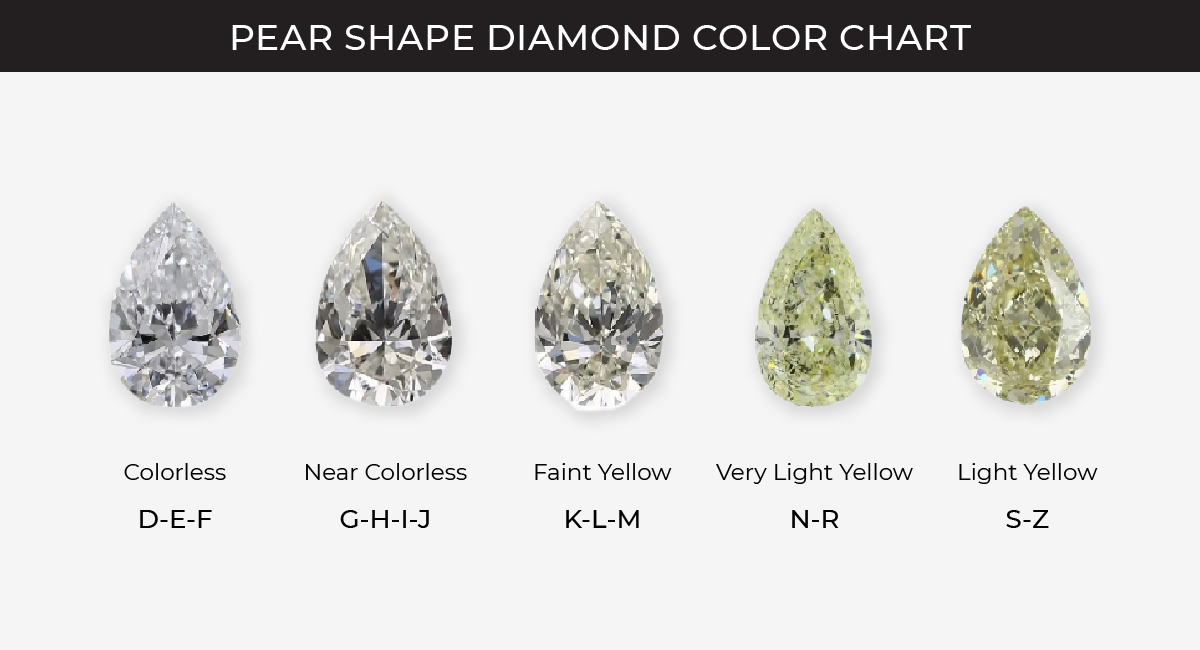
Pear shaped diamond color chart

The color may appear significantly darker at the tip of larger pear shaped diamonds. Thus when in comparison to other diamonds people may choose to increase the color gradient in pear shaped diamonds.

Do not misunderstand this color of diamonds as ‘fancy colored diamonds. These are two different things, the latter is an extensive range of diamond colors like blue, yellow, pink, green, brown, black, etc. The former is the tint and colorless scale of a diamond. 

  1. Carat

The carat range that a pear shaped diamond can vary from is 0.50 Carat – 3 Carat, each one of which has its own beauty. But, yes larger the diamond gets more protection it would need, because of how it can nip or be damaged.
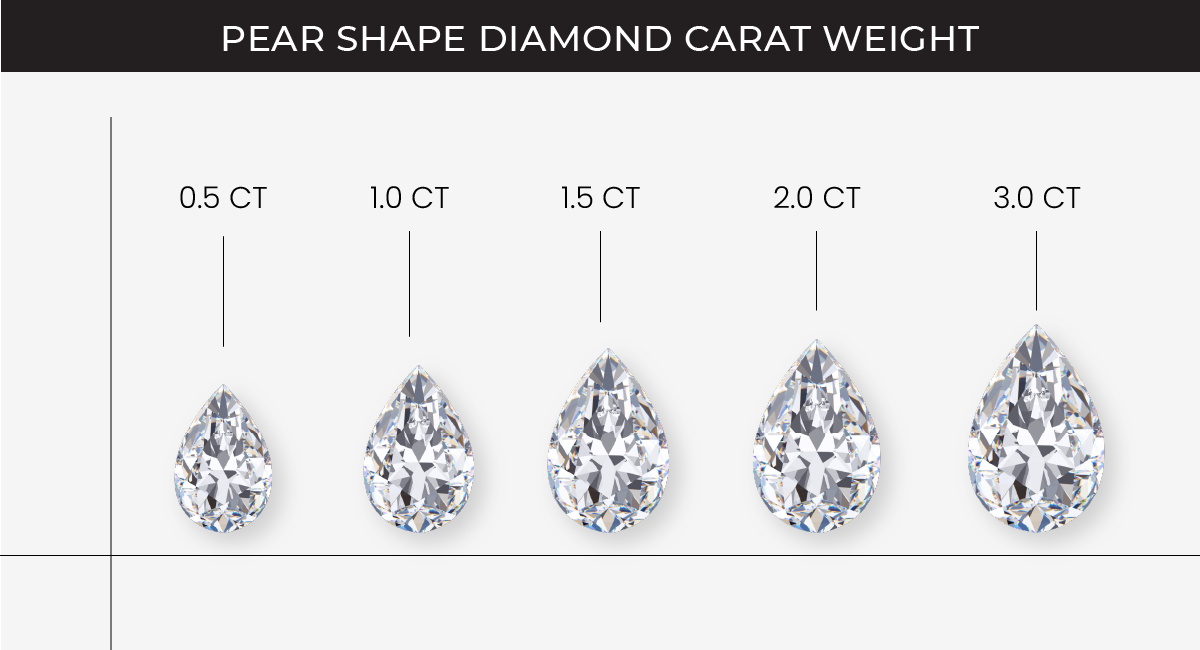
Choosing the carat size depends on a lot of things from budget to subjective choice as to what your loved one would like to wear. You can check the carat size with our Diamond Size Chart. Rightly so, these notions should be kept in mind before making a decision.

Length to Width Ratio of Pear Shaped Diamonds

The length-to-width ratio of the pear cut diamond has a lot of influence on the elegance and the shape of the pear shaped diamond ring. And, a lot of times it depends on how one likes their diamond to look.

Some people like thicker pear shaped lab diamonds than thinner ones and vice versa are also applicable. To have the length and width of the pear shaped diamond between 1.50-1.75 is what most people find suitable and is also a good call to make. A pear diamond with an excessively high length-width ratio will resemble a malformed round diamond.

length to width ratio pear shaped diamond

The length and the width of the diamond at the end depend upon individual decision-making. There are no incorrect or right answers when it comes to your preference regarding a thinner or stubbier stone. The pear’s outline must speak to you and your loved one, in the end.

Pros and Cons of Pear Shaped Diamonds

Pros

Everything in this world has its own benefits and dis-benefits such as the case with pear shaped diamonds.

  • Price: As compared to the other diamond shapes the pear shaped diamonds are very less expensive and are pocket-friendly to a level. At the same price we pay for the other diamond cuts, we will get a bigger and cooler size as in the case of the pear shaped diamonds.
  • Size: Along with the benefit of the less cost the size of the pear shaped diamond also looks quite large and elongated as compared to the other diamond shapes. It is approximately 8 percent larger in size than the traditional round shaped diamonds.
  • Sophistication: It is quite versatile in nature and can be worn as a neckpiece, ring, earrings, etc., and still look the best among its counterparts. This type of diamond cut can also be used as a side stone in various types of jewelry pieces despite being the main stone majorly.
  • Adaptability: The unique and antique visual effects of the pear shaped diamond are loved and appreciated by many. If worn around the neck it compliments the collar bone, and if as a ring it makes the fingers look thin and long. And also gives a completely sophisticated and classy look in the case of earrings. This is the most elegant diamond cut out of all the others.
  • Antiqueness: It is in the market for around many years now and is one of the evergreen and timeless classic cuts of diamonds. For women who prefer vintage and aesthetic shapes, it is the best choice.

Cons

If a certain thing has its positive sides there are negative aspects also same is applicable to pear shaped diamonds.

  • Expertise: As mentioned above symmetry and polish is a must for pear shaped diamonds and so it should only be done by experts in the fields. The naive ones cannot efficiently carry out the process thus giving it a not-so-complementing look. They also have a bow-tie effect that is they at times tend to show a dark pattern similar to the bow and tie. But in the case of well cut diamonds, this effect is not that much.
  • Fragileness: If we talk about the tip of the pear shaped diamonds it is very narrow and thus is prone to breakage and damage. Thus it becomes very important to carefully examine the tip of these diamonds before making a purchase.
  • Availability of fewer options: The pear shaped diamond cuts are very much popular and in-demand but they are not that enriched if we look at the case of options and varieties

Pear Shaped Diamonds Ring Settings

[su_youtube_advanced url=”https://www.youtube.com/watch?v=Jw1rJywO9W4″ width=”1600″ controls=”alt” autohide=”yes” autoplay=”yes” mute=”yes” loop=”yes” rel=”no” modestbranding=”yes” theme=”light” playsinline=”yes” title=”pear shaped diamond engagement ring”]

To find the ideal pear shaped diamond and that being paired with the most appropriate setting is a task we shall guide you with as it is not as simple as it may seem. The setting of a ring is important because it portrays the true beauty of a diamond while preventing it from damage; particularly on the sharp tip.

This tip is prone to chipping and catching on to items such as clothes. Hence, selecting the best setting for your style and how regularly you will wear it is important. 

Prong Settings

To put the pear shaped engagement rings in prong settings of either 5 or 6 prongs is a common phenomenon. The prong setting incorporates metal projections or blades, called prongs, to secure the diamond piece. 
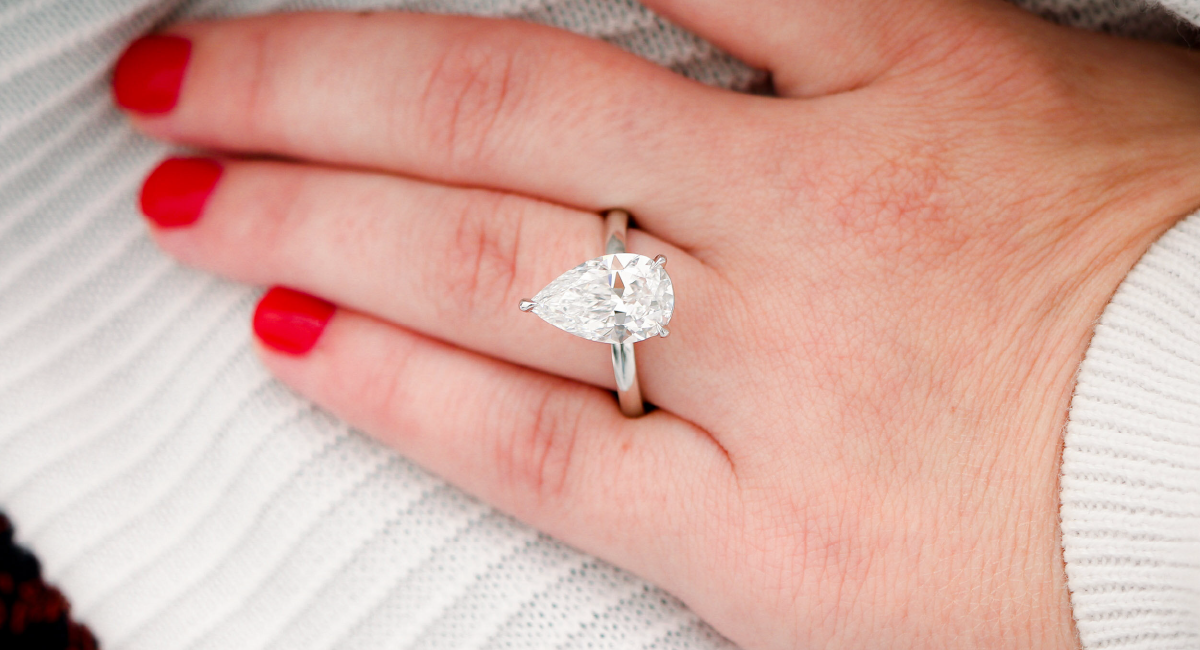
Solitaire ring

How do they protect the stone? The prong’s job is to secure the stone without taking away from the diamond’s shine and show, and one prong on the point of the lab created diamond safeguards that too. You can choose the 5-prong setting for more protection, whereas the 6 prong setting protects the diamond a little less, but gives more space to let the diamond shine in its glory.

Bezel Setting

The bezel set pear diamond ring makes sure that it provides maximum protection to the main diamond completely by enclosing the outer ring. What does the Bezel setting look like? It is a setting where the diamond is made to fit in the design completely. In this type of setting, the engagement ring metal runs along the entire edge of the gemstone to hold it in place.
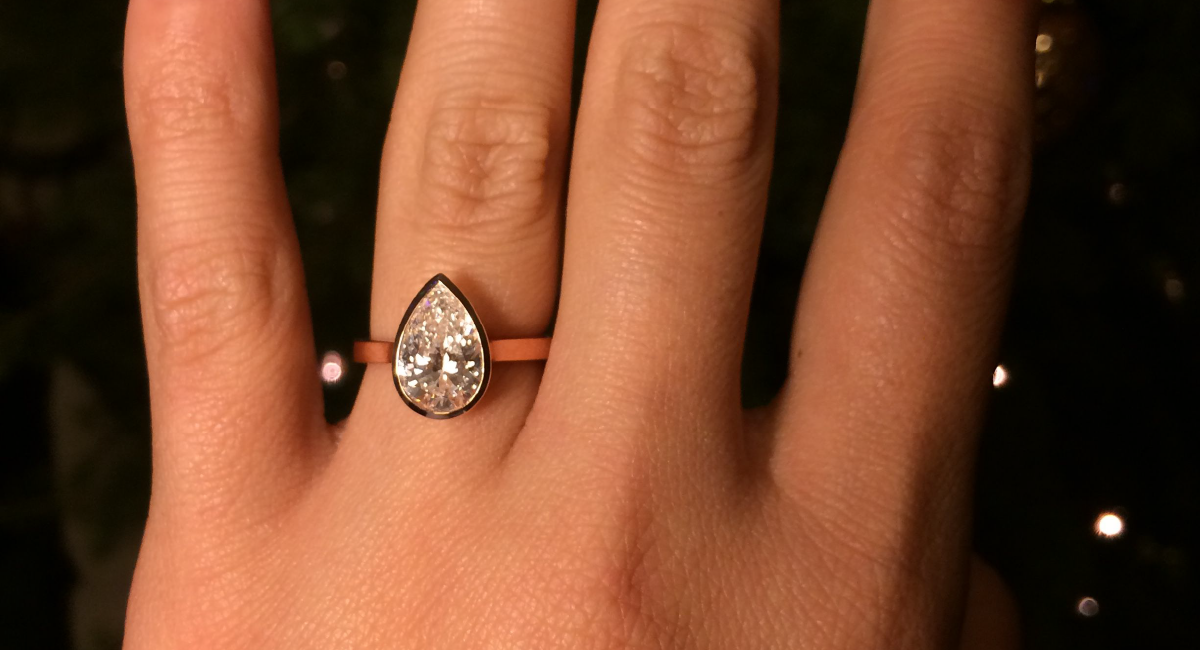
bezel set pear diamond ring 
The bezel setting is sleek, classic, simple, and most importantly functional when you have to work wearing the ring every day.

Halo Setting

The halo-setting pear shaped engagement ring is made of smaller stones, which cover the diamond and enclose the center of the stone. This setting can be of the same shape as the pear shaped diamond or can be different too depending on how the buyer likes it. 
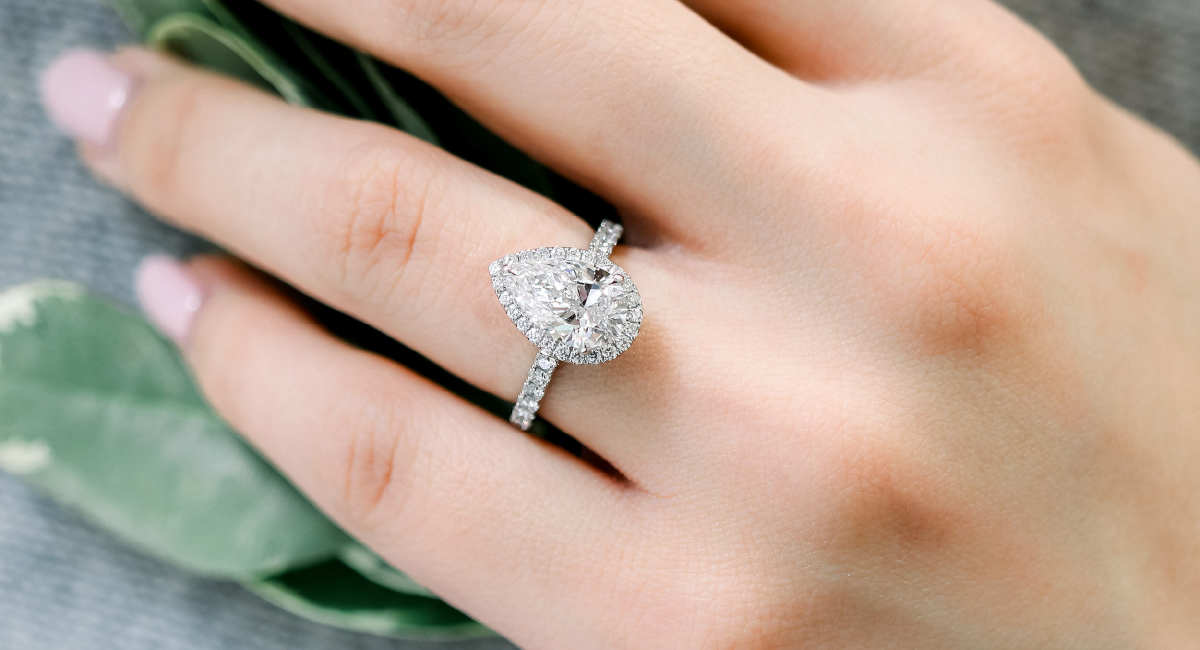
pear diamond halo ring

It creates a breathtaking all-around glitter by highlighting the diamond’s distinctive shape as it constructs a ring around it with several smaller diamonds. The lesser diamonds make the center diamond appear larger, resulting in a stunning halo engagement ring.

Tension Settings

You can also use a tension setting which is another gemstone setting where the central diamond is held in the center via contact. In this setting, the central diamond seems to be hovering between the two pieces of the casting or metal, or can in the ring band itself. 

It creates a lovely, elegant, and stand-out design. As a part of the setting is used to curve around the sharp side of the diamond to protect it from any kind of damage. This setting is very ideal for pear cut lab diamonds.
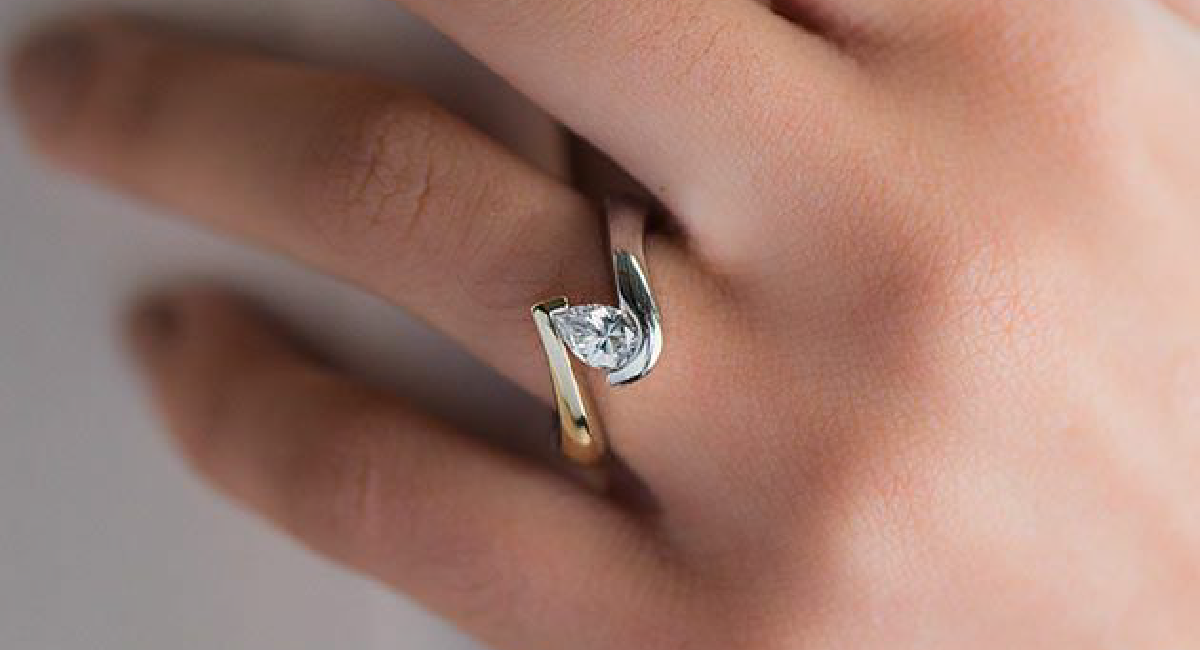
pear cut diamond tension setting

This setting brings the diamond front and center, allowing you to fully appreciate its brilliance and radiance. Tension settings are normally more expensive, but they are an option if you want to go all out on a magnificent ring. These settings can be modified along with the pear cut diamonds.

Three Stone Settings

[su_youtube_advanced url=”https://www.youtube.com/watch?v=dEuGUsp0n1Y” width=”1600″ controls=”alt” autohide=”yes” autoplay=”yes” mute=”yes” loop=”yes” rel=”no” modestbranding=”yes” theme=”light” playsinline=”yes” title=”pear three stone engagement ring”]

A three-stone pear diamond ring features a central pear shaped diamond flanked by two smaller diamonds. The women’s pear-shaped diamond ring combines timeless elegance with a modern touch, making it a popular choice for those seeking a unique and stylish symbol of love and commitment.

Where Should I Buy Pear Cut Diamonds From?

We at Loose Grown Diamonds offer world-class modifications which you can attain by sending a request. Our pear lab-grown diamonds start at are available from just $450, offering diverse options for various preferences and your budgets, providing GIA/ GCAL and IGI certification for authenticity.

Even the small-sized diamonds of this shape have a tendency to make a big impact due to their shape and size which looks enlarged which makes them look nearly 8 percent bigger on the top surface as compared to the other popular diamond shapes and sizes.

Take advantage of our exclusive discount promo code during checkout to enjoy additional savings. Adorning these magnificent vintage cuts is beautiful in every way. Shining brightest among all, they are the classy and trendy choice for women these days.


Conclusion

2018 has undoubtedly been the year of pear shaped diamonds. From Paris Hilton to Ariana Grande, Cardi B, Kaley Cuoco, Zoe Saldana, Victoria Beckham, Margot Robbie, and Katherine Heigl all these celebs were seen flaunting this shape diamond out there in the public eye. Due to the large dimensions of these diamonds and a distinctive asymmetrical look more and more people are opting out of them these days.

The women who do not want to fit into ordinary designs and styles should definitely opt for them. They also have a personal touch in them with their shape being similar to teardrop and raindrops thus depicting tears of joy and sorrow and the various seasons of life accordingly along with its unique and elegant style which adds a statement to the look of the women wearing it. It makes all the heads turn towards her thus making her the most elegant and classy one out of all others.

FAQs

What is a pear shaped diamond?
A pear shaped diamond features a distinctive teardrop shape, combining the elegance of a round cut with the uniqueness of a marquise cut, creating a stunning and timeless silhouette.

How do I choose the right setting for a pear shaped diamond?
Select settings that enhance the diamond’s elongated shape, like a solitaire or halo setting. These accentuate the beauty of the pear shape while providing stability and security. For more clarity about this diamond shape’s ring, refer to our other informative piece to the rescue here.

Are pear shaped diamonds prone to the “bowtie effect”?
Like other fancy shapes, pear diamonds can exhibit a bowtie effect, a dark area across the center. Expertly crafted cuts and proper proportions minimize this effect, ensuring optimal brilliance.

Do pear diamonds sparkle?
Yes, pear shaped lab diamonds can sparkle beautifully if well-cut. The symmetry of the diamond is crucial in enhancing its sparkle.

Are pear shaped diamonds suitable for engagement rings?
Absolutely! The unique and romantic pear shape is a popular choice for engagement rings, symbolizing enduring love and sophistication. Customize your perfect ring with a pear shaped diamond at Loose Grown Diamonds.
Cushion Cut Diamond: A Complete Guide

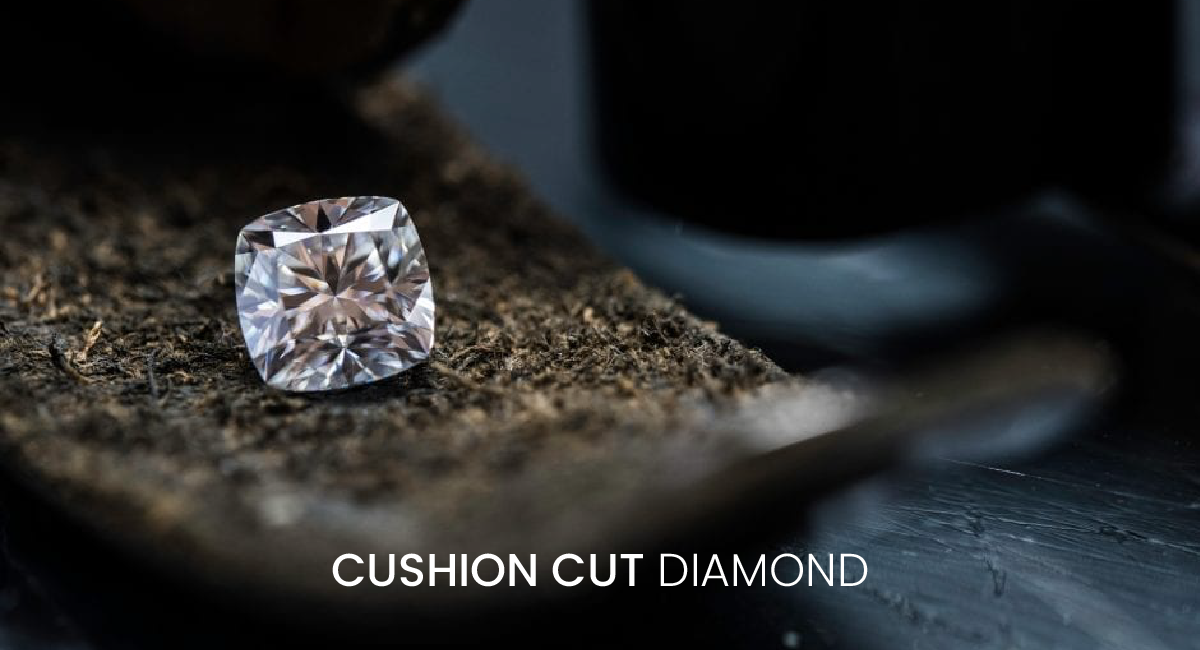
Everyone loves a good cushion-cut diamond. They are one of the favourite cuts in the market and are known for their beauty, brilliance, cut, and clarity.

Cushion-cut diamonds are pieces of art and expertise. They combine the exquisiteness of a great design with the most beautiful natural element. Such diamonds are all in all a great option, but selecting the perfect cushion cut diamond can be a handful task with so many suppliers and manufacturers in the market.

Cushion Cut Diamond: A Complete Guide

Just buying the right lab-created cushion cut diamond requires you to roll up your sleeves and understand the details and features of the diamond. Read about it ahead!

History of the Cushion Cut

Cushion-cut diamonds are called the perfect amalgamation of modern and classic. Even though they seem to be gaining popularity now, the cushion cut can be traced back to the 19th century. 

Many diamond experts and historians believe that it was either known as mine cut back then or the cushion cut is an evolution of mine cut. You can certainly see the resemblance between the two. The place of origin is often recognized as Brazil or more specifically Brazilian mines, hence the old name, mine cut was coined. 

The biggest difference between the mine cut and cushion cut diamond is that the mine cut has 58 facets whereas the modern cushion cut has a total of 64 facets. Throughout the evolution from mine cut to cushion cut, the diamond first gained popularity amongst manufacturers and then the entire world. 

The world Famous Hope diamond is a cushion cut diamond weighing approximately 45 carats and the enchanting Regent diamond which is also one of the most popular diamonds around the world, is also in a cushion cut weighing around 140 carats. 

Many crown jewels of the Englishmen and royalty are cushion cut and once the diamond was popular amongst the royals it became a rage amongst the masses. To date, the cushion cut is known to be an antique cut because of its history.

What is a Cushion Cut Diamond?

What is a Cushion Cut Diamond?

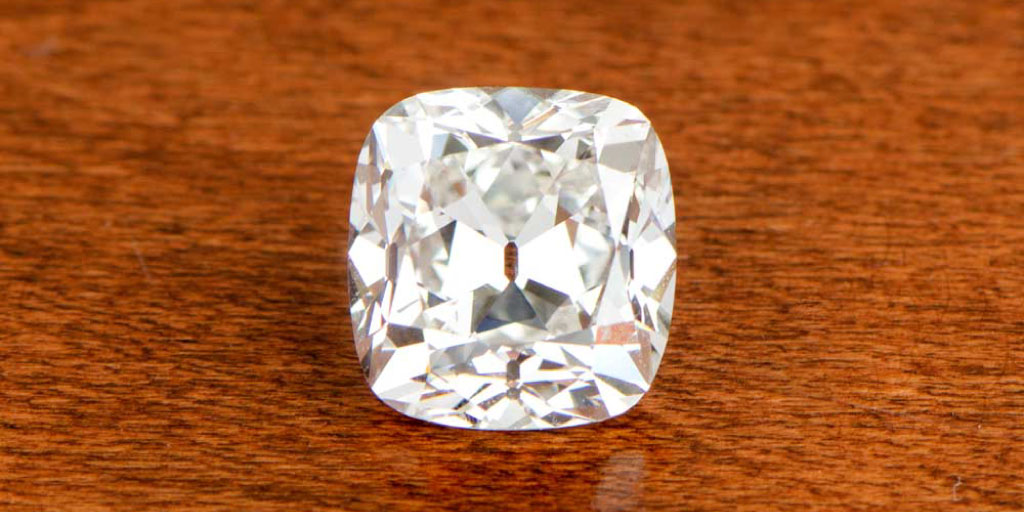
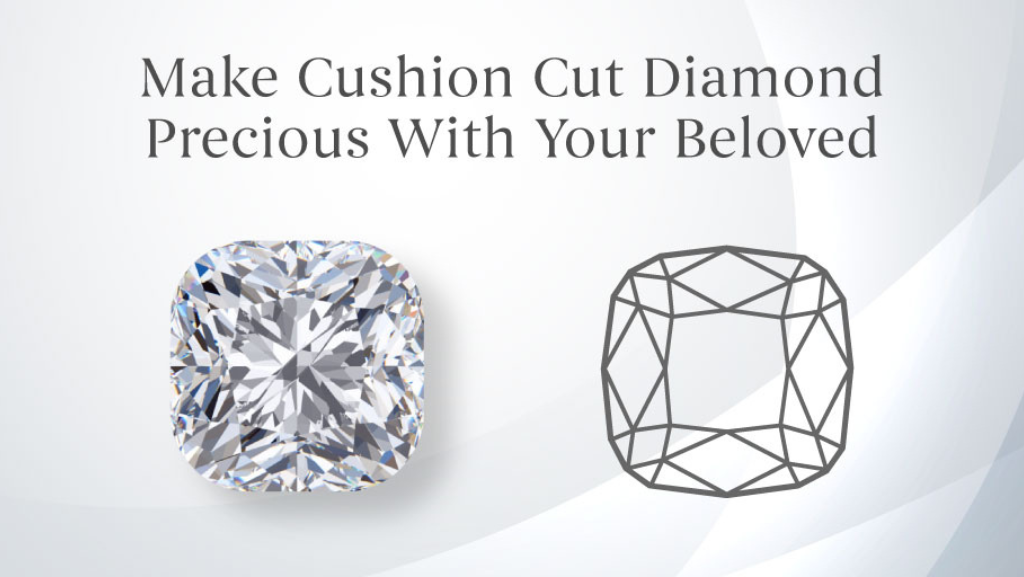
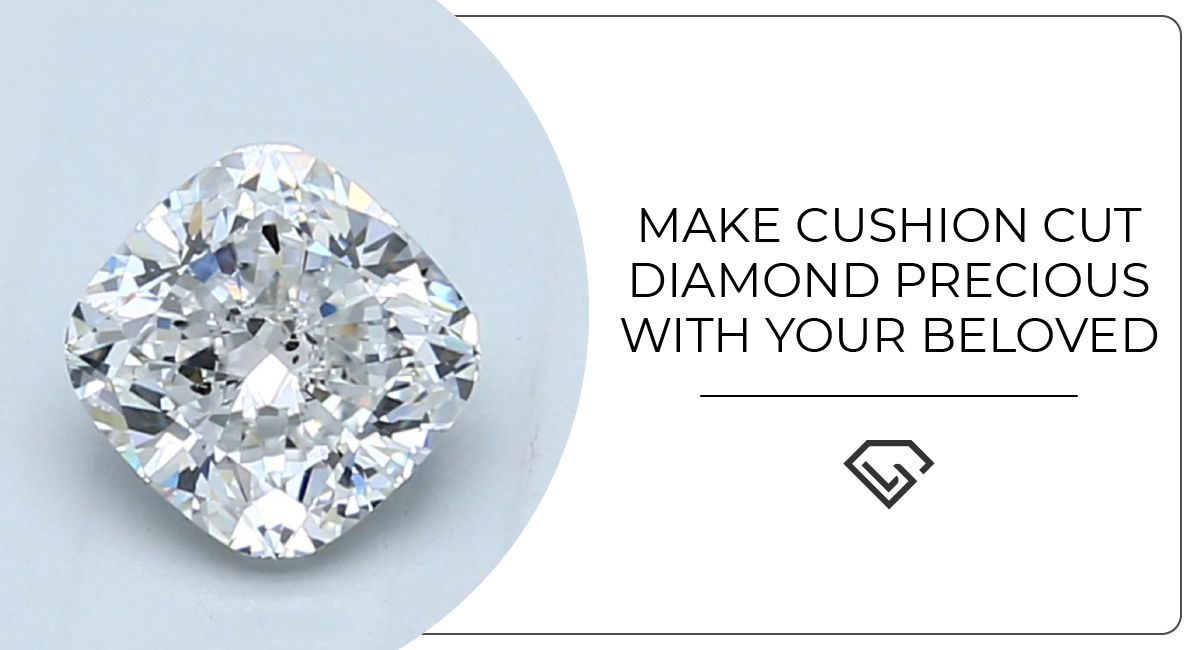
A cushion cut diamond is a popular and classic diamond shape known for its rounded corners and larger facets, which give it a soft, pillow-like appearance. It is a square shape with curved edges, resembling a pillow. This cut combines a square or rectangular shape with rounded corners, creating a timeless and elegant look.

The World of Cushion Cut Diamonds

Cushion cut diamonds are gaining popularity around the world and rightly so. Cushion cut diamonds are one of the most popular diamonds because they maximize brilliance. How? Because they combine a round cut and a square cut. Their facts increase their brilliance and even add fire. Fire is the appearance of colored light inside the diamond.

Cushion cut diamonds come in many designs, metals and when paired with other diamonds or precious stones, they have a classic and vintage feel to them. If you are looking for a diamond with durability they are the most suitable option because they have rounded edges and many facets.

The best thing about lab grown cushion cut diamonds is that they are less expensive when compared on a per-carat basis than an average round-cut diamond.

The Perfect Guide for Cushion Cut Diamonds

What you see at your diamond trader showroom is a beautiful end product, but cushion cut diamonds have much more to them that goes into making. The most essential things you need handy to buy the perfect cushion cut diamonds are knowing about the cut, clarity, color, length-width, and size of the diamond. 

The Perfect Guide for Cushion Cut Diamonds

There are a lot of things to know about cushion cut diamonds when you buy them, but we don’t want you to have to go through the hassle of researching and looks multiple places, we have made it easy for you. 

We give you the perfect guide on how to buy cushion diamonds. It covers everything from what to look for in a cushion cut diamond, all the grading, types of rings, a comparison of the two most popular types of cushion cuts, and answers to the most frequently about cushion cut diamonds.

Without making you wait further, let’s dive right ahead into the world of cushion lab diamonds.

How to Select Cushion Cut Diamonds?

Here are a few pro tips you should surely exercise before buying a cushion cut diamond. All of them, when exercised and performed in the right manner, make the process of selection so much easier and you can absolutely buy diamonds like an expert! So here we go:

How to Select Cushion Cut Diamonds?

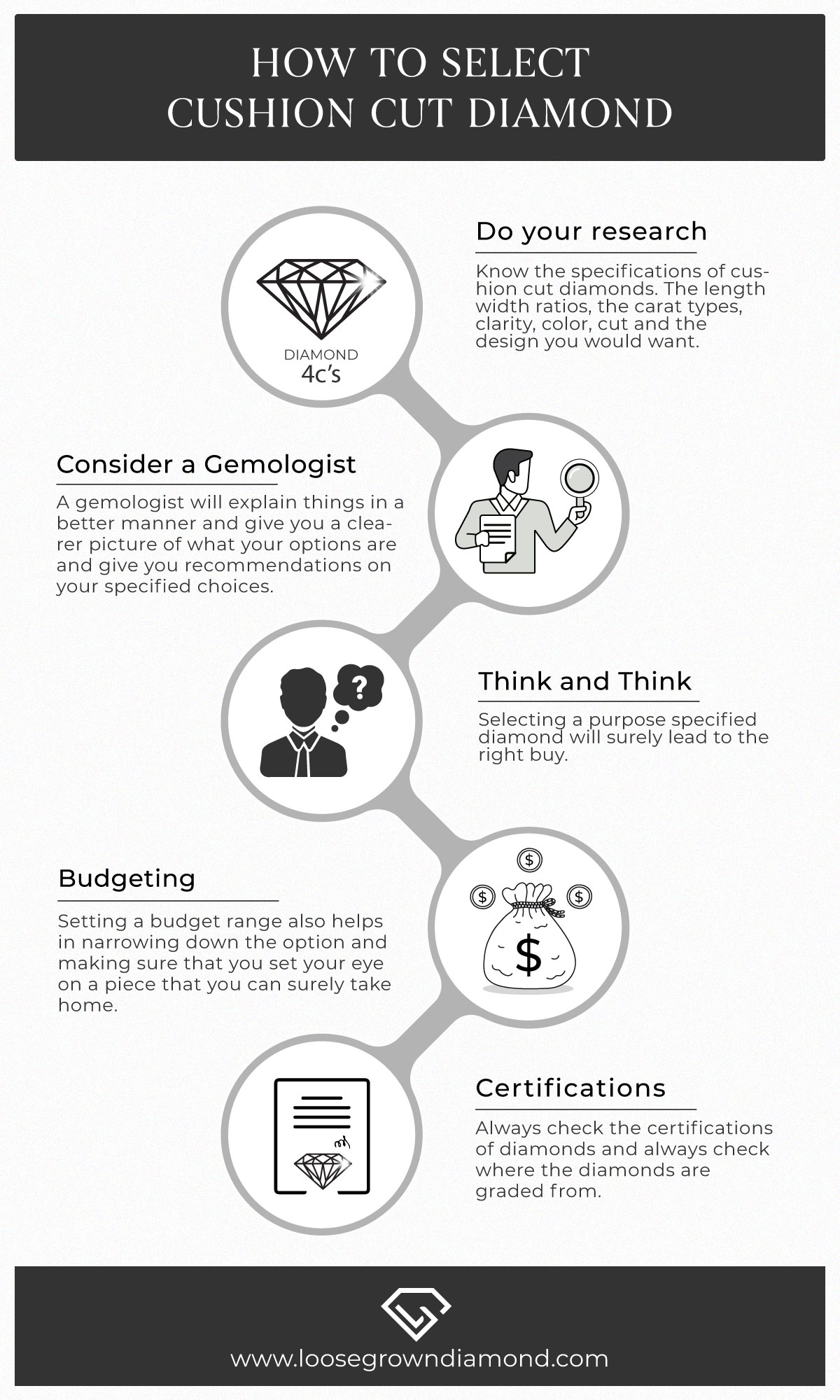
  1. Do Your Research

Cushion cut diamonds are one of the most eye-pleasing diamonds but require a good amount of research. Before walking into any store, do thorough research on what the prices are, which stores are the best, what kind of diamond you prefer? Natural or lab-grown.

All of this is important to know when buying a diamond, especially a cushion cut. Know the specifications of cushion cut diamonds. The length-width ratios, the carat types, clarity, color, cut, and the design you would want. Cushion cut diamonds come in a plethora of designs.

Check different exporters and suppliers and see if any which one stands out to you. An expensive buy deserves extensive research.

  1. Consider a Gemologist

If you are buying a cushion cut diamond for a super special occasion then consider hiring a gemologist or at least consulting one once. 

A gemologist will explain things in a better manner and give you a clearer picture of what your options are and give you recommendations on your specified choices. 

Hiring a gemologist is great because the cushion cut diamond market is huge, and narrowing down the options and selecting the best one, is done right by an expert. 

  1. Think and Think

Going diamond shopping without knowing what you need and what you need it for is a rookie mistake. Go in knowing exactly what you need it for, formal wear, daily wear, occasion wear, or big event wear. 

Knowing what you need the diamond for help when you look at so many options because all you have to ask yourself is “is this right for the purpose I am buying it for?”.  Selecting a purpose-specified diamond will surely lead to the right buy. 

If you are a couple who is buying a diamond, always remember to have a long detailed discussion before buying a diamond. Discuss what you and your partner like, what kind of cut will suit both of you, what is an absolute no, and then come to a list of things that are mutually acceptable. Doing this helps in buying a diamond which you both will cherish.

If you are someone looking for a ring to propose to your partner, remember to know the ring measurements and try and know their choices by asking them a few indirect questions or maybe taking the help of their friends.

  1. Budgeting

Never set an exact price. Set a budget range. Setting a budget range has a higher chance of you remaining in the budget. Setting a budget range also helps in narrowing down the option and making sure that you set your eye on a piece that you can surely take home. 

  1. Certifications

It is absolutely imperative to be thorough about certification because you never want to be fooled by the supplier. Certified diamonds are the best diamonds and the only diamonds you should buy. Always check the certifications of diamonds and always check where the diamonds are graded from. Given below are the most renowned diamond certification bodies in the world.

    1. GIA: Gemological Institute of America
    2. AGS American Gem Society 
    3. IGI: International Gemological Institute. 
    4. EGL: European Gemological Laboratory
    5. GCAL: Gem Certification & Assurance Lab

Each of these certifications is regarded on an international level and aims to check the quality of diamonds. Always remember to buy certified diamonds, with certifications from well-known labs. 

[blog_page_inventory shape=”Cushion” carat=”2.00,3.70″ cut=”1,4″ color=”0,10″ clarity=”0,11″]
[blog_page_btn title”Buy Now” url=”https://www.loosegrowndiamond.com/inventory/?”]

Understanding the Cushion Cut Grading Level

Cushion cut diamonds also involve a lot of different gradings and statistics. But do not worry, we have all that you will need in one place. Grading levels are important to understand before buying lab grown diamonds, so here are the grading levels of cushion diamonds.

  • Length – Width

Cushion cut diamonds come in three varied lengths to breadth ratios.

    1. 1.00- Equal length and width.
    2. 1.10- Has one side is slightly longer than the other.
    3. 1.20- A cushion cut in an obvious rectangular shape.
  • Depth

Depth % for Cushion Diamonds: The side view of the diamond can be seen to look at the depth of the diamond. Above 70% depth is not considered good. You can keep these categories in mind when looking for the perfect cushion cut diamond depth. 

    1. Excellent: 61%-67% & 67- 70 
    2. Good: 56%-61% & 71- 73
    3. Poor: 56> & 73<
  • Table

Cushion cut diamonds by virtue of their cut have a table-like top. Above 72% percent is not considered the best. These percentages need to be kept in mind while assessing the table of cushion cut diamonds. 

    • Excellent: 61% – 67% 
    • Good: 68-61% or 56%-58% 
    • Poor: >73 or < 54
  • Cut

Cushion cut diamonds also come in a few variations, with varying pavilion cuts and facet designs. There are four main types: 

    • Chunky or old mine- The oldest known cushion diamond with symmetrical facts. The facets are clearly defined and this is also known as an antique cushion cut diamond.
    • Crushed ice – A more modern type of cushion-cut diamond. The diamond gets its name because if you look at it, it looks like pieces of crushed ice have been placed inside the diamond. The diamond often resembles the look of a radiant cut
    • Brilliant- Brilliant cushion cut diamonds are cut in a specific way to maximize the reflection of light in order to give the best brilliance. 
    • Hybrid- The newest and most cutting edge cushion cut diamond. Hybrid combines the brilliance of the brilliant-cut and the beauty of the crushed ice diamond. 
  • Clarity

Clarity is very important in many diamonds and determines their value. FlawlessVery Very Slightly Included (VVSI) is ideal for under 0.50 carat to 2 carat cushion cut diamond. However, a range of Very very slightly included to slightly included (SI) also looks good for 0.50 to 2 carat diamonds. 

  • Color

Cushion cut diamonds have a reputation for retaining color, it becomes even more important to carefully check the color grade of the diamonds you are buying. 

  1. For any diamond below .50 ct.,  a D-G grade is the best, however, H-I grades also look good. Anything below a K grade is not recommended.
  2. 0.50-1.0ct. Diamond D-G grade is recommended, H-I grades also have good color but anything below a J grade is not recommended.
  3. For 1.0 – 2.0ct. diamond DF is recommended and anything below a J is not recommended.
  4. For diamonds above 2.0ct, a D-F grade is recommended and anything below an H is not recommended.

Cushion Diamond Size Chart

Cushion diamonds come in various carat sizes, and the carat weight is generally associated with the dimensions of the stone. It’s advisable to consider personal preferences when choosing a cushion diamond size. For a comprehensive guide covering various carat sizes, kindly visit our diamond carat size chart.

The Best Cushion Cut Engagement Rings

Cushion cut diamond rings are one of the top contenders in the engagement ring market. The soft finish gives the perfect romantic undertone to the ring.

If you are looking to buy a ring that hits the sweet spot of balance between romantic and designer, buying the cushion cut diamond engagement ring is probably your best bet. Selecting a great design that impresses your significant other, can be a handful of tasks. 

Cushion Shape Solitaire Diamond Engagement Ring

Cushion Shape Solitaire Diamond Engagement Ring

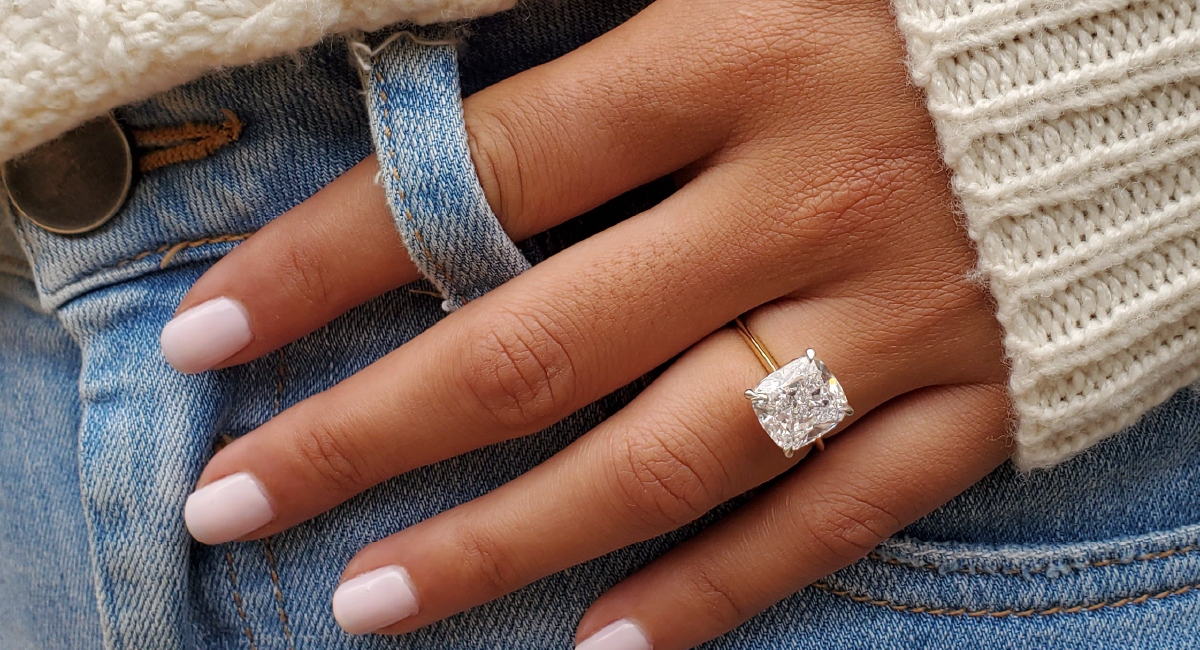
The most classical and evergreen design that you get with cushion diamonds is the solitaire diamond engagement ring. It is a simple and clean look that does not let the attention get away from the central beautiful cushion cut diamond ring.

There are multiple styles you can still choose to opt for with the cushion cut, especially the kind of setting you would want, the metal you want for the ring band, and lastly also choosing the style of the band.

You can have a pave set band with diamond accents or you can keep the ring simple with a plain band and a four-prong setting.

Cushion Shape Three Stone Diamond Engagement Ring

If you are someone who wants to give a shine to the sobriety of the cushion cut with some extra diamonds. The three-stone diamond ring is a design that has a little bit more grandeur than the simple solitaire and if you are someone who likes a clean but jazzy look, this design is perfect for you.

[su_youtube_advanced url=”https://www.youtube.com/watch?v=87yET2796Pc” width=”1600″ controls=”alt” autohide=”yes” autoplay=”yes” mute=”yes” rel=”no” modestbranding=”yes” theme=”light” playsinline=”yes” title=”three stone cushion cut engagement ring”]

The three-stone diamond ring as the name suggests has one central cushion diamond, accompanied by 2 more diamonds adjacent to you. You can choose to customize the ring to your liking and select which stone would accompany the central diamond, the best. 

There are certainly a lot of options you can look at like going ahead with half-moon cut diamonds or pear-cut side diamonds. You can also choose cushion cut diamonds to be the only cut that the ring features. We would personally suggest going ahead with either a platinum band or a white gold band.

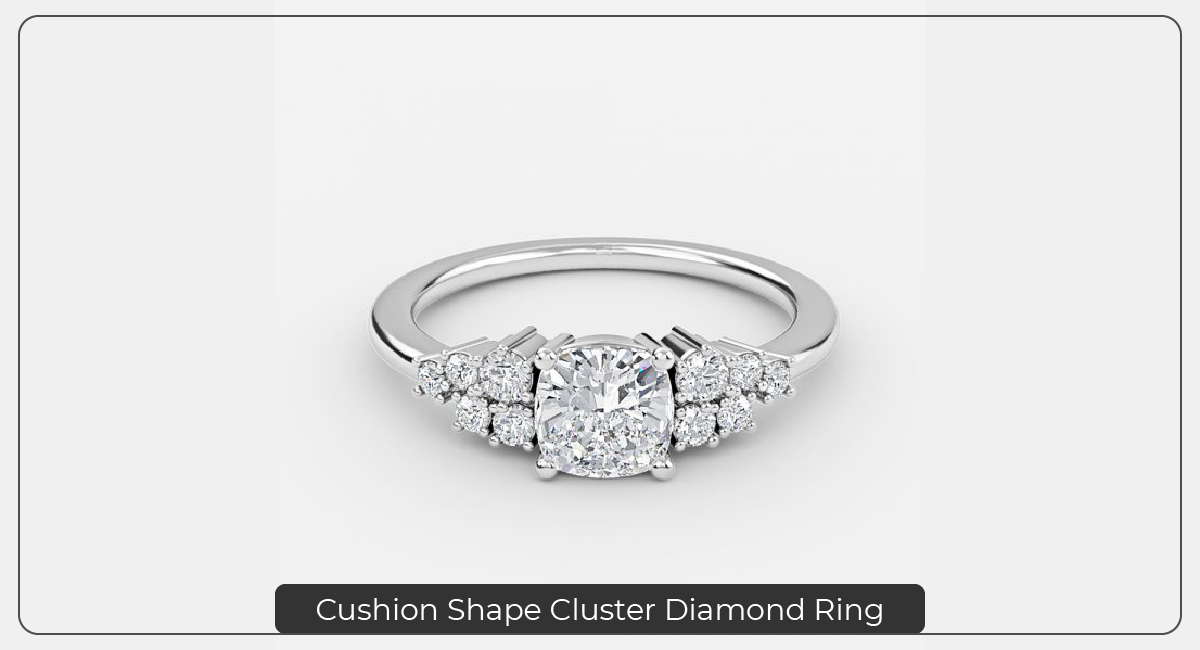
Cushion Shape Cluster Diamond Engagement Ring

Cushion Shape Cluster Diamond Engagement Ring

 A cushion cut cluster diamond ring entails a bunch of cushion cut diamonds organized neatly in a design. The number of diamonds and diamond accents differs on the basis of what ring design you go ahead with but definitely, the center stone is a cushion-cut diamond.

A cluster cushion cut engagement ring is complemented by grain designs known as filigree designs which are intricate and make for an absolutely regal ring.

Bezel Cushion Cut Engagement Ring

The setting of the diamond refers to how it is secured onto the ring. A bezel setting involves encircling the diamond with a metal rim, or bezel, that holds the stone in place. This metal rim surrounds the entire perimeter of the diamond, offering both security and a distinctive look.

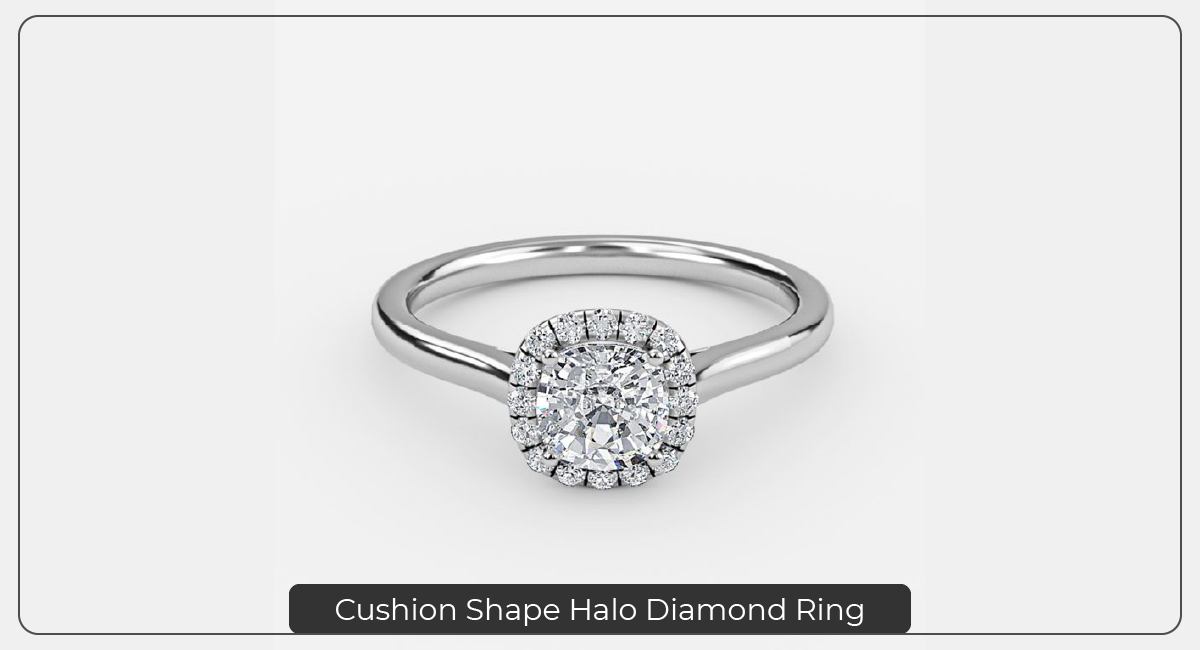
Cushion Shape Halo Diamond Engagement Ring

Cushion Shape Halo Diamond Engagement Ring

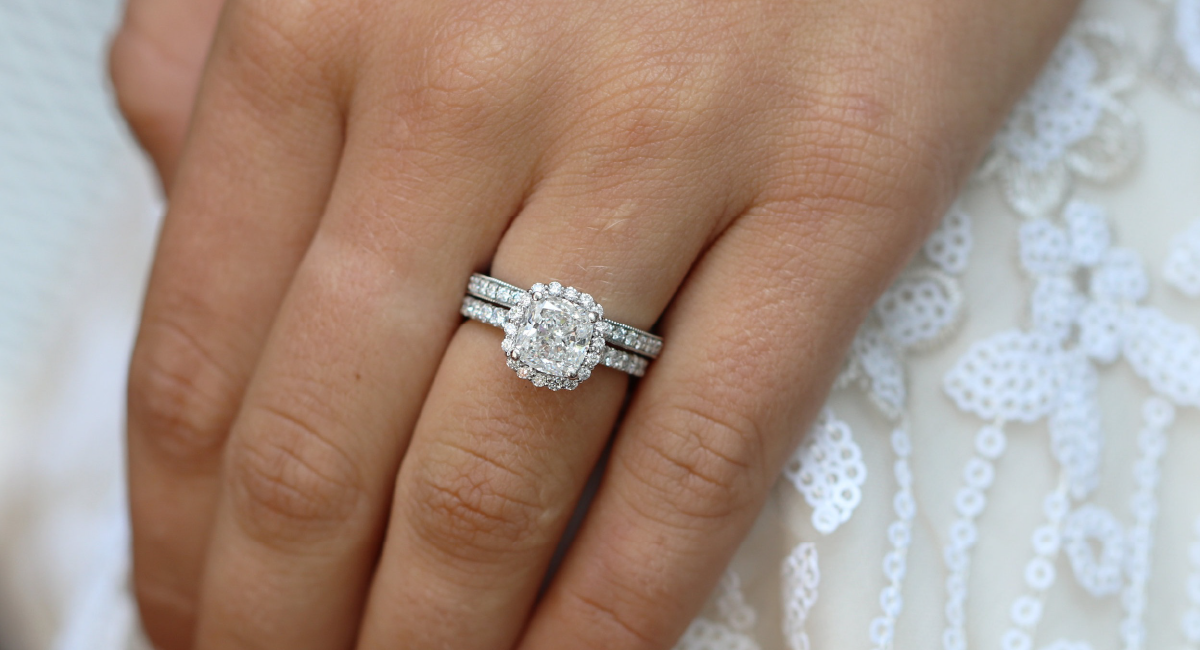
One of the best-selling designs when it comes to cushion cut diamond rings, the halo diamond shape is a forever favourite in the market. It offers a great design that only enhances the shine of the central cushion cut diamond.

There are multiple cushion cut halo ring designs you can go for like a hidden halo cushion cut engagement ring which has the halo beneath the central diamond, adding a layer of depth to the ring. You can also go for a double halo design which adds an extra layer of glamor to the look.

Conclusion

Cushion cut diamonds make a great buy diamond and everyone’s best friend especially for soon-to-be-married couples. 

If you are looking for the best cushion cut diamond Diamond and want to select you to need to do your homework and here Lab Grown Diamond curated this guide to help you out in making an informed and great choice. 

Cushion diamonds are popular and will never disappoint you. Equip yourself with this amazing guide, and you are now ready to shop cushion cut diamonds like an expert.

LGD specializes in lab-grown diamonds and provides a range of certified cushion diamond and cushion cut diamond engagement rings options with distinct characteristics.


FAQs

How does the cushion cut differ from other diamond cuts?
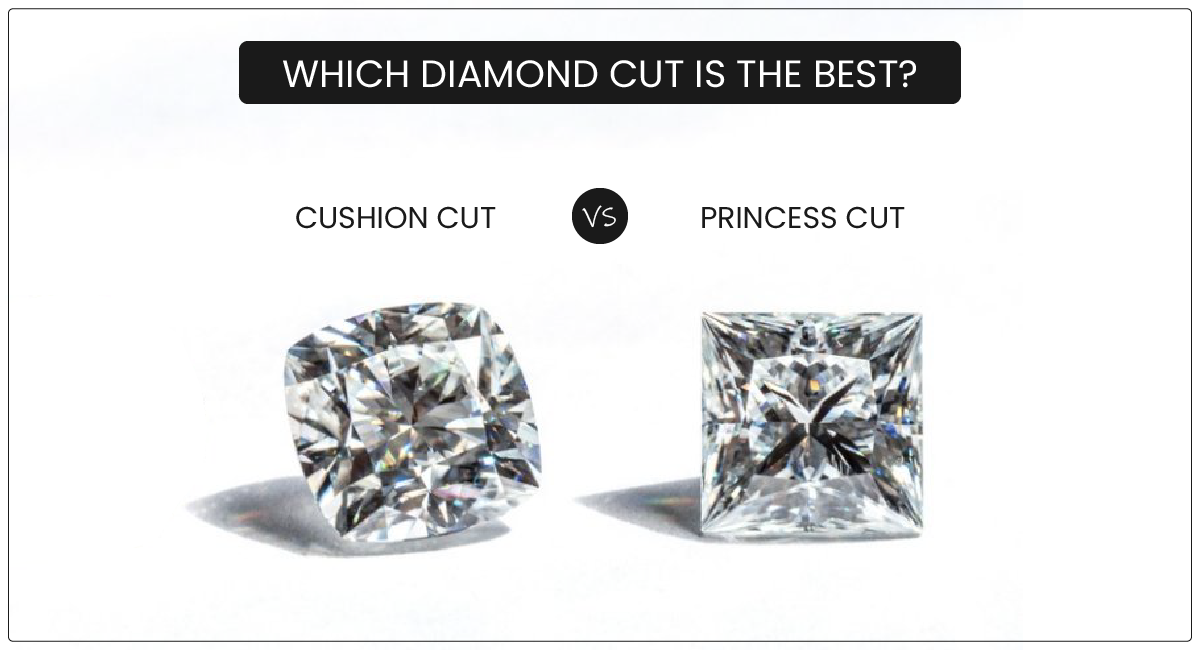
The cushion cut combines elements of the round brilliant and princess cuts. It has larger facets, which can give it a distinctive sparkle.

What is a cushion-modified diamond?
A modified cushion cut diamond is a variation of the traditional cushion cut, featuring adjustments to facets or ratios to enhance its brilliance or visual appeal.

Why choose a cushion cut diamond ring?
cushion cut is versatile and complements various ring styles, from classic solitaires to intricate vintage designs. It pairs well with different settings and metal types a fire that adds a touch of romance to the jewelry.

Can a cushion cut diamond ring be customized?
LGD offer customization options for cushion diamond rings, allowing you to choose the metal, setting style, engraving and additional features to create a personalized and unique piece.

Are cushion cut diamond rings suitable for everyday wear?
Yes, cushion cut diamond rings are suitable for everyday wear. However, it’s essential to consider the setting and choose durable materials to ensure longevity and minimize the risk of damage.

Old Mine Cut Diamonds: Everything You Need to Know

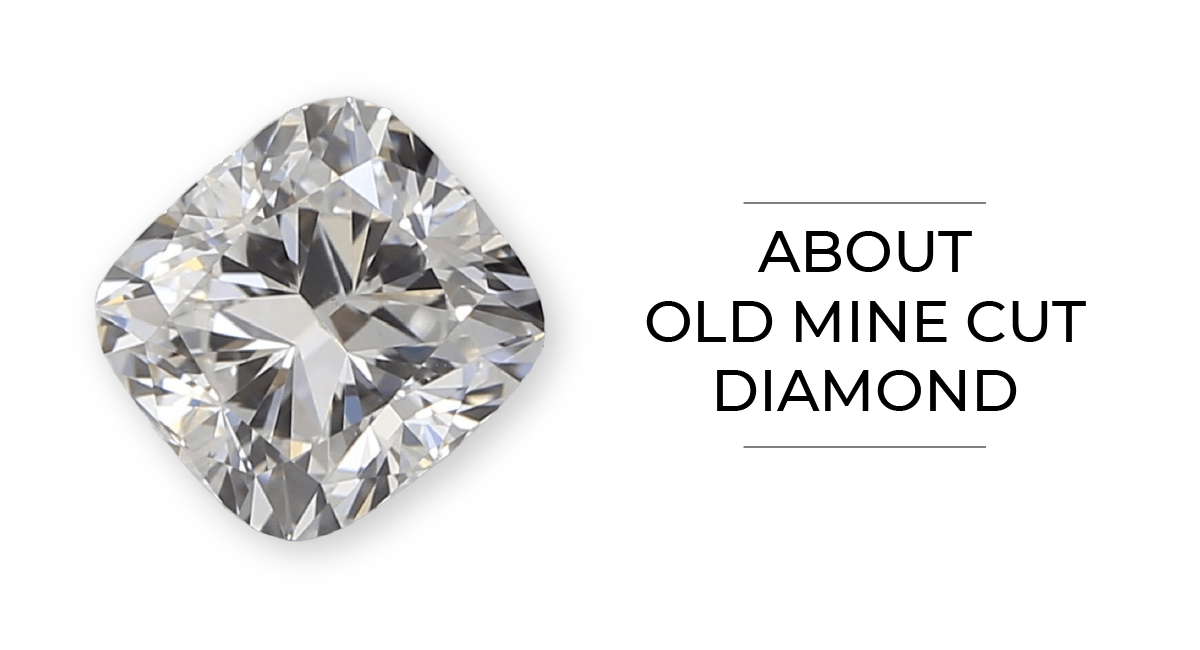
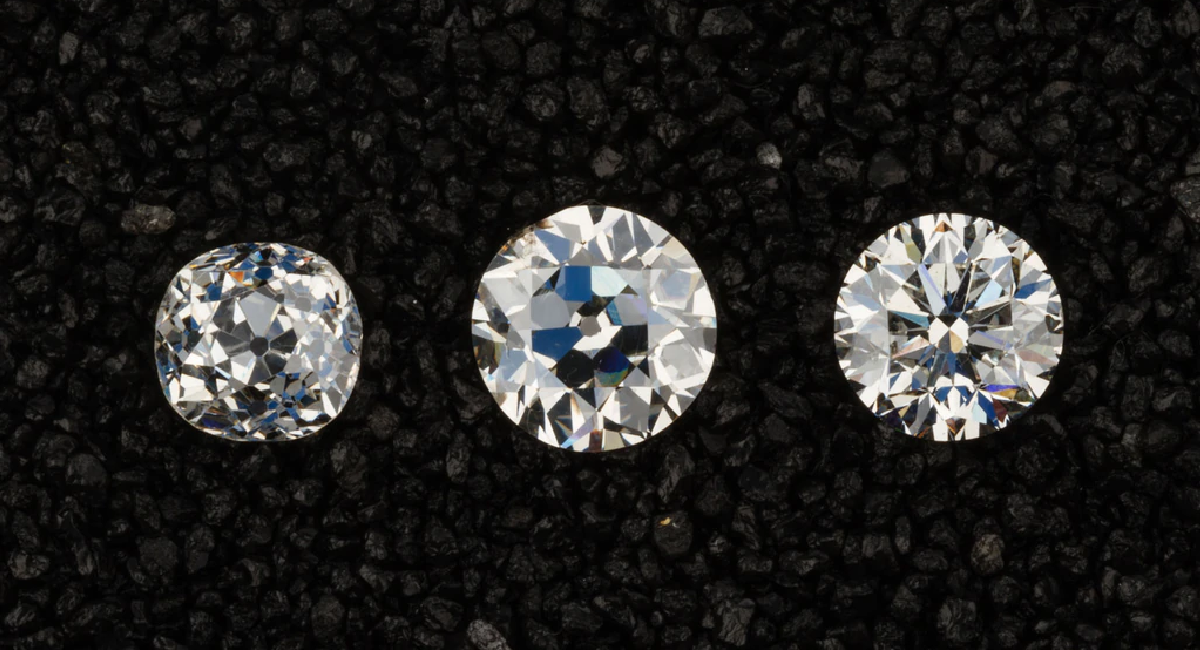
Diamonds with an old mine cut are recognized as antique diamonds. The old mine cut diamond has distinct proportions and a unique fire about them due to which they are having somewhat of a renaissance.  This cut was prominent in the 18th and 19th centuries among nobles and voracious diamond collectors throughout the Georgian, Victorian, and Edwardian eras. 

about old mine cut lab grown diamond

Their distinctness can also be attributed to the fact that, unlike modern cut diamonds, these were cut only by hand, giving the diamond the warm appearance that people love about antique engagement rings.

Sometimes today the old mine cut is also referred to as the ‘miners cut. Even though they are cut by hand and modern cut diamonds utilize modern technology and brilliant machinery, the aesthetics of these diamonds are quite similar with certain key differences that make each one unique. 

What is an Old Mine Cut Diamond?

The ‘Cut’ of a diamond means the design in which it has been shaped. The cut is not the same shape as a pear, princess, cushion, round, oval etcetera; like the name suggests. This way of naming diamonds dates back centuries and is still very much popular. It belongs to the mid-18th century and remains a timeless piece. It is one of the oldest cut types that the diamond industry knows of. 

For any antique or vintage lover, this type of cut is a jackpot. It has the hints of 18th-century Europe, making its appearance a historic piece attached with value. ‘Old mine cut’ was first used to refer to diamonds from India and Brazil and they used to be square in shape with sparkle. However, later on, diamonds were sourced from Africa because of their better quality in terms of color, hence were recognized as ‘old mine cut diamonds. These are all hand-cut diamonds. 

old mine cut lab created diamonds

As compared to other diamonds, the old mine cut diamond has a higher crown with a table smaller in size and a larger cutlet. The cutlet is placed below the pavilion and this does allow light to escape. This in return makes deep circles that reflect. Modern cut diamonds do not usually have a cutlet. If they do, the size is quite small. The appearance of this diamond is cushion-like and square-ish.

The similarity between old mine cut diamonds and modern cut diamonds is the number of facets on each. Although they remain popular, they do not beam like a modern cut diamond. Old mine cut diamond also have facets that are rough and unruly in shape. The old mine cut diamond were made with a grandeur so they would shine in candlelight, which was a major source of light at the time, hence the large proportions. These diamonds are ethical as they are available in plenty and can be reused. 

Trends come and go, but when making an investment, especially in jewelry your interests have to be in timeless and classic pieces. They are here to stay and will be embraced by the younger generations in new and different ways. There will surely be variations to this old mine cut diamond. Most people prefer timeless stones for their collection because wearing them is never a risk but a statement!

History of Old Mine Cut Diamonds

Their origin can be dated back to the 18th century. In this period the dimensions of diamonds were measured and cut by hand, as technology and machinery were not as advanced as it is today. The skill of a diamond cutter was unmatched, while the lack of science in the field gave great importance to the aesthetic perceptions of a diamond cutter. 

This cut was quite popular amongst the people up until the end of the 19th century, where we saw a shift from the old mine cut to the modern brilliant-cut and the European cut diamond which was a hybrid of the previous two cuts. These became the popular choice then, however, regardless, it is commendable that the old mine cut managed to stay in trend for more than a century. 

An old mine cut diamond is sure to pop up when you’re looking for an original vintage engagement ring. They have a squarish form with soft, curving edges, like contemporary cushion-cut diamonds. During the 18th and 19th centuries, old mine cuttings were fashionable.

India was the world’s initial, largest supplier of diamonds. Most of these diamonds were mined from mining-centered cities such as Golconda. Whereas that changed when diamonds were first discovered in the city of Belo Horizonte in Brazil, in the year 1724. Hence throughout the entire period of the 18th century, India and Brazil enjoyed the glory of being the only countries to supply high-quality rare diamonds. 

However, in the 1860s with the discovery of diamonds in South Africa, a massive shift of attention in the trade of diamonds took place. 

Hence initially even if the term “old mine” was used for diamonds mined from India and Brazil, over time it was used for any diamond that had this style of cut. Once we reached the 20th century, all kinds of antique diamonds cut were left for more modern diamond shapes such as the round brilliant and other such unique cuts. The advancement in diamond technology surely aided the process.

[blog_page_inventory shape=”old mine” carat=”1.00,10.90″ cut=”1,4″ color=”0,10″ clarity=”0,11″]
[blog_page_btn title”Buy Now” url=”https://www.loosegrowndiamond.com/inventory/?”]

How Many Old Mines Cuts Still Exist?

As mentioned earlier, the old mine cut diamonds are hand-cut. Surely, the process would have been tedious, energy, and time-consuming. This gives the customer the assurance that their piece is special, irrespective of any of the factors. Surely, an issue arises that diamonds that are this old still exist? And if yes, then are they scarce? Since these are old pieces, they have been obvious victims of loss, theft, wars, and change in the political and social structure of the world. 

Many diamonds have been lost at the advent of various revolutions and the era of modernization and later globalization. Most diamonds that are in the market for the last two decades are mostly cut by machine. As they are produced with the help of a machine, their number goes up and so does the circulation. 

The Visual Characteristics of Old Mine Cut Diamond:

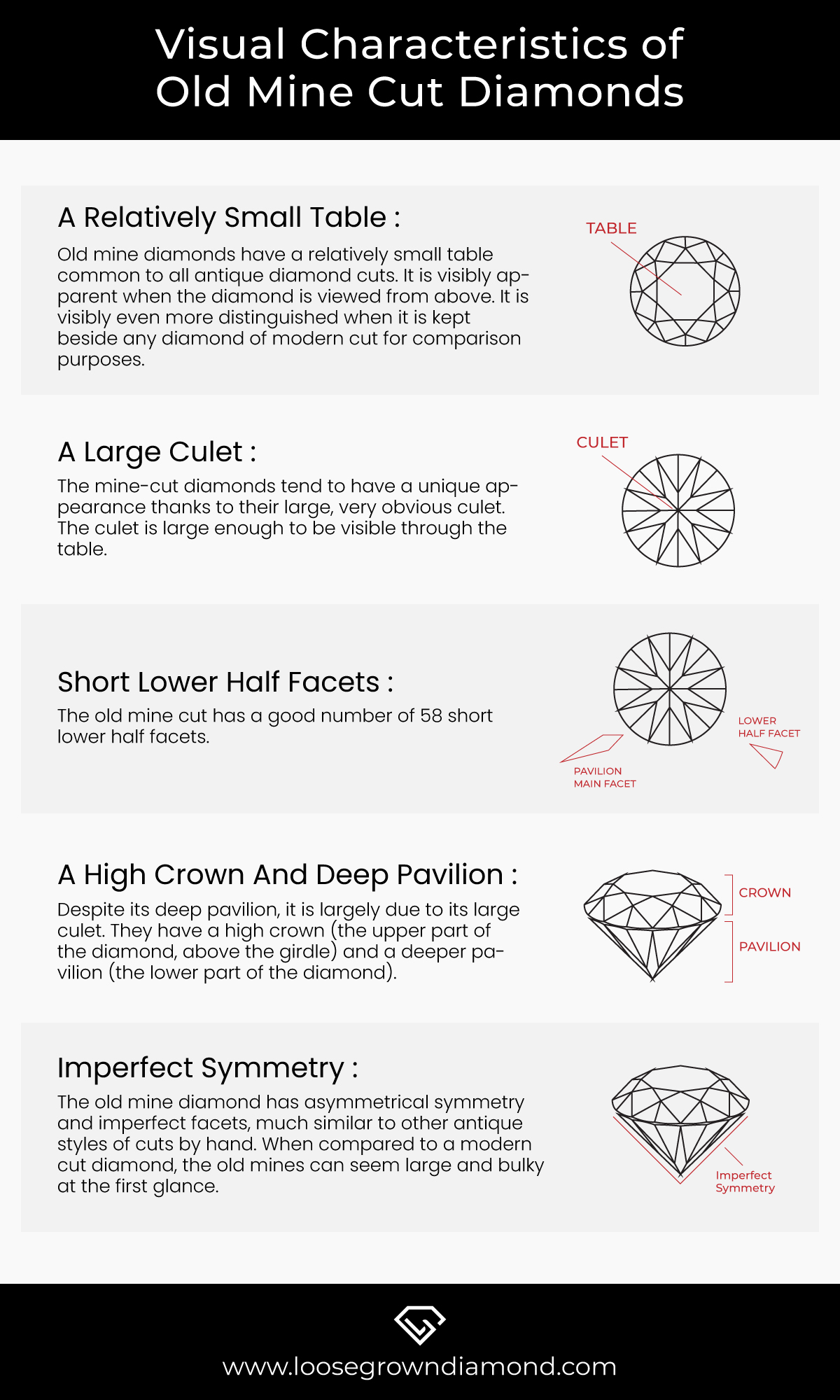
Old mine cut diamonds are very similar to today’s Modern cushion cut diamond with a square shape and soft slightly rounded corners. However, they still tend to differ majorly from modern cut diamonds in terms of their cut and symmetry.

The Visual Characteristics of Old Mine Cut Diamonds

Relatively small table. Old mine diamonds have a relatively small table common to all antique diamonds. It is visibly apparent when the diamond is viewed from above. It is visibly even more distinguished when it is kept beside any diamond of modern cut for comparison purposes.

A large Culet. The mine-cut diamonds tend to have a unique appearance thanks to their large, very obvious culet. The culet is large enough to be visible through the table.

Short lower half facets. The old mine cut has a good number of 58 short lower half facets.                               

A high crown and deep pavilion. Despite its deep pavilion, it is largely due to its large culet. They have a high crown (the upper part of the diamond, above the girdle) and a deeper pavilion (the lower part of the diamond).

Imperfect symmetry. The old mine diamond has asymmetrical symmetry and imperfect facets, much similar to other antique styles of cuts by hand. When compared to a modern cut diamond, the old mines can seem large and bulky at the first glance. 

However, it was once considered a deliberate part of the design because unlike the sleek cut of the modern diamonds, old mine cut diamonds were cut to be seen under candlelight, a definite stark contrast to today’s bright LED.

Are Old Mine Cut Diamonds More Valuable?

The value remains in terms of the legacy the old mine cut diamonds carry. They belong to a golden era of history. Patrons and lovers of art and jewelry as well as others who feel passionate about these items, do believe in collecting and cumulating their personal collection. You will find many such items belonging to the same era being auctioned amongst the people who can and want to afford them. Going into the technicalities, the value of an old mine cut diamond is measured in terms of the four C’s: cut, color, clarity, and carat weight, like any other diamond.

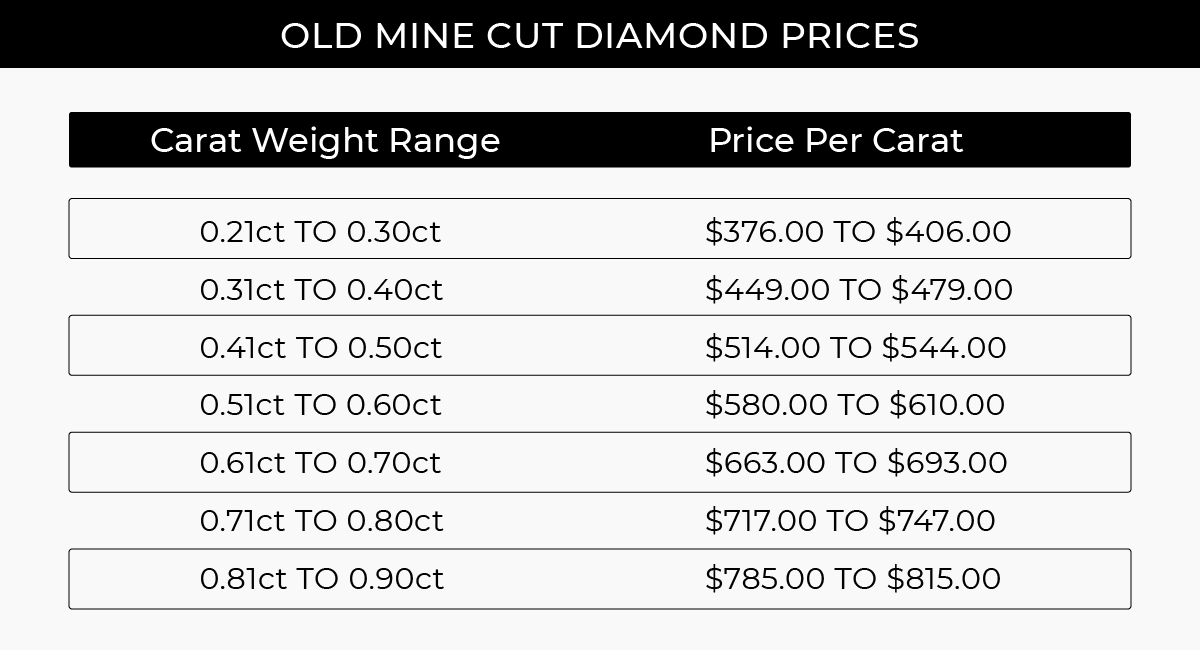
old mine cut lab diamond pricing

They are also graded by the GIA. Many of the old mine cut diamonds do have rough cuts and less clarity making them less valuable. Old mine cut diamonds have also been sold for a lesser price because there was modification leading to the original diamond being lost in the process. Another point that affects their value is that old mine cut diamonds are larger than most diamonds and when fitted for an engagement ring then it fulfills the purpose. People who are interested in the extra-bling, opt for such a piece. 

How Different is an Old Mine Cut from a Round Brilliant cut?

old mine cut vs round cut lab diamond

  • Table size: Old Mine cut diamonds account for 38 – 45% of the diamond’s total diameter which is a relatively smaller table size than a round cut more than average 52 – 60%. However, the ideal table size of a diamond according to most gemologists should rest from somewhere between 54-59%.
  • The Culet size: The old mine diamonds have a large easily visible culet attributed to their deep pavilion. Their culet size is only so much larger than the modern cut diamonds because it was merely impossible to cut smaller cutlets without cutting technology. Round cut diamonds do have a culet, that can only be observed under a microscope.
  • When it comes to the girdle finishing, antique cut diamonds have a frosted girdle in contrast to the round cuts faceted girdle.
  • Since the lab grown old mine diamonds were cut by hand, it was almost impossible to attain impeccable precision and symmetry. Their asymmetrical facets and unequal symmetry appeal to the taste of many who seek to purchase antique diamonds. Since modern cut diamonds do not hold such imperfections in high regard.
  • As far as brilliance and color are concerned the brilliant round cut diamond as the name indicates is quite renowned for its brilliance. The facets and dimensions of a round-cut diamond are designed to take in all light giving it a sparkly appearance. In contrast to the old cut diamond, which was designed to produce a warm glow under candlelight, a far more subtle appearance that many prefer.

Choosing the Perfect Old Mine Cut Diamond

The struggle with buying old mine diamonds begins with the simple fact that this style of cut is antique and vintage, and hence no longer manufactured, it has a limited supply with only a couple of diamond vendors selling them. Certain things you can keep in mind while buying a diamond of this cut are:

  • The diamond’s GIA certificate no matter how important should not deviate you from keeping your preference a priority. When it comes to modern diamonds, it is certainly recommended that you at the very least go through it with an AGS or GIA certification as those are pretty dependent on the 4c’s – cut, color, clarity, and carat. The color and clarity are still considered paramount features when purchasing a diamond of an old mine cut, however, it is cut quality grade can be neglected. 
  • Old mine cut diamonds are a spectacle of what we in today’s terms call imperfections, however, unlike modern cut diamonds these imperfections only add allure to the antique stone. How much ever recommended a diamond certification maybe, the best advice with these cuts is to always go for what appeals to your eye. 
  • Unlike modern diamonds, the color may not pose such a problem, as the old mine cuts are meant to have a warm color suitable for the era, they were popular. Most of the stones with this cut have a visible color grade of K or below.  This is mainly because most of the higher color grade diamonds have been recut and redesigned over the years into brilliant modern diamonds.
  • Hence it should be obvious to you by now that a diamond of an antique cut cannot be judged according to modern parameters, as they were never initially designed for this decade.
  • It is always advised that because of the warm glow of antique cut diamonds, a yellow or rose gold setting is bound to beautify an old mine cut diamond ring. However, there is no such compulsion, and you can always go for whichever metal appeals to your tastes and looks attractive to the eye. 
  • The last and most important detail is that you buy it from the right vendor, modern-day retailers, and companies that fashion in antique cut diamonds; hence it is best if you buy an antique cut diamond from an antique jeweler. 

Where to Buy Old Mine Cut Diamond?

Explore online platforms that specialize in antique and vintage jewelry such as loosegrowndiamond.com carries a selection of old mine cut diamonds in various carats. They may be able to source or create a custom setting for an old mine cut diamond.

Ensure that the diamond comes with a proper certificate. Our experts will help you find the perfect certified diamond for your budget. Choose from hundreds of styles on loosegrowndiamonds.com.

[blog_page_btn title=”Buy Lab Grown Diamonds” url=”https://www.loosegrowndiamond.com/inventory/?shape=OldMine”]

Conclusion Thoughts

Old Mine cut diamonds belong to the 18th and 19th centuries, these diamonds tend to have a warm glow to them which makes them perfect for a candlelight setting. These lab diamonds are dated for an era where they are crafted by hands, they cannot be graded by the same scales used for modern cut diamonds.

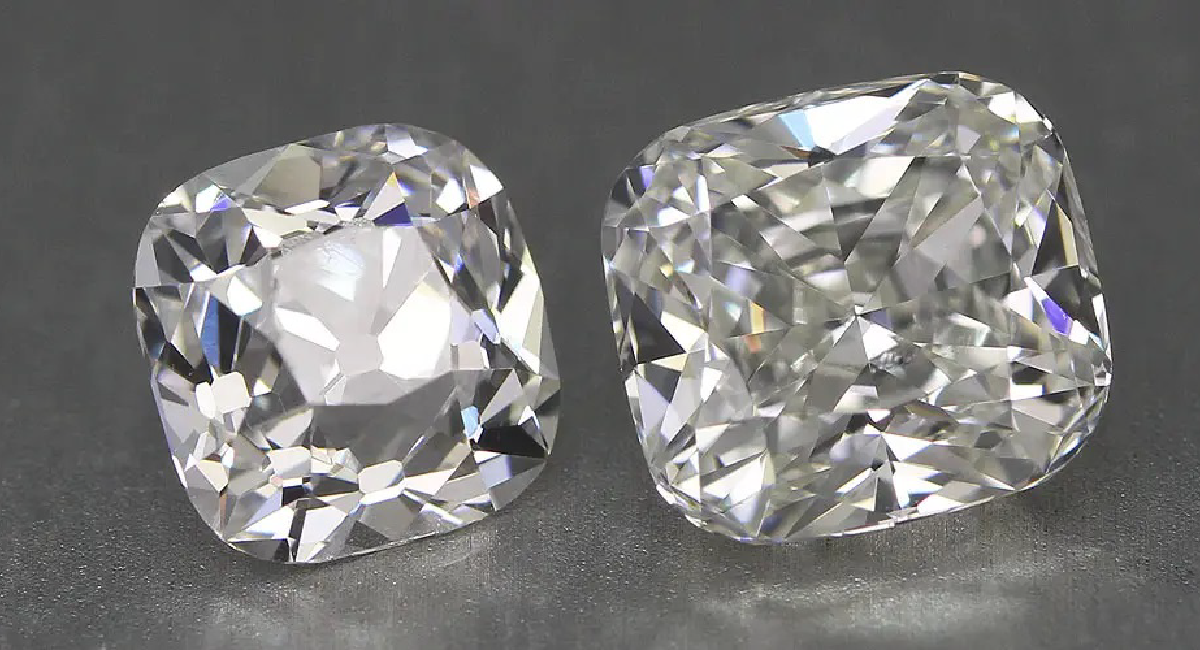
Their rugged appearance has all the more beauty compared to laser-cut modern diamonds. You can always keep them side by side and compare them. Old mine cut diamonds have large facets which produce great fire in the diamond and that is hence why it is still preferred by some people in the 21st century. 

However, dating its origin back to a couple of centuries it is always recommended that you buy an old mine cut diamond from an antique diamond jeweler to get the most out of your buck.

FAQs

What are the characteristics of an old mine cut diamond?
Old mine cut diamonds typically have a cushion shape, a small table, a high crown, and a deep pavilion. They may also exhibit a small open culet, and the facets are often larger and more rounded than those in modern cuts.

What settings complement old mine cut diamonds?
Antique-style settings, such as halo designs or vintage-inspired settings, often complement old mine cut diamonds well. These settings can enhance the overall vintage aesthetic of the diamond.

How is it different from other diamond cuts?
The old mine cut is distinct from modern cuts like the round brilliant cut. It has a different faceting pattern, with larger facets that give it a unique appearance. It is known for its romantic and vintage charm.

Princess Cut Diamonds: What Every Buyer Must Know

The relationship an individual has with a diamond is something out of the ordinary. The sparkle it brings in one’s life is accompanied by the promise of togetherness and an auspicious bond. People always debate as to which diamond shape is the greatest and most appropriate option. 

Princess Cut Diamonds: What Every Buyer Must Know
Yes, round-shaped diamonds might be popular and more favorable but a princess cut diamond on the other hand has all the properties and features of multiple diamond shapes combined. The princess-cut diamond symbolizes one’s undying devotion and commitment with its spectacular brilliance and exquisite shape for wedding bands.

What is a Princess Cut Diamond?

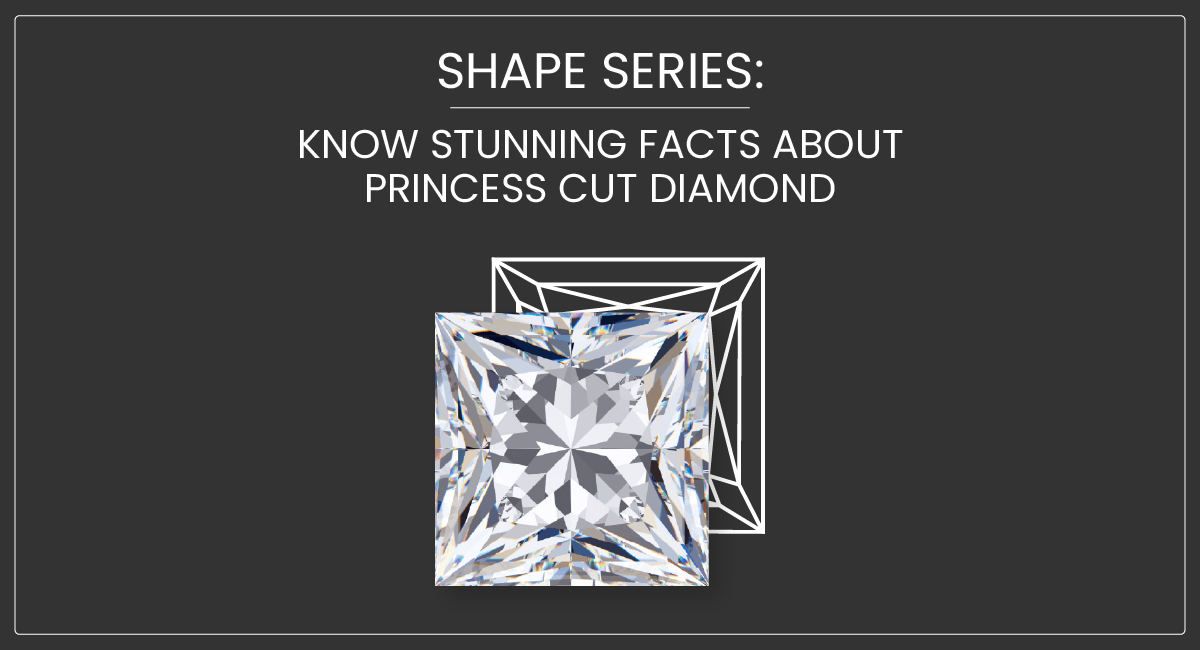
The princess cut diamond is one of the most prominent diamond cuts, has a brightness and luster that other square-shaped gems lack. Thus putting it above all. A Princess cut diamond is often described as Square Modified Brilliants as they are frequently linked to round gems; this is in terms of sparkle and brilliance.

Princess-cut stones are also called Rectangular Modified Brilliants or Square Modified Brilliants based on the length-to-width proportion. 

This pattern disperses more light than any other square-shaped diamond, giving the princess cut a stunning and generally preferred brightness. Princess-shaped diamonds are also frequently cut from exceptionally well-formed raw diamonds. This implies that princess-cut diamonds are much more probable than other forms to be fashioned from a finer raw stone.

[blog_page_inventory shape=”Princess” carat=”1.00,3.10″ cut=”1,4″ color=”0,10″ clarity=”0,11″]
[blog_page_btn title”Buy Now” url=”https://www.loosegrowndiamond.com/inventory/?”]

History of the Princess Cut Diamond

Inspired by a “French Cut”, a princess diamond shape provides brilliance greater than most of the shapes having a similar cut. Nonetheless, the modern princess-cut diamond is a pretty recently-developed cut. Numerous global designers contributed to and improved it throughout the second section of the twenty-first century.

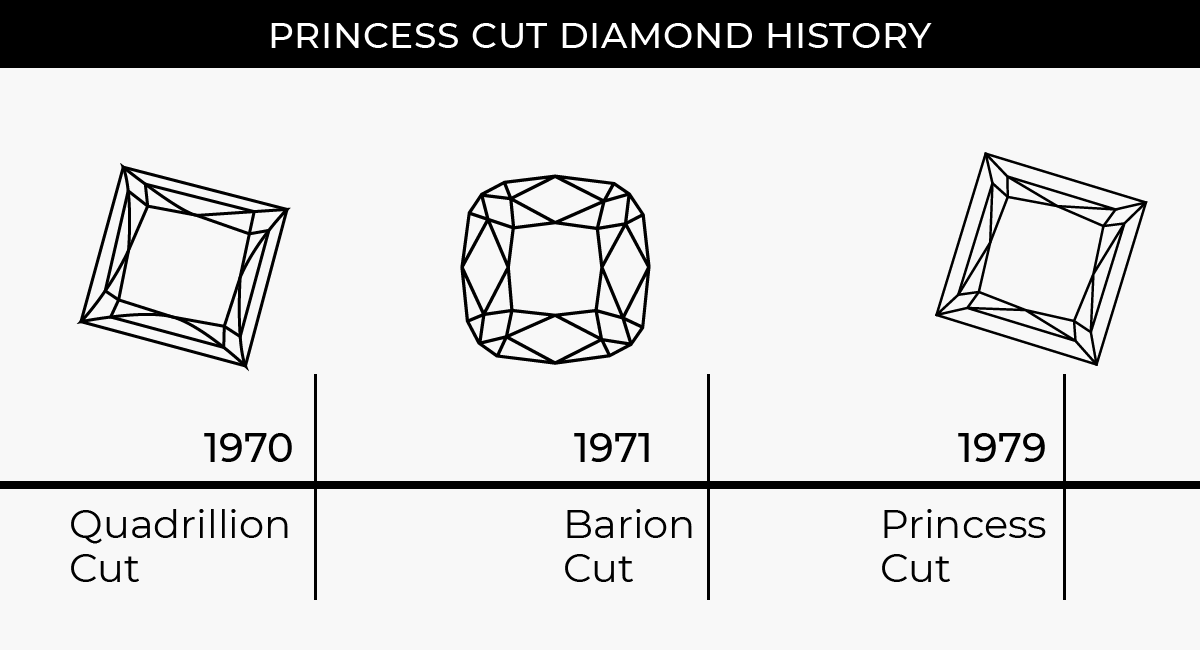
princess cut diamond history

  • An early form of this design, first conceived in the 1960s, was used in conjunction with some other cut: the profile cut. 
  • In 1961, a London gem designer named Arpad Nagy was known for inventing the profile cut. 
  • Ambar Diamonds in Los Angeles started cutting and marketing the quadrillion diamond of 1970; a stunning square cut with 49 facets, just about ten years later. 
  • The Barion cut of 1971 was then developed by skilled South African cutter Basil Watermeyer. This gem cut had rounded sides and a square shape. 
  • Ultimately, Ygal Perlman, Betzalel Ambar, and Israel Itzkowitz, Israeli stone cutters, popularized the French cut. They invented the modern princess-cut we recognize today in 1979.

How Many Facets Does a Princess Cut Diamond Have?

Based on how well the diamond is cut, a Princess Cut diamond contains about 50 to 58 facets. The canopy and crown have the most facets, with some on the girdle. Princess Cuts are also known for having 2 4 chevron designs, which are cross trends seen when looking at the diamond above it.

When a diamond contains two chevron designs, it radiates more bright and colored light more intensely. These patterns come together to cause more refraction of light thus making the diamond shine more.

What are the 4Cs of a Princess Cut Diamond?

Clarity

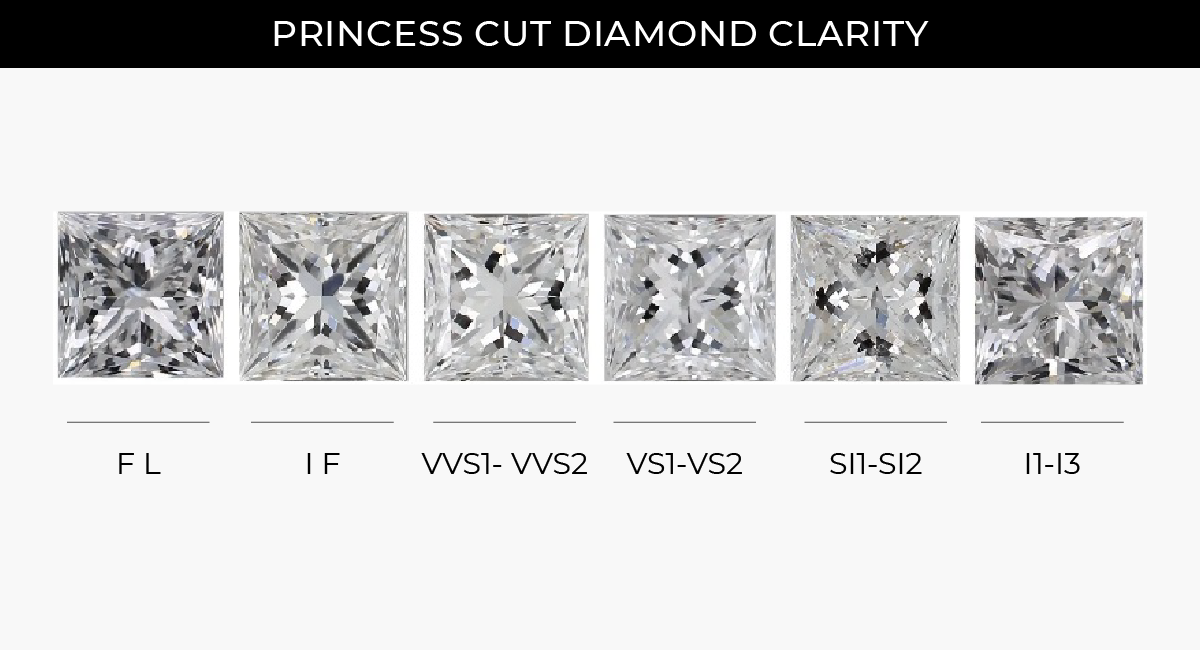
Just like people, even diamonds aren’t flawless, they all have their own blemishes and inaccuracies. The clarity rating describes the extent to which these flaws are obvious. An SI1 or VS2 stone will provide eye-clean brilliance on a decent budget. SI2 and I1 diamonds can also be eye-clean, making them good choices for individuals on a limit.

princess cut diamond clarity

  • Flawless (FL)
  • Internally Flawless (IF)
  • Very Very Small Inclusions (VVS1)
  • Very Very Small Inclusions (VVS2)
  • Very Small Inclusions 1 (VS1)
  • Very Small Inclusions 2 (VS2)
  • Small Inclusions 1 (SI1)
  • Small Inclusions 2 (SI2)
  • Inclusions 1 (I1)
  • Inclusions 2 (I2)
  • Inclusions 3 (I3)

However, you will discover very few princesses cut diamonds in these clarity gradings. Avoid heavy imperfections in the center of the diamond when you’re shopping according to these clarity grades. As any inclusions or blemishes in the center will be easily visible and will ruin the look of the diamond. In particular, keep an eye out for irregularities in the princess cut’s edges. Inclusions in these regions weaken the edges and increase their likelihood of breaking/chipping/damage.

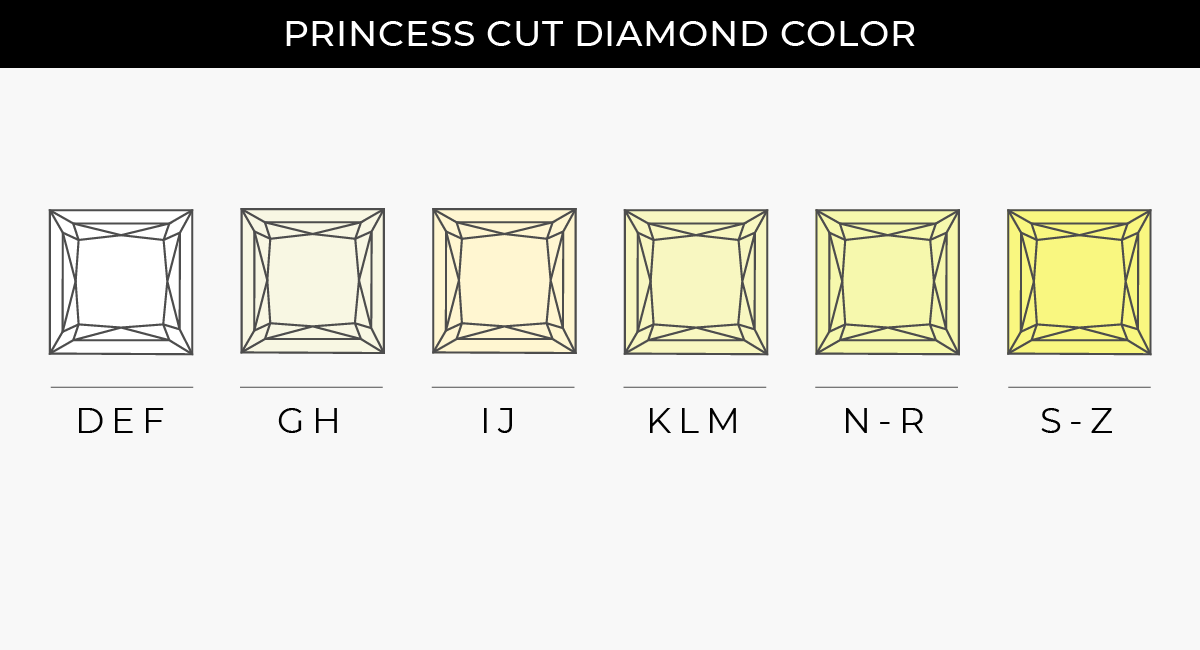
Color

Princess cut diamonds, as well as other exotic varieties, have a wider range of hues than round gems. Even so, there’s no point in paying a premium for the highest color grades. Even if there is a little hue variation, it is tough to discern unless you compare the gems beside each other. 

Princess cut diamond color
The color here is referred to in terms of the GIA color grading chart which goes as follows:

  • Colorless- D,E,F
  • Near Colorless- G,H,I,J
  • Faint-K, L, M
  • Very Light-N, O, P, Q, R
  • Light-S,T,U,V,W,X,Y,Z

To optimize your spending, we recommend an H or I-color stone for princess cut stones set in white gold or platinum. A J-color stone, on the other hand, will look excellent in rose gold and yellow gold bands.

Because diamond color grades are based on body color rather than face-up color, certain diamonds with lower color grades will appear whiter. Though it will take considerable time and energy, people on a low budget may find that looking for these jewels is worthwhile!

Because the genuine distinctions in color are hard to recognize in an environment without diamond color grading, the price premium for better scores would be dramatically lower.

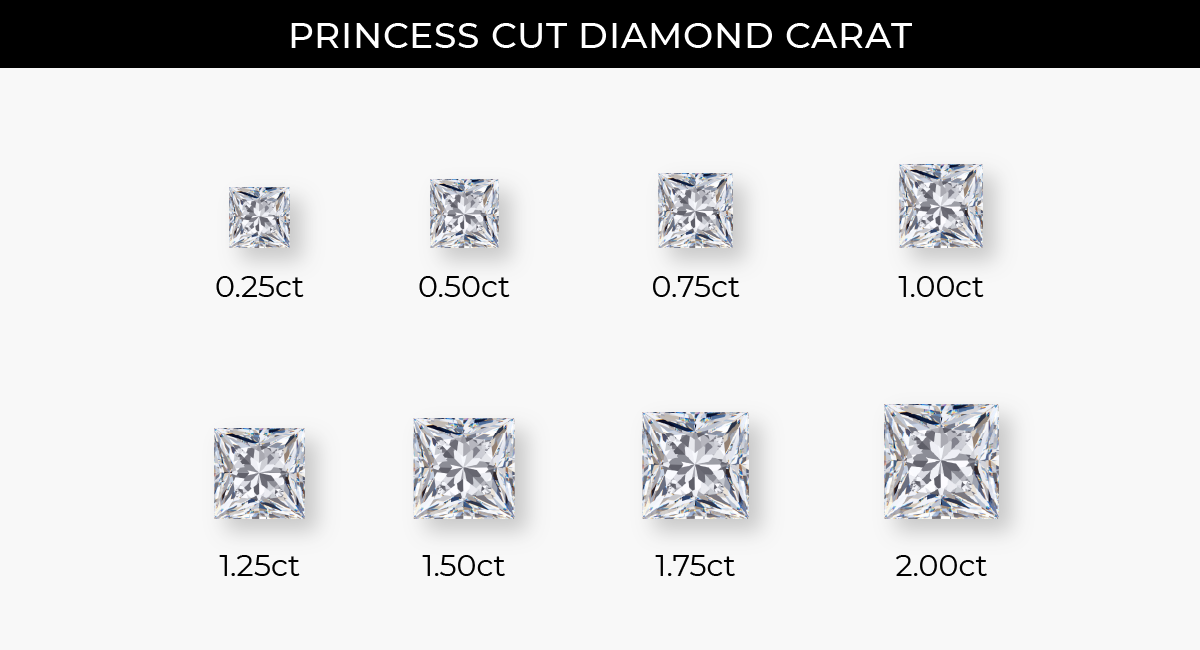
Carat

The carat system is used to determine the gems’ mass. Gem Studies Laboratory employs sophisticated weights to obtain accurate weight measurements, with masses measured in hundredths of a carat.

Princess lab diamond carat
One metric carat equals 0.2 grams in the carat standard. That’s why, when it comes to establishing gem grades, skilled examinations and precise equipment are crucial. Princess cut diamonds, when compared to their round-cut competitors, have a greater carat weight for their volume due to their form.

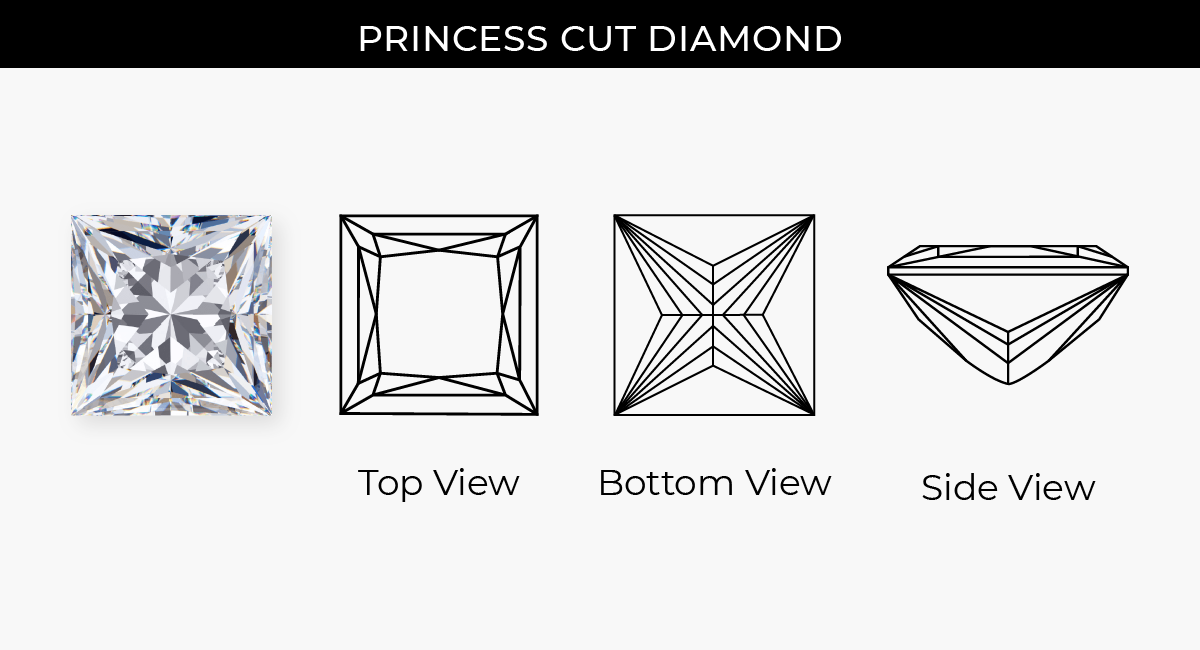
Cut

The degrees, facets, and clarity of a gem are all considered while evaluating its cut. Overall, the purpose of a great stone cut is to create a stone with the correct ratio to allow the most amount of light to pass in.

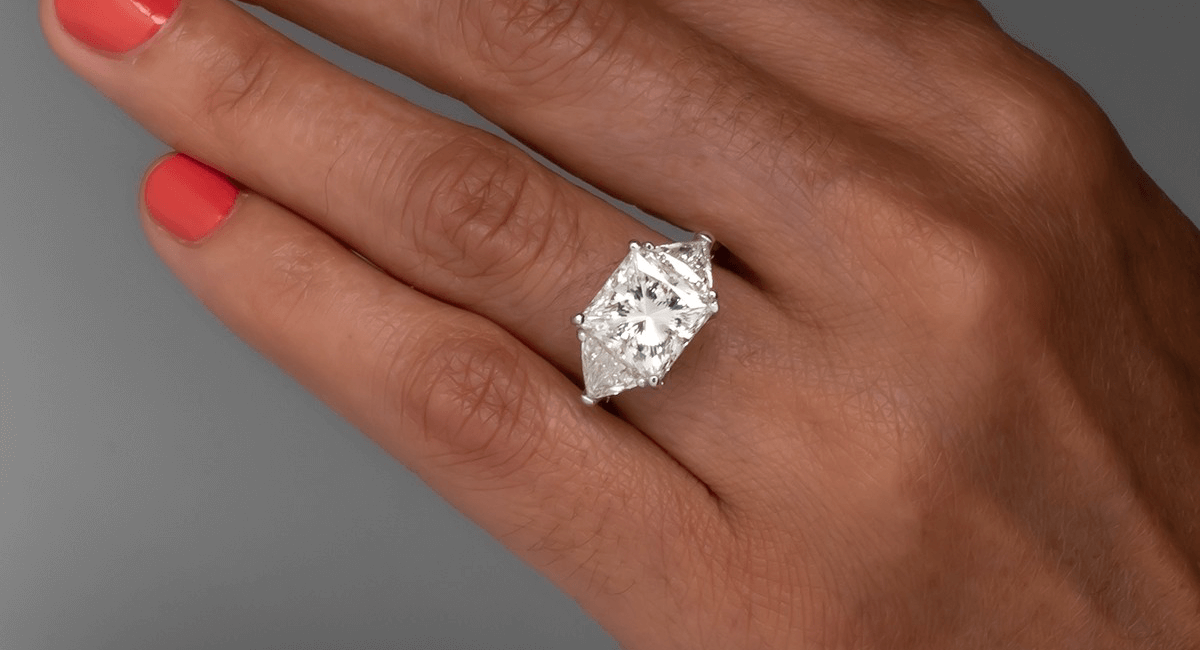
princess cut diamond
It will add a lovely gleam to the gem, which the lover will like. While cutting a princess gem, the objective is to produce a completed product that is neither too broad nor too deep, with an equivalent amount of chevrons.

What is the Length to Width Ratio of a Princess Cut Diamond?

Adhere to length-to-width ratios (L/W) of 1.05 or less for a symmetrical princess cut. The gem seems off-shape anything above 1.05. Princess cut stones must be adequately square so that they do not appear to be off-shape. The gem will seem rectangular if the L/W ratio is at least 1.2.

Pros & Cons of Princess Cut Diamonds:

Price

A Princess cut diamond is at least 30% less expensive than round-shaped diamonds because cutting a princess-shaped diamond produces minimal wastage. This can not only be very helpful for people with a limited budget and the value that a princess cut diamond provides is incredible because the shape typically looks bigger compared to the same carat weight of a round-shaped diamond.

Sparkle

Princess cuts are known for their sparkle. In terms of light efficiency, they surpass any sophisticated cut. This diamond has exceptional brilliance when compared to other diamonds. One needs to know that a round-cut diamond still surpasses the sparkle and brilliance when compared to other diamonds. 

Size

When comparing the face-up surface area of a princess and a round diamond of the same carat weight, the round will have a slightly bigger face-up contact area. Princess cuts, on the other hand, usually appear broader due to their huge orthogonal dimensions. Nonetheless, it’ll be possible to have a princess cut that is much bigger than a round cut while staying within your diamond ring limit.

Durability

The corners of a princess-cut diamond are vulnerable to snagging and flaking. Hooks must be used to safeguard the crystal’s edges to prevent it from being damaged. Round diamonds can still chip, but they don’t have any weak areas that make them susceptible to scratching. With a diamond shape like a princess-cut-shaped diamond comes the responsibility to look after it.  

Best Engagement Ring Settings for Princess Cut Diamonds:

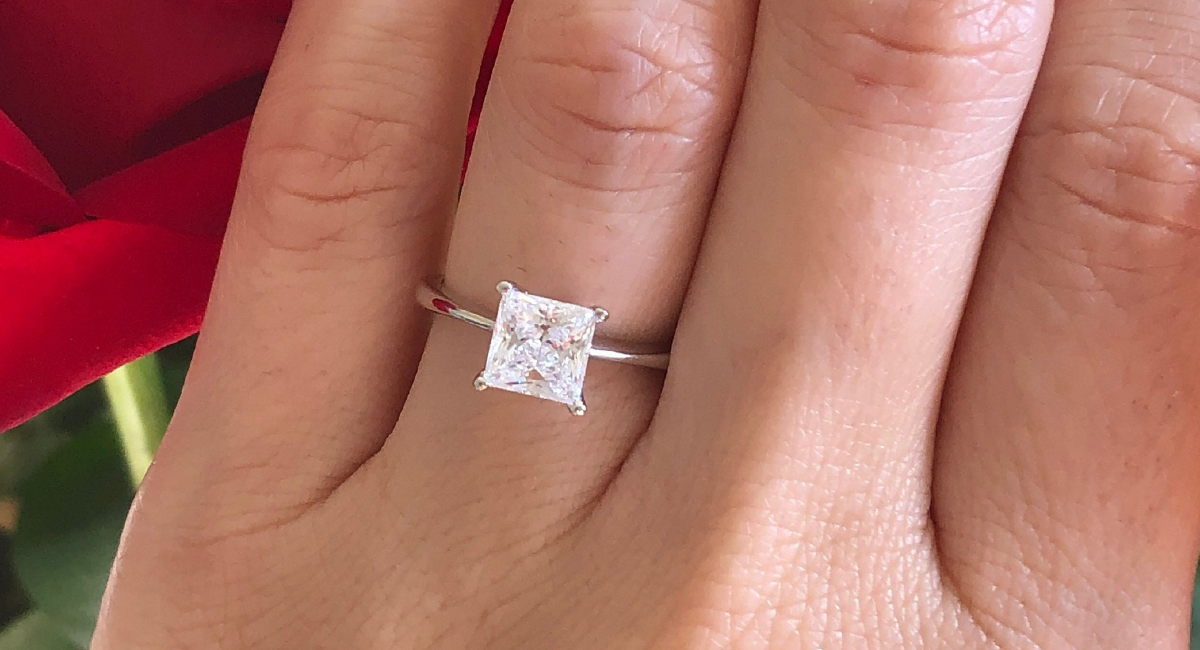
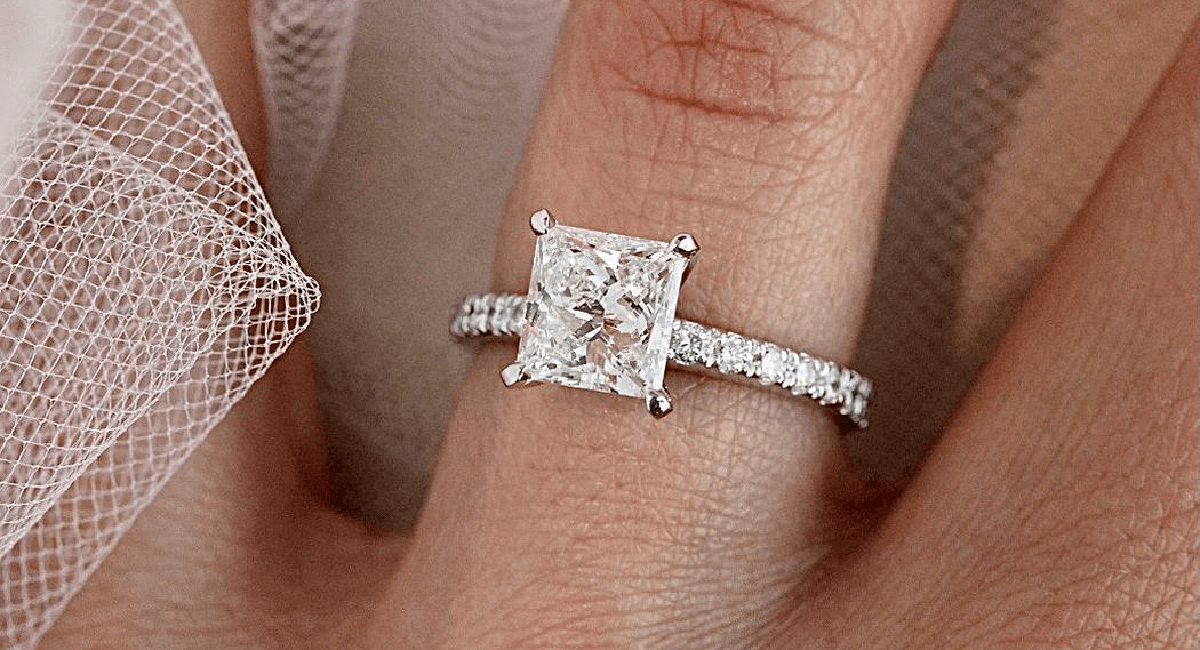
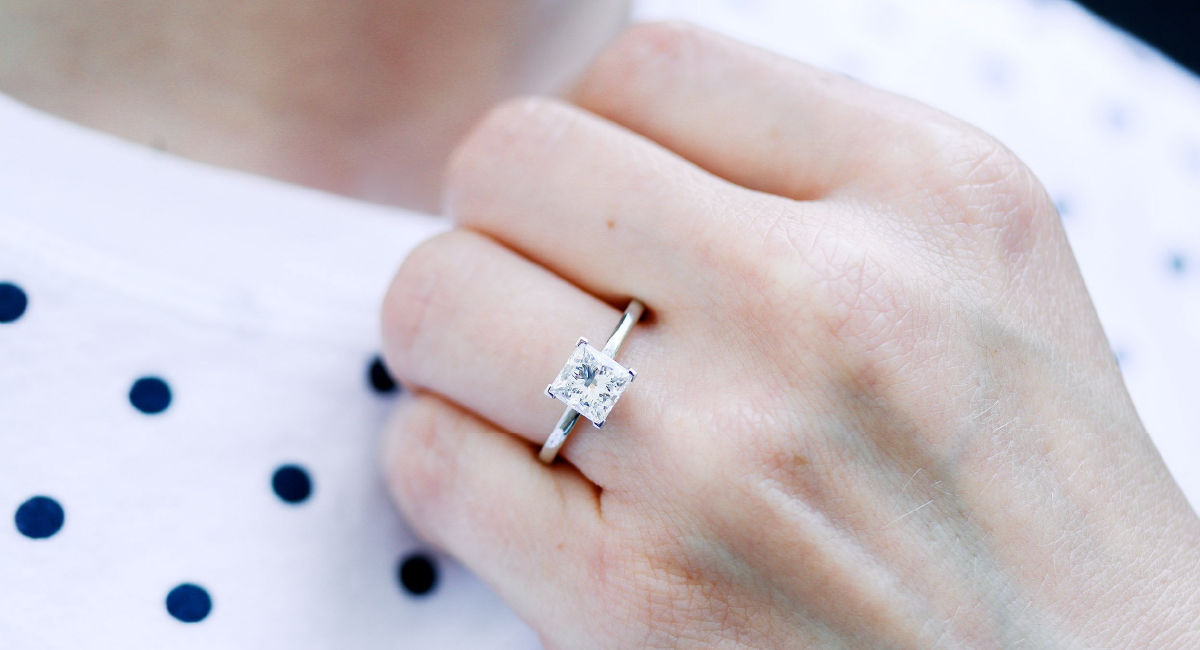
  • Princess Cut Diamond Solitaire Ring

Princess solitaire diamond
The princess cut can take center stage in a solitaire setting, allowing the most light to enter. The solitaire arrangement helps the diamond to be the center of attention and gives the sparkle it deserves.

  • Princess Cut Diamond Channel Set Band

Princess cut channel set
Princess cuts can be protected by using a channel configuration. Because we know that princess-shaped diamond cuts are prone to breakage, this setting is ideal for practically everyone.

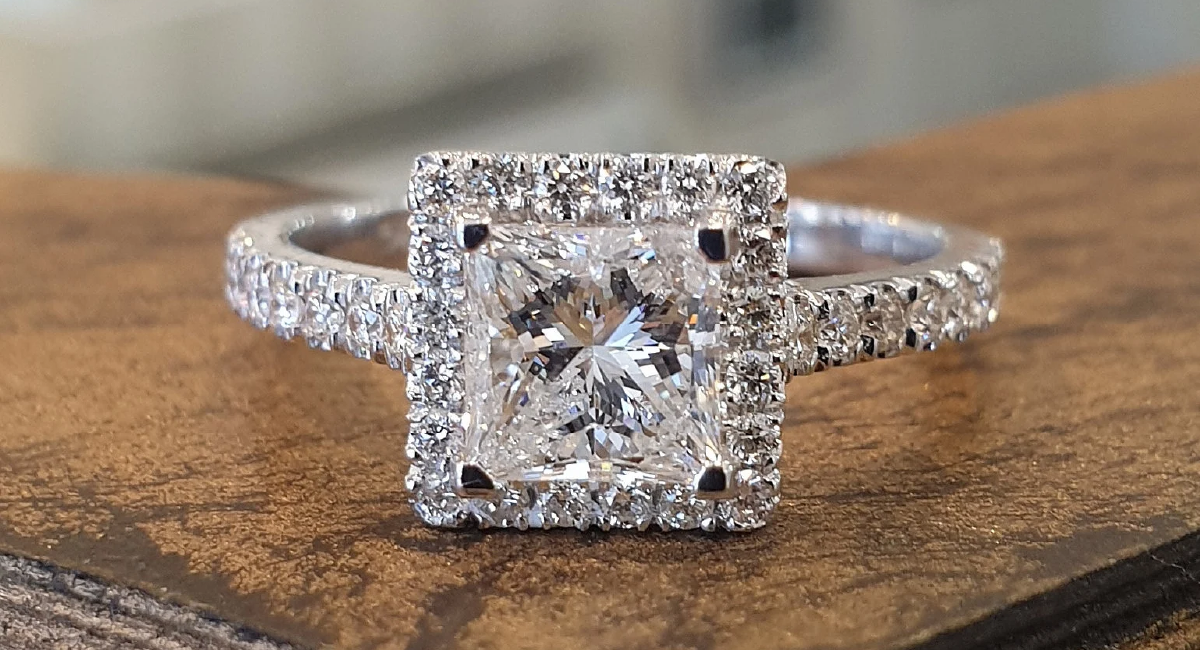
  • Princess Cut Diamond Halo Ring

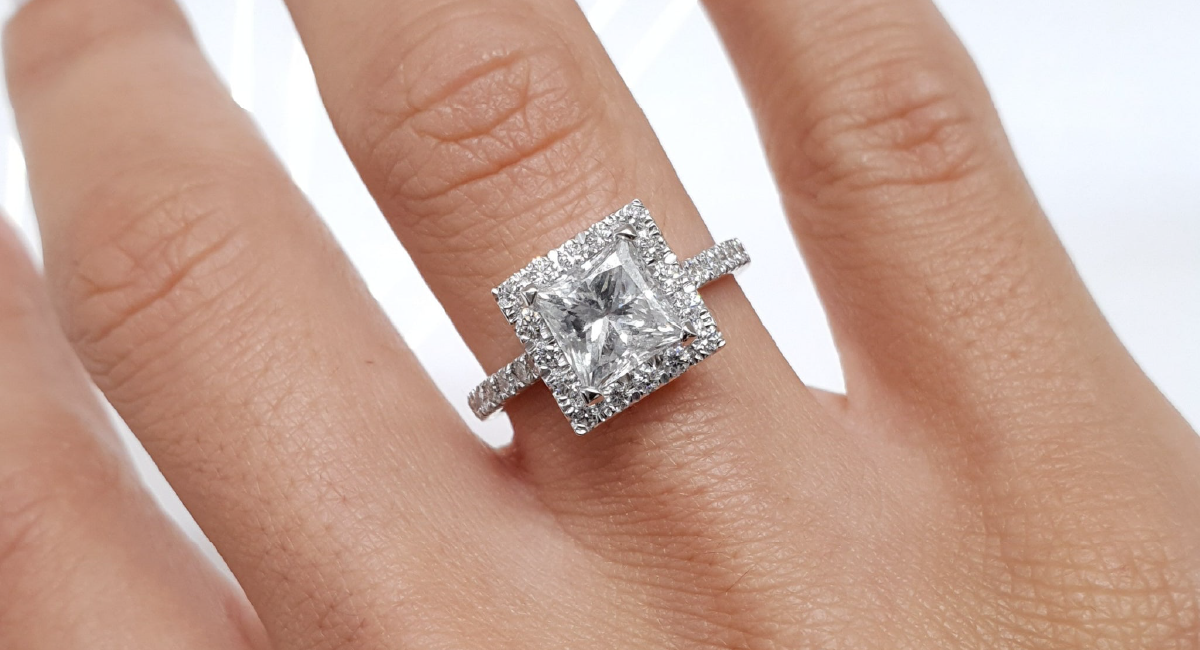
Princess halo lab diamond ring
Smaller gems encircle the center stone in Halo wedding rings, making it look much bigger. Not only is a princess-cut shape big enough but the smaller gems that are arranged around the diamond not only make it look extra big but provide too much sparkle.

  • Princess Cut Diamond Vintage Band

Princess Diamond Vintage Band
The ancient arrangement on a princess-shaped diamond is a wonderful choice for anyone looking to spice up their look. This arrangement has become very popular in the last few years and will surely be of the top favorites for the coming years.

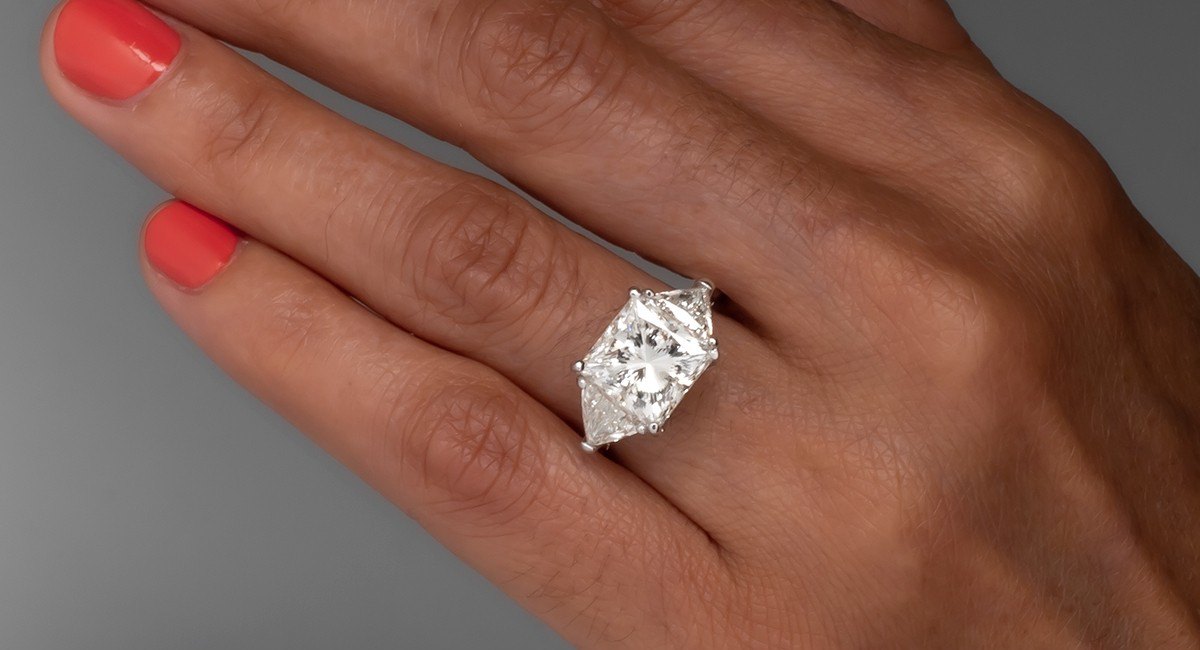
  • Princess Cut Three Stone Engagement Ring

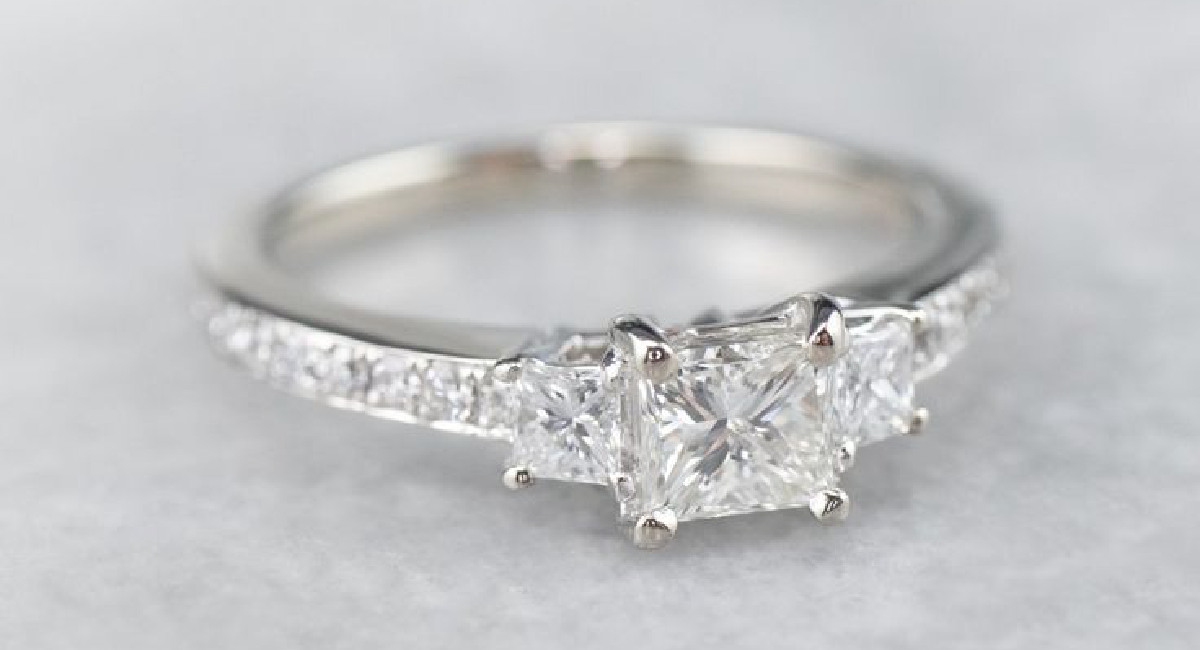
Princess Three Stone

The design that defines the eternal boundaries of your past, present, and future is known as the princess cut three stone engagement ring. It is a three stone setting where the central diamond is in a square or a rectangle shape, and the other two stones are attached on both sides, enhancing the beauty of the ring.

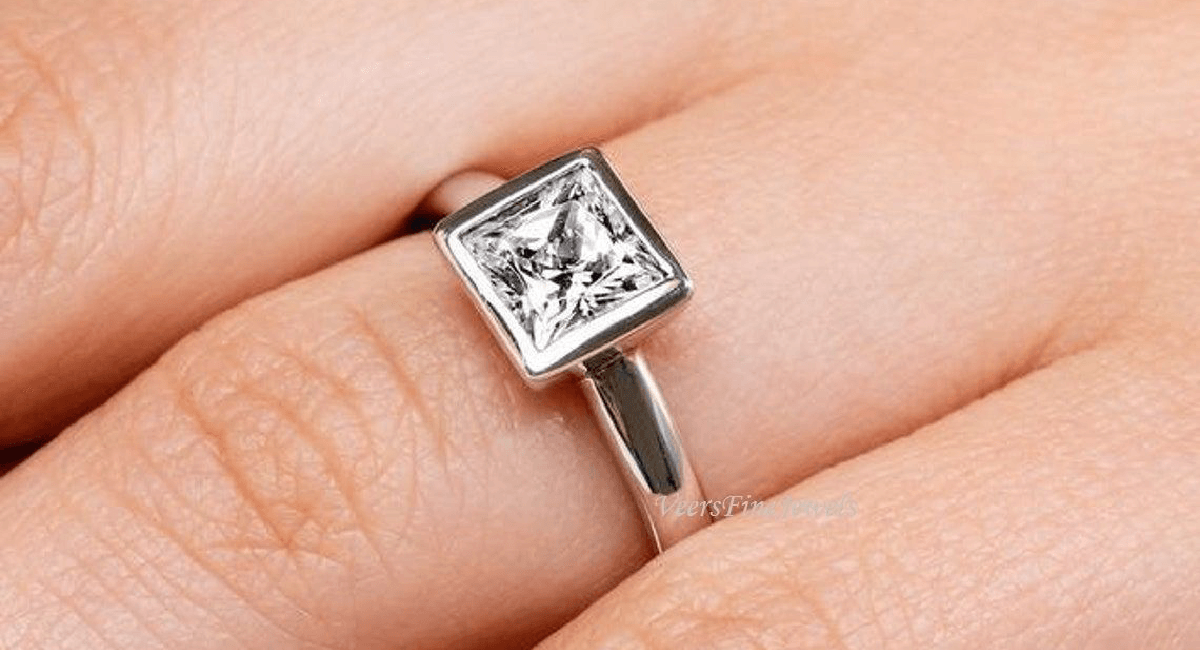
  • Princess Cut Bezel Setting Engagement Rings

Princess Bezel Ring

The setting where your princess cut diamond remains the center of attraction which is held high and around by the custom-made metal rim in the center of the band is the princess cut bezel setting engagement ring.

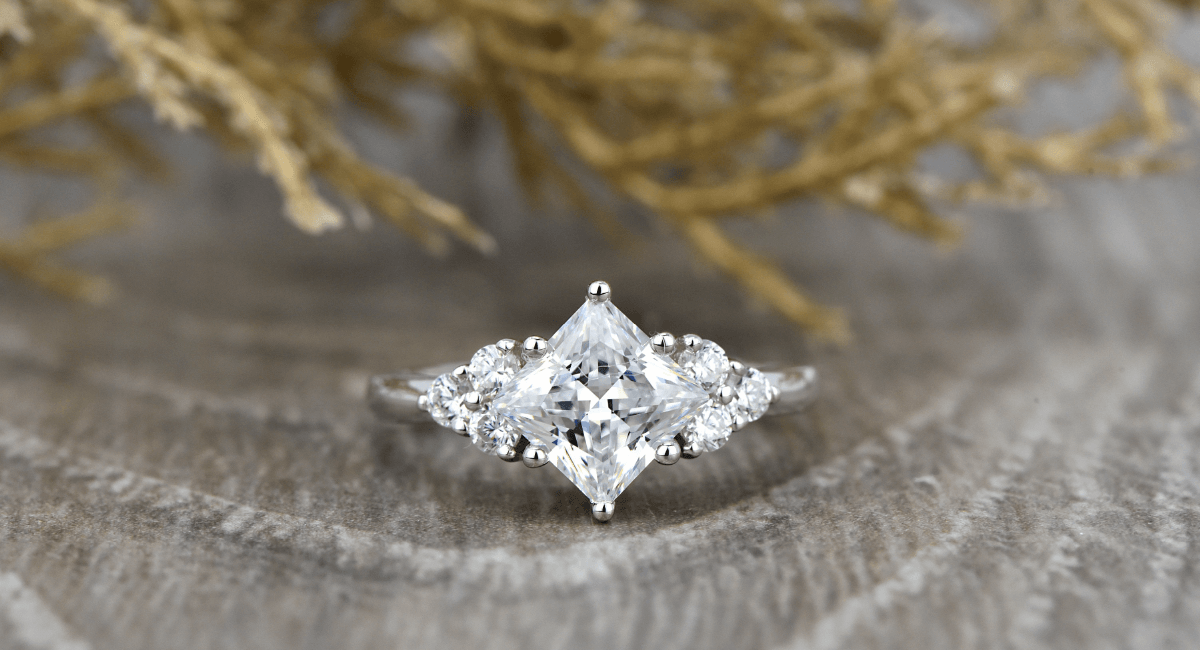
  • Princess Cut Cluster Setting Engagement Rings

princess cluster ring

Princess cut cluster setting engagement ring is highly defined by its name itself just where the princess cut diamond is in the center with the many other small stones around it forming a structure of cluster, enabling the shine to sparkle more.

  • Princess Cut Diamond Band

Princess diamand band

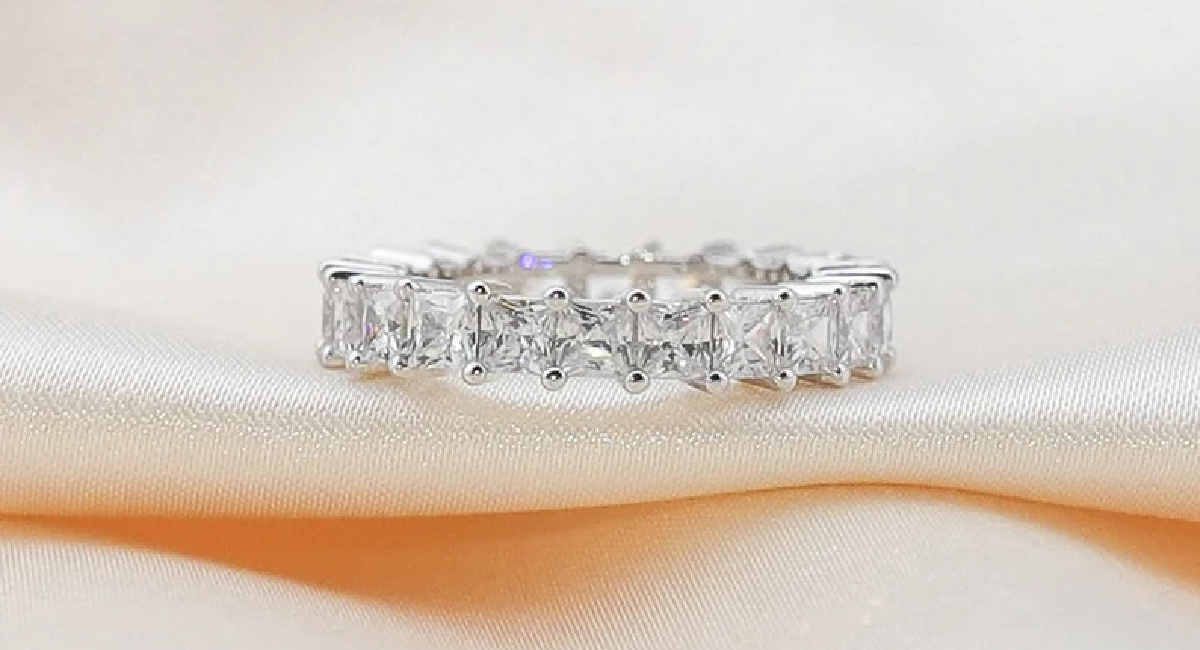
This style delivers an elegant vintage look with aesthetic charm in it as the whole band is covered with small princess cut diamonds. It strengthens the look of the ring and this design formation is subtle yet heart pouring. A very minimalist setting that offers a lot of it.


Conclusion

The second most popular diamond shape in the market, with all the best features of shapes like round, square, and rectangular. This shape is one of the most distinctive shapes and very exquisite compared to others. Also considered one of the most brilliant cuts out there. 

Despite being commonly likened to the round form, the princess-cut has distinct faceting techniques that are not found in round-cut gems. Princess-cut gems can also have diamonds put side-by-side with really no spaces because of their more rectangular shape. As a result, princess-cut diamonds are preferred for commitment and marriage rings, particularly eternity bands, which are among the most famous band designs nowadays.

FAQs

Are princess cut diamonds more affordable than other cuts?
Princess cut diamonds are generally more affordable per carat compared to round diamonds. This is because the cutting process yields less waste when shaping a square or rectangular stone.

How much is a 2 carat princess cut diamond
The price of a 2 carat princess cut diamond can vary widely based on factors such as cut, color, clarity, and overall quality. 2 carat princess cut diamond price a rough estimate could be anywhere from $800 to $50,000 or more.

Do princess cut diamonds come with certifications?
Yes, loosegrowndiamond.com provides certifications from gemological laboratories, detailing the quality and characteristics of the princess cut diamond, including its cut, color, clarity, and carat weight.

What does a princess cut diamond look like?
A princess cut diamond is a square or rectangular-shaped diamond with pointed corners. It has a modern and elegant appearance, characterized by a cross-shaped pattern when viewed from the top, showcasing its brilliant facets.

Asscher Cut Diamonds: Everything you Need to Know

In the diamond world, there are many different cuts to consider before buying. Every different cut signifies different aspects of a diamond and you need to explore every cut in detail before you make a final choice. The Asscher cut diamond is considered to be one of the most symmetrical and eye-pleasing cuts in the world of diamonds. 

Asscher Cut Diamonds: Everything you need to know
If you’re someone who has been exploring cuts for pure diamond engagement rings for a significant diamond pendant then this article is perfect for you to understand what an Asscher cut is and what are the different aspects of the Asscher cut.

What is Asscher Cut Diamond?

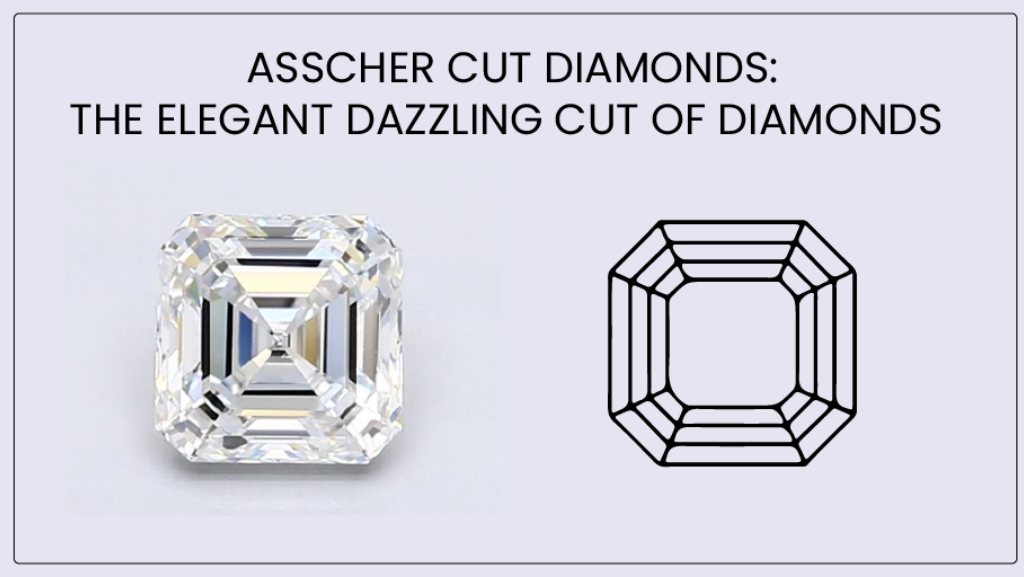
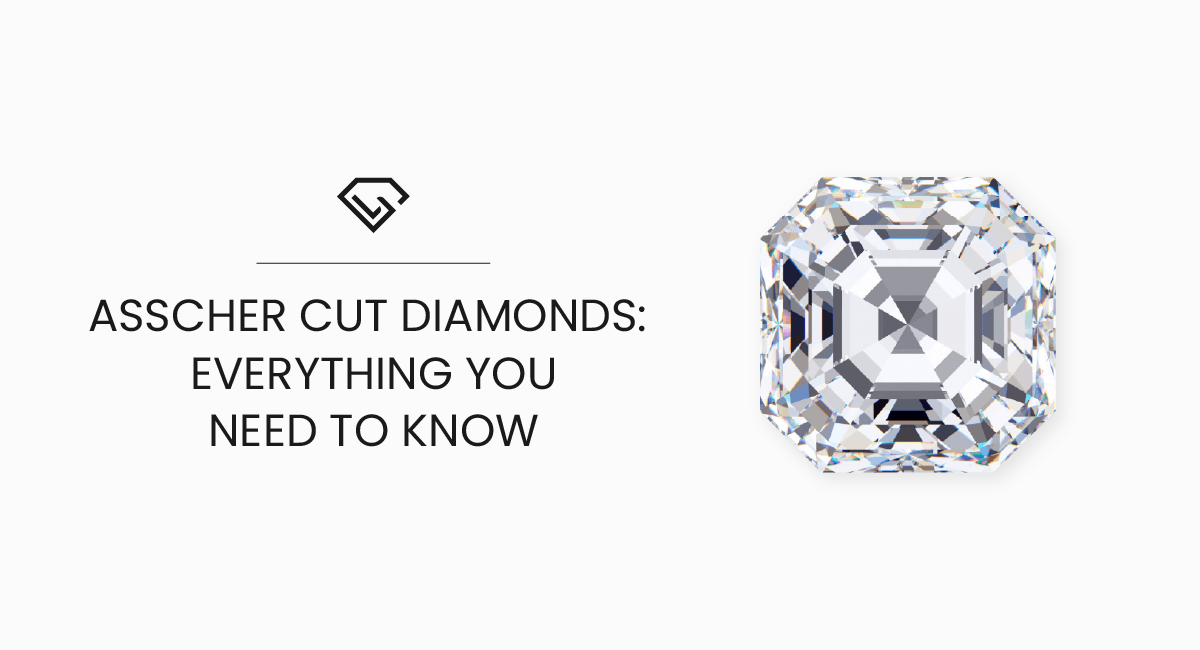
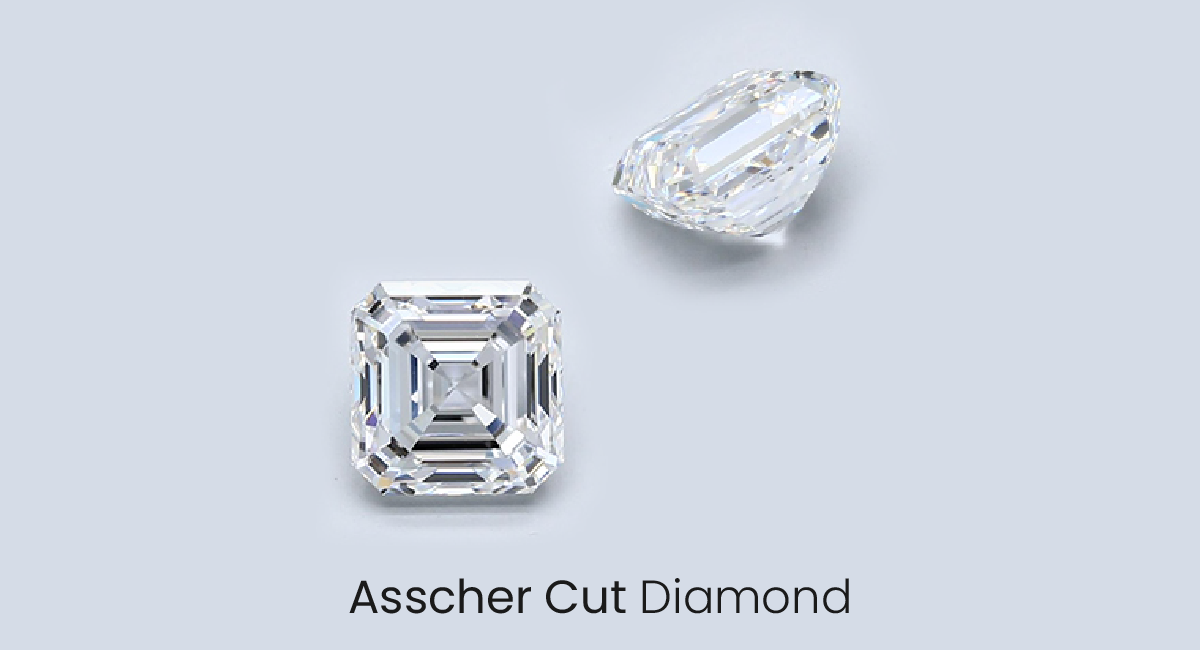
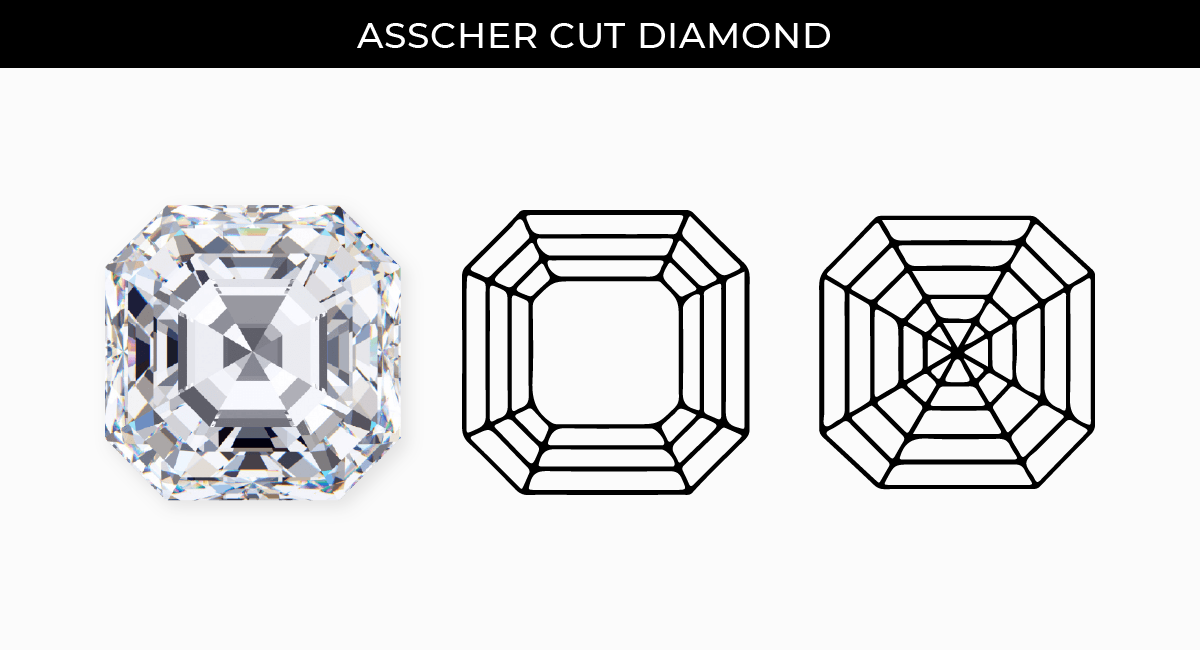
The Asscher cut diamond has 8 edges and hence is often known as the octagonal diamond as well. The main identifying features of an acid cut are it is square in shape and has a significantly small table. All the facets of the diamond are rectangular in shape and this is what gives the effect inside the diamond. 

What is Asscher Cut Lab Diamond
The Asscher cut is also known as a step-cut diamond because the diamond is cut at different levels exactly like a staircase. The diamond is also often compared to the emerald cut and the Princess cut because of its shape and similarity in cutting style.

There are two types of Asscher cut diamond 1 is the classic Asscher cut which has 58 facets and the other one is known as the Royal Asscher cut diamond which has 74 facets. Both these cuts are identified as having a tall crown and a deep pavilion. 

[blog_page_inventory shape=”Asscher” carat=”2.00,2.50″ cut=”1,4″ color=”0,10″ clarity=”0,11″]
[blog_page_btn title”Buy Now” url=”https://www.loosegrowndiamond.com/inventory/?”]

History of  Asscher Cut Diamonds

The Asscher cut diamond is named after its founders which were the Astor brothers and specifically the diamond is named after Joseph Aster who founded the cut. The diamond cut is only 120 years old and was discovered in the early 1900s. 

The Asscher cut diamond became super popular very early after its conception because in 1920 the art deco period started which is an era that was popular for geometrical and symmetrical pieces of art. Many say that the popularity of the Asscher court was heavily influenced by the ongoing industrial revolution.  

Geometry and Modernity were seen as a sign of prosperity and the Asscher cut which is highly symmetrical of course gained popularity in terms of design.

Till today as Asscher cut diamonds are considered an elegant choice because of their unique cut. Throughout history, lab grown Asscher diamonds, which are the favorite of the royal families around the world and are still the highlight of many historical pieces.

Length to Width Ratio of Asscher Cut Diamond

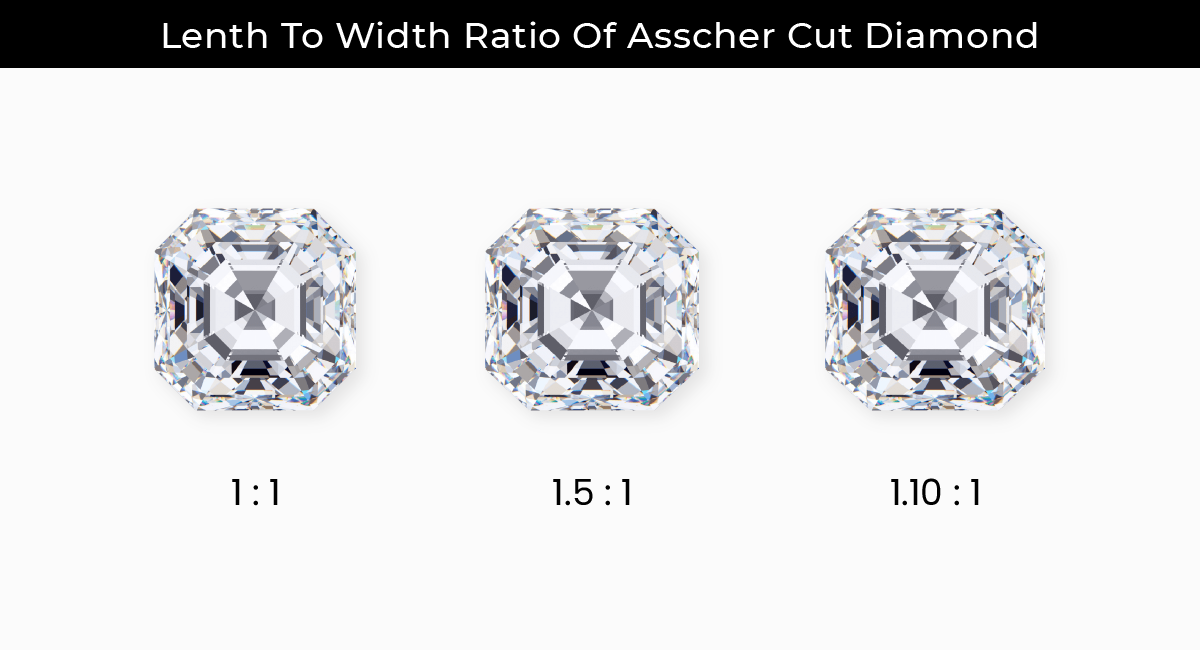
The Asscher cut is known for its symmetry and geometric appearance. The best ratio is 1.00-1.05 when it comes to the Asscher cut.

Length to Width Ratio of Asscher Cut Diamond
A ratio of 1.05-1.10 is considered the second-best side-to-side ratio for an Asscher cut. A 1.10-1.15 ratio is considered poor but if you have no other option, you can consider this as the last resort.

What Makes Asscher Cut Diamonds a Great Choice?

Other than its appearance, lab created Asscher cut diamond offers a lot of other plus points that make them worth their price.

What Makes Asscher Cut Diamonds a Great Choice?
– They are a perfect blend of emerald cut diamond’s elegance and brilliance of a princess cut diamond, which makes these Asscher cut diamonds quite unique and one of a kind.

– In proper settings, Asscher lab diamonds may look bigger for their carat value. This can be further enhanced by adding a halo around the center diamond. Hence you could end up with a much bigger diamond compared to the price range.

– Asscher cut diamonds have a clean, neat, fine, and elegant look. Their perfect blend of vintage and modern makes them quite an excellent choice for any piece of jewelry, especially an engagement ring.

– Due to their large facets and tables, the body color is easily refracted from within the Asscher diamond. This makes the lab grown asscher cut diamond perfect for every skin tone. Coupling the warmer-hued diamonds with yellow gold or rose gold might just enhance its vintage and timeless appeal. By going for white gold or platinum with a colorless diamond, the overall look may appear very elegant and sophisticated to anyone who would look at it.

– Asscher cut diamonds are one of the most affordable diamond cuts. Since the amount of wastage that occurs while the diamond is cut is very low, it also makes the price of the diamond drop. If you’d like to make the diamond even more affordable, you can go for lab-grown diamonds. They are real diamonds that are manufactured synthetically in machines.

Asscher Cut Diamond Ring Settings

[su_youtube_advanced url=”https://www.youtube.com/watch?v=MB3Hn6aHpRU” width=”1600″ controls=”alt” autohide=”yes” autoplay=”yes” mute=”yes” rel=”no” modestbranding=”yes” theme=”light” playsinline=”yes” title=”asscher cut diamond ring “]

Asscher as mentioned before are highly symmetrical and have a lot of texture in themselves already. This is also the reason why simple settings are considered best for Asscher cut diamonds. If you are someone looking for an engagement ring setting for Asscher cut diamonds we suggest you go with pave set bands and a 6-prong or a 4 Prong solitaire setting.

Asscher cut diamonds look best with white gold and platinum bands because they enhance the brilliance of the Asscher cut. Simple small diamond accents in a pave setting or a gypsy set band look great. You can also opt for Asscher cut diamond in a Halo setting where the central diamond is complemented by a fancy colored diamond like a green diamond or maybe another precious stone.

When it comes to fancier setting variations designs in the band itself are our favorite. Small engravings on the band look minimal and do not take the spotlight away from the diamond itself.

Another few setting variations you can go for are old vintage art deco designs. Since the Asscher cut was the highlight of the Art Deco era, these designs complement the cut beautifully. The three diamond ring with trapeze-shaped diamond accents is a great design. 

Another famous design from the Art Deco age would be the Jessyca ring design which features a big Asscher cut Centra diamond, multiple types of diamond accents, and an intricate grain design on a platinum band.

Wearing an Asscher cut diamond ring on finger adds an air of timeless elegance, as the distinct facets of the diamond catch the light and exude a subtle yet captivating sparkle.

We at Loose Grown Diamond sell best-price asscher cut diamonds and provide GIA/GCAL and IGI certification for authenticity. If you’re unsure about the pricing, you can utilize our diamond price calculator for assistance. Explore unparalleled discounts using our exclusive promo code while enhancing your diamond shopping journey.

[ls_products_byid id=’1924846,133146,990723,133116′ btn=’true’ btn_text=”SHOP NOW” btn_link=”https://www.loosegrowndiamond.com/build-a-ring/?yith_wcan=1&filter_shape=asscher-cut&query_type_shape=and”]

Conclusion

Asscher cuts are vintage diamond cuts that are still thriving in the modern world. They are elegant, sophisticated, and antique which has quite a high appeal to the contemporary crowd. Lab grown diamonds sweeten the pot further as they are natural diamonds grown in man-made conditions that yield the same results. It is impossible to tell the difference between earth-mined diamonds and synthetic diamonds without their grading certificate.

They make a great substantial, ethical and amazing substitute to natural diamonds. These budget-friendly diamonds look great in a wide variety of settings. They are less bound to get damaged or chipped which makes them perfect candidates for brides with an active lifestyle.

FAQs

Are Asscher cut diamonds suitable for engagement rings?
Yes, Asscher cut diamond engagement rings are popular choices. Their vintage-inspired look and elegant appearance make them a timeless option for those seeking a classic yet sophisticated ring.

Can Asscher cut diamonds be customized in terms of settings?
Asscher cut diamonds can be set in a variety of settings. Customization allows you to create a unique and personalized engagement ring or jewelry piece.

Does Asscher cut diamonds sparkle?
Yes, Asscher cut diamonds do sparkle, but their sparkle is more subtle and elegant compared to brilliant cuts like round or princess cuts.

Heart Shaped Diamond: Everything You Need to Know

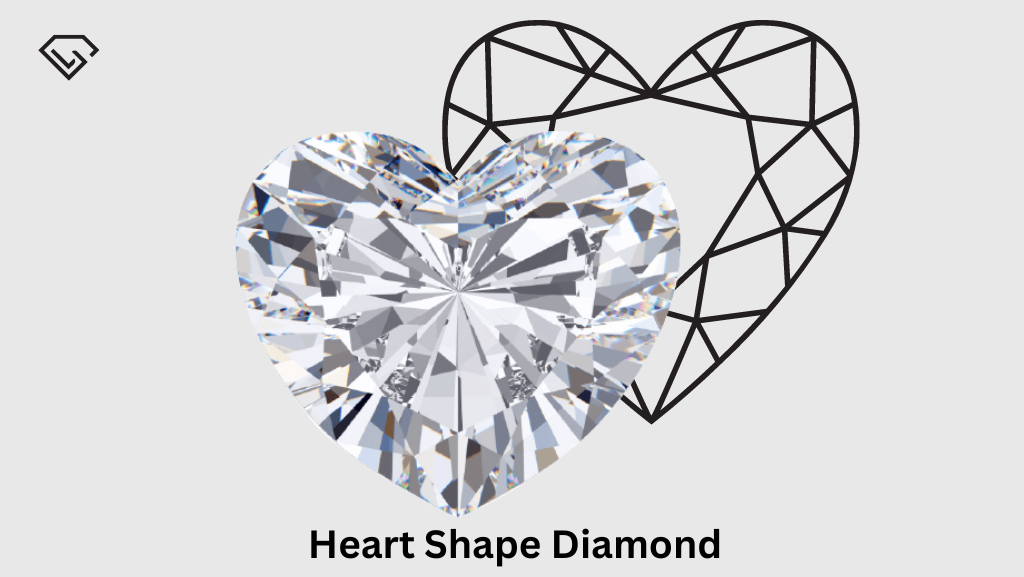
One of the rarest and symbolic cuts in diamond with its never-ending evergreen symbol of love and affection the heart shaped diamond is eccentric and an attractive substitute to the other common, repetitive day to day diamond cuts. 

Where round-shaped diamonds cover around two-thirds of the market, the heart shaped diamonds on the contrary cover a minute fraction as compared to the former ones making them distinctive and even more special.

Heart-shape-lab diamond
Historically the heart-shaped diamond has always been related to beauty and class with its creation in the late 1500s when Mary Queen of the Scots sent Queen Elizabeth the heart shaped diamond ring by which the queen was really impressed and happy thus marking the stone of their friendship and taking their alliance to new heights.

Making it one of the most unique and elegant symbols of friendship and goodwill between the royals.

Even after being a more accessible cut over time it still remains quite expensive and coherent diamond cuts to create. Only a skillful and talented craftsman along with the best tools can create this cut thus making it rare and exotic. 

What is Heart Shaped Diamond?

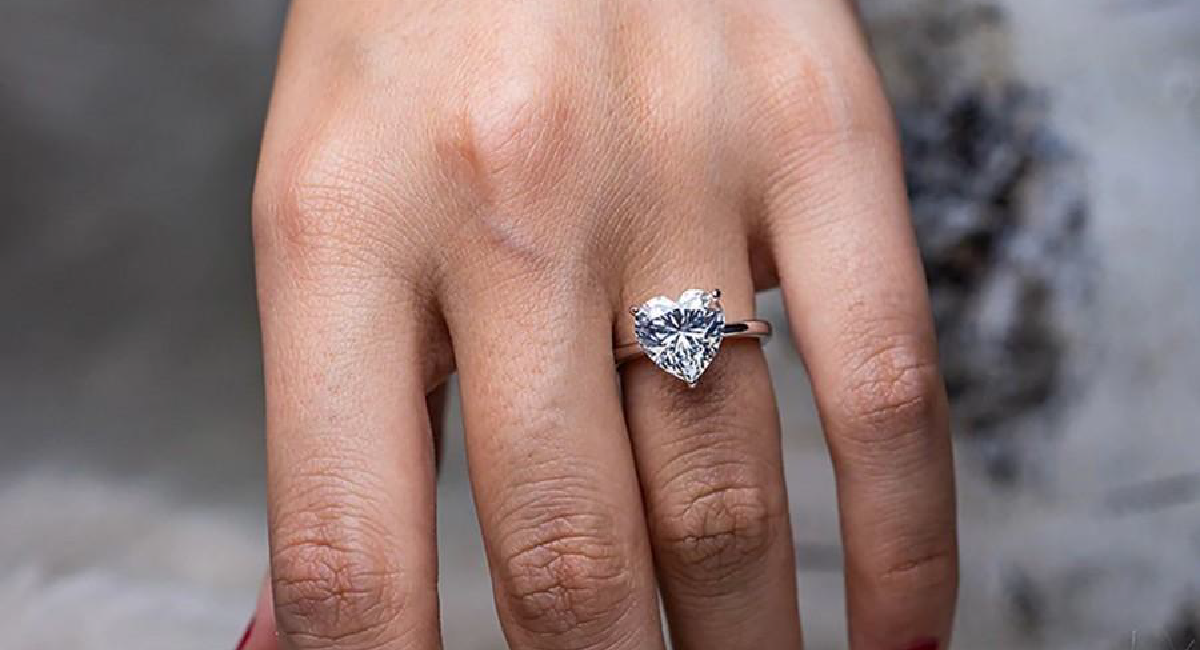
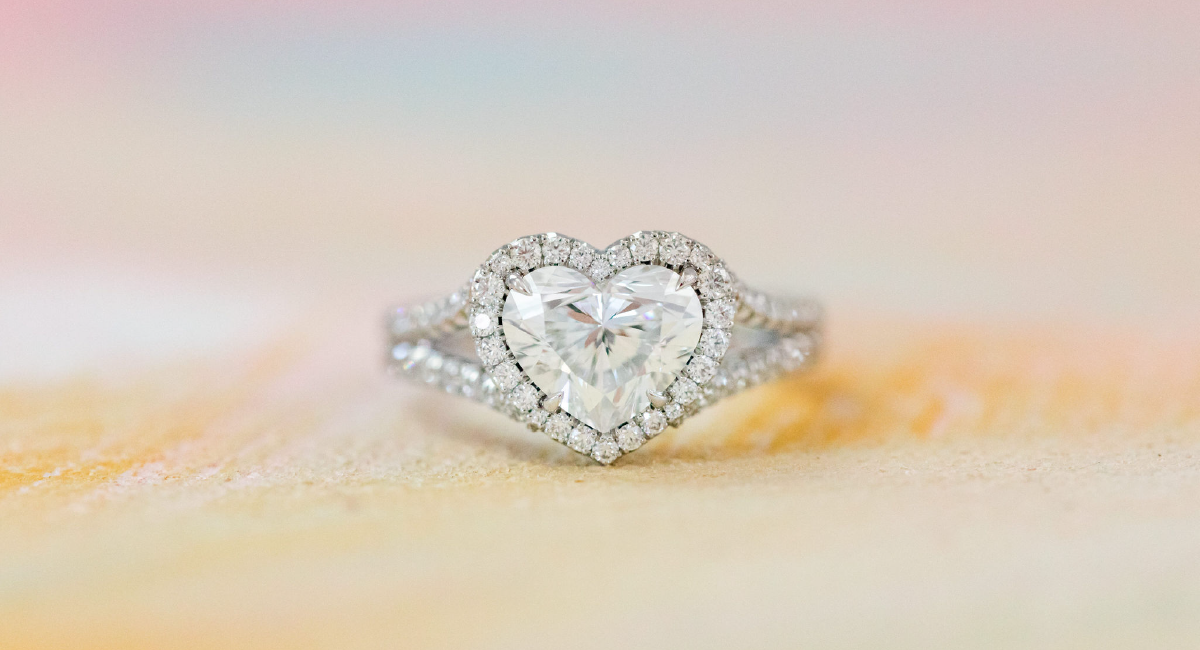
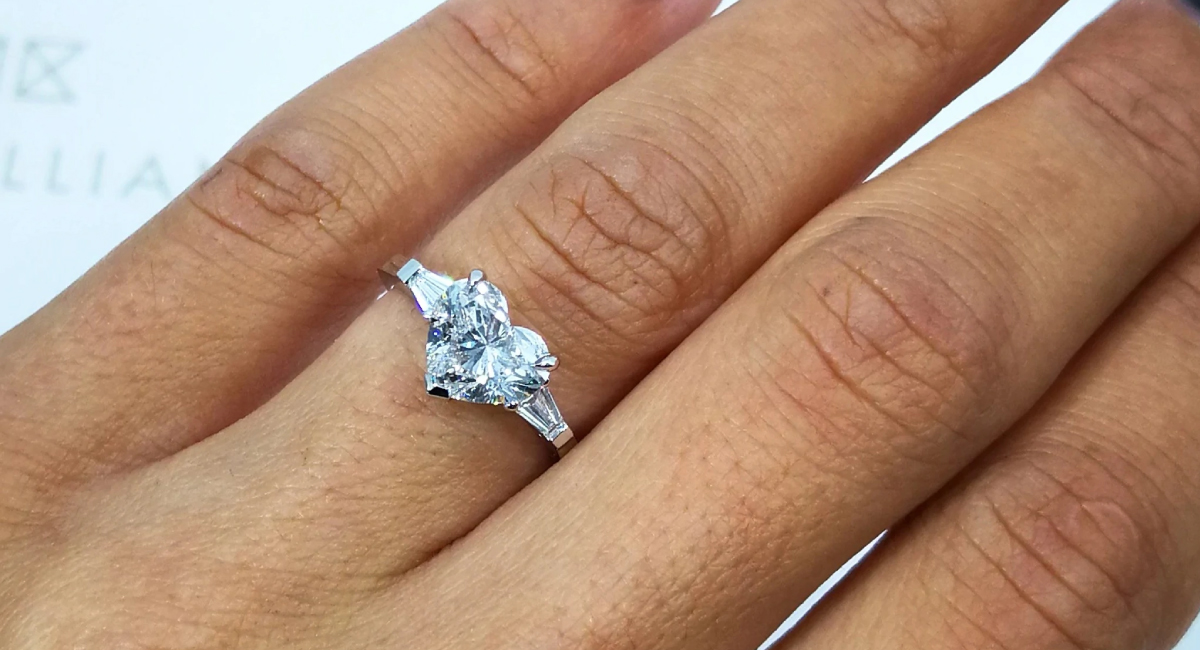
From bracelets to pendants to rings the heart shaped diamonds are used in various jewelry pieces, commonly used in diamond engagement ring in the center thus enhancing it even more.

Heart shape lab diamond
Even celebrities have been spotted time and again with heart shaped diamond rings the most recent ones being Lady Gaga and Nicki Minaj.

Even though it is quite distinct in terms of look and design, this cut is based on the round brilliant cut. Varying in length and width, usually, the heart shaped diamond has about 56 to 58 facets. 

The diamond cut has been in existence for quite a long time but these days it’s the most popular choice of the less traditional brides who relate it with love and uniqueness thus making it a symbolic representation of love on their special day. 

While buying the heart shaped diamond one should take into account the symmetry as it is important that the halves are identical for perfection. 

Even the size needs to be taken into account as it also impacts brilliance, the smaller the size is less visible the cut becomes. Also one should consider the setting to maintain shape. 

[blog_page_inventory shape=”Heart” carat=”1.70,4.10″ cut=”1,4″ color=”0,10″ clarity=”0,11″]
[blog_page_btn title”Buy Now” url=”https://www.loosegrowndiamond.com/inventory/?”]

4C’s of Heart Shaped Diamond

Heart Shaped Diamond Cut

While comparing different diamonds one needs to take into account the cut quality due to the distinctive appearance of the heart shaped diamond thus making it one of the important aspects to look for.

But easier said than done, judging the cut quality of the heart shaped diamond is no cakewalk as compared to reading the GIA certificate. The GIA certificate of the heart shaped diamond does not always go into the slightest of the details of the cut quality, unlike the other common diamond shapes.

Heart-Shape Diamond Cut Quality GuideTo ensure that we are buying a well-cut diamond with an enchanting appearance one needs to take a look at the cut grade thus making it quite important to take this into consideration before making a purchase.

Heart Shape Diamond Length to Width Ratio

The ideal L/W ratio for the heart shaped diamond is 1 which means that the diamond should be exactly as long as it is wide. The heart shaped diamonds which are having an ideal or nearly ideal L/W ratio look compatible and reasonable and also do not appear bulbous and ugly. 

Heart Shape Diamond Length To Width RatioThe ones with a ratio less than that of 0.9 will look quite wide and so should be avoided for the best. Even if the ratio is above 1.1 they start looking lean and overly stretched. So for the best results, one should go for the ratio to be as close to 1 as possible as in all the diamonds near to this range look ecstatic and until and unless we specifically desire thin or wide diamonds.

Depth and Table

The diamonds shine and sparkle based on the amount of light that enters and is reflected off its other facets and so size plays an important role in this.

The heart shaped diamonds are nearly flat at the top facet which is known as a table. And ideally, it should make up to 50 to 60 percent of the overall width. The measurement from the bottom to the top of the diamond gives us an idea of the depth of the diamond which is expressed as the width percentage of the same.

For the best sparkle and shine in the heart shaped diamonds this percentage should lie between 56 to 66 percent of the range.

Symmetry

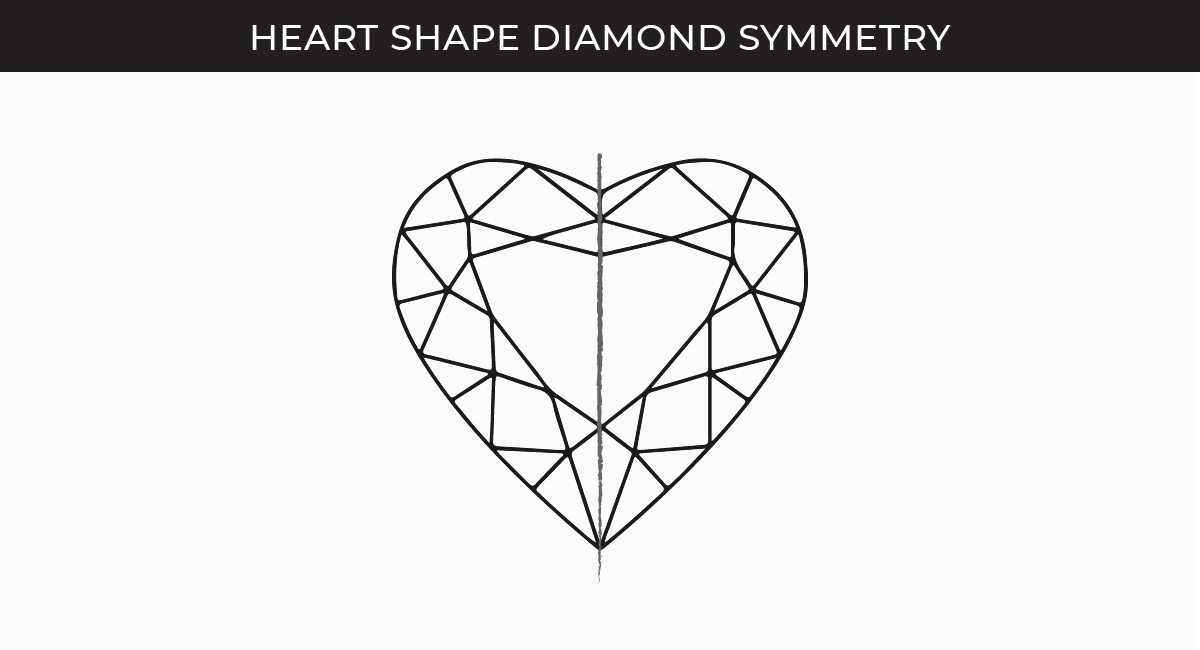
One of the most important factors of the heart shaped diamond is its symmetry due to its bit complicated shape.

The point from the top of the diamond shapes which faces inwards is referred to as the cleft, the sharp point at its bottom, the lobes(the round parts of the diamond which are responsible for creating the heart shape), and also the belly and the wing included are also some of the fancy features that make the shape of the heart shaped diamond of this cut.

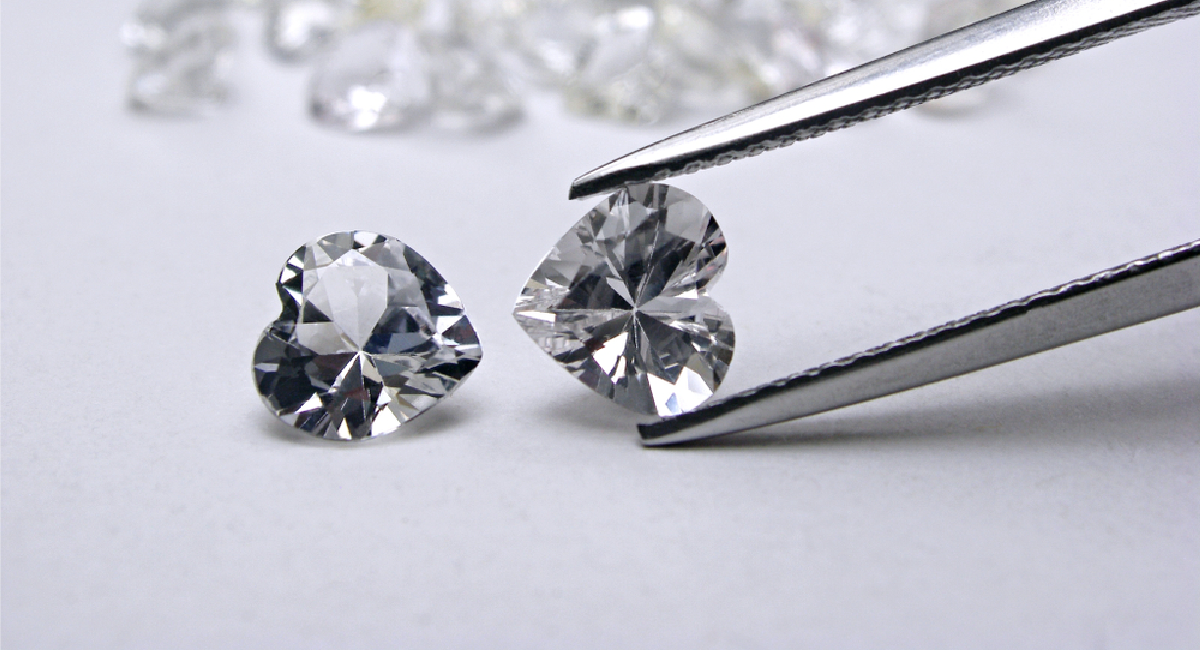
The left picture has a distinct cleft that makes its heart shape easy to see also when we look at the diamond from an angle. Even though there is no necessity for the point to be sharp for a clear beautiful heart shape it should divide the bottom section of the diamond into two clear, equal, and separate halves.

on comparing, on the right side of the image, there is a less distinct point and as a result, it is less heart like in appearance and looks more round. 

HEART SHAPE DIAMOND SYMMETRY
Beyond the cleft and also the point it is quite important to check whether the diamond is symmetrical or not. one should always take a look at the lobes of the diamond in case of any imperfections. These are the upper rounded areas that create the top of the heart shape. We should always take into account the symmetry and the lobes to rule out imperfections, the upper top areas which create the top of heart shape.

Both different sides of the diamond should most probably look similar with not much visible difference in facets or in the lobe size. The right picture on the other hand despite its better color and the clarity of grades is visibly less symmetrical. 

Wings and Belly

The shape of the sides of the heart shaped diamond is called the wings and belly. Usually, the wings of the heart shaped diamond should be a little bit rounded but not overly bulbous as a result creating the ideal heart shape and will look spectacular as a center stone or as a part of a pendant or other piece of jewelry. The heart shape will not be highlighted much if the appearance is quite round. 

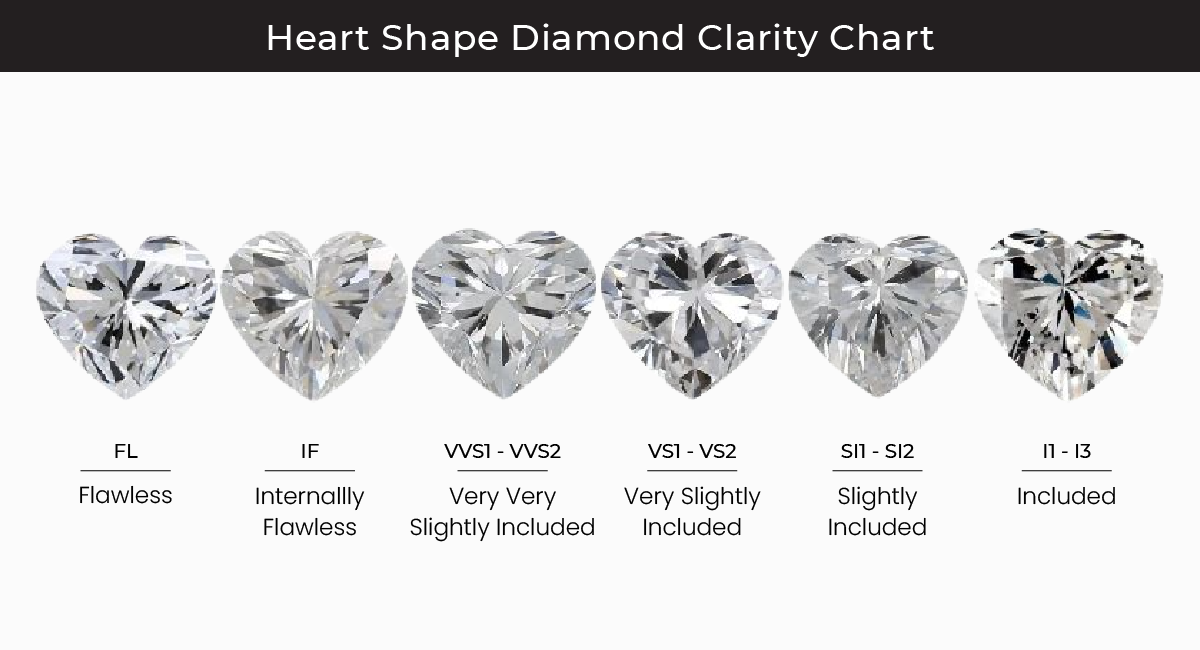
Heart Shaped Diamond Clarity

When seen by a gemologist the scale at which the diamond appears to be clean should always be good. The diamonds in which the clarity grades are high have very few scars and imperfections as compared to the ones with lower clarity grades where the blemishes are quite obviously visible.

The scale of GIA grades Clarity:

  • Flawless (FL)
  • Internally Flawless (IF)
  • Very Very Small Inclusions (VVS1)
  • Very Very Small Inclusions (VVS2)
  • Very Small Inclusions 1 (VS1)
  • Very Small Inclusions 2 (VS2)
  • Small Inclusions 1 (SI1)
  • Small Inclusions 2 (SI2)
  • Inclusions 1 (I1)
  • Inclusions 2 (I2)
  • Inclusions 3 (I3)

The grades which are of quite a high scale for instance IF and VVS1 are very rare to achieve and it is very unlikely to find a diamond of IF grade obviously, the cost and premium to purchase a stone with this clarity grade is very huge.

Heart Shape Diamond Clarity Chart
While grading for clarity the gemologist will precisely look into account by using the loupe of jeweler having 10x magnification as in with this level of magnification it is quite easy to find the imperfections which are also entirely visible to the naked eye once we set the diamond in a ring.

In the case of the diamonds with heart shape the clarity grade of S1 or good shall be provided which is eye clean. As the heart shape is modified into a brilliant cut the small inclusions found in S1 and VS2 diamonds are not that visible to naked eyes.

Heart Shape Diamonds Color

The grades of the diamond color which are used by the GIA fall in the range from D to Z where the D grade denotes that our diamond is crystal clear and colorless. 

As at Z, it is obvious that the diamond is tinted with visible yellow color clearly. The color of the heart shaped diamond is quite hard to distinguish as it reflects quite a huge amount of light. The heart shaped diamonds are a modification of the common round brilliant-cut thus making it rare and unique. 

Heart Shape Diamond Color Chart
The color grade H or better is mostly recommended if one chooses white gold or platinum setting and the saved money can be used to choose a diamond that has a higher carat weight.

A grade in lower color is recommended in a yellow or rose gold setting and a J color grade is mostly for the settings which are solitaire.

Heart Shaped Diamond Carat weight

To put it in simple words diamond carat weight measures how much the diamond weighs. Like all other lab-created diamonds, the heart shaped diamonds are also available in a huge variety of carat weights. It is usually recommended one should choose the largest carat weight that fits in one’s budget.

The amount saved on color and clarity can be used to get a noticeably larger diamond size than one has initially expected to buy. 


Due to the unique shape and cut of the diamond, the ones with the larger carat weights become visually more appealing and enchanting as in higher the carat weight of the diamond more highlighted and beautiful the heart shape becomes. The usual recommendation for the heart shaped diamond is that of the 1+ carat range as in the heart shape of the diamond smaller in size becomes less visible and appealing once it’s set in the ring.

Do Heart Cut Diamonds Have a Bowtie?

Well, this generally comes about when the light shimmers through and enters the diamond through a table, and the large parallel surface on the top of the stone, but it doesn’t reflect the viewer. It isn’t just with diamonds that have fancy cuts, but to an extent, all heart cut diamonds show the bowtie effect, there is also shadowing around the sides.


There are reasons why diamond cutters try to avoid the bowtie effect and one of them is, they want the heart shaped diamonds to reflect as much light. Rightly so, there is a reason people invest in heart cut diamonds, and the reflection of light usually catches the eye and is liked by many.

Factors to Consider Before Investing in Heart Shaped Diamond

The best size of the Heart diamonds is when they are around .50 carats or above because when that big piece of solitaire outshines other rings is when it looks best. Also, anything below the size mentioned makes your heart shaped diamond hard to identify. So, invest wisely because your expression of love should be seen from a distance.

If you don’t know this then let us tell you maintaining regularity or symmetry is a very prime consideration you need to look out for. The heart, the two halves of it, must be of equal sizes as an uneven style will take away from your ring majorly. 

[su_youtube_advanced url=”https://www.youtube.com/watch?v=wl1tcA5asaY” width=”1600″ controls=”alt” autohide=”yes” autoplay=”yes” mute=”yes” loop=”yes” rel=”no” modestbranding=”yes” theme=”light” playsinline=”yes” title=”heart shaped diamond ring”]

Also, remember to consider the division between both the heart-halves should be prominent and done with utmost precision to attain even halves.  Symmetry is a vital component to examine when choosing a heart diamond. It’s essential that the two halves of the heart shape diamond are indistinguishable and the heart’s portion is distinct and even.

Make sure to consider a place where precision is given utmost importance when you invest in the heart shaped diamond ring of yours because the cut in your prized possession should be chiseled to perfection with utmost detail and accuracy. 

There’s a reason why heart shaped diamond rings are such a famous gift for lovers. It is the precision put into creating them, and without that, a heart shaped diamond may not attain its glorious look.

When choosing a heart shaped diamond ring make sure you pay a lot of attention to what is the overall shape of the ring. Making sure that it isn’t uneven is vital because if so then it takes the unique look away from the ring, and that is not something you’d like to waste your money on.  

Lastly before making that important decision of investing in this once-in-a-lifetime gift make sure you check the ratio at which the heart shaped lab diamond. Ideally, you should strike a 0.90 to 1.10 balance of the heart stone as that would be the perfect size making it look evenly big and equally wide. 

Best Heart Shape Diamond Engagement Ring Settings

Heart Shaped Diamond Solitaire Ring

If you love the old school, the classic solitaire positioning, which has a four-prong setting, the prong setting is nothing but the use of metal projections, called prongs, to secure a gemstone. The prong setting lets the light strike a stone from more angles, which increases its elegance.

heart shape solitaire ring
It helps enhance the brilliance of your heart cut diamond to a greater extent. Though a six-prong setting protects your ring better, however, the downfall is that it lets far less light in. But again on the brighter side, this setting manages to conceal inclusions on the edges of the stone, too.

Heart Shape Diamond Multi-Stone Setting

If you have your heart cut diamond less than one carat, though we don’t suggest that, but if you do a fine halo setting that will surround your heart cut diamond with smaller ones would do just fine.

heart diamond halo ring
Not only will it make it shine from a distance, but also another touch of elegance to your classic beauty.

Heart Shape Diamond Three Stone Setting

Another trick that you can use to make your heart shape diamond ring stand out is adding a three-stone setting, which makes the heart stone look bigger. They can be colored and placed alongside it, which only enhances the show of the diamond in the center because of the contrast. 

hear-three-stone-diamond-ring
We all know that the heart shaped diamond is something you may hold very dear to you, hence it should be your duty to ensure the pointy end of the stone is well-guarded, for whichever setting you choose.


Conclusion

Unique and classy in its own way the heart shaped diamond is the best way to show one’s love and care and also to take into account that the large percentage of the rough diamond is used in making the heart shape thus making it quite feasible and pocket friendly.

Over the years the choice for this diamond cut is increasing widely as people relate it to the symbol of love.

The main factors which we need to have a look at in this one are the cut, nearly ideal L/W ratio, excellent depth and table, best symmetry, and the perfect overall shape one should also ask for the 360° photos of the diamonds for optimal results.

FAQs

What is the best ratio for a heart diamond?
The ideal ratio is around 1:1, creating a well-proportioned heart shape. However, personal preference plays a role in choosing the perfect ratio.

Can heart shaped diamonds have inclusions?
Like other diamond shapes, heart diamonds may have inclusions. A higher clarity grade ensures fewer imperfections, enhancing the diamond’s brilliance.

How much is a 1 carat heart shaped diamond worth?
The value of a 1-carat heart shaped diamond can vary significantly based on factors like cut, color, clarity, and overall quality. On average, you can expect prices ranging from $400 to $6,000 or more.

Do heart shape diamonds come in various sizes?
Yes, heart shaped diamonds are available in a range of sizes to suit different preferences and budgets, from delicate to more substantial carat weights. You can use heart shape diamond size chart on LGD.

Do heart shape diamonds come in various sizes?
Yes, heart shape lab grown diamonds are available in a range of sizes to suit different preferences and budgets, from delicate to more substantial carat weights.

Round Cut Diamonds: Everything You Need to Know

They say that size doesn’t matter but does shape? A case must be made for round cut diamonds here, for they are both traditional and everlasting and are generally the cut that comes to mind when people think of diamonds. 

From time immemorial in the history of the diamond, permutations of this famous sphere-like form have been tried and tested. Round cut diamonds have a glimmering radiance like no other, making them ubiquitous, and the round cut is regarded as the common currency in diamond cuts for investors, jewelers, and consumers.

round lab grown diamond

Coming into the 21st century the round cut saw a few modifications and the already shiny cut now had enhanced brilliance due to technological advancements. The Round brilliant cut is now a timeless classic diamond cut.

Surprisingly, a round cut sheds most of its carat weight during shaping and polishing as compared to other cuts, making it comparatively more expensive as well.

The brightness of a round diamond is boosted when decided by refinement techniques conducted by professional diamond shapers.

What is a Round Cut Diamond?

The round cut is the most famous diamond of all and is commonly called the ideal cut. It can fit into engagement rings, earrings, necklaces, and anything else.

The lab grown round diamond has been refined to have 58 facets. Its round design accentuates all of these 58 various glittering facets by optimizing and capturing light coming from all directions. Being the most common design is the circular cut, the cut can not only be effortlessly spotted, but also adapt to every occasion’s needs, daytime or nighttime, and the bearer, youthful or aged, modern or antique.

round cut lab diamond

The quest for the perfect cut to highlight all the facets of the gemstone’s stone’s luminosity and brightness has resulted in the development of several unique cuts over the years.

Round cut diamonds are the only gems having a separate grading system on its GIA diamond grading report is the round brilliant cut. Since GIA is the largest and most successful diamond certifying laboratory, it has considerable power in the business.

[blog_page_inventory shape=”Round” carat=”2.00,2.10″ cut=”1,4″ color=”0,10″ clarity=”0,11″]
[blog_page_btn title”Buy Now” url=”https://www.loosegrowndiamond.com/inventory/?shape=Round”]

History of Round Cut Diamonds

Over many centuries, the expertise or technological apparatus needed to make a round lab diamond was nowhere to be found and practised. 

The round brilliant diamond cut was made a reality with the development of the bruting machine at the close of the 19th century.

Due to the ‘Diamond Design Thesis’ by Marcel Tolkowsky, the round cut underwent another change in 1919 through his carefully calculated mathematical formula to angle the facets in a way that reflects the most light.

Since Tolkowsky’s work, the round brilliant cut has become the most popular and widely used diamond cut in the world. Its timeless elegance and unparalleled sparkle have made it a favourite choice for engagement rings and other fine jewelry.

What Do You Call a Round Cut Diamond?

round diamonds on hand

A round cut diamond has 57 or 58 facets on the sides depending on whether it has a culet or a flat face at the bottom of the diamond. The facets of an evenly cut diamond would simply converge at a critical location, making no space for a culet.

There are Two Types of Round Cut Diamonds:

  • Brilliant Cut Round Diamonds

This cut makes excellent use of its edges to reflect not absorb but throw out infinite flashes of light. Contours and dimensions interact with each other to refract spectacularly and be the brightest. The brilliant cut round diamonds have a culet that ranges from average to big and an underside holds up 65% of the diamond’s total durability and strength.

Brilliant cut round diamonds are a fantastic selection for contemporary jewelry with stunning glitter.

  • Old European Cut Round Diamonds

The antique European cut round diamond was prevalent before the twentieth century as well as meticulously manufactured before contemporary diamond processing. As a result, these cuts have greater depth in dimensions than brilliant cut round diamonds. Diamonds of the Old European cut were principally fashioned due to their hue. 

The fundamental distinction between brilliant cut and old European cut diamonds pertains to their facets since the old European cut had facets with triangular frames, whilst the round brilliant diamond has narrower kite or ace-shaped facets. Both the cuts have their own special way of reflecting light.

4cs of The Round Cut Diamond

The 4Cs of diamond quality measurement have not only become a globally understood vocabulary among jewelers, but also a handy checklist for any customer lacking expertise in picking the perfect diamond for their requirements. The Gemological Institute of America (GIA) created the Cs as an official grading method in 1953.

It encompasses Color, Clarity, Cut, and Carat Weight, to provide an objective, effective, and reliable appraisal of diamond excellence and cost. These aspects interact and might be reliant on each other within a diamond, needing a holistic examination rather than a concentrated inquiry of one feature.

4cs round cut diamond infographic

  • Carat Weight

Mostly, people who prefer round-cut diamonds will be benefitted as these stones will always seem to be more carat weight than the other cuts. Moreover, unlike other cuts that require a minimum carat size to maintain the integrity of their shape, round cuts can go as small as possible without making their shape obscure. 

  • Clarity

The GIA divides clarity into 11 key subcategories, which are mentioned below from highest to lowest-

  • Flawless (FL)
  • Internally Flawless (IF)
  • Very Very Small Inclusions (VVS1)
  • Very Very Small Inclusions (VVS2)
  • Very Small Inclusions 1 (VS1)
  • Very Small Inclusions 2 (VS2)
  • Small Inclusions 1 (SI1)
  • Small Inclusions 2 (SI2)
  • Inclusions 1 (I1)
  • Inclusions 2 (I2)
  • Inclusions 3 (I3)

The most crucial factor in determining a diamond’s clarity is whether or not the diamond appears to be clear to the naked eye. Many imperfections may be apparent only to a trained specialist using highly sophisticated equipment.

For round diamonds, most of the decision-making procedure depends on the onlooker since some individuals might want to know that their stone is confirmed as perfect, while some are fine with the idea of slight defects that are not easily observable. 

  • Color

Diamond color grading is the accepted practice for classifying round diamond tints as a scale that starts from a D grade (translucent) and progresses to a Z grade. Diamonds are tested to match specified color categories all of which are carefully selected and tested before usage.

The hue of the diamond tends to be directly related to the size and setting of the round cut. Small variances in the color of the cut are harder to identify with the naked eye, yet they can constitute a significant change in the diamond’s cost. Furthermore, the color and substance of the rough diamond chosen can create a significant impact on the finished stone.

  • Cut

The cut quality of the diamond must be considered too. The dimensions of a round cut dictate how vividly it will sparkle. The cut of a diamond is graded by assessing its edges and gloss. The purpose of achieving a decent cut is to pick the one with all the proper proportions to have the greatest passage of light, giving the stone a gorgeous glitter that your companion shall adore.

The cut of each diamond is graded as Ideal, Excellent, Very Good, Good, Medium, Fair, or Poor. A good round cut will have measurements that permit ideal reflectivity through the crown and table, resulting in a stunning, bright shine.

Round Cut Diamond Price

Loose Grown Diamond has an extensive inventory of round-cut diamonds with half-carat round-cut diamonds, beginning at $600 and fluctuating according to cut, clarity, color, and carat weight preferences.

The industry benchmark for elegant 1-carat round diamonds is around $900. 2-carat round diamonds certified by the Gemological Institute (GIA) are scarce and worth a starting price of $1500.

These 2-carat round cut diamonds on hand are a charming scene. Now, coming to more significant pieces, these stones display genuine brilliance, priced at $2000 for a 3-carat round diamond and $3,000 for a 4-carat round diamond option.

If you’re stuck, you can use our ‘diamond price calculator‘ to help with pricing.

Why Should You Choose a Round Cut Diamond?

There are certain advantages that a Brilliant round cut diamond has and why you should prefer buying it. Here are the pros of buying a lab grown round cut diamond.

round cut diamond infographics-2

Brilliance: Round-cut diamonds have the best brilliance in the market. The diamond is cut in such a way that it reflects a maximum of the white light making it extremely lustrous. As the name suggests, brilliance is the top priority of the round cut.

Better Option: If you like to have options, then round-cut diamonds are your stone. Round cut diamond has a lot of variety in terms of designs. They can be adjusted and added to any jewelry design and this is one of the reasons why they are so widely used.

Never Goes Out of Style: The round-cut diamond has been the jewelry world favourite for decades. They are a classic timeless cut that will never go out of fashion. Your jewelry piece will always be in trend if you buy a round-cut diamond.

Fire: Have you ever looked inside a diamond? If you have, chances are you would have seen a rainbow-like light inside the diamond. This is known as the fire of the diamond, one of the beauty factors the stone has. Round-cut diamonds have the most fire and it makes them look exquisite and expensive.

Round Diamond Ring Settings

A diamond setting in a lab grown diamond ring can be anything from a plain band to a complex design with several diamonds or other jewels placed onto the ring. It’s the style of the ring that secures the diamond. Choosing one that compliments personal taste in addition to the diamond’s shape and size is crucial as it dramatically affects the ring’s overall appearance and beauty. Herein, let us explore the different settings for round cut diamond rings.

Solitaire Round Diamond Ring:

The solitaire setting is a popular option for round-cut diamonds since it showcases the stone by mounting it on a thin band. Classic and beautiful patient settings range from simple to ornate.

Bezel Set Round Diamond Ring:

Another option is a round diamond ring with a bezel setting, which encases the stone in a metal rim for further security. The diamond’s brightness may be slightly diminished but offers additional protection.

Pave Round Diamond Ring:

Another alternative is the pavé setting, which involves intricately arranging little diamonds or gemstones around the center diamond. This technique enhances the ring’s brilliance and gives it a more contemporary look.

Three-Stone Round Diamond Ring:

[su_youtube_advanced url=”https://www.youtube.com/watch?v=5EGzKuu8TF0″ width=”1600″ controls=”alt” autohide=”yes” autoplay=”yes” mute=”yes” loop=”yes” rel=”no” modestbranding=”yes” theme=”light” playsinline=”yes” title=”round diamond three stone engagement ring”]

A round diamond band with Three Stones features three diamonds, one slightly larger than the others, placed in a three-stone setting. The center stone adds sentimental value to the round cut engagement ring. These 3 diamonds symbolize the past, present, and future.

Halo Round Diamond Ring:

round diamond ring with halo style makes the center diamond look larger by encircling it with a circle of lesser diamonds or gemstones. It has a romantic, vintage vibe and is perfect for those who love diamonds.

Vintage Round Diamond Ring:

This ring style is perfect for the one you love, with its classic round stone and delicate filigree or milgrain settings that will always stay classic. A halo or pavé setting may be added to set the stone off.

Celebrity Round Diamond Engagement Rings

The round cut diamond engagement rings are popular among many famous people. Quarterback Tim Tebow presented Demi-Leigh Nel-Peters with a flawless 7.5-carat round diamond, while Brittany Snow showed off a round diamond set in a pave band.

Felicity Jones chose a timeless circular cut on a band of golden metal. A halo-encircled round diamond is the focal point of Alison Brie’s rose gold ring.

Jamie Bell proposed to Kate Mara with a classic round cut diamond engagement ring back in 2020. The round diamond on Meg Ryan’s yellow gold band and the one on Rosie Huntington Whitley’s equally astonished viewers.

So, celebrities equally invest in the diamond saga, with each of them gifting/selecting a unique ring.

Conclusion

Round diamonds were the most favoured diamond cut in the marketplace for generations, notably for engagement rings, pendants, and studs. This magnificent diamond cut is designed to match new artistic principles while maintaining an ageless and traditional appearance.

Round cuts have remarkable brightness and flare, which flashes under lighting, thanks to stringent rules for optimal dimensions. To define the quality of a round diamond, these rules look at its facet shapes, girdle breadth, culet, luster, and evenness.

The appropriate ratios of round cuts give universality, grace, and superb sparkle, proving a traditional yet attractive diamond alternative.


FAQs

How many facets in a round brilliant cut diamond?
A round brilliant cut diamond has 58 facets, optimizing brilliance and sparkle for exquisite beauty.

How much is a 3 carat round diamond worth?
The value of a 3 carat round diamond varies widely depending on its quality and characteristics, but it could range from $5,000 to $70,000 or more.

Does a round diamond sparkle the most?
Yes, a round cut diamond typically sparkles the most due to its symmetrical shape and faceting pattern, which maximize light reflection and brilliance.

Why do round diamonds look bigger?
Round diamonds often appear bigger than other shapes of the same carat weight due to their unique cutting style, which maximizes the stone’s surface area visible from the top, known as the table. This optical illusion makes round diamonds appear larger than other shapes of equal weight.

Princess Cut vs Cushion Cut: Which One to Choose?

When it comes to diamonds, each cut has its charm and beauty that make them unique. No two diamond cuts are alike hence it all comes down to the diamond. Finding a diamond that not only suits your tastes but also your budget can be quite a hard task.

Princess Cut vs Cushion Cut: Describing the both diamonds

Princess cut vs cushion cut diamonds are two of the very famous and popular diamond cuts in the market. Princess cut and cushion cut both have a geometrical appearance that pleases a lot of minimalistic and contemporary people with varying differences.

Each has a different fan following for different reasons.

Princess Cut Diamonds

Princess cut diamonds are perfectly square diamond cuts that sparkle with brilliance and fire. The second most popular diamond cut, princess cut diamonds feature straight edges with sharp corners. These square cut diamonds are as brilliant as round brilliant diamonds.

Princess shape diamonds first made an appearance in 1961. They were also called ‘square modified brilliant’ and ‘profile cuts’ based on their cut and similarity to round brilliant diamonds. With up to 76 facets around them, princess cut diamonds are full of brilliance and sparkle that is bound to grab everyone’s attention.

princess cut diamond: what they are and Pros and cons of the cut

Since these diamonds are more about sparkle and brilliance, they make an excellent case for not showing their true colors. Most of their colors are concentrated at the corners, making it hard to tell the difference between two diamonds of consecutively different grades when kept side by side. This also works in the favor of the buyer lower color grades are quite acceptable when it comes to princess cuts. 

Princess cut diamonds refract up to 70% of the light that enters within them. That percentage not only makes them highly refractive and reflective but also gives them an upper hand over cushion cut diamonds.

Pros and Cons of Princess Cut

Pros:

  1. Sleek Appearance: Princess cut diamonds offer a sleek and elegant look, making fingers appear longer.
  2. Versatility: Looks great in various settings, enhancing the overall appeal of your jewelry.

Cons:

  1. Sparkle: Slightly less sparkle compared to cushion cut diamonds.
  2. Price: Can be relatively higher due to high demand.

[blog_page_inventory shape=”Princess” carat=”1.00,2.10″ cut=”1,4″ color=”0,10″ clarity=”0,11″]
[blog_page_btn title”Buy Now” url=”https://www.loosegrowndiamond.com/inventory/?”]

Cushion Cut Diamonds

Cushion cut diamonds or old mine cut diamonds, are soft square or rectangle diamond cuts that sparkle with soft gleam and elegance. One of the most popular diamond cuts, cushion cut diamonds have rounded edges with blunt curved corners. They might be as brilliant as princess cut diamonds but they do have an unparalleled sophistication that is highly unique.

Cushion diamonds first made their appearance in the 1700s. They were also called ‘old mine cuts’ due to them being the way old mined diamonds were cut. They are one of the oldest cuts of diamonds. They were the standard diamond cut until the 19th century when new and modified diamond cuts started making their appearance.

Cushion cut diamonds have 58 facets which gives these diamonds a less sparkly nature compared to princess cut diamonds. 

cushion cut Diamond: Describing the cut and pros and cons
Cushion lab diamonds have subpar color retention, which makes colors within them quite visible. They retain their natural color best. Because of their comparatively less brilliance than princess cuts, it is easier to spot inclusions and blemishes inside a Pillow cut diamond.

Due to their rounded blunt corners, their color doesn’t tend to accumulate at the corners. Hence it is not suggested to go for a lower grade of a diamond, not below H when it comes to color. But these colored influences can be nullified if yellow gold or rose gold is chosen as the metal for the same. 

Due to their variety of sizes, choosing the wrong cushion cut diamond may either end up looking way similar to the round brilliant diamond or radiant cut diamond. The preferable ratio of L-W happens to be 1.00-1.30. Elongated cushion cuts have their unrivaled charisma.

[blog_page_inventory shape=”Cushion” carat=”1.00,2.10″ cut=”1,4″ color=”0,10″ clarity=”0,11″]
[blog_page_btn title”Buy Now” url=”https://www.loosegrowndiamond.com/inventory/?”]

Pros and Cons of Cushion Cut

Pros:

  1. Brilliant Fire: Resembles a round diamond, providing excellent fire and brilliance.
  2. Size: Makes a strong visual impact due to its shape.

Cons:

  1. Bulkier Appearance: Creates a bulky impression on the finger.
  2. Versatility: While still versatile, may not suit all settings as seamlessly as princess cut diamonds.

Princess Cut vs Cushion Cut Diamonds

Cushion cut vs princess cut: shape, history, facets, prince, popularity, color

Difference Between Princess and Cushion Cut

[su_table responsive=”yes” fixed=”yes”]

Aspect Princess Cut Cushion Cut
Shape Geometric, sharp square with four beveled sides Distinctly rounded square, reminiscent of a pillow
History Invented in 1980 by Betazel Ambar and Israel Itzkowitz Dates back to the 1700s, with a resurgence in popularity
Fire and Brilliance High brilliance, comparable to round or cushion cut diamonds Intense sparkle and fire, especially in modified cushion cuts
Facet Patterns Contains 57 or 76 facets, with variations in pavilion and crown facets 58 facets, with classic and modified patterns, creating ‘hearts and arrows’ or ‘crushed ice’ effects
Ratio Variations Slightly rectangular, ratio typically 1.00-1.05 Square or elongated options, ratios vary for different preferences
Price More affordable, up to 30% less than round brilliant cut diamonds Lower demand makes them 15-20% cheaper than round cuts per carat
Size Perception Appears larger face up due to bigger face-up surface area May look smaller per carat due to the smaller table and depth
Versatility Versatile, suitable for various settings and styles Combines antique feeling with modern performance, adaptable to different designs
Vulnerability Sharp corners may be prone to chipping if not protected Generally less vulnerable, but girdle thickness should be considered
Colour Display Tends to display more color due to the large table May have a slight tint, but usually not highly noticeable

[/su_table]

Which Diamond Cut is Best: Princess Cut vs Cushion Cut Diamond?

Neither is truly superior to the other; it is simply a question of taste. If you want a more contemporary style, a princess cut diamond is the way to go. The cushion cut, on the other hand, works nicely in a variety of situations if you prefer a more classic look. 

Cushion cut diamonds are excellent at illuminating color, and the soft, round edges lend a classic touch, particularly when used in a halo arrangement. However, they can make a diamond appear smaller than it is, so if you choose a cushion cut, you may want to go with a greater diamond to compensate.

Princess cuts are more architectural in structure than cushion cuts, providing it with a sleek, sophisticated, regal feel. They have the most vivid brilliance of any cut, following only the round cut, making them a popular option for engagement rings.

Cushion Cut Diamonds Ring Setting

THREE STONE SETTING:

[su_youtube_advanced url=”https://www.youtube.com/watch?v=87yET2796Pc” width=”1600″ controls=”alt” autohide=”yes” autoplay=”yes” mute=”yes” loop=”yes” rel=”no” modestbranding=”yes” theme=”light” playsinline=”yes” title=”cushion diamond engagement ring”]

A cushion three-stone diamond ring typically features a central cushion cut diamond flanked by two smaller diamonds on either side. This style of ring is known for its elegance and versatility.

SOLITAIRE SETTING:

cushion solitaire ring

Due to its soft gleam on top of its symmetrical shape, solitaire settings work amazingly with pillow-cut diamonds. Combining a warmer cushion cut diamond with yellow gold or rose gold gives it a very vintage vibe. Also using a combination of two metals can make it very unique and enhance its antique charm.

HALO SETTING:

cushion diamond halo ring
If the vintage charm of the cushion cut is not enough as it is, adding a halo around it may work for you. Since cushion cut diamonds aren’t the sparkiest diamonds, the halo might just make the center diamond appear more dazzling and bolder.

Princess Cut Diamonds Ring Setting

SOLITAIRE SETTING:

princess diamond solitaire ring
Due to its rectilinearity, solitaire settings work great with diamonds having princess cuts as these diamonds shine bright all by themselves. Placing a square cut diamond with white gold or platinum will provide an utmost chic and sophisticated look that would be unrivaled.

HALO SETTING:

princess diamond halo ring
If you feel like enhancing the beauty of the princess cut diamond, then do get a halo around the center diamond. A halo has small accent diamonds in the periphery of the center stone. They refract and reflect part of their light into the center stone making it sparklier.

Halo settings are also great since they make the center diamond appear bigger by giving an illusion of increased surface area.

THREE STONE SETTING:

Princess three stone ring
Opting for side stones on either side of the center stone can make your diamond look gorgeous. Side stones can be half-moon diamonds, triangles, trillions, baguettes, and even small princess cut diamonds as well. Timeless elegance meets modern allure in this symbol of everlasting love exquisite princess cut three stone engagement ring.

Buy Best Lab Created Princess Cut and Cushion Cut Diamond

Transform your engagement ring ideas into reality with Loosegrowndiamond.com beautiful princess cut vs cushion cut diamonds. Our certified lab grown diamonds are the epitome of sophistication, and they are unrivaled in both price and quality.

We provide a user-friendly Diamond Price Calculator on our website. This tool helps you make informed decisions based on your budget and preferences.

You can check out LGD’s specialized “Diamond Size Chart” guide for measuring diamond sizes and check out the “Printable Ring Size Chart” guide for measuring ring sizes.

Save an extra 2% off already low pricing when you use our promo code at checkout. Pick Loose Grown Diamonds for a classic token of your affection because of superior craftsmanship and moral standards.


Conclusion

When it comes to the argument of what is better: Princess cut or Cushion cut? There is no explicit winner. Neither is superior or finer than the other. It all comes down to personal choices; of what you like. However, if you are going for a charm of modern, then Princess cut diamonds are the best choice. But if it is a vintage and minimalistic look for you, then it is a cushion cut.

Cushion cut diamonds. And if you are still having issues with choosing between them, go for something that has both stones in it. It might be slightly expensive but it will look gorgeous with a perfect combination of modern and vintage.

FAQs

Can I customize rings from LGD?
Absolutely! Loose Grown Diamonds offers a personalized touch, allowing you to create customized rings tailored to your preferences. Our expert craftsmen bring your unique vision to life.

Is a cushion cut diamond better than a princess cut?
Both cuts have unique appeal; a cushion cut offers a softer, romantic look, while a princess cut exudes modern elegance. The choice depends on personal preference and style.

What are the disadvantages of princess cut diamonds?
Princess shape diamonds may be prone to chipping at the corners due to their sharp edges. Choosing protective settings can mitigate this risk, ensuring durability.

Which diamond cut has the most sparkle?
The round brilliant cut is renowned for maximum sparkle, thanks to its numerous facets that enhance light reflection and brilliance. Explore more about this diamond shape’s ring in our carefully advised blog here.

Is a princess cut diamond more expensive?
Generally, princess diamonds are more affordable than round cuts, offering a budget-friendly option without compromising on elegance and beauty.

Emerald Cut vs Radiant Cut Diamond: Clear Cut Distinction

Diamonds have always been available in a wide variety of qualities, cuts, colors, shapes, etc. to customers around the world. While the diamond has many important features, one of its most important aspects includes how the diamond has been cut by the jeweler or designer. Hence, every piece of diamond is available to the customers in various cuts such as the round cut, radiant cut, emerald cut, princess cut, etc.

One such example is the emerald cut and the radiant cut made in diamonds. Although similar from many perspectives, both cuts signify different things and are suitable for different kinds of diamond wearers. Hence, customers should choose according to their personal preferences and what they think would accurately symbolize the situation for which the diamond jewelry is being bought.

radiant vs emerald cut cut diamonds
The emerald cut and the radiant cut are very similar in their outward appearance and hence might tend to confuse people when seen from afar. They are cuts that stay unique and individual in their appearance. Emerald cut diamonds have been a classic cut that imparts a vintage feel to the jewelry. While radiant cut diamonds have a more modern twist and give off an aesthetic vibe.

What is an Emerald-Cut Diamond?

An emerald-cut diamond is shaped like a rectangle with accurately cut corners. Owing to their step-cut facets, a term coined due to their staircase-like ascending cuts, emerald diamonds feature numerous long, beautiful dashes of light. The paralleled cuts form the iconic hall-of-mirrors appearance of the diamond.

Emerald lab diamond-1
The Emerald Cut became rather prevalent during the period of Art Deco (1920-30). The cut gradually became more complex as it was given more facets by jewelers around the world, and became the contemporary cut as we know it today. Currently, the emerald cut is primarily used to emphasize the clarity and purity of the color of the gem.

The cut is unforgiving to diamonds with the slightest of inflictions as blemishes are easily susceptible to the naked eye. The name was coined due to the sequential arrangement of its 57 facets, which are separated into 24 facets on the base, 8 facets on the girdle, and 25 facets on the table. The flat tabletop does have a broad and dazzling width.

[blog_page_inventory shape=”Emerald” carat=”2.05,2.1″ cut=”1,4″ color=”0,10″ clarity=”0,11″]
[blog_page_btn title”Buy Now” url=”https://www.loosegrowndiamond.com/inventory/?shape=Emerald”]

What is a Radiant Cut Diamond?

Having merely ten more facets and a cubical shape similar to the emerald cut diamond, one can argue that the radiant cut diamond might have a similar outline as the former. However, there are crucial differences that help people choose between the two. 

Invented by Henry Grossbard, a renowned diamantaire during World War II, in 1977, the radiant cut is a stunning square geometry of the gemstone that incorporates every one of the biggest outlines seen in the round cut and emerald cut. Hence, it has flashes of a rainbow and bright white light.

radiant cut diamond
Square cuts hold an innate beauty within themselves that stands out among the other varieties of diamond cuts. The radiant cut is a middle ground between the emerald cut and a round brilliant diamond.

The 70 facets transport the light to the center of the stone and help it bounce back, giving the stone incomparable sparkle. It is commonly believed that radiant cut is the only cut that comes close to outperforming brilliant cut in terms of dazzle and brilliance.

Radiant cut diamonds seem bigger than other diamond cuts having similar carat weight owing to their oblong form. Also, because of its oblique edges, the radiant-cut diamond is immune to the damage and ravages of time, making it far more durable.

To help customers get a better idea about the differences that lie between an emerald cut and a radiant cut diamond, here are some of the factors that cause the variations between the two.

[blog_page_inventory shape=”Radiant” carat=”2.05,2.10″ cut=”1,4″ color=”0,10″ clarity=”0,11″]
[blog_page_btn title”Buy Now” url=”https://www.loosegrowndiamond.com/inventory/?shape=Radiant”]

Difference Between Emerald Cut and Radiant Cut

The basic distinction between the Emerald cut vs radiant cut is the appearance of the diamond’s brilliance. The emerald-cut diamonds have straight cuts and light can be seen in the form of strips through the diamond. Whereas, the radiant cut diamond is seen sparkling with flashes of light here and there.

infographic emerald cut vs radiant cut

Emerald Cut vs Radiant Cut: History of the Diamond Cuts

Emerald Cut 

One of the oldest diamond shapes to exist, the emerald cut can be traced back to the table cut of the 1500s from which the emerald cut was further developed. Originally termed as the multi-faceted table cut, the cut was first and foremost used on emeralds as the name suggests, and was only a lot later on brought as another variety into the world of diamonds. 

With the term ‘emerald cut’ emerged in the 1920s, it has often been associated with the era of Art Deco wherein clean lines and symmetry were in trend amongst the people and enjoyed their own class of popularity. Then in the 1940s, the cut was further more refined and standardized which could be done with the invention of much more advanced and systematic diamond-cutting tools. 

Radiant Cut 

Unlike the emerald cut which is a design of the olden times, the radiant cut is a much more modern style that was an invention made by Henry Grossbard in the 1970s. The term ‘radiant cut’ has been patented by Grossbard so generally on the laboratory certificates provided by GIA or AGS, the cut is referred to as a “rectangular brilliant” or “cut-cornered square”. 

The radiant cut was created as a hybrid wherein the cut has many facets that have been designed in a manner to maximize the brilliance and beauty of the diamond. One of the sparkliest varieties in cuts for the diamond industry, the radiant cut diamond is made with a brilliant faceting pattern that is present in both the crown and pavilion of the gemstone. 

Emerald Cut vs Radiant Cut: Facets

The number of facets on an emerald cut diamond is 57, whereas in a radiant cut diamond is 70. In an emerald diamond, one can see that the facets are created in a ‘stepped manner’ (one step after another like a staircase) that adds a mirror effect to the diamond cut. The facets are all elongated and hence we can see that the inclusions are very evident if any. The diamond appears very sleek and classy.

In a radiant cut diamond, one can observe the facets to be triangular or kite-shaped. These angular facets add more character to the rectangular diamond and mask a lot of inclusions that the diamond might possess. The cuts of the diamond make it appear shiny and brilliant. A lab-grown emerald-cut diamond will be as stunning and brilliant as a naturally extracted diamond.

Emerald Cut 

The emerald-cut diamonds have a rectangular outline and the corners are cut in a particular manner. Depending on the dimensions of the gem, the emerald-cut diamonds can be home to 50 to 58 step-cut facets. The step cuts are arranged parallelly and this leads to the creation of stunning flashes of light which in turn causes a “hall of mirrors” effect. This cut is known to be slightly more elegant than radiant cut diamonds and also exhibits a more sophisticated sparkle. 

Emerald-Cut diamond facets

Radiant Cut 

The major difference in the radiant cut is that although it is rectangular in shape much like the emerald cut, it does not have step cuts and is instead home to 70 triangular or kite-shaped facets which originate from the center and do an excellent job of maximizing the brilliance and sparkle of the stone.

Radiant Lab Diamond Facets

Emerald Cut vs Radiant Cut: Carat Weight vs Visible Size

The difference between carat weight and the visible size between the emerald and radiant cuts is almost the same, with both the cuts appearing larger than their actual carat weight. You can use our Diamond Carat Size Chart to determine the right size for your diamond. 

When comparing a round brilliant cut diamond with an emerald and radiant cut diamond, all of the same carat weight, it can be easily noticed that both these diamonds appear larger. In the case of emerald cuts, they appear larger due to the top surface is bigger than the one found in round cuts.

Radiant cuts are also created in an elongated manner and hence appear bigger than the round cut diamonds, even though they have a slightly smaller face-up measurement when compared with the round cuts of the same weight.

With radiant diamonds, it was within Grossbard’s interest to create a diamond that would appear as large as possible by investing not too much. And so, he paired a broad and shallow design with a highly brilliant faceting pattern. This gave rise to an excellent optical illusion wherein the radiant cut diamonds truly felt like they were radiating brilliance and shimmer. 

Emerald Cut vs Radiant Cut: Clarity and Inclusions

Emerald cut diamonds emphasize clarity, with their step-cut faceting style making inclusions more visible. It’s essential to prioritize high clarity when choosing an emerald cut. In contrast, radiant-cut diamonds are more forgiving with inclusions due to their brilliant-cut facets that disperse light, making flaws less noticeable.

This allows for flexibility in selecting a slightly lower clarity grade while still achieving a brilliant appearance. Your choice should depend on your preference for clarity and the balance between clarity and brilliance in your diamond.

When choosing between the two cuts, consider how you prioritize clarity in your diamond and your willingness to balance it with other factors such as brilliance and sparkle.

Emerald Cut vs Radiant Cut: Which is Better?

The choice between an emerald cut and a radiant cut diamond ultimately depends on your personal preferences and the specific qualities you value in a diamond. If you value a classic, understated look and are willing to prioritize clarity, the emerald cut might be the better choice. On the other hand, if you’re drawn to a more brilliant, contemporary, and versatile option with exceptional sparkle and are open to various clarity grades, the radiant cut could be the ideal choice for you.

Radiant cut diamonds are known for their exceptional brilliance and fire. The emerald cut is often associated with a classic and timeless look. Both radiant-cut diamond and emerald-cut diamond have their strengths and beauty. The radiant cut vs emerald cut diamond is a tough choice, wherein the radiant cut is more modern and the emerald cut is more vintage.

Emerald Cut vs Radiant Cut: Valuable Tips for Choosing Diamonds

Different diamond cuts have varying degrees of leniency in relation to the 4C categories. Two particular cuts, the Emerald Cut and the Radiant Cut, exhibit significant differences in how they showcase flaws.

When opting for an emerald-cut diamond, it is advisable to prioritize a higher clarity grade. This is because the large table of an Emerald Cut tends to highlight any visible inclusions. Due to the lower concentration of color in this cut, you can compromise on the color grade and instead focus on securing a higher clarity grade.

On the other hand, Radiant Cut diamonds feature a faceting style that is more forgiving of internal flaws, effectively concealing inclusions with intense brilliance. It is possible to find a stunning Radiant Cut diamond with an SI1 or SI2 clarity grade. With this cut, you can consider upgrading to a higher color grade, as the faceting style tends to reveal a more pronounced concentration of color.

Regardless of the chosen cut, you have some flexibility in sacrificing a bit on the color grade if your ring is crafted from yellow or rose gold, as opposed to white gold or platinum.

Where to Buy Emerald Cut and Radiant Cut Diamonds?

An emerald-cut diamond or a radiant-cut diamond can be bought at Loose Grown Diamonds. We offer the best in class diamonds which can be shipped anywhere on the globe. Additionally, if you are confused about determining the price of your selected diamond, you can use our Diamond Value Calculator.
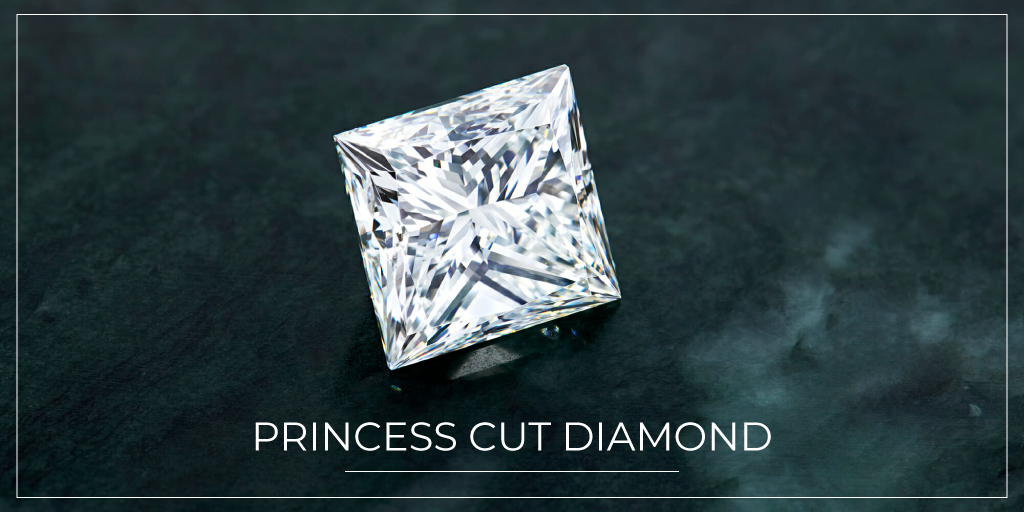
From customizations in pieces of jewelry to the availability of a specific type of stone we have it all. You can have a look at our inventory and also get a discount by using our promo code.


Ending Remarks

Emerald cut vs radiant cut diamonds have seen some similarities and some differences. The beauty of these diamonds is most enhanced in diamond rings and that is when the diamond tends to individually stand out within themselves.
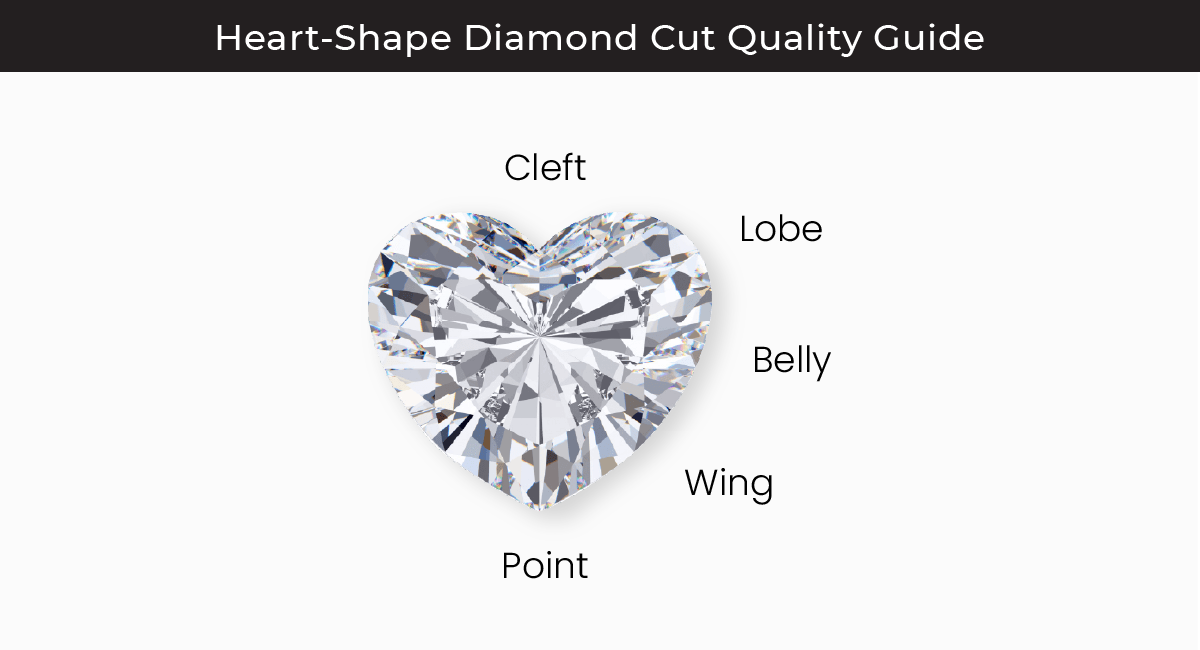
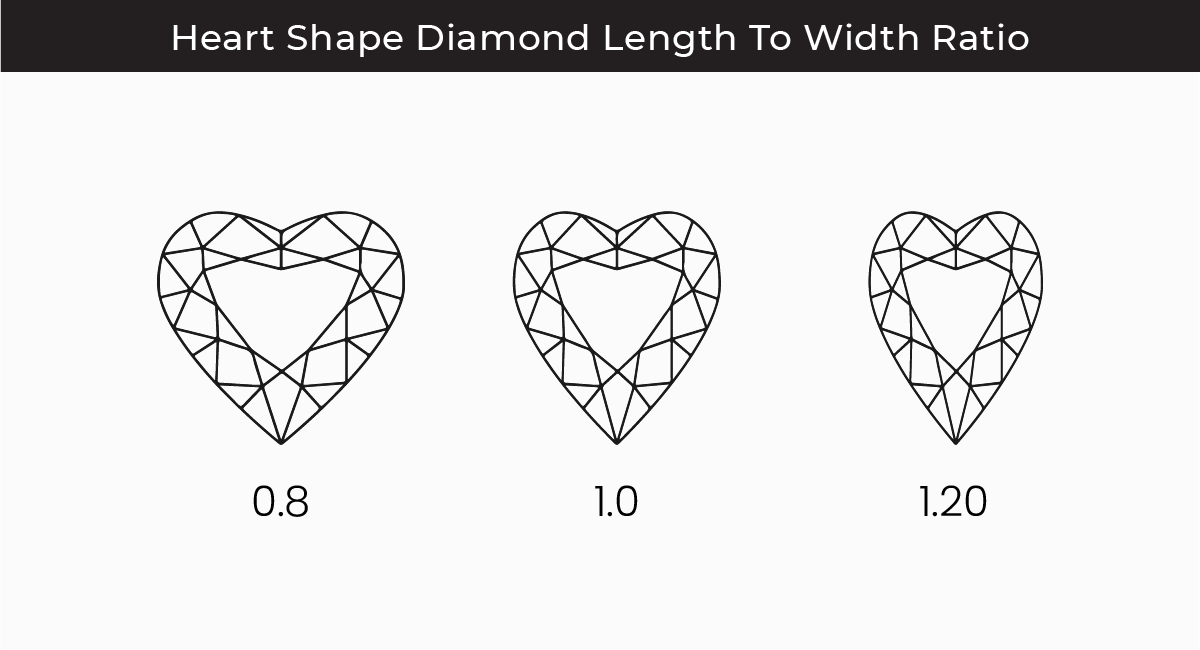
The emerald cut engagement rings have had the vintage touch and hence the huge demand for this classy style. The radiant cut diamond ring has its own fan following. But as a diamond ring has an amalgamation of classy and modern styles you can choose which stone favors your personality. Both of these cuts have their own strongholds and hence both stay as beautiful and stunning, evolving through the test of time.

FAQs

How much is a 2 carat emerald cut diamond?
A 2 carat emerald cut diamond can cost starting from around $600 and increases based on the other 3 C’s that are chosen.

Which is the more expensive emerald cut and radiant cut?
A radiant cut diamond is slightly more expensive than the emerald cut diamond as we see the number of facets increase and so does the effort to add those facets.

Which cut is more suitable for an engagement ring?
Both the radiant cut and the emerald cut look absolutely stunning in an engagement ring.

Can I customize the ratio of length to width for emerald and radiant cuts?
Yes, the ratio of length to width can be customized. For an emerald cut diamond, the ideal ratio is 1.3- 1.6 and for a radiant cut diamond is 1-1.35.