Everything About VS Diamond vs VVS Diamond You Can’t Afford to Miss

In the public eye, diamonds are forever, but this belief often lacks the finicky caution required to tell apart those diamonds that are a cut above the rest. Outwardly, diamonds are just pure carbon turned to a transparent crystalline form, but the quality of these gems can differ widely when the level set by the (Gemological Institute of America) through the 4Cs of clarity, cut, color, and carat weight is taken into consideration.  

Uniting these factors, however subtle, has the power to significantly sway the worth of lab diamonds, particularly when comparing gems of equal size. 

What are VVS Diamond and VS Diamond?
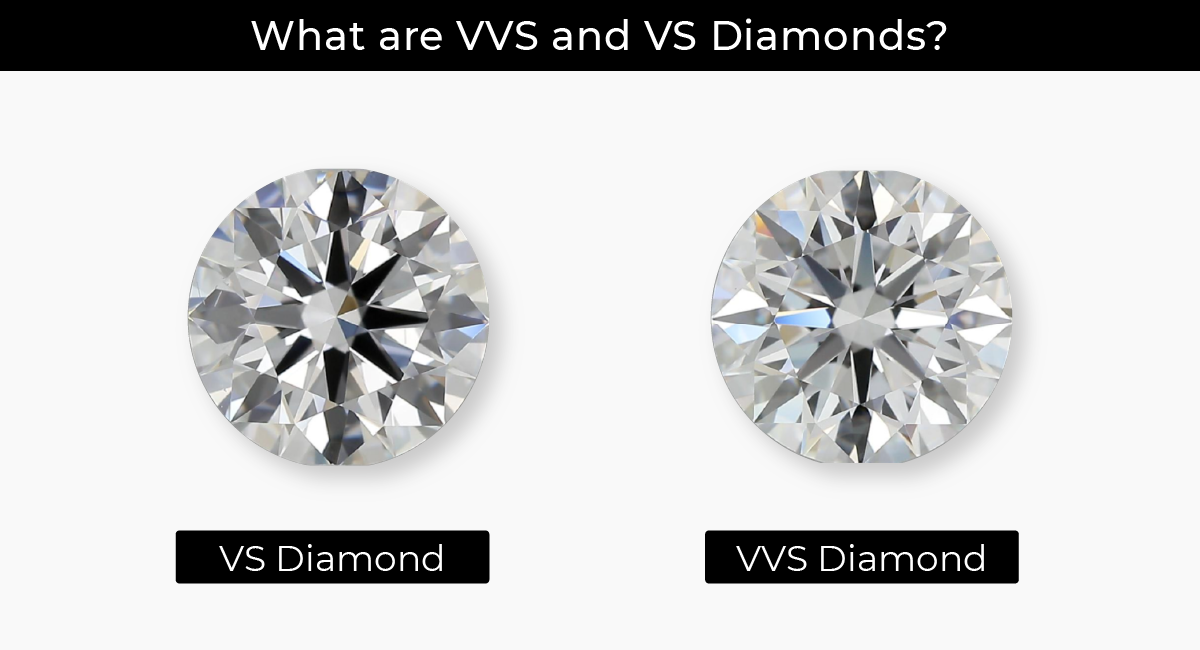
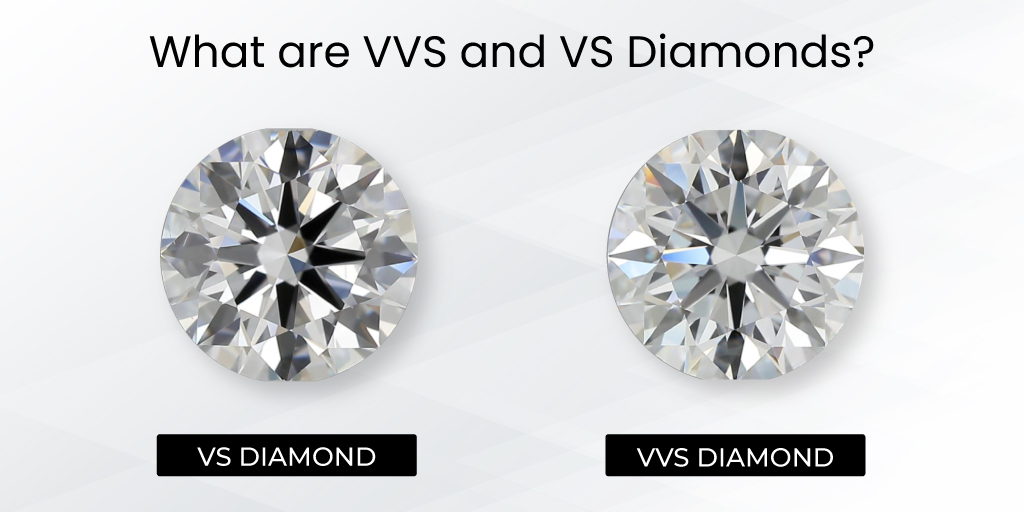
VVS Diamond versus VS Diamond 
At the outset, a little background on how diamonds are created and how that, in turn, affects the clarity of the stone is important. Real or natural diamonds are created deep within the earth when carbon is compressed under immense heat and pressure.

During this process, diamonds inherit certain features that may be internal, known as ‘inclusions’, and external, meaning ‘blemishes’. Inclusions are confined to the interiors of a diamond and develop when small crystals get trapped in a diamond during its formation, affecting the gem’s appearance from within. On the contrary, blemishes turn up on the surface of the diamond through abrasions, polish lines, etc.

Ascertaining the clarity of a diamond, especially with respect to the VVS and VS grades, requires a meticulous approach towards recognizing the size, position, number, relief, and nature of these features as well as the effect it has on the overall appearance of the lab diamond. 

As a thumb rule, it must be remembered that no diamond is absolutely pure, however the higher its clarity, the closer it comes to purity and the more expensive its price. Such consequences make it impertinent to evaluate the clarity of a diamond with the help of a predetermined grading system before deciding to make a purchase. 

What is VVS Diamond?
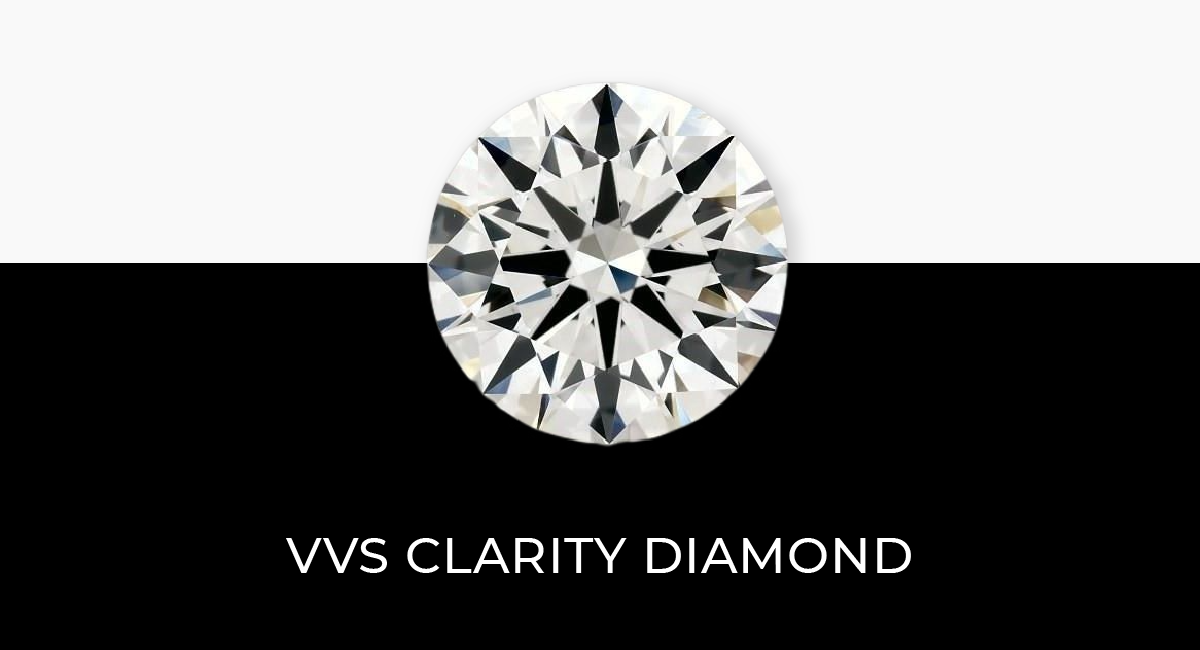
vvs diamond

The inclusions in a VVS diamond are so tiny that they become difficult to view by the naked eye and can only be detected with the help of a microscope. For this reason, VVS diamonds are known to be eye-clean. Common inclusions, that can either be extremely difficult (VVS1) or fairly difficult (VVS2) to find, can include the following:

  • Cloud pinpoints, needles or internal graining are unnoticeable from the table of the diamond but can be spotted through the pavilion, or the commonly found “V” shape at the base of the diamond. These inclusions are extremely difficult to find face-up, or from the top facet of the diamond, at 10x magnification (VVS1).
  • Clouds pinpoints, needles, or internal graining that are fairly difficult to spot face-up at 10x magnification (VVS2). The difference between these two subcategories remains virtually insignificant.
  • Negligible inclusions that reach the surface from within in the form of a chip, bruise, feather, abrasion, indented nature, bearding, etc. These can show up in both subcategories.

It is important to note that any diamonds with inclusions visible to the naked eye cannot be granted the clarity grade of  VVS1 and VVS2.  You will notice that even though VVS diamonds do not look any different from Flawless or Internally Flawless.

[blog_page_btn title=”buy VVS diamond” url=”https://www.loosegrowndiamond.com/inventory/?clarity=7.00,9.00″]

What is a VS Diamond?
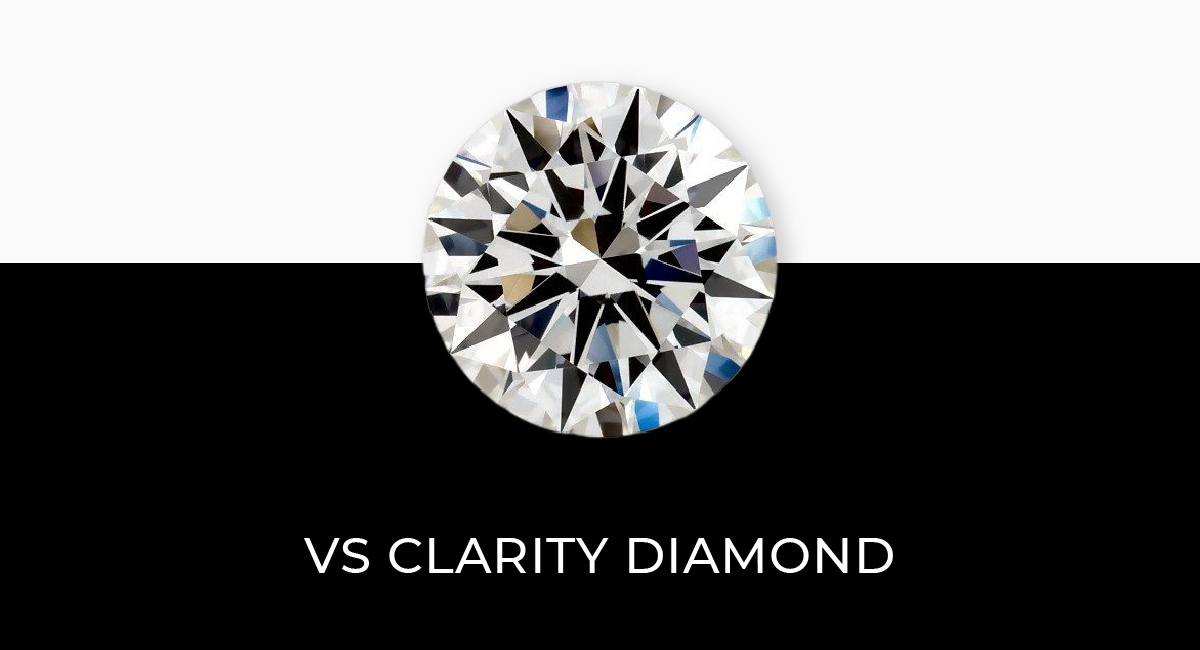
Vs lab diamond

A VS diamond has minute inclusions that vary from very difficult (VS1) and somewhat easy (VS2) to find with 10x magnification. No matter what the features of the inclusions are, their size must be relatively small to that of the lab diamond.

The VS designation refers to Very Small inclusions in a diamond. These inclusions can vary from crystals, clouds, knots, or small abrasions reaching the surface like feathers or cavities. Despite not being Flawless, inclusions are rarely noticeable under bright light or even magnification (VS1). In rare circumstances, a large enough VS stone may have inclusions that were visible to the naked eye in bright light (VS2), but they are usually eye-clean.

We would suggest you explore VS diamonds as they can be a great and adjustable alternative that might suit your budget and requirements better than VVS clarity diamonds.

[blog_page_btn title=”buy VS diamond” url=”https://www.loosegrowndiamond.com/inventory/?clarity=5.00,7.00″]

Also Read: The Different Cuts of Diamonds: A Guide to Choosing the Best One in 2022

GIA and its Diamond Clarity Scale
Certificate

In devising its clarity grading scale, the GIA uses 10x magnification as a standard measure for each grade. It takes a jeweler’s skilled eye and microscope with increased magnification of 10x loupe to determine the clarity grade of a diamond. During this process, the grader must keep five factors in mind:

  • Size: With all factors being otherwise equal, the relative size of the inclusion or blemish in comparison to the size of the diamond, meaning if the same is easily visible, the clarity grade allotted will be lower.
  • Number: With all factors being otherwise equal, the number of inclusions or blemishes visible at 10x magnification will have a positive relationship with the clarity grade.
  • Location: The closer the inclusion or blemish is to the table of the diamond or the facet that is visible when the stone is viewed face-up, the lower the clarity grade.
  • Nature: This refers to the overall effect the blemish or inclusion has on the appearance of the diamond, something that only the grader can ascertain.
  • Color: In some cases, the color of the inclusions can affect the overall appearance of the diamond. Dark-colored inclusions, like black carbon spots, maybe more noticeable and potentially impact the clarity grade.

It’s important to note that each factor is evaluated in conjunction with the others, and the overall assessment leads to the assignment of a specific clarity grade on the GIA Diamond Clarity Scale.

[blog_page_inventory shape=”cushion,round,heart,pear,oval,cushion,princess,emerald,radiant,marquise” carat=”1.30,2.60″ cut=”1,4″ color=”1,10″ clarity=”1,6″]
[blog_page_btn title”Buy Now” url=”https://www.loosegrowndiamond.com/inventory/?”]

Diamond Clarity Grading
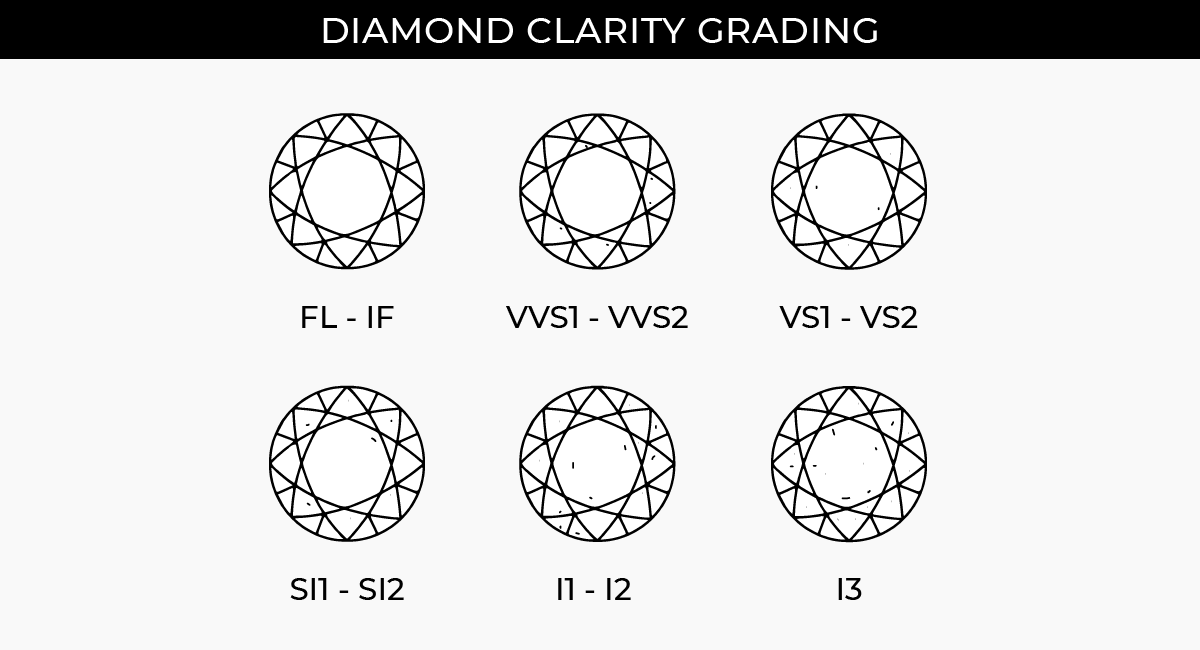
diamond clarity

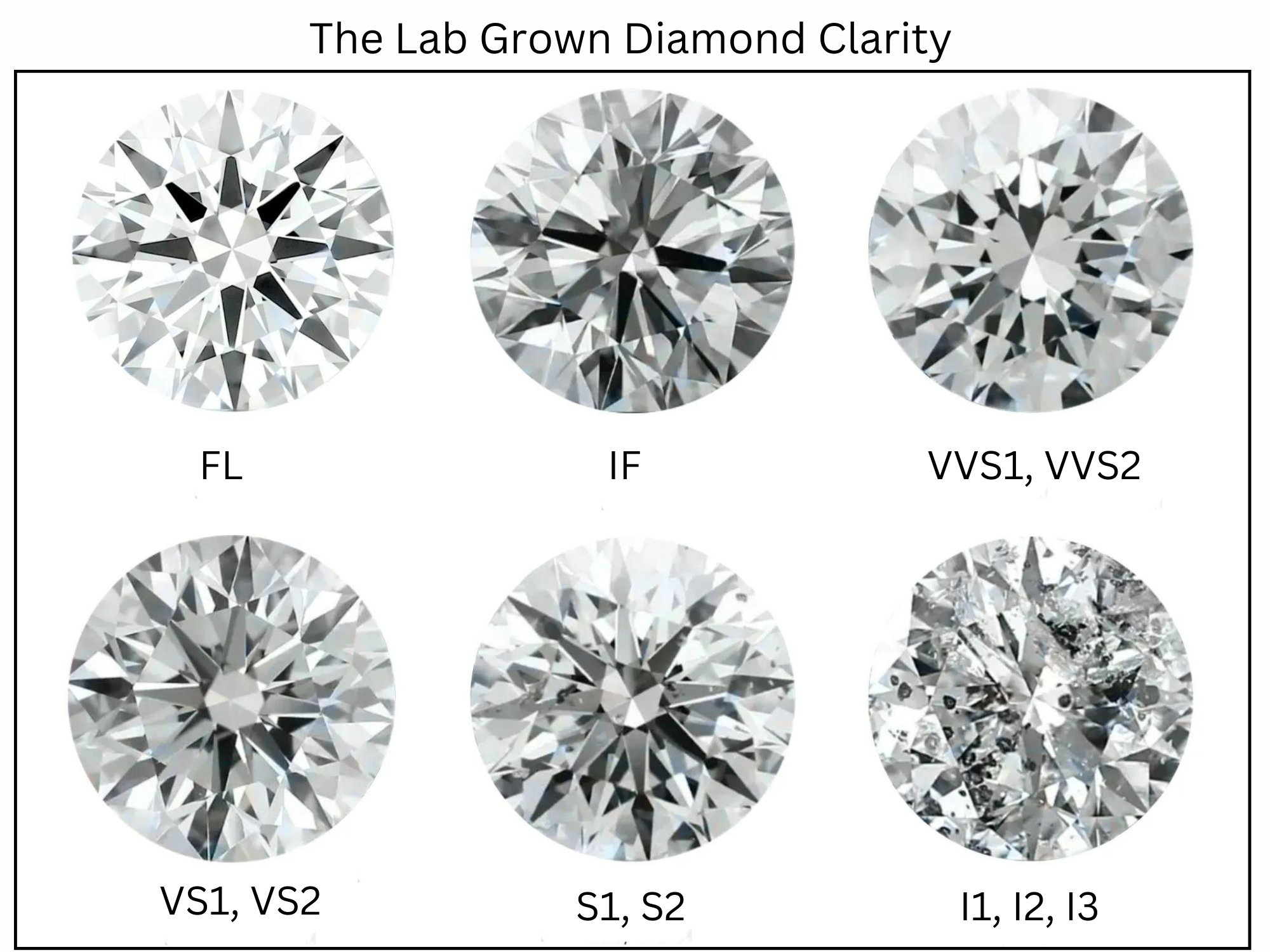
Founded on these five clarity characteristics, the GIA grading scale for diamond clarity can be divided into 6 main categories, ranked according to their descending price value, as follows:

[su_table responsive=”yes”]

Flawless (FL)
No inclusions or blemishes upon examination under 10x magnification.
Internally Flawless (IF)
Under 10x magnification, no inclusions are detectable.
Very Very Slightly Included (VVS1 and VVS2)
Such negligible or undetectable inclusions that vary from extremely difficult (VVS1) and very difficult (VVS2) to detect that even a skilled grader will find it difficult to find them under 10x magnification. VVS1 denotes slightly higher clarity than VVS2.
Very Slightly Included (VS1 and VS2)
With considerable effort, the inclusions can be discovered either with considerable effort (VS1 ) or easily (VS2), however, they still remain minor in nature.
Slightly Included (SI1 and SI2)
Inclusions that are easily discoverable (SI1) or apparent in nature (SI2)­ under 10x magnification.
Included (I1 clarity, I2, and I3)
Inclusions are so apparent that they are not only evident under 10x magnification but also affect the brilliance and transparency.

[/su_table]

Each diamond is individually assessed and assigned a clarity grade based on the GIA Diamond Clarity Scale.

The GIA Clarity Scale provided uniformity in diamond evaluation for jewelers across the globe, hence, these grades have become a common measure despite the nationality of the jeweler. Since blemishes only affect the top two categories, it is only about inclusions that we will continue the discussion on VVS and VS diamonds.

Difference between VVS Diamonds and VS Diamonds

While it is obvious that VVS diamonds are rank superior to VS diamonds, outlining the exact point of difference before deciding to purchase either is extremely important. Before all else, let’s understand the typical inclusions that may be found in both the diamonds-

  • Pinpoints– A tiny inclusion in the form of a crystal trapped inside the diamond that is noticeable under 10x magnification.
  • Clouds– Groups of minute inclusions that cannot be spotted individually but can make the appearance of a diamond hazy.
  • Internal Graining– Lines, angles, or curves during the process of crystal growth in the formation of a diamond.
  • Needles– These are elongated crystals that appear as thin, needle-like inclusions.
  • Knots– Knots are external crystal growth that has extended into the diamond.

Here’s a comparison table highlighting the differences between VVS (Very Very Slightly Included) diamonds and VS (Very Slightly Included) diamonds:

It is with reference to these inclusions that we differentiate between VVS and VS diamonds as follows-

[su_table responsive=”yes”]

Parameters

VVS Diamonds

VS Diamonds

Definition
VVS diamonds have very few and very small inclusions
VS diamonds have minor inclusions that are noticeable under 10x magnification
Clarity Grade
VVS1 and VVS2
VS1 and VS2
Brilliance
VVS diamonds tend to have exceptional brilliance and sparkle due to their high clarity
VS diamonds also have good brilliance and sparkle, but it may be slightly lower compared to VVS diamonds
Inclusion Visibility
Inclusions are extremely difficult to see with the naked eye
Inclusions are relatively easy to see under magnification but may be barely visible to the naked eye
Inclusion Size
Inclusions are usually very tiny and microscopic
Inclusions are slightly larger than VVS diamonds but still small and not easily noticeable
Eye-cleanliness
VVS diamonds are considered eye-clean, meaning they appear flawless to the naked eye
VS diamonds are often eye-clean, but some inclusions may be visible to a keen observer without magnification
Price Range
VVS diamonds are more expensive, with prices typically higher compared to VS diamonds
VS diamonds are relatively more affordable compared to VVS diamonds
Setting Options
VVS diamonds offer more flexibility in terms of setting options due to their smaller and less visible inclusions
VS diamonds also provide a wide range of setting options, but certain designs may need to consider the placement of inclusions
Investment potential
VVS diamonds, especially larger sizes with exceptional clarity, have high investment potential
VS diamonds can also hold investment value, particularly if they possess other desirable attributes like exceptional cut or color
Certification
VVS diamonds are certified by gemological laboratories to ensure accuracy and guarantee the quality
VS diamonds also come with certifications, providing assurance of their authenticity and characteristics

[/su_table]

Despite the numerous differences, both these clarity grades will defeat the observation of a naked eye. In addition to this, they also share one characteristic of having flaws that are closer to the periphery of the stone, meaning they will look more or less the same from face-up. The choice between VVS and VS diamonds often depends on personal preferences, budget considerations, and the specific characteristics of the individual diamond being evaluated.

What to Choose: VVS Diamonds or VS Diamonds?

Since buying diamonds is inherently an expensive affair, it is well reasoned to be money-conscious while deciding what to purchase. The key question to ask here is- Will a higher clarity grade prove worth of the expense? There are two ways to go about it, both resting on personal preference. 

On one hand, the flaws of a VS diamond will not be evident to the naked eye and, on the other hand, VVS diamonds represent a more unique, closer to perfect, stone. A choice between convenience and rarity will always dominate the decision to purchase either, where the former may weigh lighter on the pocket but the latter can symbolize the purity of a big romance.

There are also other factors at play here, where a selection may be made solely on the basis of the cut and shape of a diamond. Usually, rectangular cuts, heart shapes, emeralds, round brilliant, asscher cut, princess cut, and marquise suit higher clarity grades the best, making a purchase of VS diamonds in these cuts more desirable.
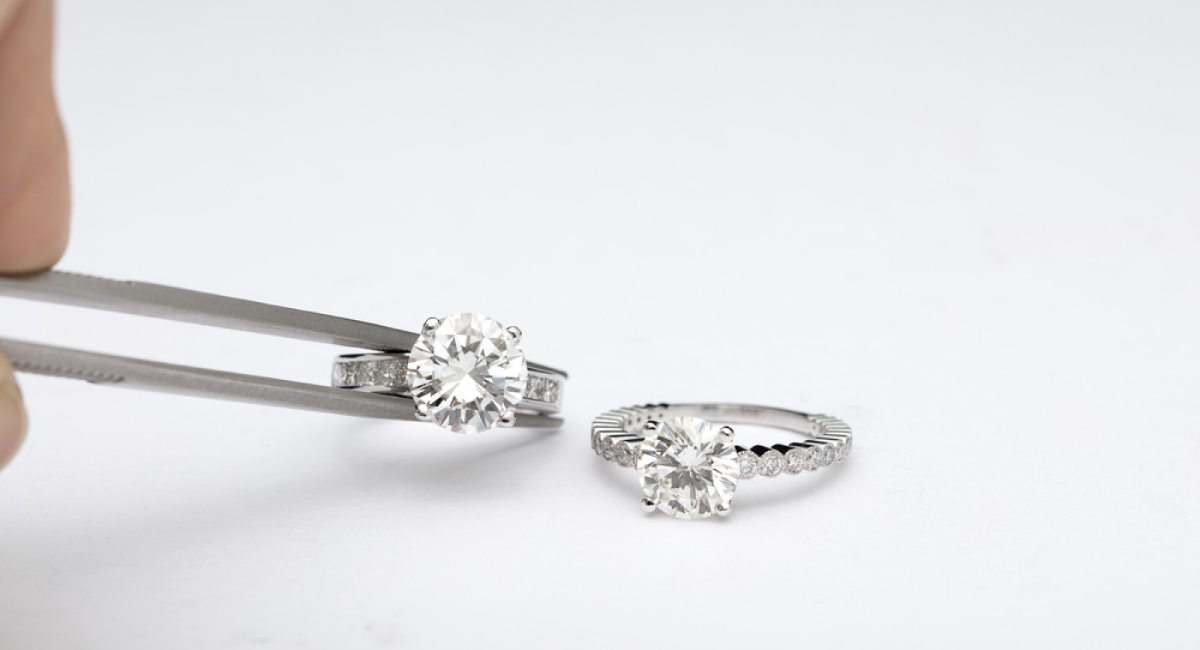
VS-&-VVS-Ring

It must be kept in mind that clarity cannot be the sole determinant for any selection, and multiple choices have to be made with respect to the cut, carat weight, and color that make diamonds so dynamic.

For instance, it is better to buy a VS diamond for engagement rings, where the size and clarity of the diamond are customarily mutually exclusive since one might get a bigger diamond of better color and cut for a lower price. You can check the diamond size with our diamond size chart.

Where to Buy VS or VVS Diamonds?

You can get your hands on the VVS and VS diamonds at the best price at Loose Grown Diamonds. A diamond wholesaler who cuts out the middleman and sells directly to you. Elevate your lab grown diamond purchase with our exclusive promo code for added savings.

We will guide you all the way to help you purchase the best quality VVS diamond within your budget. Additionally, if you are confused about determining the price of your selected diamond, you can use our Diamond Value Calculator.

[blog_page_btn title=”buy certified lab diamonds” url=”https://www.loosegrowndiamond.com/inventory/”]

Conclusion

The difference between VVS and VS diamonds will always be obvious only to a handful of people with the required expertise. To an average consumer, choosing the “best” diamond has to be a choice made pragmatically as the difference will mostly go unnoticed by the naked eye. 

In such circumstances, it is always better to pay attention to the budgetary restraint every consumer exercises on themselves and focus on buying an eye-clean diamond. Buying a diamond of a higher clarity grade will not always prove to be a smart purchase or a better investment, instead, it is more prudent and profitable to buy diamonds of lower clarity grade that are clean to the naked eye. 

In the end, one must go back to the original saying that all diamonds will last forever no matter what the grade.

FAQ

Which is better VS or VVS diamond? 
VVS diamonds are considered higher in clarity and generally more desirable than VS diamonds.

How much is a vvs diamond? 
The price range of a VVS diamond starts from almost $149 to hundreds of dollars. The price of a VVS diamond can vary significantly based on factors such as carat weight, cut, color, and other quality characteristics.

How do you tell if you have VVS diamonds?
To determine if you have a VVS diamond, a professional gemologist would examine the diamond under magnification to assess the presence of very minute inclusions that are difficult to see even at 10x magnification.
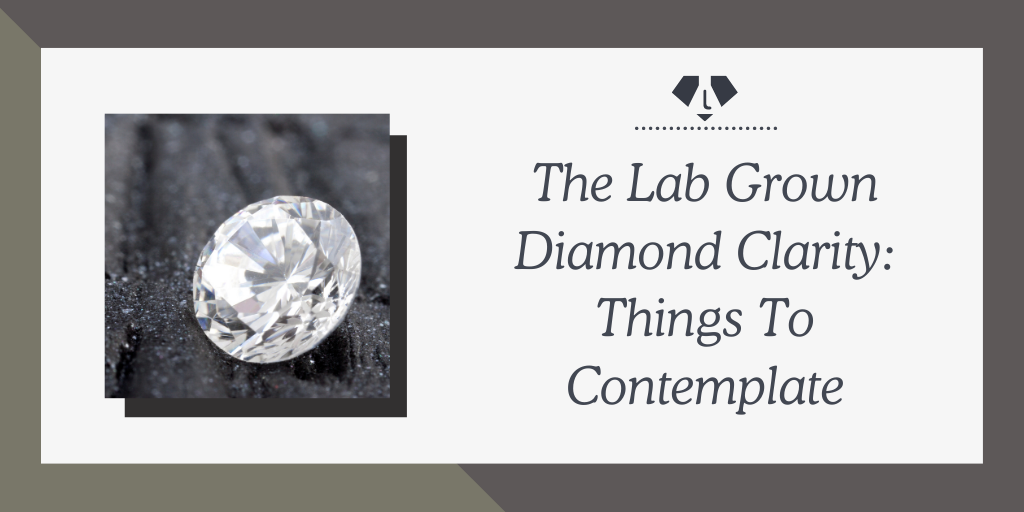
The Lab Grown Diamond Clarity: Things To Contemplate

Also referred to as synthetic diamonds at times, these are man made diamonds that are made in laboratories by various processes. These days the demand for such types of diamonds is increasing due to their similar properties as that of natural diamonds but low cost.

Diamond Clarity

It is usually created by the process known as cutting-edge technology, which is similar to that of the process of naturally growing diamonds. It chemically and optically resembles that of natural diamonds to an extent. They are not fake diamonds as the misconception of certain people leads them to call them fake. They are as real as natural diamonds.

The properties of these diamonds mainly depend on the process which is used for their manufacturing. In Fact, certain diamonds are even harder and their conductivity is also high as compared to natural diamonds.

Clarity of the Lab Grown Diamonds

The clarity of the diamonds plays an important role in the overall look and charm of the diamond. It is determined by various factors such as the amount of inclusion and the blemishes that the diamond has along with various other imperfections. 

They can be internal or external, depending on the type and the extraction process of the diamond. For best results and looks, the imperfections and blemishes should be as low as possible. The value of the diamond also has a direct relation with the clarity the more clear the diamond the more it will shine and the more it will appeal to the human eye. While any inclusions are not visible to the naked human eye but they affect the overall look and charm of the diamond.

There are various methods and techniques by which we can enhance the clarity of the natural diamonds. While in the case of the artificial diamond which is our primary concern here the diamonds are created by high temperature and pressure situations in the labs. The complex structures obtained are then cut into various small pieces depending on the carat weight which one wants. Such processes take weeks and weeks for their completion and to get the desired diamond.

So in the case of a lab grown diamond, the blemishes and inclusions are quite very less as compared to the natural diamonds.

But this does not mean that they don’t exist in this case. They exist and they too vary in amount depending on the process which was opted for the creation of the diamonds. So the GIA certificate is a must before making any purchase in the diamonds.

But it is mostly for the natural diamond. In the case of lab grown diamonds, one should mostly go for the IGI grading scale. This gives us a particular scale for the color and clarity of the diamond which one wants to buy.

The IGI Clarity Grade Scale

All these are written on the best to the worst range of clarity in the case of lab grown diamonds:

Internally Flawless (IF), Very Very Small Inclusions 1 (VVS1), Very Very Small Inclusions 2 (VVS2), Very Small Inclusions 1 (VS1), Very Small Inclusions 2 (VS2), Small Inclusions 1 (SI1), Small Inclusions 2 (SI2), Small Inclusions 3 (SI3) Inclusions 1 (I1), Inclusions 2 (I2), Inclusions 3 (I3).

Certification of the Diamond

Lab-made diamonds’ certification process is similar to that of natural diamonds. Their grading is done after sending them to the experts in their field in the gem labs. The grading is done based on the popular 4 C’s: cut, clarity, color, and carat.

Mostly all the labs use the same criteria and process to grade the diamonds. They are graded individually by the experts and then the compilation of the individual results is done for the best possible optimum results. The grades are given to the diamonds unbiasedly in the case of this process. 

[blog_page_inventory shape=”Round,Oval,pear,cushion,heart,princess,emerald,radiant,kite,old mine” carat=”2.30,2.60″ cut=”0,4″ color=”0,10″ clarity=”0,11″]
[blog_page_btn title”Buy Now” url=”https://www.loosegrowndiamond.com/inventory/?”]

How to Determine the Clarity Grades of the Lab Grown Diamonds

The clarity grade in the case of diamonds is a must and should not be avoided at any cost. the gradation is done by the professionals and experts in this field with years and years of experience by various processes.

They mostly tend to go for a 10x magnification process and evaluate every aspect of the diamond precisely. The microscope gives a closer and proper look at the diamonds so it also becomes easier for them to take an account of all the blemishes and inclusions present and thus work accordingly to resolve them.

Before allocating any diamond clarity grade of clarity to the professionals generally look for the 5 described factors which include the size of the diamond, its nature, the location where it was located or the process by which it was created, etc. These factors play a vital role in determining the clarity rate of the diamonds.

The Size of Inclusions

The size of the inclusions plays a very vital role, as it has to be clearly determined whether the inclusions are small enough to ignore or worked upon or not. Because the bigger the diamond inclusions, the lower is the look and quality of the diamond. Certain inclusions are also visible to the naked human eye if their size is quite large. So this factor becomes quite important to analyze and resolve.

The Nature of Inclusions

The inclusions can be of various types. They can be either internal or external, depending on the type of diamond. If they are present internally deep inside the diamond, then it becomes quite difficult to resolve them, and the grade and quality of the diamond are also impacted.

The Number of Inclusions

If the number is the most, then the fancy diamond is the prettiest. In lesser the amount of blemishes and imperfections, the greater is the grade and quality of the diamond. A few numbers of inclusions can also be ignored to a level depending on nature and their 

The Location Where they are Located

It has a major role to play while determining the quality and the gradation process. As in if the inclusions are there in the corners or the edges, they are not that visible to the naked human eye and can be ignored or resolved by polishing or cutting. But on the contrary, if they reside deep inside the diamond then they cannot be ignored and thus impact the look and gradation of the diamond.

The Various Types of Inclusions

  • Graining: The internal graining occurs due to the internal growth inside the crystal. It causes white, colored, or reflective lines, thus making the diamond look shabby.
  • Feather: It is a very tiny line or a crack that is observed on the surface and can mostly be ignored. 
  • Cavity: It mostly is colorless and depends on the minerals which are there inside the diamond which as such impacts the number of blemishes and inclusions. But if they are colored they will very much be visible and thus cannot be ignored.
  • Bearding: These types of inclusions are found close to the girdle and make the appearance of the diamond dull.

Why Should One Opt for Lab Grown Diamonds?

  •  Crystallinity: The crystals which are large and clear are mostly used in making gemstones. These diamonds are very pure and highly crystalline and thus are transparent in color. Thus very much desired.
  • Hardness: Synthetic diamonds are even harder than natural diamonds. Their hardness depends on their levels of purity, orientation, and crystallization.
  • Inclusions: Certain levels of blemishes and inclusions are present in all the diamonds. But in the case of synthetic diamonds, they are very less in number.
  • Cost: As they are not mined and extracted deep down from the earth’s surface but are instead made with artificial man-made technologies in the labs, thus the cost of these diamonds is less as compared to the naturally found diamonds.

But this does not apply to the fact that the diamonds which are grown in labs are cheap. The supply chain in the case of natural diamonds as large as they are mined first then are distributed, cut, polished, and then sold accordingly to the jewelry manufacturers. But in the case of lab-grown diamonds, the supply chain is shorter as the process of extraction and mining are skipped, thus making its cost a bit less as compared to natural diamonds.

  • Ethical: Many years ago there was a taboo associated with the mining industry, as many believed that various unethical practices are being carried out in their extraction process. They were even referred to as the blood diamonds as many believed that they are used to fund violence and the miners and their families are overexploited and taken for granted. Also, they promoted child labor in various places. 

So lab grown diamonds are your ideal choice if you are a peace-friendly person and also need reassurance as to how your diamonds were made.

  • Environment friendly: As we all are aware of the fact that during the process of mining, there are various bad and negative impacts on the environment and the surroundings. Although various steps have been taken to reduce and avoid them to a level, they still exist.

But in the case of lab grown diamonds, you will not face such an issue as they are quite environment friendly and take less energy for their creation. They also are pocket-friendly and can save a few bucks which can be used elsewhere.

The Types of Diamond Clarity Scales

ab-grown diamonds are typically graded using the same clarity grading scale as natural diamonds, which ranges from Flawless (FL) to Included (I3). The clarity grade is determined based on the size, nature, position, and number of inclusions present in the diamond.

The Lab Grown Diamond Clarity: Things To Contemplate

IF/ FL (Internally Flawless)

This is the best type of grade and is flawless, as the name itself suggests. If in case any particular thing is observed on them that can for sure be ignored as in, it is the best gradation of them all. This is the most preferred and searched-for grade when people tend to buy diamonds as it is a one-time investment that lasts nearly a lifetime.

VVS1 (Very Very Slightly Included 1st Degree)

If this clarity grade is given to the diamond, that means it is nearly close to flawless. As in the small number of inclusions and the blemishes which are present can only be seen under a microscope and thus these can be ignored as they are for sure not visible to the naked human eyes. 

Many couples who are on budget buying go for this grade of diamonds as it is similar to the first one but the cost of these diamonds is less than the above-mentioned ones.

VVS2 (Very Slightly Included 2nd Degree)

In this type of gradation, one needs an expert or a gemological microscope to find out the blemishes. The number and amount of inclusions are not that much but are present at scattered points and are not that much visible. As in they are very tiny in size one needs a microscope to find them out.

SI1 (Slightly Included 1st Degree)

The location of the blemishes has a major role to play while determining the quality and the grade of the diamond. As in if the inclusions are there in the corners or the edges, they are not that visible to the naked human eye and can be ignored or resolved by polishing or cutting. 

But on the contrary, if they reside deep inside the diamond then they cannot be ignored and thus impact the look and gradation of the diamond.

If a diamond is of this grade, it means that the imperfections are very less and are not that visible on the surface of the diamond. So they can be ignored to a level.

SI2 (Slightly Included 2nd Degree)

They are not that much visible to the naked human eye if seen casually. But if one tends to observe them keenly then a few of the blemishes might pop up but then also they do not impact the look of the diamond to a bigger extent.

Conclusion

These diamonds are the future and are revolutionary because of their pocket-friendliness, sustainability and are also conflict-free in nature. 

They have the same clarity, color, and composition as compared to the natural ones and are also nearly 50 percent less in cost, thus making us save a few bucks which can be saved and invested upon for future use.

There are various methods by which their color can be checked and improved so one should always keep them into account. As in the color plates an important role in the overall look of the diamond.

The more clear the color and the best grade it is, the more beautiful and flawless the diamond looks. One can go for a bit lower grade if on a budget but should never neglect the grade of the color as it is a one-time investment that lasts for years and nobody wants to invest in something which does not yield good results.

FAQs

What is lab grown diamond clarity?
Lab-grown diamond clarity refers to the degree to which a lab created diamond is free from internal and external imperfections or inclusions that may affect its appearance and value.

How does clarity affect the value of lab grown diamonds?
Clarity is one of the factors that influence the value of lab grown diamonds. Diamonds with higher clarity grades are generally more valuable because they are rarer and more visually appealing.

What diamond clarity should I get?
For optimal value aim for a diamond with clarity grades ranging from, VS1 to SI1 and for beauty VVS1 to IF.

What are inclusions in a diamond?
Inclusions in a diamond are internal or external imperfections, such as minerals, fractures, or other materials, that affect the clarity and appearance of the diamond.

What is the best diamond clarity?
The best diamond clarity is Flawless (FL), which means the diamond has no internal or external imperfections visible under 10x magnification.

Difference Between Clarity Enhanced and Lab Created Diamonds

Buying a diamond may seem an easy thing, but what’s the reality? Many people think that buying a diamond is the equivalent of going shopping, whereas it is a tough job. It requires a lot of research if you want to make the best choice. Proper knowledge and advice can be very helpful to you as there are a variety of diamonds in the market.

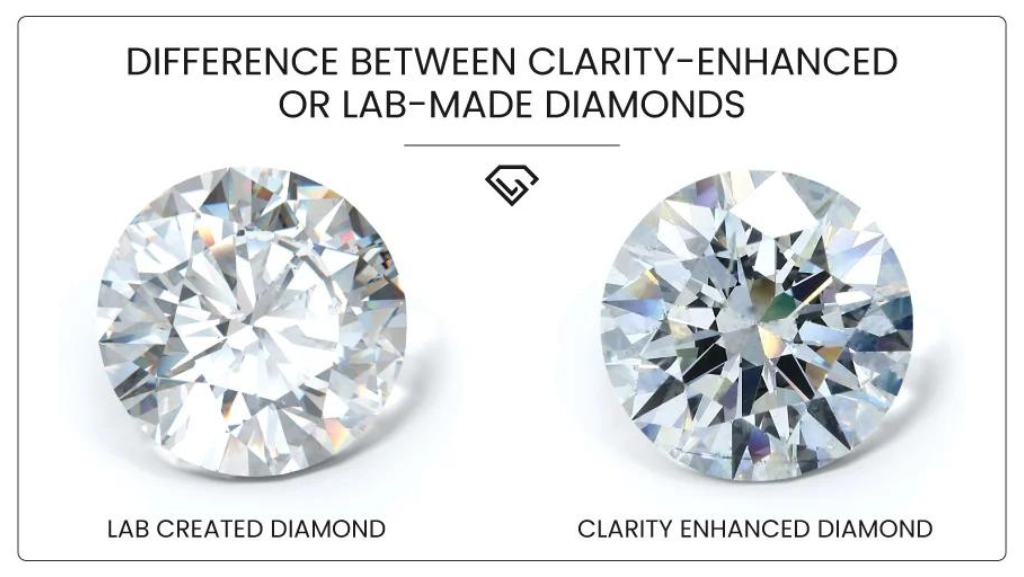
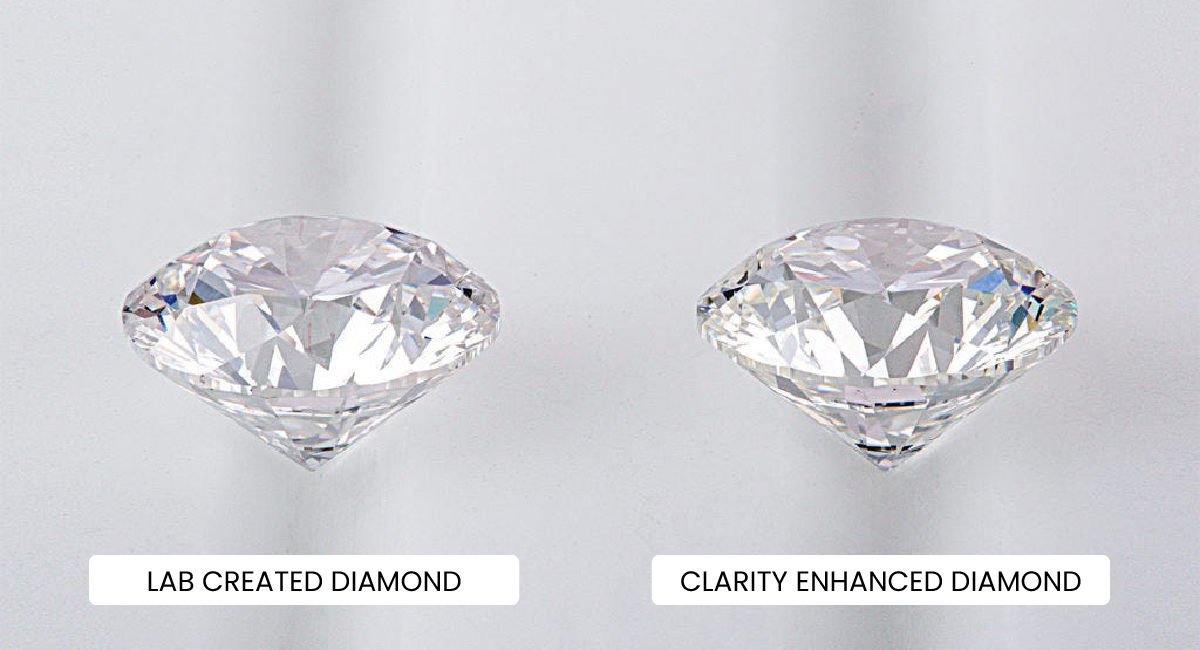
Clarity enhanced diamonds, as the name suggests are mined diamonds enhanced for their clarity by professionals. The natural imperfection and flaws are shaved off from that of a natural diamond to make it free from any inclusion or any flaws that it might have.

Difference Between Clarity Enhanced and Lab Created Diamonds

As you might be familiar with, diamonds that have been developed in a facility in a brief period are known as lab grown diamonds. Lab grown diamonds are considered to be identical to that mined diamonds. Both the diamonds have the same properties optically, chemically as well as physically.

Some of the major factors to look for when buying a diamond you like: are shape, quality, size, brand, price, and many more. One major factor is how the seller impacts you, here is where you need to be aware of the type of diamond you are going to buy.

What are Lab Grown Diamonds?

The lab grown diamonds are different from mined diamonds in the way they occur and are processed. Where mined diamonds occur naturally, on the other hand, lab-grown diamonds are created by imitating similar natural conditions but inside a lab. These are created inside certified labs that provide you with the best quality of diamond that is worth buying.

lab grown diamond

The process involves the use of a natural diamond seed which is then put under certain conditions that mimic those under the earth’s surface. The resulting environment leads to the formation of lab-grown diamonds. These diamonds are just as real as naturally mined diamonds, possess the same optical, chemical, and refractive properties.

[blog_page_inventory shape=”Round,Oval,pear,cushion,heart,princess,emerald,radiant,kite,hexagon,Asscher,Marquise,Triangular,Baguette” carat=”2.30,3.60″ cut=”0,4″ color=”0,10″ clarity=”0,11″]
[blog_page_btn title”Buy Now” url=”https://www.loosegrowndiamond.com/inventory/?”]

What is a Clarity Enhanced Diamond?

Although diamonds are the strongest they can have visible imperfections that need to be treated at times. Those small cracks and creaks can be seen even in the mined diamonds, they need a final touch to enhance their shine and brightness. Which is done with the help of a process called clarity enhancement.

clarity enhanced diamond

Two Treatments Used in the Clarity Enhancement of Diamonds

Fracture Filling
Small cracks are healed under this process with the help of glass-like resin material. This filing is done in a way that no loop is left to detect any flaws. Moreover, the filling has similar refractive and optical features as naturally mined diamonds so it is difficult to find the repaired sections of the diamond.

But, this process is not a permanent solution to the diamonds as with time the sunlight and also heat from future repairs affect the filling. This way it can deteriorate the filler or even change its color.

Laser Drilling
Laser drilling is a process that is used to remove minor inclusions to enhance the diamond. Tiny lines are created in this process that resemble tiny trails. Some chemicals may also be injected in some instances to change the color of the diamond.

In comparison to fracture filling, this process is more stable and has more permanent effects on the diamond. Still, many experts argue that this process reduces the quality and purity of diamonds.

These treatments are typically done to make the diamond appear clearer and more valuable.  It’s important to note that while clarity enhancement can improve the appearance of a diamond, it may affect its long-term durability and value. Clarity enhanced diamonds are typically sold at lower prices compared to untreated diamonds, as they are considered less desirable by some consumers and may have reduced resale value.

Pros and Cons of Lab Made Diamonds and Clarity Enhanced Diamonds

Price
The price of clarity enhanced diamonds is considerably cheaper (around 30%) than those diamonds that aren’t clarity-enhanced. And the price of lab-grown diamonds on the other hand is comparatively cheaper( around 40-30%) when compared to natural diamonds. 

Origin
Clarity enhanced diamonds are diamonds that are mined from the earth’s core and have been known as ‘real diamonds’ and lab-produced diamonds are diamonds grown in a laboratory.

Effects on the Environment
As clarity enhanced diamonds are mined from the earth’s core they are very toxic for the environment because of huge emissions of carbon released in the environment whilst extracting them. On the other hand, lab-grown diamonds do not produce as much carbon emissions as mined diamonds. Lab created diamonds are manufactured in controlled facilities and are considered an eco-friendly option in comparison to natural diamonds.

Resale Value
We already know that the resale value of the diamonds is low but when we compare clarity-enhanced and lab-grown diamonds together, the resale value on clarity-enhanced is much more than those of lab-grown diamonds.

Investment Option
While diamonds might seem like a good investment option, both lab-grown, as well as clarity-enhanced diamonds, shouldn’t be considered as an investment option. There are many reasons for the above statement such as none of them provide good resale value, clarity enhanced diamonds are weak compared to those which aren’t clarity-enhanced. Nor are they fully certified.

Uniqueness
Lab-grown diamonds are less likely to be unique because all the diamonds produced look very similar to each other, on the other hand, clarity diamonds that are mined are unique in their own way.

The Major Difference Between Lab Made and Clarity Enhanced Diamonds

Lab created diamonds are made in certified labs under an artificial atmosphere similar to those of natural circumstances in which a natural diamond occurs. High pressure and temperature conditions are built inside the laboratories themselves. The methods used to create them are Chemical Vapour Decomposition (CVD) and High-Pressure-High-Temperature (HPHT) methods.

The Major Difference Between Lab Made and Clarity Enhanced Diamonds

These have similar chemical, physical and optical properties to a real diamond. Most of the lab made diamonds are Type II diamonds that are the purest form of diamonds.

Whereas clarity-enhanced diamonds are the enhanced form of mined diamonds. Since they have imperfections in them, the process of clarity enhancement helps in concealing the diamond with the help of different treatments. Small cracks and inclusions are treated in this process.

This imperfection in the diamond is invisible to the naked eye as they are available in different colors, shapes, clarities, and sizes. Clarity enhanced diamonds cost less in comparison to mined diamonds.

The Durability of Lab Made and Clarity Enhanced Diamonds?

Durability is one of the important factors. Clarity enhanced diamonds are an enhanced form of mined diamonds. So, they contain glass-like pieces inside them that were used to bind the cracks in them. This affects their durability and makes them less durable.

Whereas, Lab made diamonds are created under labs with similar natural phenomenon to that of a real diamond. So, they have gone through tough processes and are more durable as compared to clarity-enhanced diamonds. Since they do not need any enhancement they are in pure form and thus they are more stable. They do not need to go under any alteration and can sustain over a longer period of time.

Should you Buy, Clarity Enhanced or Lab Made Diamonds?

There are different opinions of the buyers and the experts on this. People look for real diamonds, and for them mined diamonds are the only real diamonds. They think of lab made diamonds as artificial diamonds, this thought is there due to the lack of complete knowledge. 

They are ready to buy mined diamonds whose clarity is enhanced. They do not think of flaws and imperfections in them that were hidden or concealed since they can not see them through their naked eyes. This way they pay for a diamond that is enhanced with the help of some treatments.

Whereas lab made diamonds are the ones that are completely made inside the lab with proper conditions and procedures.

Many facts related to clarity enhanced vs lab made diamonds have been presented before you. Prior knowledge is always helpful. Know about what you buy and choose the diamond that is best and perfect for you.

[blog_page_btn title=”Buy Lab Grown Diamonds” url=”https://www.loosegrowndiamond.com/inventory/”]

Conclusion

Clarity improved stones are considerably less expensive than genuine or synthetic gems, but they can be just as spectacular. There is a tiny price to pay in terms of complete legitimacy, but they are still genuine diamonds.

Similarly, lab grown diamonds are the best alternative, budget-friendly, and environmentally safe as well as being very up-to-date and trendy. In the above article, we compared both diamonds while mentioning their pros and cons.

A clarity-enhanced diamond may be the right choice for you but if you’re looking for a gorgeous, clear, and affordable diamond then opts for a lab-grown diamond. As they are a budget-friendly and environmentally safe option.

FAQs

How is a clarity enhanced diamond different from a lab-created diamond?
A clarity enhanced diamond is a natural diamond that undergoes treatment to improve clarity, while a lab-created diamond is a diamond grown in a laboratory setting using advanced technological processes, with the same chemical and physical properties as natural diamonds.

Are there any drawbacks to clarity enhanced diamonds?
One potential drawback of clarity enhanced diamonds is that the enhancements may affect the stone’s durability and long-term stability. Additionally, some people may prefer untreated diamonds for their natural integrity and value.

Which option is better: clarity enhanced or lab-created diamonds?
The choice between clarity enhanced and lab-created diamonds ultimately depends on individual preferences, budget, and ethical considerations. Some may prefer the natural origin of clarity enhanced diamonds despite the treatments, while others may prioritize the eco-friendly and potentially higher quality aspects of lab-created diamonds.

Are clarity enhanced diamonds considered natural or synthetic?
Clarity enhanced diamonds are considered natural diamonds because they originate from the earth like other natural diamonds. However, they undergo enhancement processes to improve their visual appearance.

Should I buy an enhanced diamond for an engagement ring?
Enhanced diamonds undergo treatments to enhance their appearance, potentially affecting long-term durability and value. They are often more budget-friendly but may raise ethical concerns regarding their environmental and social impact.

Lab-created diamonds typically have excellent clarity. They often have higher clarity grades compared to natural diamonds, including clarity enhanced ones. It’s essential to weigh these factors carefully before making a decision.

What are SI Diamonds? – An Incredibly Valuable Guide For You

There are so many factors to judge a diamond, but one of the important factors is its clarity. SI diamond clarity is one of the main factors that can change your buying decision. Sometimes this factor can hamper your decision and due to this, you might do a bad purchase. 

So, in this blog, we are going to tell you how you can judge an SI diamond and its SI clarity. These factors are going to help you a lot when you are going to buy one.

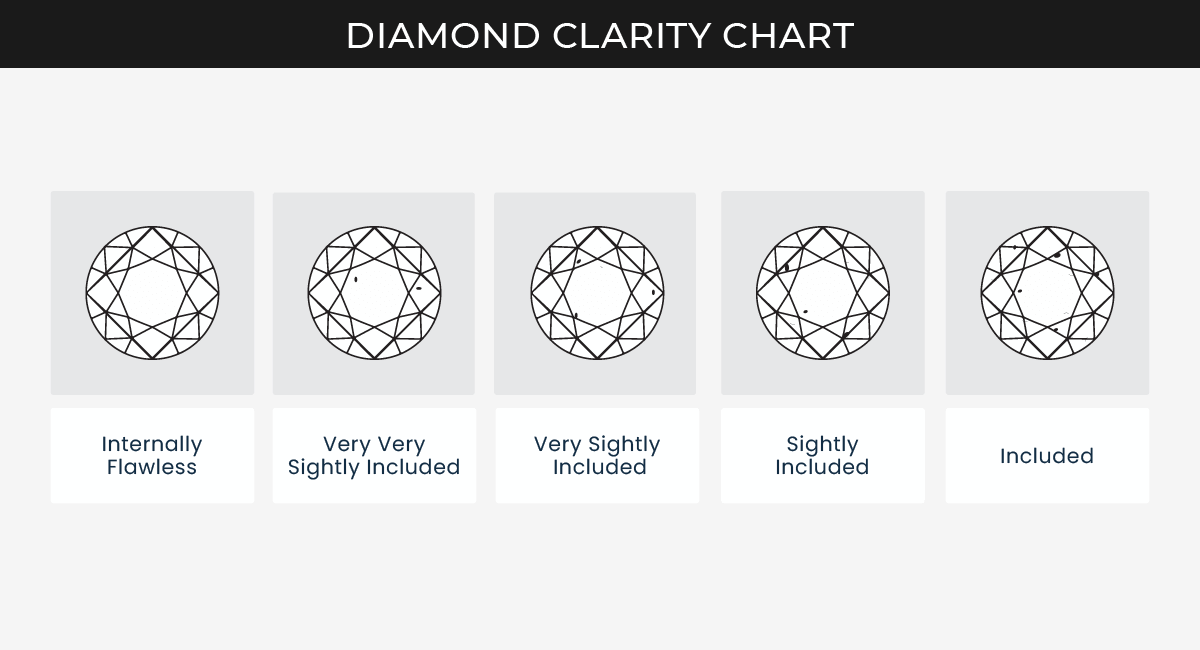
Diamond clarity chart

There are some cons if you are buying a diamond online. You cannot see the actual view of a diamond, which means you will not be able to find out impurities and imperfections in the diamond that can be examined by magnifying glasses.

So, make sure that you pick a trusted brand and website where you are going to purchase a diamond.

What Is SI Diamond?

SI Clarity Diamonds are the easiest on-pocket yet quality-worth diamond for a large customer base. It is a fact that all diamonds have flaws, even Flawless ones. 

However, these imperfections seldom come to the notice of normal scrutiny of a consumer. It is only certified experts that get into the nitty-gritty of diamond clarity that has minimal variations. 

For people with a tight budget, SI diamonds are the ideal choice as they appear the same as Very Slightly Included diamonds but usually vary by a great margin in terms of price. 

The question is: do you buy the first thing in sight or do you want to contemplate and get the fundamentals to bang on with every purchase? 

The point worth keeping in mind is, whatever the choice might be, will it have a big impact on your own or people’s perception of it, both limited by appeal and your perception? 

SI diamonds will definitely get you the brownie points of making a selection with no visible flaws and save an extra buck. 

The only thing to be wary of is to make sure the diamond’s fingerprint does not have markings that obstruct light to the point of splitting the appearance with a rock or being noticeable from a considerable difference. 

SI diamonds are the best seller of the bunch since they are eye-clean and economical.

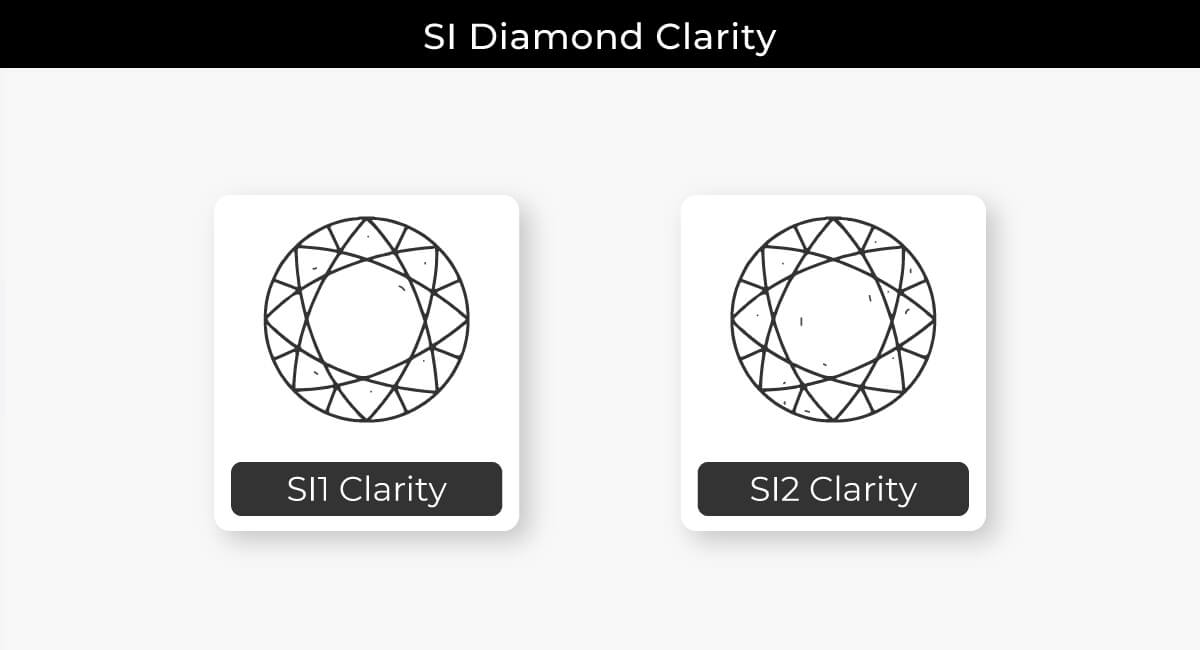
Types of SI Diamonds: Here, SI stands for Slightly Inclusive. In this range of clarity, some inclusions can be seen by the naked eye but are hard to find. These SI diamonds are classified into two kinds. The first is slightly inclusive 1 (SI1). These diamonds have small inclusions which can only be seen by magnification, and the second is slightly inclusive 2 (SI2). These diamonds have larger inclusions that can be seen by the naked eye.

Si1 vs Si2 Diamond Clarity: SI diamonds vary from SI1 and SI2, wherein the first one has considerably less concentrated and lighter inclusions compared to the first one. Although the size of these inclusions does not cross-medium throughout the range, this variation can be located anywhere, from the table of the diamond to the girdle.

The smallest infliction in this location can have a huge impact on the overall look of the diamond, and hence the purchaser must have a keen eye for spotting these infirmities and judging their impact.

Difference between SI1 & SI2

Technically, both SI1 and SI2 clarity have inclusions that the naked eye might catch, however, there are key differences between both SI diamond clarity that make the SI clarity a clearly better selection.

SI1 vs SI2 diamonds debate usually centers around the moot point of the amount and type of inclusions these stones have. SI1 diamonds typically tend to have lesser and less contrasting inclusions than SI2.

Although the difference between any two adjacent clarity grades is virtually impossible to pinpoint. SI2 can have a relatively hazy appearance when looked at closely. With respect to price, SI1 is priced 10-20% lesser than VS diamonds and delivers more or less the same quality.

In such circumstances, it is always beneficial to choose SI1 diamonds as a budget-friendly yet affordable option. 

Clarity Features to Look Out For

The inclusions listed above can be in any number, size, or even color. For instance, white or translucent inclusions affect the appearance far lesser than dark-colored inclusions do. As mentioned earlier, the location of these flaws has far-reaching consequences too. 

If the inclusion is situated smack in the middle of the stone or near the table will have a larger impact on the brilliance of the diamond than the ones on the surface or edges will. 

It must also be remembered that the inclusions on the edges can be alleviated with a cover-up through cutting or prongs, but the interiors of the diamond cannot be touched and will remain out of the control of both the jeweler and the consumer.

Factors to Consider When You are Buying an SI Diamond

Here are the four most important factors you should know before buying a SI diamond:

  1. Diamond 4C’s: You may have heard of 4C quality diamonds. These “4Cs” simply denote color, carat, cut, and clarity. 4Cs is a popular way to understand diamonds. However, you can lower the price a bit by focusing on the color and clarity rating of a diamond that, when seen by the naked eye, appears as a clear diamond.
  2. Shape: The diamond shape is the starting point for ring design. Every shape is unique in its way. Round diamonds are the most commonly used diamond form for engagement rings and are the prettiest. For SI diamonds, fancy shapes are preferred, like oval, cushion, radiant, or even heart shaped diamonds.
  3. Certification of diamonds: We always recommend buying certified diamonds issued by a reputable gemstone lab. It is the safest way. The Gemological Institute of America (GIA) and the International Gemological Institute (IGI) are the two most trustworthy geological laboratories. A certificate guarantees the quality of a diamond by listing its cut, color, clarity, and weight. This protects a buyer’s investment by making sure that gems keep their value over time.
  4. Lab grown diamonds or natural: Natural and lab grown diamonds are real with the same molecular formula and the same chemical composition. Some people might think that lab grown diamonds will have no inclusions because they are lab grown under controlled conditions, but that’s not the case. They are just as eye-clean. The price of lab-grown diamonds is much less than that of natural diamonds because lab grown diamonds are not rare.

[blog_page_inventory shape=”Round,pear,oval,cushion,heart,” carat=”2.50,2.60″ cut=”0,4″ color=”0,10″ clarity=”3,5″]
[blog_page_btn title”Buy Now” url=”https://www.loosegrowndiamond.com/inventory/?shape=Round&carat=2.50,2.60&color=0,10&clarity=3,5″]

What Are SI Diamonds Types Of Inclusions Or Blemishes Found In Them?

What Are SI Diamonds Types Of Inclusions Or Blemishes Found In Them?

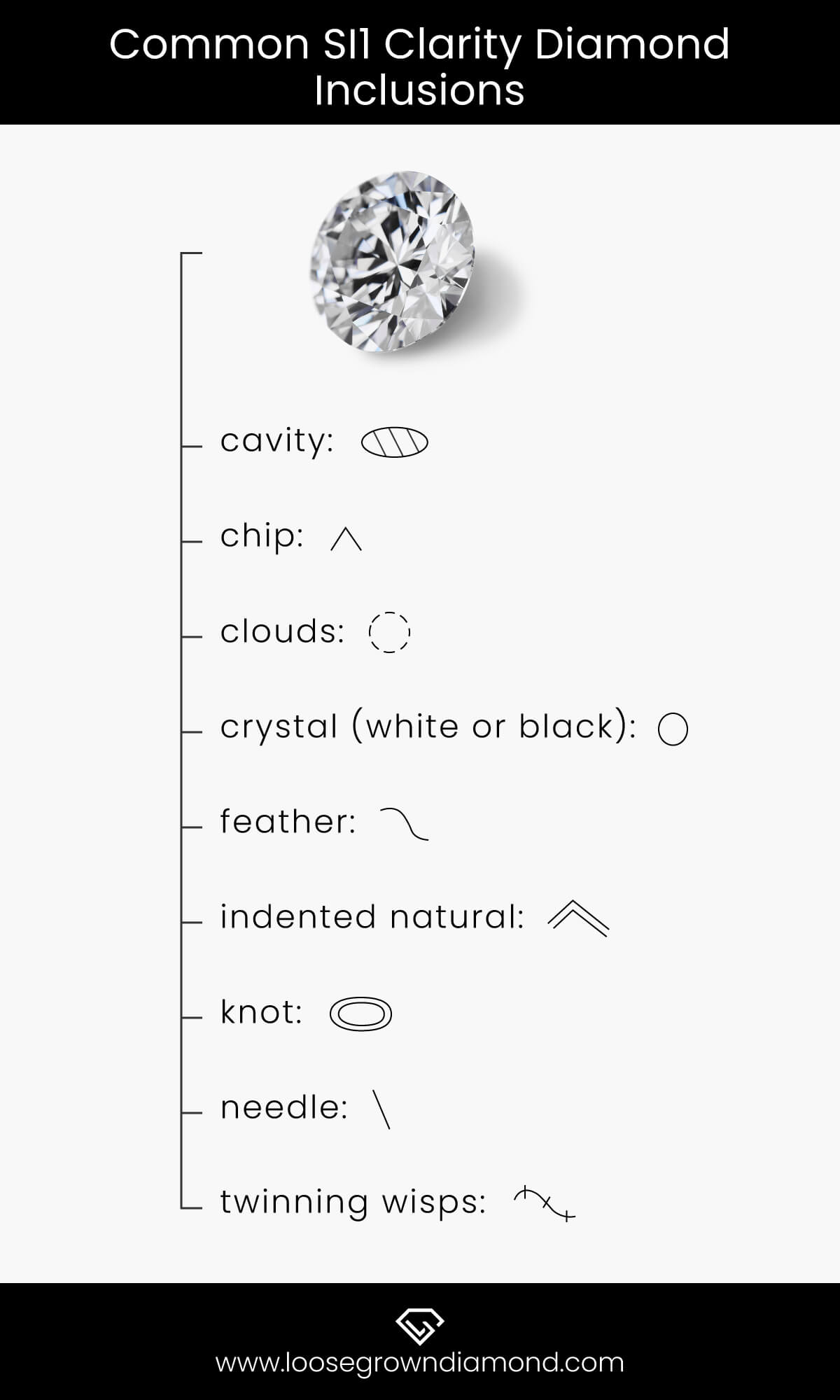
Common SI1 inclusions are pinpoints (small black dots at the table of the diamond), needle (small white crystalline), knots (crystal inclusion that reaches the surface), crystals (mineral deposits in the interior), cavities (small holes on the surface), chips (daily wear and tear), clouds (cluster of pinpoints) and feathers (tiny cracks on the exterior that may compromise the structure of the diamond).

Is An SI Clarity Diamond Considered A Good Choice For An Engagement Ring?

Yes. Although a SI diamond’s clarity will not be flawless, it will look lovely and retain its value. Anyone would be hard-pressed to find any inclusions if they looked closely enough. That is, assuming you stay away from diamonds with visible imperfections.

A brilliant round-cut diamond under 2 carats is the most acceptable diamond shape for SI diamond.

Like other high-quality diamonds, both SI diamonds are expected to appreciate in value over time. To protect yourself, I urge that you always buy a diamond that has been graded by a respected institution such as the Gemological Institute of America (GIA).

To get the best gem, you must examine the diamond closely. You’ll be able to see if that SI diamond is eye-clean this way. Having close-up photos will give you peace of mind while purchasing SI clarity diamonds.


Conclusion

A few questions that you will need to ask yourself before choosing among SI diamonds are whether the diamonds are eye-clean, whether their inclusions are deep in the interiors, will the inclusions cause chipping or breakage, and whether the same can be controlled with, say, polishing or prongs.

A holistic analysis of the diamond’s blueprint as well as a very naive yet equally important test of the normal appearance of the stone will help you make the right judgment. 

So, it depends upon your preferences on how and what you want to buy. If you want to save money then you have more options or if you want to buy other diamonds then you have more options. We at Loose Grown Diamonds manufacture and sell lab grown diamonds to customers directly without any involvement of a middleman.

Fequently Asked Questions (FAQs)

Are SI diamonds real diamonds?
SI clarity grade diamonds are real. It can be a little tough for an inexperienced person to tell the difference between real and fake diamonds. However, looking under 10x magnification will get you an answer. You can find SI diamonds at a lower price than other diamonds, but that doesn’t mean they have lost their value or are not real diamonds. They just have low clarity; other than that, they are good for jewelry.

What’s better, SI or VVS?
Speaking in terms of clarity and brilliance, VVS is the best diamond. However, both diamonds are the best, depending on what criteria you want to fulfill. The key difference between VVS and SI diamonds is that VVS diamonds generally have fewer impurities. This results in VVS diamonds looking cleaner and selling for more than those graded as SI clarity diamonds. As VVS diamonds have fewer inclusions, they are said to be more durable than SI diamonds.

What are SI diamonds worth?
One of the best reasons for buying SI diamonds is their low prices. They can be 40–50% less expensive than other flawless diamonds. The price of an SI clarity diamond is determined by many additional factors. SI2 diamonds can be even cheaper than SI1 diamonds. The cost of a 1 carat SI diamond can range between $1800 and $3000.

Will SI diamonds pass the diamond tester?
Yes, it will pass the diamond tester. A diamond tester is a device used to check whether a gem is a diamond or not. SI diamonds are real diamonds, so they are tested as authentic by a diamond tester. It’s not the highest quality diamond because of the inclusions, but it’s undoubtedly real.