What is Diamond Windowing & Why Should You Avoid It?

What is the Windowing Effect of a Diamond or Gemstone?

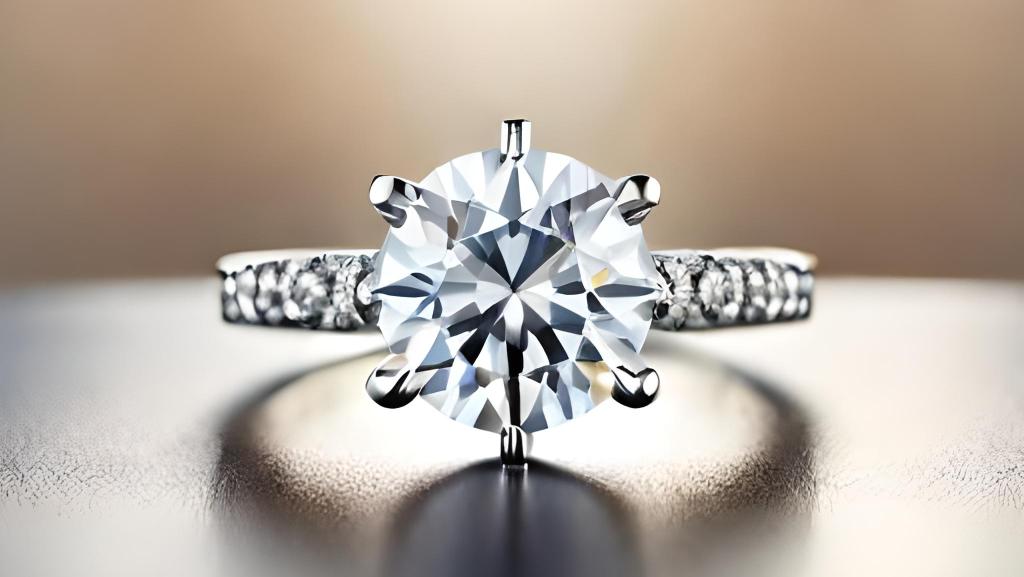
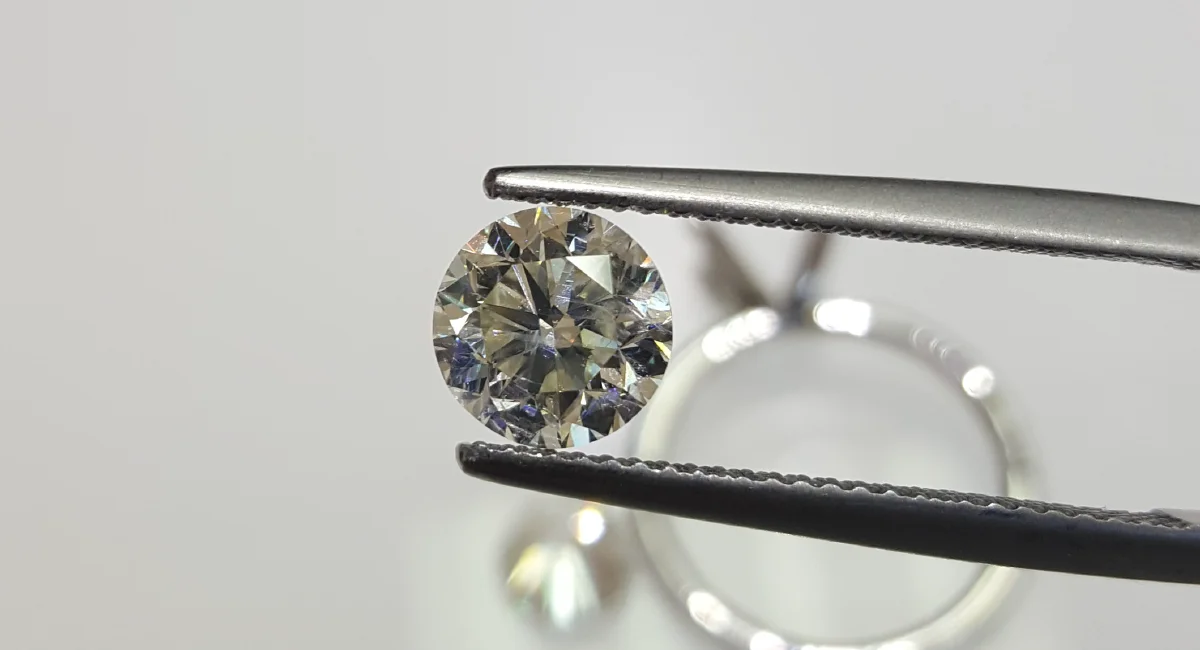
When light flows through a diamond or gemstone rather than being reflected into it, it is called the diamond windowing effect. 

Incorrect facet angles or inadequate proportions can cause this. When substantial light leakage is visible through the gem, it is clear that this is the case. 

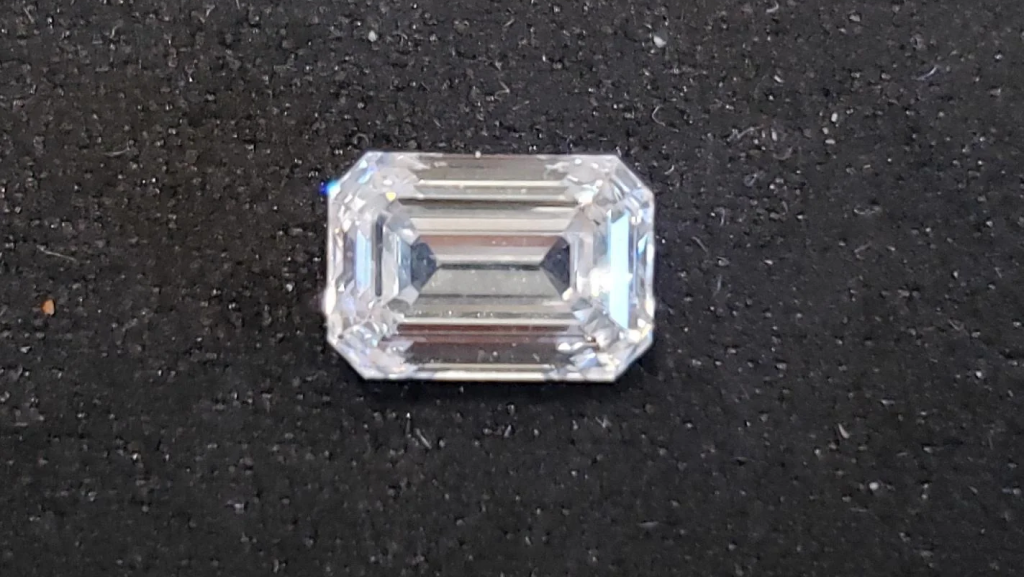
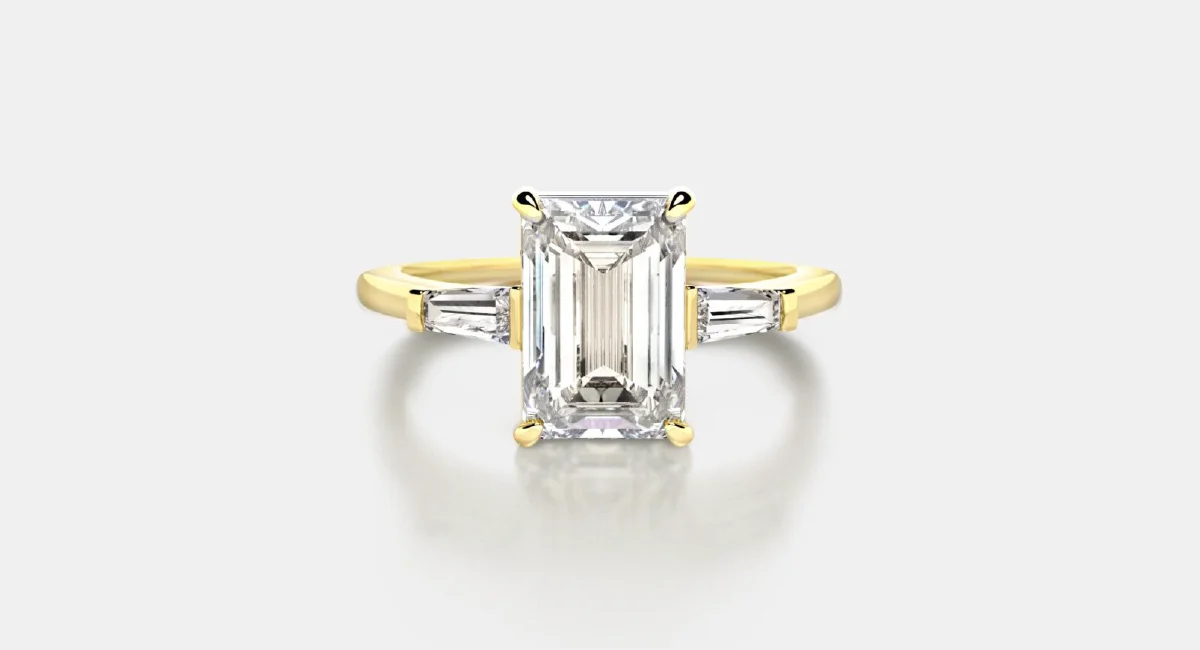
One example is windowing in emerald cuts which is a common thing because of their facet configurations. The angle at which light is refracted back into a gemstone is known as the critical angle, and it depends on the stone’s hardness. 

A gemstone with poor cutting quality could have facet angles that let light through, reducing brilliance. Gem cutting necessitates exact angles to minimize windowing and maximize light reflection. 

Cutters may intentionally create gemstone windowing by prioritizing color preservation or weight retention over brilliance. To remain high-quality and brilliant, windowing must be understood and avoided for diamonds and other gemstones. 

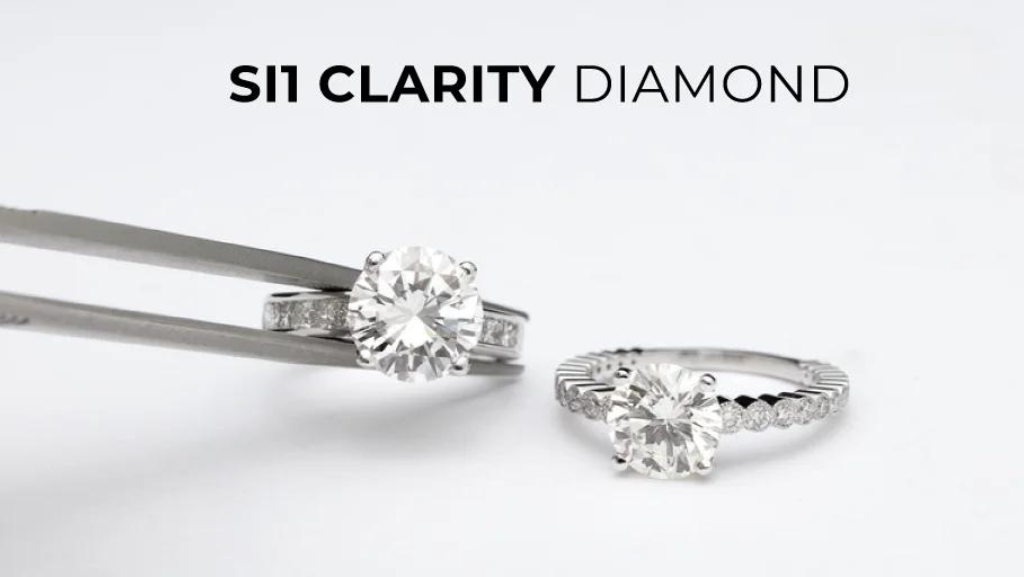
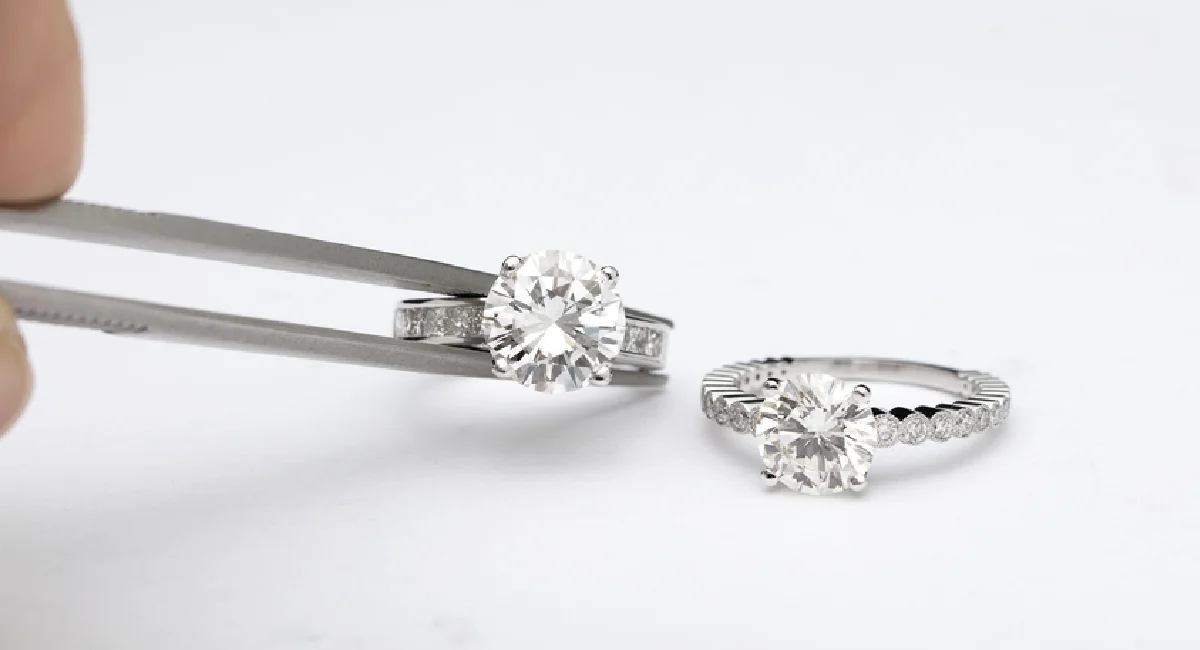
Hold a diamond or gemstone using tweezers to determine if you can see through it quickly. If so, this indicates extensive light leakage, known as windowing. 

As an alternative, look at the stone in various lighting settings. If the top view looks translucent, windowing is probably present.

How to Identify Windowing in Diamonds?

When buying gemstones, it is essential to recognize windowing in diamonds since it can considerably reduce the piece’s value regardless of the stone’s carat weight. 

Look for indicators of leaking light, such as the gemstone’s ability to reflect on tiny texts when placed on a newspaper. 

Furthermore, note whether the stone seems less brilliant in different lighting settings and check the crown facets for lack of light reflection or blackness. Look for unusual proportions because windowing can come from deep or shallow incisions, both. 

Beware of diamond sellers who try to increase brightness through side facets because the top-down light entry should be given importance.

How Vital is Cut Quality in Preventing Windowing?

The main goal of a diamond’s cut is to find a good mix between brilliance, dispersion, and scintillation. 

High cut quality makes the stone look good and maintain its appeal for years to come. In the stone, pavilion facets make the diamond brighter by reflecting light to the eye. While, crown facets make spreading light throughout the stone easier. 

On the other hand, colored jewels value brilliance and scintillation more than dispersion because they usually have less dispersive power. So, the way colored gems are cut emphasizes their brightness for the best visual effect. 

Hence, cutting plays a crucial role in preventing windowing for any type of diamond.

How Does Windowing affect Diamonds? 

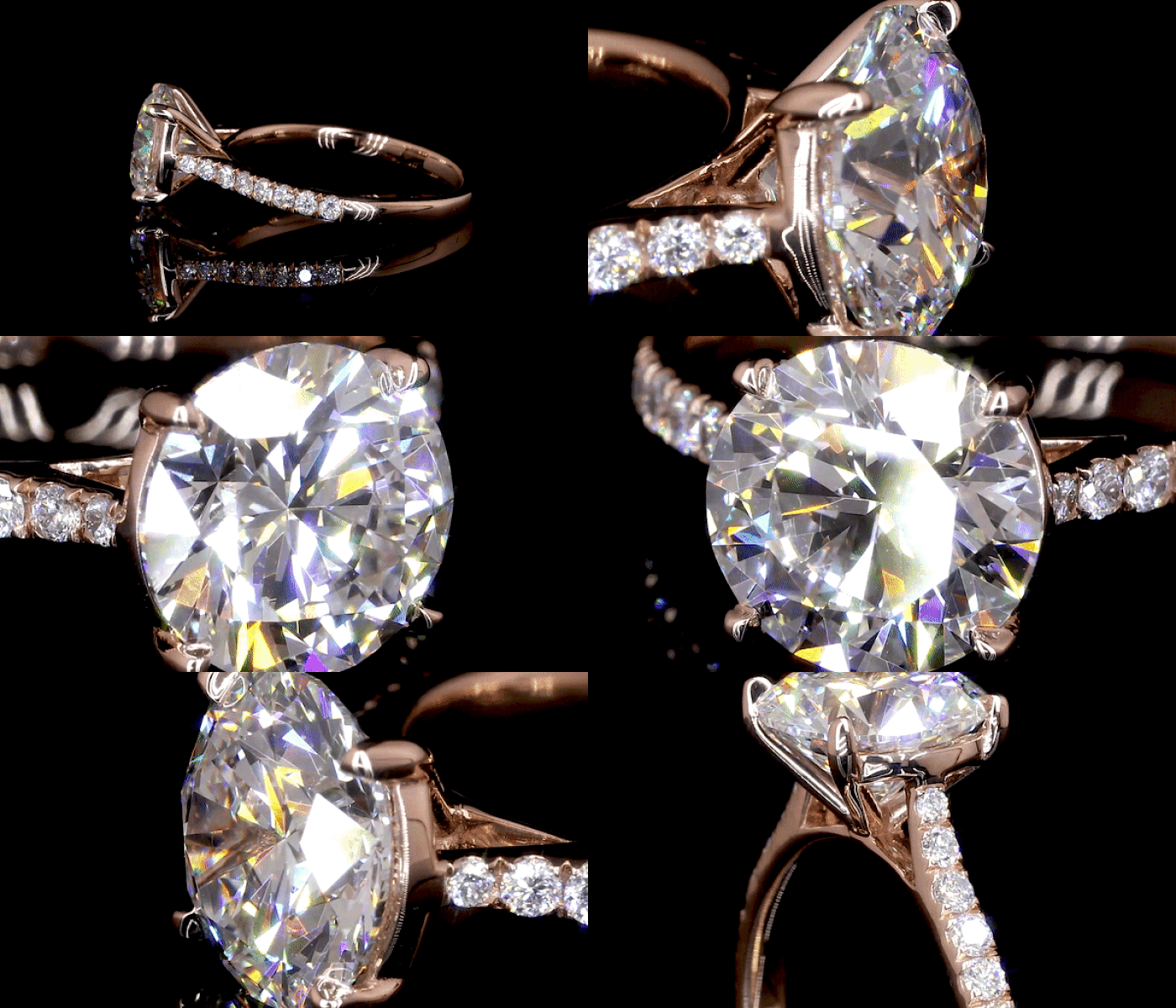
Windowing effects diamond’s overall appearance and ability to refract light. Windowing makes a part of the diamond appear see-through. This transparency can reduce brightness and sparkle for any stone, thus making it unappealing. 

Windowing reduces light refraction in traditional brilliant cut, diminishing the diamond’s sparkle and fire. 

Diamond windowing is caused by improper proportions, such as a steep crown and shallow pavilion, failing to reflect light internally, reducing brilliance and increasing transparency. Light escapes through the bottom of a shallow pavilion, producing a window-like illusion when viewed from the top. 

Large table faces increase visibility through the diamond, making windowing more visible as more light travels through rather than being refracted internally and coming back up. 

Windowing helps beautify non-traditional and antique diamonds. As these cuts, with tall profiles, narrow tables, high crowns with extended facets and steep angles, might purposely generate windowing for a distinct look and different light performance.

What remedies are available if my diamond already has a window?

Re-cutting or Re-polishing: Re-cutting or repolishing gemstones fixes windowing. However, it depends on the windowing intensity and gem size. Small diamonds under 1 carat that have severe windowing, will find recutting problematic. As recutting can lower carat weight by 50%, depending on the severity of the cut. Before proceeding, consider factors like carat weight reduction and trimming fees. Repolishing pavilion depth and table size improves brilliance but might also lower weight.

Choosing the Right Setting: The correct setting may hide windowing. A bezel or halo can hide windowing. A bezel with a metal rim and a halo setting with smaller diamonds hide the transparency. Making windowing is less obvious in these settings.

How to Stay Away From Windowing?

Choose light-performing cuts like round brilliant or princess cuts to avoid windowing. Make sure pavilion depth and crown angles are ideal for light reflection. Review diamond grade reports and examine the gem in different lights. For the final test, quality can be assured by consulting a trusted jeweler or gemologist.

Best Setting for Diamond with Windowing

If you have a diamond with windowing, it is suggested you consult your jeweler to find the best setting. The diamond look can be affected by metal color, such as 18k gold. Rhodium plating on the ring may also help avoid the showing of diamond windowing. As mentioned above a bezel and halo setting can also help hide the windowing effect.

Best Tips for Choosing Well-Cut Diamonds 

Try light performance analysis and computerized imaging in addition to typical evaluation methods. These sophisticated technologies can reveal a diamond’s optical characteristics, revealing windowing concerns. Trust your instincts and choose a diamond that shines and vibes with you for a memorable purchase.

How Can I Ensure I Purchase a Diamond Without Windowing?

Consult your jeweler before buying a diamond to avoid windowing. Look for GIA, IGI, or GCAL certifications to verify the diamond’s quality and dimensions. Check diamond transparency under different lighting conditions.

Conclusion

Maintaining the value and aesthetic appeal of diamonds and gemstones requires understanding and attention to windowing. Diamond Windowing can be efficiently minimized or camouflaged by carefully assessing gemstones, consulting with professionals, and considering cutting styles and settings. Buyers can confidently choose diamonds and gemstones if they can identify the lighter center and absence of light flashes in gemstones or distinguish between well-cut stones and those with windowing.

FAQs

Is the emerald diamond windowing issue regular?
Because of its step-cut facets, emerald diamonds are frequently used in windowing; nevertheless, excessive windowing may cause poor quality.

Are windowed Diamonds always of lower quality?
No, windowed diamonds are not always of lower quality. While the brilliance of windowed diamonds may be diminished, other factors also affect quality.

Does a window lessen the value of the stone?
If a window drastically alters a stone’s appearance or light performance, then that stone’s value may be diminished.

What is the difference between Diamond Windowing & Extinction?
In diamond extinction, poorly cut stone prevents light from returning, whereas diamond windowing has light flowing through the stone and leaving without returning to the observer’s eye.

What can be used under the gemstones when setting it on a ring to minimize the effect of the window?
When mounting gemstones on a ring, windowing effects can be reduced by placing reflective materials underneath them, such as aluminum paper, rhodium or gold.
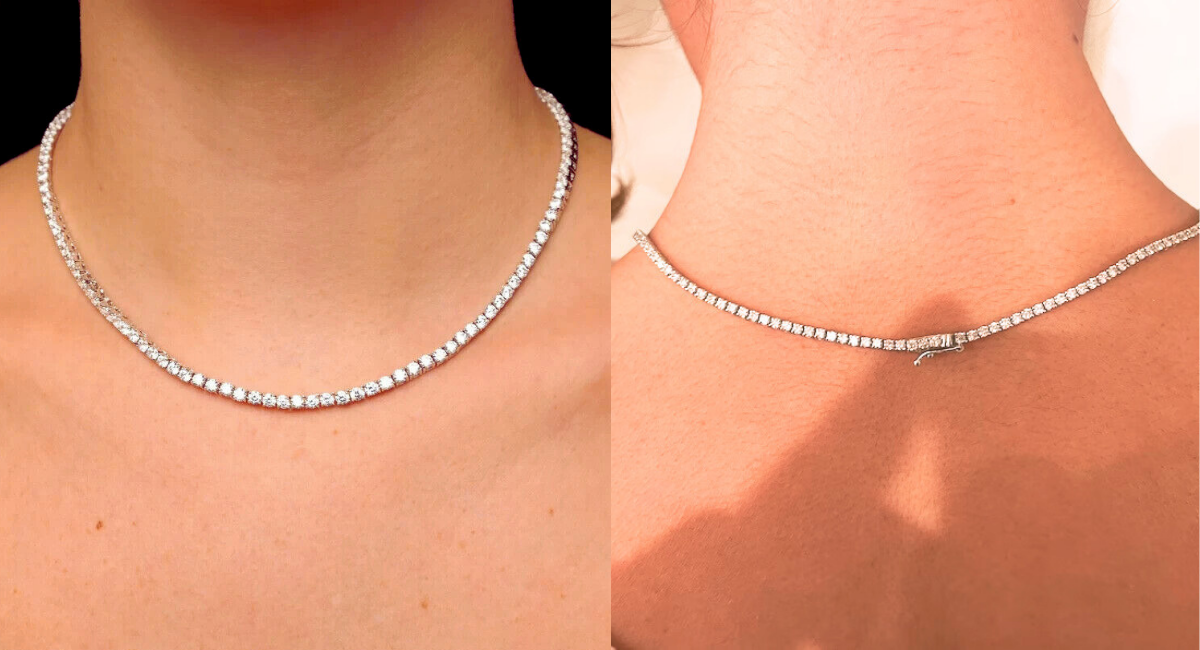
The Timeless Beauty of the Lab Grown Diamond Tennis Necklace

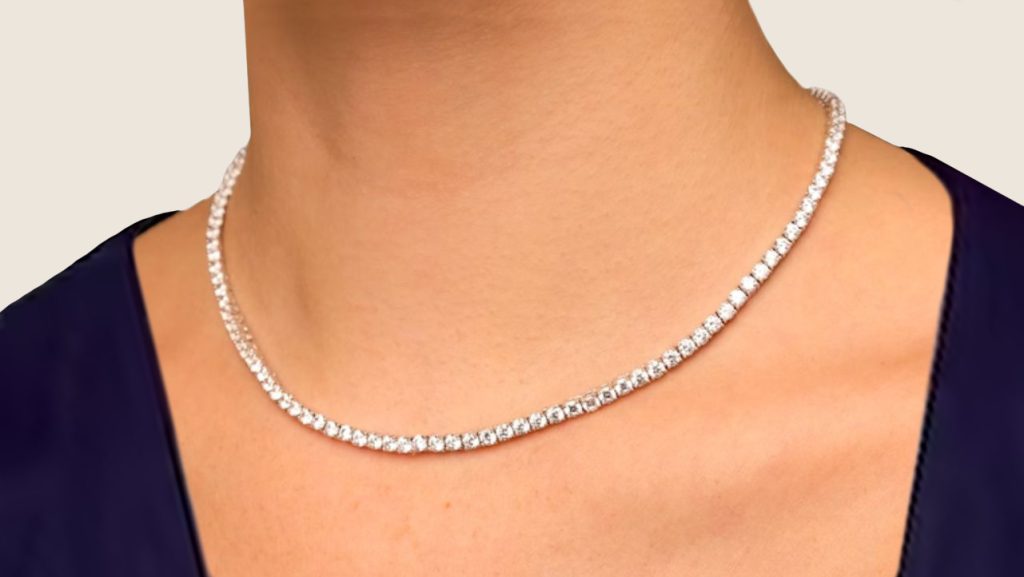
The diamond tennis necklace is a piece of jewelry that has been in trend for a long haul and continues to be a timeless piece that enhances and fits in with all styles. Even in its subtlety, we see the round diamond necklace standing out like no other piece of jewelry. Its origin dates long back, but the beauty of the chain sustains the test of time.

We see the tennis diamond necklace being inspired by the tennis diamond bracelet. The top tennis player in the 1970s wore the tennis diamond bracelet. This inspired the rise of a necklace pattern from the bracelet style. Necklaces are such unique jewelry pieces that one would love to have a special piece for themselves.

What is a Diamond Tennis Necklace?

What is a Diamond Tennis Necklace

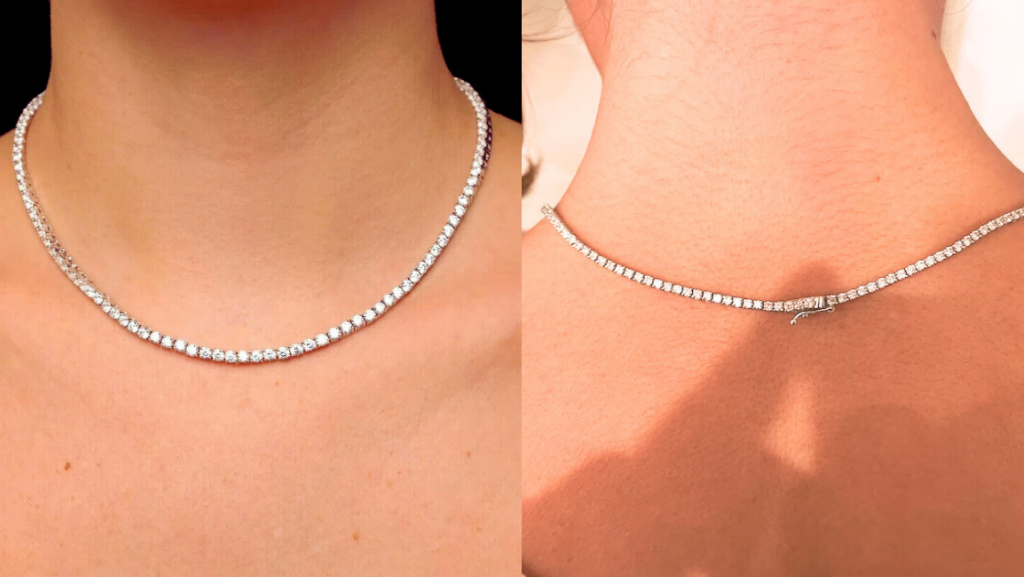
A diamond tennis necklace is a piece of jewelry that is subtle yet quite impactful when worn correctly. This particular style is said to fit in with all fashion and enhances the fashion sense with each style it is paired with.

The tennis necklace has continuous diamonds placed next to one another. The necklace is conventionally known to have diamonds lined of the same size, but in recent times, we have seen experimentation with varying sizes too.

The diamonds are set into metal that is chained together. In simpler words, one can call this a chain of diamonds. The diamond tennis necklace is something one can wear from casual outings to a high-end fashion outfit.

How Do I Choose a Diamond Tennis Necklace?

Choosing a tennis necklace can seem like an easy task due to the simplicity of the design, but we see that the beauty is in the details. The details enhance the beauty of this subtle necklace design, and hence even the tiniest details matter.

The main thing can be, what to look for when shopping for a lab grown diamond tennis necklace, and the answer is straightforward. As you get cleared one by one on these questions, you will start building up your beautiful necklace piece.

One can prefer a lab grown tennis necklace or a natural diamond necklace, with the previous option having more budget and clarity advantages too. Since the diamonds are lab-created, the diamond constituents are the same, with fewer inclusions, making the diamond appear more transparent and shine better.

Diamond carat: As you build up the design of the necklace, you can see that determining the carat weight of the diamond is a crucial aspect. Once the overall weight of the diamond tennis necklace is decided upon, you can put together the diamonds and determine a uniform carat weight of the diamonds themselves.

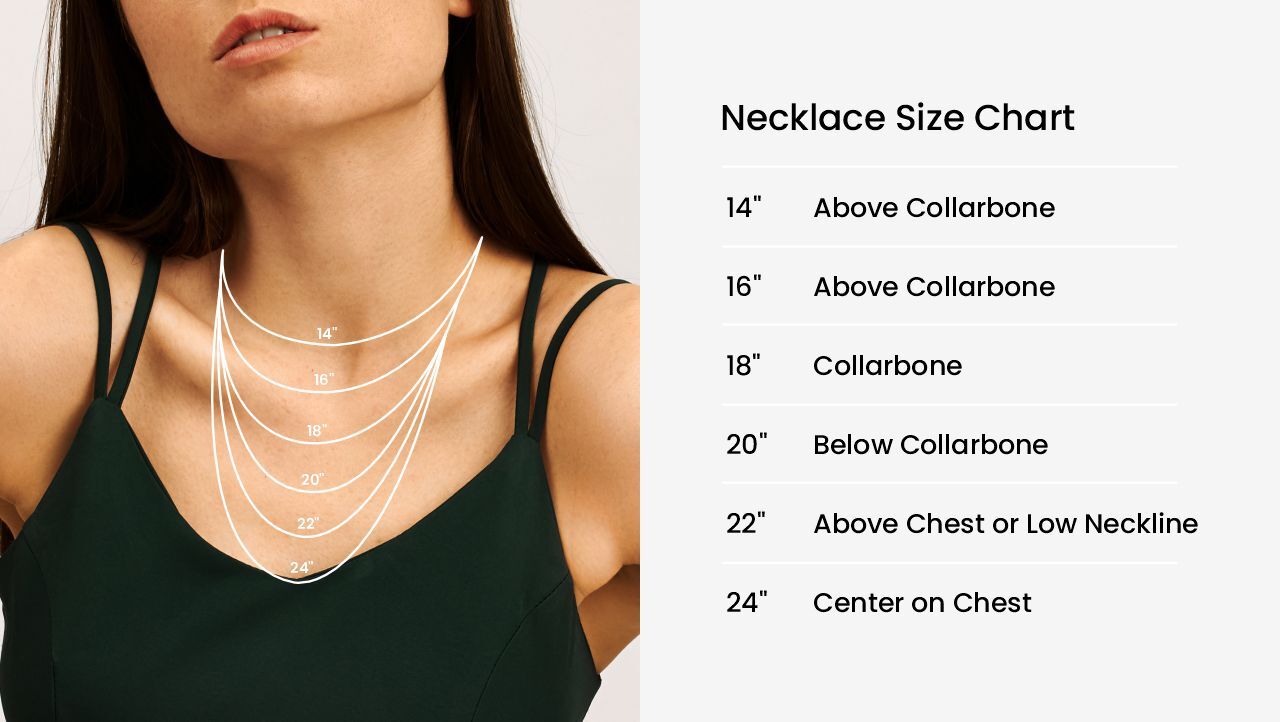
Length: The length of the diamond tennis necklace helps us figure out the approximate cost depending on the carat and number of diamonds one has decided. Tennis necklaces are available in a variety of sizes, right from 14, to a length of about 26. The best length of a tennis necklace ranges from 16 to 18 inches, wherein it does not completely create a choker effect, nor does it hang from the neck and we see it sit comfortably on the collarbone. The length can be an important factor once one determines the style they are going for in the necklace.

Metal: the metal in which one chooses to place a diamond changes the impact of the diamond. A diamond tennis necklace in yellow gold can add a warm tone to the diamonds and can make the diamonds in the necklace seem yellow-toned. Another option is the rose gold diamond necklace, which makes the diamond necklace appear dreamy. Rose gold is also a tone that appears very mystical when worn, hence a beautiful twist to a diamond necklace.

The most conventional way to wear it is usually when the diamonds are placed in white metals. One can choose from different metals in white metals; there is platinum and white gold. A white gold diamond tennis necklace is an ideal option since platinum is a little expensive.
Price: You need to keep an idea of the budget they are looking for in the tennis diamond necklace to form a baseline and work around all the above factors to create the desired output in the chosen budget. This will require some exploration to get an idea of the necklace one is looking for. Loose Grown Diamonds gives the best price there is in the market to offer to an individual.

The Advantages of Choosing a Lab Diamond Tennis Necklace

Choosing a lab grown diamond tennis necklace has considerable advantages compared to a natural diamond necklace. A lab diamond tennis necklace will have diamonds created in the manner a natural diamond is formed but in a slightly controlled format.

The nature of these diamonds is such that it does not harm the environment as much as mining a natural diamond does. The lab grown diamond tennis necklace will be available at a price considerably less than naturally occurring diamonds.

Sparkling Celebrity Diamond Tennis Necklace Moments

The glam of the industry is something we always look up to. So, if you are looking for inspiration, these celebrity diamond tennis necklace inspirations are what you might be looking for.

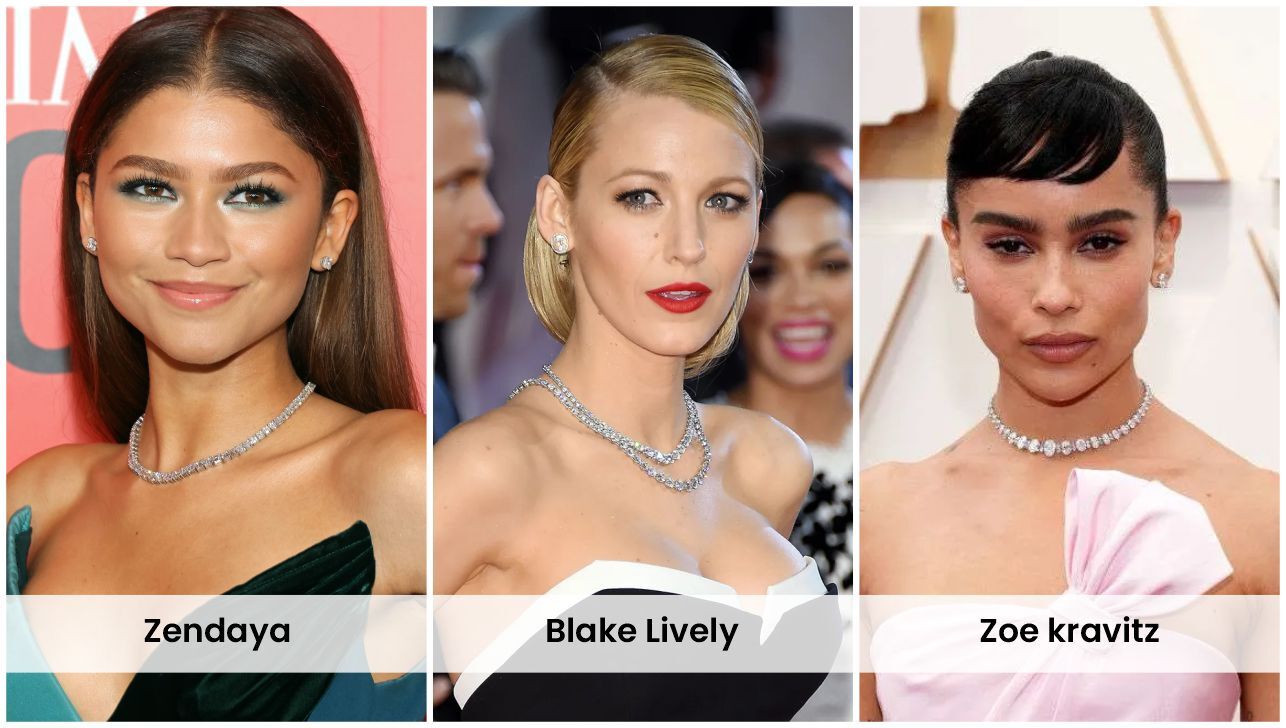
Check out some of the iconic looks from the Golden Globes, Cannes and the never-failing Met Gala. Zendaya and Lady Gaga can be seen adorning a timeless piece of the diamond tennis necklace at one of these events.

Where Can I Buy a Diamond Tennis Necklace?

You can always look online for options and customizations; offline stores can cater to your needs. You can go to the website of Loose Grown Diamonds and check out the choices you can avail as you indulge in our premium customer service. You can avail a discount by using a promo code.

If you want a design we do not have, click here you can send us its picture, note or reference. We will then create a custom setting and send a CAD3D design for you to see and that for you can contact us by filling up our custom form.

[blog_page_btn title=”Buy Diamond Tennis Necklace” url=”https://www.loosegrowndiamond.com/product-category/necklaces/”]

Conclusion

Finding the right lab grown tennis diamond necklace is not a hefty task, but choosing the details you prefer can get a little challenging. With the premium quality of lab-grown diamonds, your tennis necklace will surely catch any eye in a glimpse, all while shining in its subtlety. The tennis necklace women have been wearing has continued to create history.

FAQs

What is a diamond tennis necklace called?
Multiple names call a diamond tennis necklace, some being line, infinite, classic necklace, or unique necklaces.

How much is a diamond tennis necklace?
Depending on the details of the necklace one has chosen, the price ranges from $3000 as a base price and reaches up to $12,000, depending on the diamond clarity, color, carat, and the metal in which it has been set.

What is the best setting for a diamond tennis necklace?
Prong and bezel are the best diamond settings that one can choose from. Prong enhances the beauty of the diamond necklace to a maximum level, but the bezel offers a more stable and safer option for the diamond to be set in.

What is the length of a tennis necklace?
Tennis necklaces are available in a variety of sizes, right from 14 to 26. The best length of a tennis necklace ranges from 16 to 18 inches, which is the choker variety of necklaces.

Can you wear a diamond tennis necklace every day?
Yes, one can certainly wear a tennis necklace every day.

How many carats should a tennis necklace be?
The carat weight of a tennis necklace can only be decided after the whole design process, but an individual diamond chosen can be from 0.05 to 0.5 carats each. The smallest necklace would be around 6ct, whereas the largest 16 carats.

What metals are generally used for diamond necklaces?
The metals commonly used for diamond necklaces are white gold, yellow gold, rose gold and platinum.

Do lab diamond tennis necklaces come in different styles?
In recent times, we have a variety of patterns ranging from prong tennis necklaces to bow-tie diamond tennis necklaces that can be matched beautifully to other metals for added style.

Is a lab grown diamond necklace a good gift?
A lab grown diamond necklace is a beautiful gift that one can gift to their loved ones on special days like birthdays, anniversaries, and graduation days, or even to your loved one for simply existing.

Unveiling the Ethical Elegance of Lab Grown VVS Diamond Rings

In the realm of diamonds, a new revolution has taken place, presenting an extraordinary alternative to natural stones: lab grown VVS diamonds ring.

We have already discussed their exceptional clarity and unrivaled brilliance in our previous blog, where we mostly focused on lab grown VVS diamonds that have emerged as a testament to scientific innovation and ethical beauty.

Unveiling the Ethical Elegance of Lab Grown VVS Diamond Rings

Cultivated through advanced technological processes that mimic the conditions of the Earth, these diamonds possess the same remarkable characteristics as their natural counterparts, but with a traceable origin and a reduced impact on the environment.

As a result, they offer an exquisite option for those seeking sustainable, ethically sourced, and visually stunning gemstones that encapsulate the true essence of elegance and luxury. Today, we discuss how lab grown VVS diamonds and engagement rings are a match made in heaven for your own nuptials.

Ethical Brilliance: The Allure of Lab Grown VVS Diamond Rings

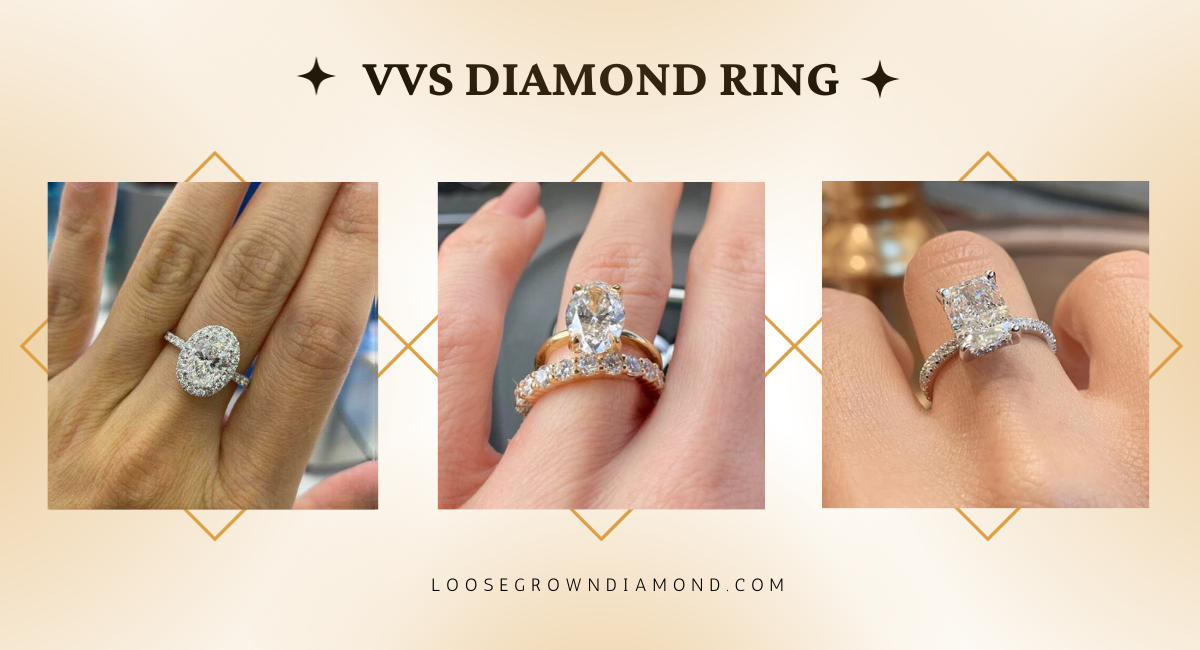
VVS Diamond rings

When it comes to selecting an engagement ring that combines breathtaking beauty with a commitment to ethical sourcing, lab grown VVS diamond ring shine as a remarkable choice.

These exquisite rings showcase the remarkable clarity and brilliance of VVS diamonds, while being cultivated through sustainable and responsible means.

Lab grown VVS diamonds offer an ethical alternative to traditional mined diamonds, as they are created in controlled laboratory environments. With their near-flawless clarity, lab grown VVS diamonds exhibit the same exceptional quality as their natural counterparts, but without the environmental impact and ethical concerns associated with traditional diamond mining.

Choosing a lab grown VVS diamond ring not only guarantees a stunning symbol of love and commitment but also reflects a conscious decision to support sustainability and responsible practices. Discover the simplicity of finding your ideal ring size with our accurate ring size chart.

A Guide to Choosing the Perfect VVS Diamond Ring

When it comes to selecting an engagement ring that exudes unparalleled beauty and exceptional quality, a VVS diamond engagement ring stands in a league of its own. VVS, which stands for Very, Very Slightly Included, refers to the diamond’s remarkable clarity grade.

These diamonds possess an incredible level of clarity, with nearly imperceptible inclusions that enhance their brilliance. So, what should you look for when purchasing a VVS diamonds ring?

Ethical Sourcing: Lab grown VVS diamonds offer a conscientious alternative to traditional mined diamonds. Ensure that the diamond you choose is certified as lab grown, guaranteeing its origin and minimal environmental impact. By selecting a lab grown VVS diamond, you can embrace an engagement ring.

Exceptional Clarity: The hallmark of a VVS diamond lies in its clarity. Look for diamonds with a VVS clarity grade to ensure they have minimal imperfections and display remarkable brilliance. The absence of visible inclusions allows the light to pass through the stone unimpeded, resulting in a dazzling sparkle that will captivate everyone’s attention.

Expert Craftsmanship: VVS diamond rings require skilled craftsmanship to highlight the stone’s brilliance. Pay attention to the setting and design of the ring, ensuring it complements the diamond’s beauty while securely holding it in place. A well-crafted ring will showcase the VVS diamond’s magnificence to its fullest potential.

Personal Preferences: While VVS diamonds are known for their exceptional clarity, it’s essential to consider your personal preferences. Factors such as diamond shape, cut, color, and carat weight all contribute to the overall appearance of the ring. Choose a VVS diamond engagement ring that aligns with your unique style and preferences to create a cherished symbol of love and commitment.

Remember, choosing a lab grown VVS diamond ring not only ensures a ring of extraordinary beauty and clarity but also reflects a commitment to ethical and sustainable practices. With their exquisite brilliance and responsible sourcing, lab grown VVS diamond rings represent a love that shines brightly and conscientiously.

Where to Buy Lab Grown VVS Diamond Engagement Rings?

With our commitment to ethical sourcing, exceptional craftsmanship, and personalized assistance, Loose Grown Diamonds is a premier destination for those seeking lab grown VVS diamond rings. Embrace the elegance and ethical beauty of these remarkable gemstones, knowing that your purchase supports responsible practices.

At LGD, your journey to finding the perfect lab grown VVS diamond engagement ring will be guided by our experts so you get the best deal there is and get access to an exclusive discount on the diamond ring of your dreams by receiving a personalized promo code.

[perfect_ring_box title=”Ready to find your perfect diamond and ring?” btn1ttl=”Buy VVS diamond” btn1url=”https://www.loosegrowndiamond.com/inventory/?clarity=5.00,9.00″ btn2ttl=”Buy VVS diamond ring” btn2url=”https://www.loosegrowndiamond.com/build-a-ring”]

Conclusion

In conclusion, VVS diamond clarity defines the highest standard of perfection in the diamond world. Whether lab grown or natural, VVS diamonds showcase impeccable clarity, resulting in breathtakingly beautiful engagement rings.

While opinions on the best diamond may vary, we maintain a firm answer to what is VVS diamonds and how they hold a special place due to their nearly flawless clarity, making them a top choice for those seeking exceptional brilliance and elegance in their engagement rings.

FAQs

Where can I find the best VVS diamond for a ring?
For the best VVS diamond for your ring, look no further than Loose Grown Diamond, renowned for their exquisite selection of VVS diamonds and commitment to ethical practices.

Can VVS diamonds be customized into different ring designs?
Yes, VVS diamonds can be customized into a variety of ring designs, allowing you to create a unique and personalized engagement ring that showcases the exceptional beauty and clarity of the diamond.

Can I wear a VVS diamond ring every day?
Absolutely! VVS diamond rings are durable and suitable for everyday wear, ensuring that you can enjoy the stunning beauty and brilliance of your ring as you go about your daily activities.

Are VVS diamond engagement rings considered high-quality?
Yes, VVS diamond engagement rings are considered high-quality due to their exceptional clarity and brilliance. The VVS clarity grade signifies a very high level of diamond clarity, making them highly desirable and sought after.

Can I insure my VVS diamond engagement ring?
Yes, you can insure your VVS diamond engagement ring. It is recommended to obtain comprehensive insurance coverage to protect your investment and provide peace of mind.

Can I choose a VVS diamond ring in different metal settings?
Absolutely! VVS diamond rings are available in a variety of metal settings, including popular options like platinum, white gold, yellow gold, and rose gold, allowing you to select the metal that best complements your personal style.

Do VVS diamond rings come with a warranty or guarantee?
Many reputable jewelers offer warranties or guarantees on their VVS diamond rings. It’s important to inquire with the jeweler about their specific warranty or guarantee policy before making a purchase.

Can VVS diamond engagement rings be resized?
Yes, VVS diamond engagement rings can be resized by professional jewelers to ensure a perfect fit. It’s advisable to consult with a skilled jeweler who specializes in resizing to maintain the integrity and beauty of the ring.

Shining Brilliance: Unveiling the World of SI1 Clarity Diamond

Welcome to our sparkling corner of the internet, where we resume our journey through the captivating realm of SI1 diamonds from our previous blog. This time we will dive deep into exploring the mesmerizing beauty and allure of SI (Slightly Included) diamonds.

What Does SI1 Clarity Mean

SI1 diamond clarity means the diamond has slight inclusions that are visible under 10x magnification, but generally not visible to the naked eye. SI1 is a specific clarity grade within the diamond grading system.

It stands for Slightly Included 1 and is a term used to describe the level of internal characteristics or inclusions present in a diamond. The clarity grade of a lab diamond refers to the extent to which it has internal or external flaws that can affect its overall appearance and brilliance.

Seeing Clearly: How to Determine Eye Clean SI1 Diamonds

Crystal Clear Choices: Essential Tips for Buying SI1 Clarity Diamonds

Review the clarity grading system: Familiarize yourself with the diamond clarity grading system, including the “Slightly Included” (SI) category and the subcategory of SI1.

Understand the definition of SI1 clarity: SI1 diamonds have slight inclusions that are visible under 10x magnification to a trained grader. The key here is that these inclusions are generally not easily noticeable to the naked eye.

Look for additional descriptors: When researching or evaluating an SI1 diamond, pay attention to any additional descriptions provided by the jeweler or seller. They may use terms like “eye-clean” or “visually clean” to indicate that the lab diamond appears free from noticeable inclusions when viewed without magnification.

Unlocking the Value: Exploring the Price Range of SI1 Diamond Clarity

SI1 clarity diamond: SI1 diamonds are generally more affordable compared to higher clarity grades. However, the price can still fluctuate depending on other factors.

Diamond G color SI1 clarity: The color grade of a diamond also plays a role in determining its price. A G color diamond, which is considered near colorless, will typically be more expensive than lower color grades.

Diamond color D clarity SI1: Diamonds with a color grade of D are considered the highest grade on the color scale, indicating exceptional colorlessness. When paired with SI1 clarity, the diamond’s price may increase due to the premium associated with a colorless stone.

SI1 diamond price: The si1 diamond price can vary significantly depending on the other characteristics mentioned above. As a general guideline, you can expect SI1 diamonds to range from a few hundred dollars to several thousand dollars per carat, with larger stones commanding higher prices.

Generally, SI1 clarity prices can start from $250 and go up to several thousand dollars.

Price confusion you can use our diamond pricing calculator to determine the right price for your lab grown diamond and elevate your diamond shopping experience by using a promo code.

Why Choose GIA Certified SI1 Clarity Diamonds

Choosing GIA certification guarantees an impartial assessment by industry experts. GIA’s rigorous standards and esteemed reputation enhance the reliability of its certificates. When acquiring an SI1 clarity diamond, the inclusion of a GIA certificate substantiates the stone’s quality and authenticity, instilling confidence in the purchase.

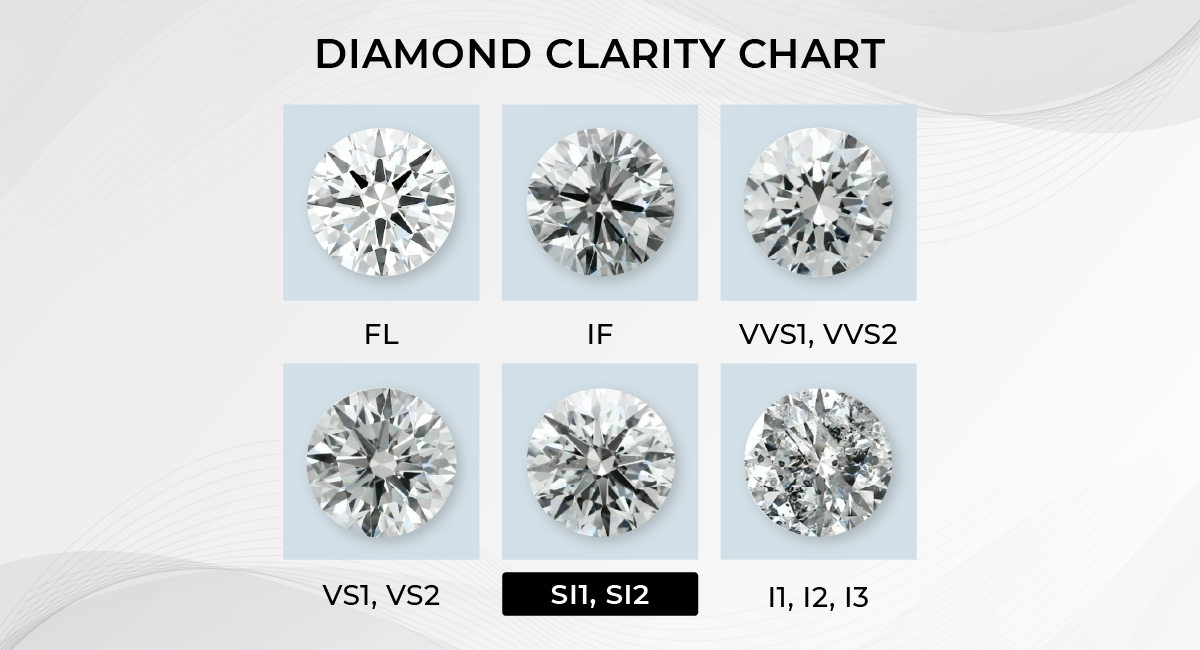
GIA clarity grades, from highest to lowest:

  • Flawless (FL)
  • Internally Flawless (IF)
  • Very Very Small Inclusions (VVS1)
  • Very Very Small Inclusions (VVS2)
  • Very Small Inclusions 1 (VS1)
  • Very Small Inclusions 2 (VS2)
  • Small Inclusions 1 (SI1)
  • Small Inclusions 2 (SI2)
  • Inclusions 1 (I1)
  • Inclusions 2 (I2)
  • Inclusions 3 (I3)

As you can see, SI1 diamond clarity is closer to the bottom. SI1 diamond is not exactly the best choice when it comes to diamonds. The clarity of a diamond depends mainly on inclusions. The type, cut, size, and amount of inclusion can make any diamond beautiful or unfit for jewelry.

Even a high clarity diamond might have some imperfections. It’s rare to find a lab diamond without any flaws. So it would be beneficial if you looking for a diamond that is eye-clean and will look good on your jewelry.

When assessing whether an SI1 diamond is eye-clean or not, it is important to consider the specific characteristics of the stone. Here are some steps to keep in mind.

Crystal Clear Choices: Essential Tips For Buying SI1 Clarity Diamonds

How to Determine Eye Clean SI1 Diamonds

Understand SI1 clarity characteristics: Familiarize yourself with the definition of SI1 clarity and its slight inclusions visible under 10x magnification. Remember that these inclusions are generally not easily noticeable to the naked eye, making SI1 diamonds a popular choice for balancing quality and budget.

Prioritize eye-cleanliness: Look for keywords like “eye-clean” or “visually clean” when searching for an SI1 diamond. These descriptors indicate that the diamond appears free from noticeable inclusions when viewed without magnification. Request detailed images or videos to personally assess the lab grown diamond’s eye-cleanliness.

Consider the color grade: If color is important to you, focus on SI1 diamonds with higher color grades such as G color or even colorless grades like D. This combination of SI1 clarity and a desirable color grade can enhance the overall appearance of the diamond.

Now that you have a better understanding of what to consider when choosing a SI1 diamond, it’s time to embark on your search! choose diamonds from hundreds of styles on LGD.


Conclusion

Alas, SI1 diamonds offer a balance between quality and affordability, with slight inclusions that are generally not visible to the naked eye. They provide an attractive option for budget-conscious diamond buyers. And if you opt for lab grown SI1 diamonds you will get the best deal there is in the market!

Frequently Asked Questions

Is SI1 diamond clarity good?
SI1 clarity is considered good as it strikes a balance between quality and affordability.

Are SI1 clarity diamonds bad?
SI1 clarity diamonds are not considered bad; they are a popular choice for those seeking value without compromising on appearance.

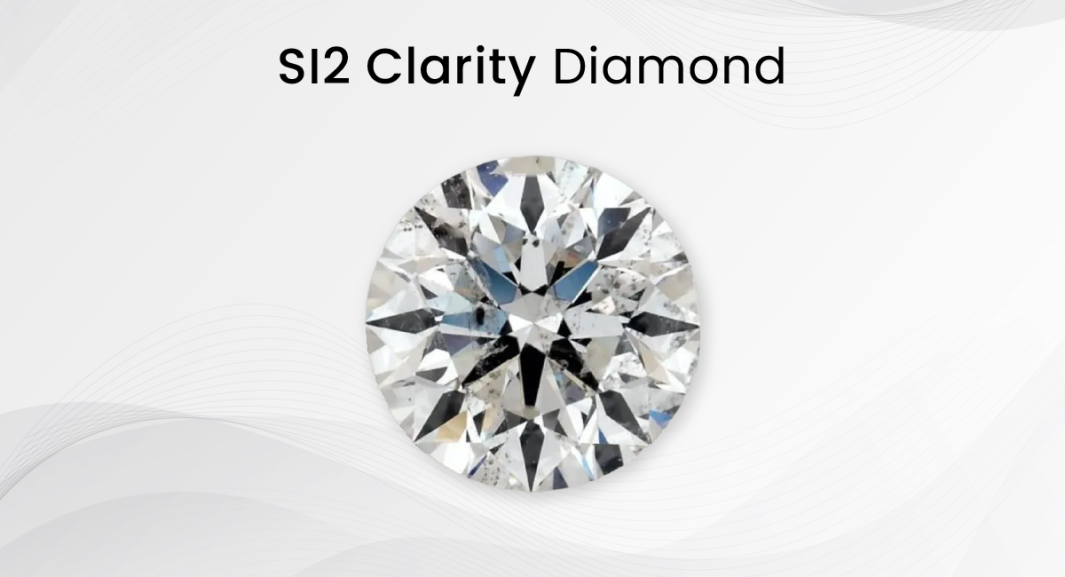
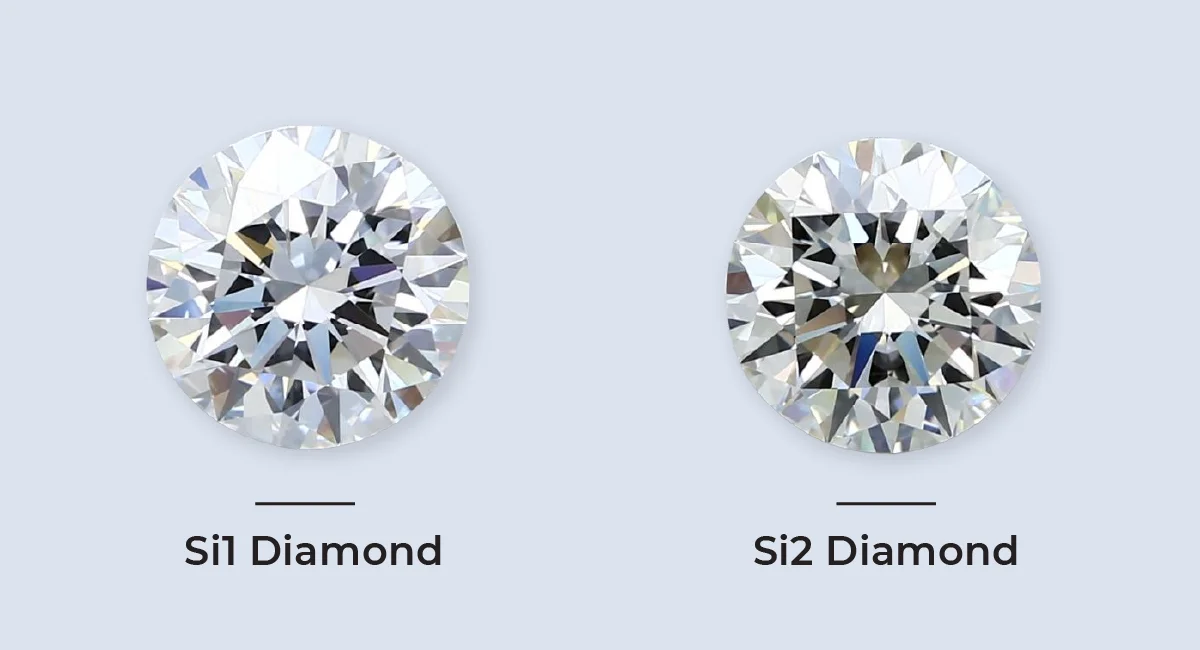
What is the difference between an SI1 and SI2 clarity grade?
The difference between SI1 and SI2 clarity grades lies in the visibility and severity of the inclusions, with SI1 having slightly fewer and less noticeable inclusions.

Do SI1 diamonds sparkle?
SI1 diamonds can sparkle beautifully when well-cut and have good light performance.

Is SI1 diamond clarity good for engagement rings?
SI1 clarity diamond is a good option for engagement rings, as long as the specific diamond is eye clean and meets your desired criteria.

The Beauty of Lab Grown Diamond Necklace and Tips to Buy Them

The task of buying a lab grown diamond necklace is more of an experience than it is a task. We at Loose Grown Diamonds are here to make your experience of buying a lab created diamond necklace enjoyable.

With the beauty of lab grown diamonds set together in a necklace, the elegance of this particular piece is priceless. Many factors go into deciding what is an ideal design. So you can get the best possible necklace or customize one according to your desire.

The Beauty of Lab Grown Diamond Necklace

A diamond necklace has always been a classic piece of jewelry that fits into all settings and can be worn with most outfits. Its versatility creates room for experimentation and thus gives people an option to select a unique style.

Factors to Consider Before Buying a Diamond Necklace

There are numerous factors to consider when one is buying a necklace. A lab diamond necklace is never a small affair, hence it needs to be looked into with much detail. The necklace is, firstly, a representation of the person wearing it. Once the person wears it, it becomes a part of their allure.

The budget, the usage of the necklace, the material used, and its look are all important factors to consider. A real diamond necklace has a different charm as each necklace differs. One can always see that diamonds enhance the wearer’s features and can fit into all styles.

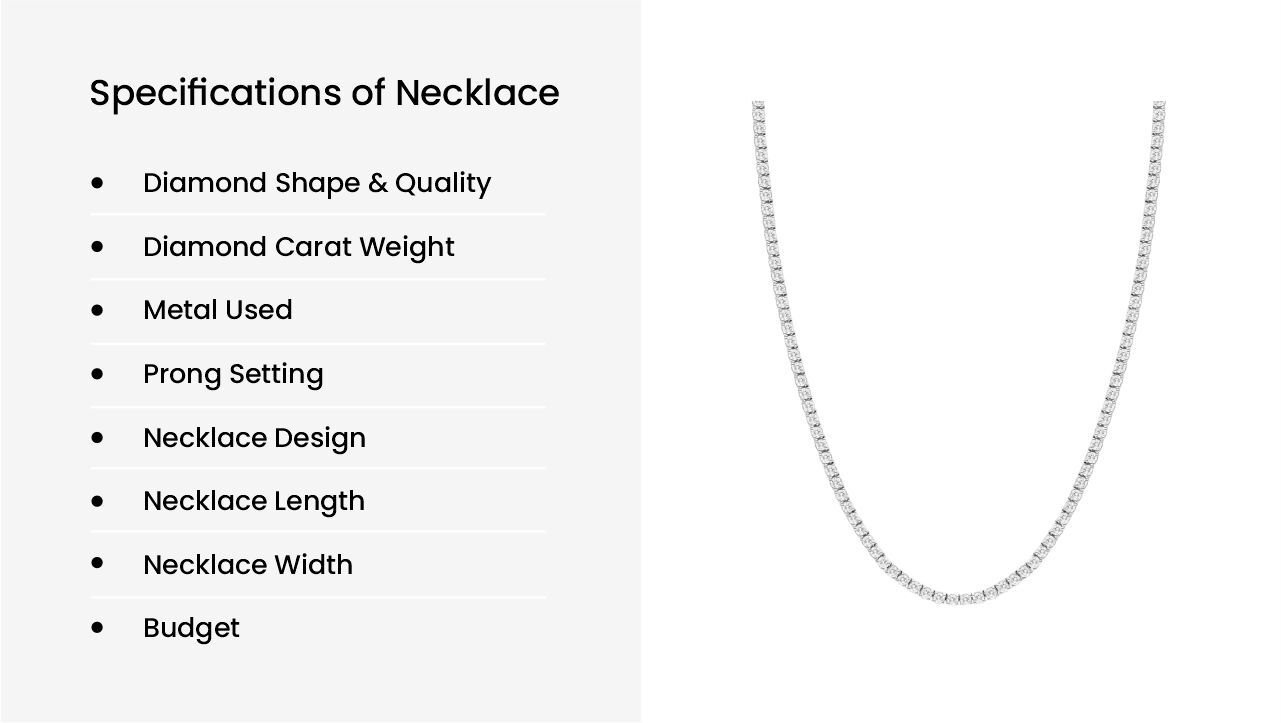
specifications of diamond necklace

Shape & Quality of the Diamond
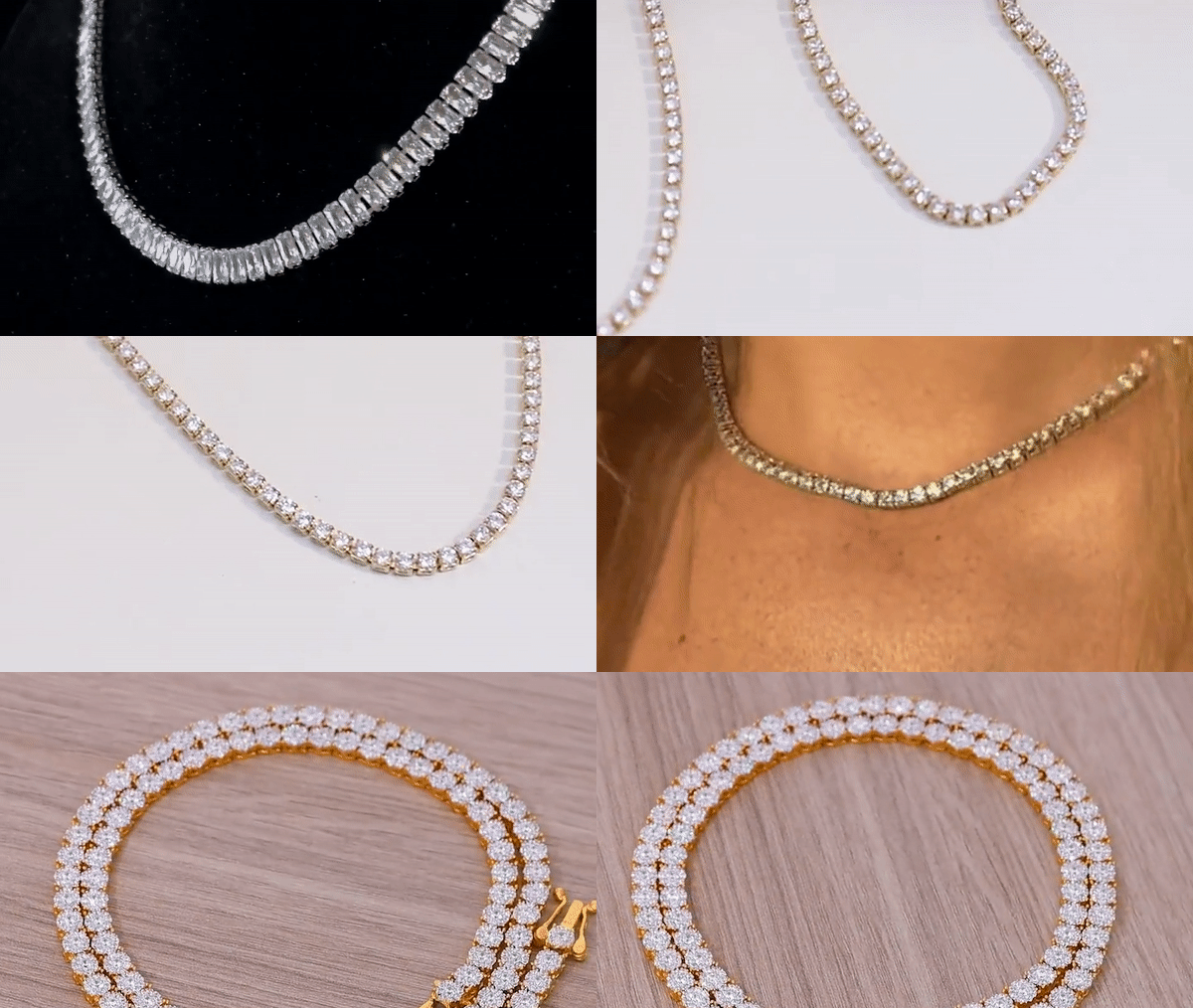
When looking for a diamond necklace, you should check the quality of the diamond used in the necklace. The clarity of the diamond and the diamond shape will help depict the quality. You can select from options like round, oval, pear, emerald, princess, and marquise cut. A round diamond necklace is the most classic design in the lab grown diamond necklace varieties.

Diamond Carat Weight
When choosing which diamonds to be placed on a necklace, it is necessary to determine the overall weight of the necklace first. Once the overall weight of the necklace is finalized, the carat weight of the tiny diamonds on the necklace is calculated.

Metals of Necklace
The diamonds in a diamond necklace are carefully set in particular metals that hold them in place and enhance their beauty. The metals that are primarily embedded with diamonds are gold, platinum, and silver.

A gold necklace with lab grown diamonds set into the design is a stunning combination. A yellow gold diamond necklace imparts a warm tone to the diamonds when placed in the necklace. A rose gold necklace is a feminine and subtle take on the gold diamond necklace. A white gold diamond necklace is a classy, gleaming piece that shines as bright as the diamonds. This metal is preferred because the diamond is placed in a neutral-toned metal in such a setting. Making the diamond stand out more.

Another neural-toned metal is platinum. A platinum necklace is a luxurious piece of jewelry that fewer people buy due to its high price. All diamonds set in platinum shine brilliantly and make their own statement.

Length of Necklace

Factors to Consider Before Buying a Diamond Necklace

The basic pattern of the necklace can determine the length of the diamond necklace. If the necklace’s design is a choker pattern or a small pendant, then the length will sit comfortably around the base of the neck. If the pendant and chain are extended, 16″ is a good length. The diamond necklaces are available in increasing lengths, wherein 20″ is considered the most comfortable length, not too short or too long. With the usage requirement of the design, one can fit in and select the length that fits them best.

Width of Necklace
The width of a diamond necklace can vary depending on the specific design and the size of the diamonds used. Diamond necklaces come in a range of styles, from delicate and minimalistic to more elaborate and substantial designs. The width of a necklace typically refers to the width of the chain or the central part of the necklace where the diamonds are set.

Some individuals prefer a narrower and more refined diamond necklace, while others prefer a wider and more prominent design that showcases larger diamonds.

Prong Settings
When looking at lab grown diamond necklace for women, the settings are always such that they work according to the necklace’s design. If a diamond necklace pattern is a tennis necklace, the diamond settings range from prong to bezel and sometimes even halo. In contrast, in other patterns, the pendant design determines the setting. These diamond settings range from prong and halo settings and sometimes even bezel settings if the design works that way.

Budget
The budget for a lab grown diamond necklace can vary significantly depending on several factors. The cost of a necklace diamond is influenced by factors such as the quality and size of the lab created diamonds, the metal used in the setting, the craftsmanship involved, and the overall design complexity.

Generally, real diamond necklaces can range from affordable options with smaller diamonds and simpler designs to high-end, luxurious pieces featuring larger, higher-quality diamonds and intricate settings. It’s recommended to work with a reputable jeweler who can guide you through the selection process and provide options that fit within your budget while still maintaining the desired quality and design aesthetic.

When purchasing a lab grown diamond necklace, it’s important to consider personal style preferences, budget, and the desired level of sparkle and presence. You can also avail a discount by applying a promo code.

Best Diamond Necklace Designs

Best Diamond Necklace Designs

Diamonds are always known to be versatile when placing them in jewelry and designing ornate patterns. Similarly, there are varieties of diamond necklace patterns too. The more familiar patterns of the necklace with diamonds are tennis necklaces and pendant necklaces. A lab created diamond necklace can be breathtaking when designed correctly.

The tennis necklace has been a favorite among many people due to its simplicity and versatility. A tennis necklace can be paired with various outfits, attracting the most attention. This is ideal if one is looking for a jewelry piece that caters to diverse options.

It can also come across as too precious for casual wear, for such circumstances, a pendant is a viable option. The pendant designs available in the market are unique and can be customized to fit personal preferences. A pendant necklace is a simple pattern you can wear occasionally or for everyday use.

Single diamond necklaces are also trending in the social media world. A diamond is placed in the center, with a chain connected at the two ends. In this specific design, you can see the diamond cut being highlighted. For those who want the best of both worlds, a stationary pendant, and a removable pendant are available.

Multiple options exist in which the diamonds are placed alternatively and connected with a certain chain length. This makes the necklace appear sleek as well as subtle. In this case, the lab grown diamond necklace does not look overwhelming and hence can be worn regularly. If you want to experiment with style, throw on some of your favorite delicate necklaces, and you will know how to layer necklaces.

Diamond Necklaces Worn By Famous Celebrities

Diamond Necklaces Worn By Famous Celebrities

In showbiz, diamonds never fail to dazzle and leave us in awe. Many of these celebrities have worn diamond necklaces, but some have rocked them so well that they left an impact on our minds. Diamonds never fail to shine, whether it be award ceremonies like the Golden Globes and Oscars or even the Met Gala or Cannes.

Channeling the classic elegance of Julia Roberts, the round cut diamond necklace showcases a round cut diamond suspended from a simple and refined chain, capturing a sense of understated glamour.

Zoe Kravitz rocked a layered diamond necklace, while Lady Gaga chose a pendant necklace so Lady Gaga was seen wearing a diamond pendant necklace. Zendaya opted for a single-line simple diamond necklace, whereas Blake lively chose a tennis necklace, all of these celebrities chose to flaunt their outfit with style and went with diamond necklaces as the eye-catching factor of their outfits.

How to Buy a Diamond Necklace?

When buying a lab grown necklace, you should always ensure you buy the diamond necklace women from a trusted jeweler or diamond merchant. The certification of diamonds is of utmost importance, as that piece of paper determines the quality of the diamond.

You can see that necklaces with diamonds have different styles and patterns. The patterns range from tennis necklaces, pendant necklaces, and a whole set of diamond necklaces to some simpler delicate designs. All these patterns are dedicated to different occasions and styles. The lengths of the necklace also complement the necklines of the outfit. A bow tie diamond tennis necklace would complement a low neckline or an off-shoulder gown for a special occasion.

While choosing or making your necklace design, you must narrow down its usage and purpose. You should figure out the budget before deciding what to go ahead with. You should select the metal of the necklace depending on the necklace’s design and budget. Then you can choose the design, carat, and cut of diamonds to be placed in the design.

Once all these factors start coming together, you can figure out which necklace pattern suits your style vibe best. Remember, with a lab grown diamond necklace one can never go wrong.

[blog_page_btn title=”Buy Diamond Necklace” url=”https://www.loosegrowndiamond.com/product-category/necklaces/”]

Ending Remarks on Lab Grown Diamond Necklace

With this knowledge, you are all set to design or buy the diamond necklace of your dreams. You must figure out your preferred designs and patterns and then go shopping. With all the details you want available online, you can have your very own lab grown diamond necklace designed according to your style.

FAQ

From where should I buy a lab grown diamond necklace?
While buying lab grown diamonds, you should focus on their origin since legitimate lab diamonds come with proper certification. The certification proves that the diamond is pure and that you are receiving the best quality of it. Loose Grown Diamonds offer a large variety of options when it comes to design and customization. We have a particular category for creating the best lab grown diamond necklace.

Can I customize a lab grown diamond necklace?
Yes, you certainly can custom design a necklace, and we at LGD Diamonds will implement your custom design on demand.

What are the different necklace sizes?
Necklaces are available in a variety of sizes, right from 14″, which is the choker variety of necklaces, to the length of about 24″, which is usually preferred for pendant designs.

How do you calculate the price of a diamond necklace?
The price of a diamond necklace is determined by the amount of metal used in the necklace and hence its cost, added up with the additional costs of the diamond and the making charges. You can use our diamond pricing calculator to determine the right price for your diamond.

How many carats should a diamond necklace have?
The diamond’s usage and budget should determine the diamond carat for a necklace. A 0.25- 1 carat diamond, such as a pendant necklace, is ideal for everyday wear. If you want a tennis diamond necklace then a carat weight of 3-12 carats is suitable.

Are lab grown diamond necklaces durable?
Lab grown diamonds are as durable as natural diamonds, lasting as long as natural diamonds, mostly forever.

Why is a diamond necklace more expensive than gold?
A diamond necklace’s price is higher than that of gold, since the price of diamonds is higher, owing to the rare availability of diamonds and higher demand.

What Is A tennis chain/tennis necklace?
A tennis chain is a chain that has an all-around coverage with diamonds. The diamonds are placed all around the chain in a continuous form.

What is another name for a tennis necklace?
Tennis necklaces are also known as infinity necklaces, line necklaces, and eternity necklaces.

Should I Choose Platinum Wedding Bands: A Guide to Choosing Perfect Wedding Band

Finding love is hard, but finding wedding bands shouldn’t be! What better than a stunning white metal to be worn as a wedding ring, symbolizing the purity of love?

Over the years, platinum has taken over the market of gold in the wedding scenario. Platinum metal is ideal for setting your wedding band in due to its neutral tone and durability. Let us look over to find out why a platinum wedding band is an ideal choice.

Why Choose Platinum Wedding Bands?

Why Choose Platinum Wedding Bands?

A platinum wedding band is something you would undoubtedly choose if you were given multiple options, and we will tell you why. Platinum is a metal that is very durable when it comes to jewelry, especially wedding bands. The strength of platinum is such that it can withstand the wear and tear of regular usage. This strength is a result of the density of the metal.

Platinum bands stay the same color and don’t even turn yellow, so you might pass it on generations after you, and the vintage platinum wedding bands will stay as eternal as ever.

Platinum rings provide enough strength to hold a diamond in place, as it is not brittle. Another reason one should choose platinum wedding bands is their hypoallergenic nature, which causes no harm to the skin and can be worn by everyone. Most of the ring is made with pure platinum with very few additions.

Platinum and Wedding Bands: The Perfect Match

[su_youtube_advanced url=”https://www.youtube.com/watch?v=yN5lpuMCaGI” width=”1600″ autoplay=”yes” mute=”yes” loop=”yes” modestbranding=”yes” theme=”light” playsinline=”yes” title=”platinum band”]

The pure white metal is extremely durable; yes, a platinum wedding band is the best option. One can opt for a wedding band. The purity of the color of the metal and its durability is a metaphor for the love it represents. It is a perfect fit for the idea of wedding bands.

When one finds love, it is surely looked upon as something that will last forever. The best platinum wedding band is something that will last forever. As a circle, it stands for eternity, as it is never-ending. Imagine giving your significant other this platinum ring that radiates purity and togetherness. Such a moment would be eternal for them.

The longevity and low-maintenance nature of platinum are such that it can be passed on to generations without its appeal getting ruined. These classic vintage platinum wedding bands will remain an heirloom without losing their brilliance and charm.

What to Look for in a Platinum Wedding Band

Plain platinum wedding bands are the simplest type of platinum wedding bands. They have a classy and elegant feel to them. However, you should take your time with the process of buying such a ring. Before you go out looking for the perfect platinum wedding band for them, let us give you a few pointers to keep in mind.

A certification is a minimum requirement that one should look for. That document will certify platinum as original and also show you the percentage of platinum that the constituent of the ring has.

The terms of purity are represented by a number, such as 950, which means the ring possesses 95% platinum. This is the purest type of platinum ring on the market. The remaining 5% are alloys that make the ring durable and easy to work with. Platinum rings are also known to maintain their color and not fade out.

The hard metal resists any scratches while keeping the luster and shine of the platinum wedding band to make it look as good as new even after years go by. Here are a few questions and answers you should know before purchasing platinum wedding bands.

How to Choose Men’s Platinum Wedding Bands?

How to Choose Men's Platinum Wedding Bands?

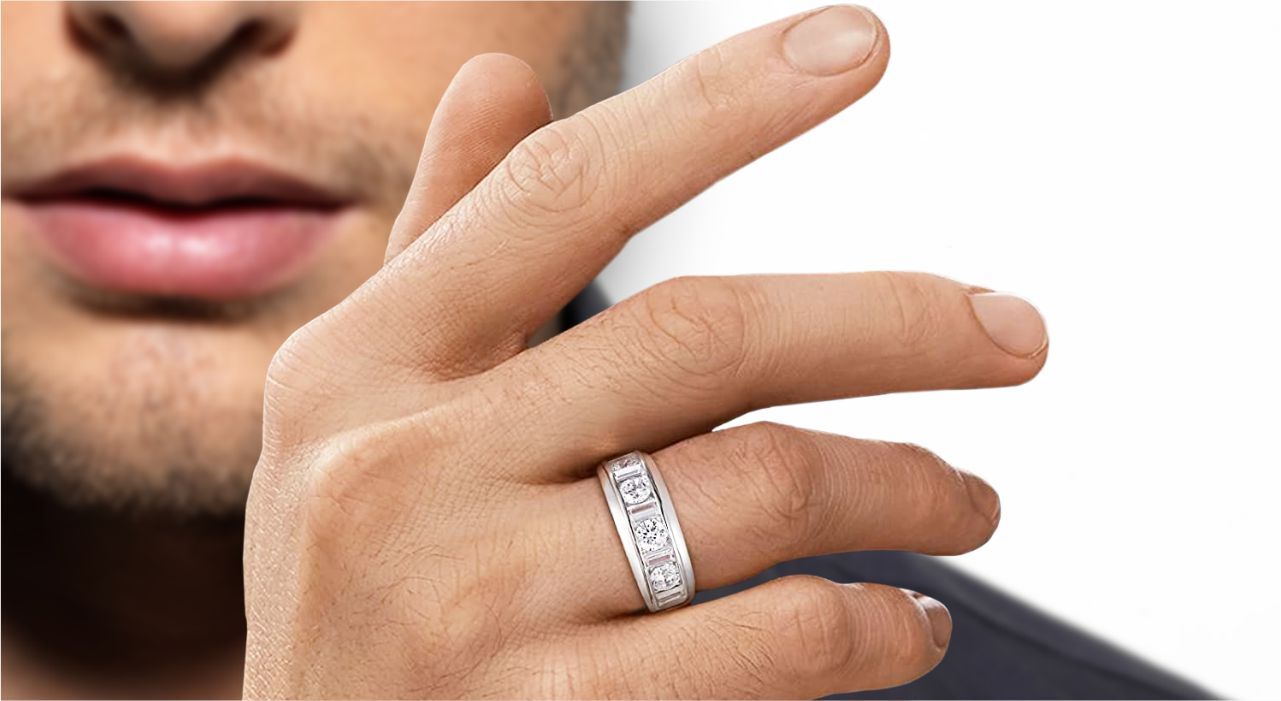
Men’s platinum wedding bands make a very bold statement. Men usually prefer plain platinum wedding bands since they are easy to care for in the active lifestyle and varied conditions. Despite choosing plain platinum wedding rings, there are many minimalistic options.

These options are based on the type of finish given to the ring. You can get a matte finish, certain stripes, engraved names, added melee diamonds, and more. To complement the woman’s chosen design, one can look for a similar design with a wider band or precise lines.

How to Choose Women’s Platinum Wedding Bands?

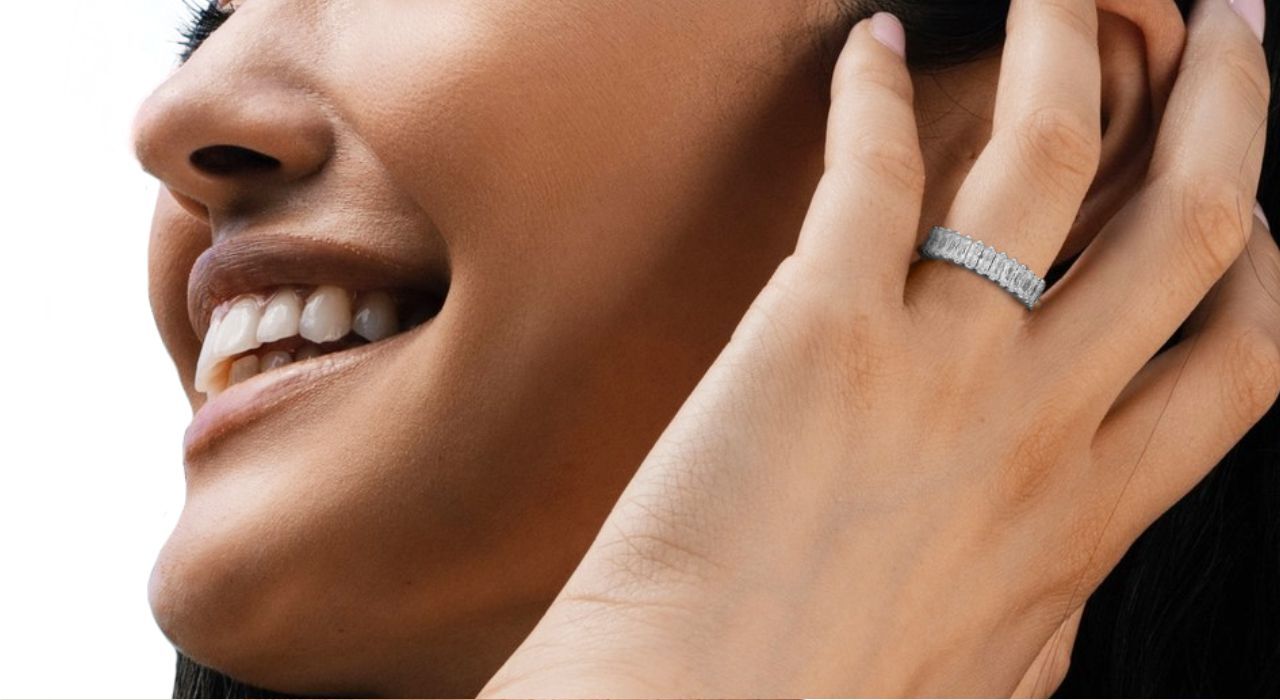
Choosing platinum wedding bands for women is a challenging task due to the presence of numerous options available. The variety of brands allows various designs that cater to every choice. This is both a blessing and a boon. Platinum curved wedding bands are designs that a lot of women prefer owing to their minimal and elegant pattern.

Another favorite set is princess cut platinum wedding bands, which enhance the wearer’s fingers and adorn them with the brilliance of the princess cut and a stunning white metal. You mainly have to pay attention to the width of the band, the style, if there are stones, where they are placed, whether it will be comfortable to wear, and how the band will look on your finger.

Do platinum wedding bands maintain their color?
Platinum wedding bands do not lose their color and maintain the same beauty from the beginning. These rings do not lose their shine or brilliance either, making them a favorite among people.

What are the levels of platinum purity?
The purest level of platinum purity is 1000. The usual level of platinum jewelry contains 95% platinum, making it a level 950. A variety of levels that range from 850-950 are available in the market, corresponding to the percentage.

What is the best type, quality, purity, etc?
The best quality platinum to buy is 95% platinum, known as 950 platinum. Some other alloys like Ruthenium and Palladium are added to the metal to keep it corrosion-resistant and durable.

Is platinum good for the diamond band?
Platinum is the best option for a diamond band since its strength and durability allow the diamond to stay in position despite regular usage. Its color enhances the beauty of the diamond, making it appear sparkly.

Example of Platinum Bands Collection

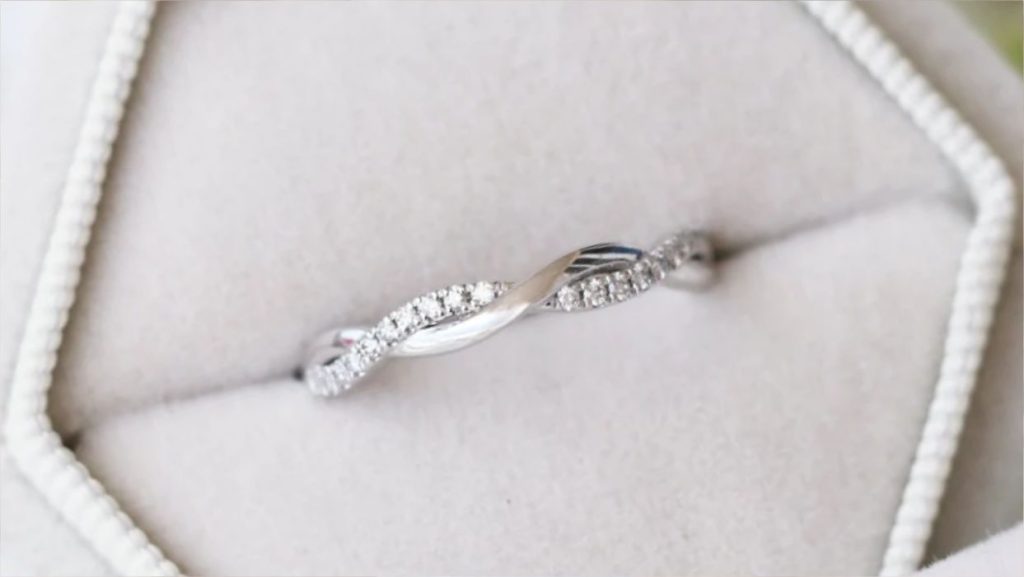
A wide variety of platinum bands are available in different styles. The solitaire platinum wedding band is a classic option. The infinity platinum and half-pave bands are very sought-after options for their simplicity and grace. These types of rings are also gifted as platinum wedding anniversary bands.

Other options for platinum diamond wedding bands are platinum stackable and platinum eternity wedding bands, symbolizing the abundance of love and the eternal nature of love, respectively. There are diverse design options, wherein some can be customized as well. This offers the user some freedom to shape the jewelry piece they have in mind.

Here are some examples of platinum wedding band designs

platinum eternity wedding band

Eternity Platinum Bands
A platinum eternity wedding band is a band that holds a series of diamonds all through the ring, hence enhancing the shine. This is a very classic option if larger diamonds are not preferred.

Stackable Platinum BandStackable Platinum Bands
More is better is one of the most heard statements. You can apply that logic to platinum jewelry with this staggering design of stacking two to three platinum bands on top of each other. This makes the ring look bigger and shine even brighter.

Infinity platinum bands

Infinity Platinum Bands
An Infinity platinum band that has diamonds placed one after the other without any gap in between. On viewing from the side you will see a U-cut style emerging. An infinity band will sparkle brilliantly whether it is worn alone or paired with another ring.

platinum wedding anniversary band

Classic Platinum Bands
The classic platinum diamond band is an elegant and very sought-after option for its simplicity and brilliance. These types of rings are also gifted as platinum wedding anniversary bands.


Reasons to Prefer Platinum Wedding Bands

The beauty of platinum wedding bands is boundless. Despite the aesthetic aspect, the functional aspect of these wedding rings outshines everything in their path. Some reasons that will make you prefer platinum wedding bands are,

  • The color and the shine do not wear out or fade at any time.
  • The durability of the metal makes it suitable for everyday usage.
  • The strength of platinum wedding bands allows the stone to be set very firmly and is very safe.
  • Platinum is naturally hypoallergenic and will not cause skin damage or reactions on regular wearing.
  • Platinum does not tarnish or catch rust at all.
  • You can pass it to future generations as a vintage platinum wedding band.
  • Cleaning platinum is very easy and only requires some dish soap and warm water, which saves on cleaning costs.

Pros of Platinum Wedding Bands

  • The durability of platinum makes it a good option for wedding rings.
  • The density of platinum is higher than gold or silver and hence does not fade out over time.
  • Platinum is hypoallergenic and can be worn by everyone without causing rashes or skin issues.
  • The shine of platinum enhances the beauty of the diamonds embedded in it.
  • Easily cleaned at home.

Cons of Platinum Wedding Bands

  • Platinum wedding band prices are higher than any other metal band, making it expensive.
  • Platinum cannot be easily resized because it is as hard as glass, so applying pressure to it may cause it to crack.

The Resale Value of the Platinum Band

Platinum tends to have a low resale value because there are few buyers in the resale business. Limited businesses are open to buying platinum, which reduces its resale value to a large extent. Selling to individual buyers does not guarantee good prices

Platinum Wedding Bands Celebrity Favorite

If you feel platinum rings are not in trend, you are wrong there. Some of the most famous celebrities have chosen to wear platinum wedding bands. Our very own Mariah Carey adorned a beautiful platinum wedding band with an emerald cut diamond and baguettes. Sofia Vergara carries a beautiful vintage style platinum wedding band with a halo around a cushion cut diamond. Other than these, Kim Kardashian, Kourtney Kardashian, Beyonce, Chrissy Teigen, Megan Markle, Blake Lively, and many more in showbiz.

Choose from hundreds of styles on loosegrowndiamonds.com or share a band design you adore, and we’ll craft a custom piece to your preference.


Conclusion

The platinum wedding band has gained much momentum in recent days due to its durability and sheer beauty. It is something that fits into every idea of a wedding band, with the only downside being the expense initially.

This expense can be managed since it can be considered a long-term investment with no maintenance requirements in the future. With the variety of wedding bands in the market, get your hands on the best platinum wedding band that combines beauty and elegance.

FAQ

Is platinum better than gold for wedding bands?
Platinum is a much better option than gold for a wedding ring due to its durability. The neutral tone of the metal is also another one of its advantages.

What unique qualities does a platinum wedding band have?
Platinum is very durable as compared to other metals, and it is also naturally hypoallergenic, making it very safe for usage. It is extremely low maintenance.

What are the benefits of platinum wedding bands?
Due to its durability, the platinum wedding band will never fade or change over the years. They also come with a color guarantee that makes them more expensive.

Why are platinum bands more valuable than gold?
The rare nature of platinum bands makes them more valuable than gold. Platinum metal is also more durable as compared to gold. The density of platinum is greater than gold, which makes it more durable.
Can you wear a platinum band all the time?
Yes, one can always wear a platinum ring since it is very durable. Due to its higher density, it will not fade or wash out over time.

How much should a wedding band cost? 
The price range of a platinum wedding band starts from almost $347 to anywhere around $5000.

How to choose platinum wedding bands?
Platinum bands can be chosen from a wide variety of brands and designs. One should choose 950-level purity of platinum. Certification is also something that should be seen while selecting a platinum band.

Is platinum good for a wedding band?
Platinum is an excellent option for a wedding band as it combines the beauty and durability required for daily wear.

Flawless Diamonds: The Ultimate Symbol of Perfection and Prestige

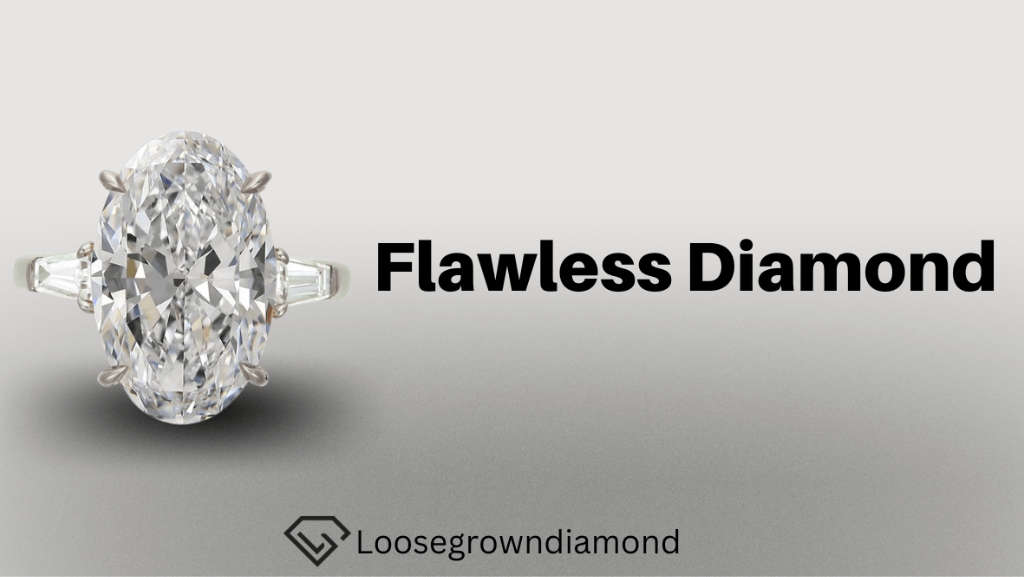
Starting with the word “flawless,” what do you think this means? It refers to anything that does not have any imperfections or defects. Therefore, diamonds with top clarity grades that have no defects within are called “flawless diamonds.”

Since no diamond is completely free of flaws, it is hard to find the ones with an FL grade, and less than 1% of all diamonds get this grade.

The question now arises: is it easy to find a flawless diamond, or is it so rare that one cannot easily find it? Since these diamonds require several severe prerequisites to be met before being developed, they are very difficult to procure.

Fans and buyers are interested in such gemstones, but it is not easy for them to find them. Flawless cut diamonds are gems that are perfect, very rare, and very expensive, and you can’t see any flaws in them when you look at them with a 10x or 20x lens.

So, if you are planning to buy a flawless diamond, you should consider that you will not find it easily.

People want them because they are clean and unique, even though they are expensive. To know more about flawless diamonds, you should read the article till the end.

What Is a Flawless Diamond?

What Is a Flawless Diamond

Considering the fact that diamonds encounter harsh conditions throughout their development stage over hundreds of years.

There will always be something wrong with them, even if it’s just a small flaw that can’t be seen with the naked eye but must be visible under a microscope.

However, as stated in the above paragraph, flawless diamonds have no blemishes. How is that even possible? Internally Flawless (IF) diamonds have apparent flaws and inclusions, but none are noticeable.

Hence, a flawless diamond may contain flaws and defects, but it will rarely have noticeable inclusions.

In reality, a flawless diamond is still not considered to be the purest, i.e., it will still have certain imperfections that require a minimum of 60 to 100 times zoom in a microscopic view to see.

Flawless diamonds have no obvious flaws or imperfections. Even though we all attempt to achieve perfection, a defect or three often keeps us rooted.

Under a microscope, it is the absence of symmetry that distinguishes the internally flawless diamond, too. In a deep taste of celestial humor, the IF diamond tells us all that what is on the inside is more important than what is on the outside.

Benefits of A Flawless Diamond

Until now, it has been clear that flawless diamonds are surely not the ones you can easily get your hands on. Despite their high price, a certain class of people prefers these diamonds. Have you ever wondered why?

  • Many buyers prefer flawless diamonds because, well, who doesn’t like perfection? It is nothing but a kind of internal satisfaction that people attain while possessing top-notch items.
  • From a distance, flawless diamonds create a great visual impact, making them worth buying.
  • Flawless diamonds are intended for enthusiasts who seek the prestige of possessing a scarce gem. Even if you have a half-carat flawless diamond, its sparkle can easily light up a room.
  • A good variety of the other 4Cs—color, cut, and carat—are available for flawless diamonds.
  • Clarity is a thing that dominates in flawless diamonds, but despite that, when you look at the options available in this range, you will surely want to buy it.
  • When individuals hear the term “flawless,” their brows crease. Flawless is at the top of the list whenever it relates to gems. Nothing really exists from above. They are incredibly rare. It is humanity’s greatest masterpiece, and there is hardly anything else on the land as beautiful as it.

Should You Buy Flawless Diamonds?

If you aren’t concerned about money and want to get your hands on something worth the cost, you should look at flawless diamonds.

But if you prefer color and cut-related factors in a diamond over clarity, you should opt for other options like VS1 or VVS1.

So first, settle on which factors you are primarily looking for in a diamond. and then make a decision accordingly.

If you still prefer to buy a flawless diamond ring, maybe a key question you should ask yourself is which color and carat size you would like to go for so that it looks fabulous.

Moreover, if you find yourself confused about determining the carat size of your chosen flawless diamond, you can make use of our diamond carat size chart.

To make it clear, we’ll just use the word “beautiful” to express how you desire the stone to appear on her hand.

For different people, perfection may lie in different things. Aiming for a purity grade better than VVS is unnecessary for some. Especially if you plan to enhance the luster and sparkle of the diamond ring by adding more diamonds or a precious metal band.

We suggest that if you have the money, go for a larger carat, a superior cut, and a brighter hue. A bigger VVS diamond will look much more appealing than an FL diamond with a half-carat weight.

Usually, the vast majority of individuals purchasing a wedding ring will not want their fiancee to notice any faults in the gemstone when looking at it.

So, first, have a clear idea if your partner would actually like flawless diamonds, and then decide on the other factor.

To give you a sense of how rare these jewels are, just seven stones weighing more than 100 carats have been auctioned in the past 30 years, and just one of those has been purchased. 

Even the recently auctioned 102.34-carat stone was considered “flawless.” It is an oval diamond with a D color grade and costs around $10 million to $30 million.

Flawless Diamond Price

Diamonds with lower clarity appear similar to perfect-looking stones but will be priced much less when compared to flawless diamonds. We’ve talked about how expensive flawless diamonds are several times; let us give you a more accurate figure.

Other than clarity, carat, cut, and color are the most important factors that determine the value of a gem, especially a diamond.

Because the color and cut of a diamond play a crucial role in its price, it’s difficult to give a precise value for a 1-carat FL gem. Furthermore, because these immaculate diamonds are so uncommon, the price of a perfect 1-carat round cut, a flawless diamond with a GH color ranges from around $4,100 to $7,000 per carat.

Bigger perfect gems are considerably rarer, and their values reflect this; since larger FL, and IF gems are much more uncommon, the price increases rapidly as the carat increases.

Although purchasing an upper purity certification may appear as the best way to ensure a gorgeous diamond, investing in an FL or IF grade is not really a smart investment. How so? 

Because no one will be able to tell the difference between an IF and an FL diamond, visually clean stones of lower grades, such as VVS1, VVS2, VS1, and VS2 stone, can be found; these gems will appear just as clear as an FL diamond. However, a flawless diamond will undoubtedly cost you extra money.

If you select an eye-clean VS1 or VS2 diamond, you’ll get a gorgeous stone while paying almost 60% less in comparison to an FL diamond.

How to Choose a Flawless Diamond?

If the flawless diamond range fits your budget and you are now wondering which diamond would suit you the best, then let us help you out.

Color: Of course, each of us would like a diamond with the highest grade of the 4Cs, especially the color grade. The higher the color grade, the more royal the stone will look.

Also, remember that most rare diamonds are colorless when choosing the diamond color. Some gems have subtle yellow hues that are difficult to notice with the human eye. Here “color” does not refer to colored diamonds (blue, brown, black, pink, etc.)

Have an idea about the color your partner wishes to have, or else it is advised to go for the least-colored diamond to make its shape more noticeable and make it look more royal.

Cut: If you are going for a flawless cut diamond, it is recommended that you go for the highest cut level according to GIA or IGI standards. That is “excellent” or “ideal” grades, respectively. A diamond’s cut plays a vital role in depicting its overall greatness.

Carat: In the case of flawless diamonds, it will be hard to find a big-carat diamond as they are scarce. Anything above 2 carats will easily cost you thousands of dollars. Thus, make a decision wisely.

Metal: The metal band you are going to choose will determine the overall look of the diamond. Gold, silver, or platinum are the best choices to match with a perfect diamond to make it look better overall.

In the end, it may be difficult to identify “the one absolutely faultless” diamond, as there might not be such a stone. As FL gemstones are rare and unique, they have a steep cost, yet there are plenty of them available on the market that you can look at.

Fl vs IF Diamonds: What’s the Difference?

According to GIA’s clarity rating, IF gems are one grade below FL (flawless diamonds). These, like flawless diamonds, are exceedingly rare, accounting for fewer than 1% of all precious diamonds.

  • Purity: Under 10x magnification, an FL (flawless) quality diamond exhibits no imperfections or flaws. It has the greatest purity grading as well as the most singular form of gem brilliance.
  • Rarity: Flawless diamonds account for fewer than 1–1.5% of all market gems. While IF diamonds account for 1–2% of diamonds on the market.
  • Imperfections: An IF (internally flawless) gem has little or no obvious internal defects but could have minor surface flaws. As a result, the primary distinction between FL and IF is the existence of imperfections on the diamond’s surface.
    Superficial surface roughness, irregularities, or patches of polish markings could place a stone in the IF category rather than the FL grade.
    Those gems are immaculate, extremely rare, and immensely valuable, with really no apparent defects under 20x, 50x, or even 90x magnification.
  • Pricing: With the exception of pricing differences, there is really not much of a structural contrast between these two types of gems being the best diamonds available in the market. Additionally, we have a Diamond price calculating tool for you.
  • Distinguishing: You can’t tell the difference between FL and IF diamonds without a microscope and the knowledge of a trained jeweler.
    However, specialists may also have difficulty differentiating between FL and IF. This is usually a negligible difference because even relatively close blemishes on an IF diamond are just so tiny and unnoticeable that they scarcely affect anything.
  • Highest Quality Diamond: Some newcomers make the error of believing that a D-colored, IF-clear stone translates to the highest natural quality of a diamond.
    In practice, the necessary variation between FL, IF, and VVS diamonds is so small that there is no substantial difference in their clarity and brilliance.
    Nothing affects a diamond’s look (sparkle and scintillation) more than its cutting grade. So, in addition to the clarity grade, have a look at the cut grade.
  • Which One Should You Buy?
    Any individual purchasing a fancy, high-grade, flawless diamond may think it is a good choice to pay such a steep price. But what for?
    Since no one can determine whether it’s an IF or FL diamond, you will have diamonds that cost double that of a VVS1 or VS1 that are eye-clean and look flawless (relatively).
    Choose a flawless cut diamond for your engagement ring only if you have enough money and want to give your partner the best stone possible.

[blog_page_btn title=”buy lab diamond” url=”https://www.loosegrowndiamond.com/inventory/“]

Conclusion

If you have a big budget for your engagement ring or are a passionate collector of rare gems, flawless diamonds are an optimal choice. As discussed, flawless gems are pretty uncommon since they must meet several demanding standards before being made.

It’s no surprise that bigger diamonds frequently earn record-breaking prices at auctioneers. If you are going for a flawless diamond ring, be ready to spend a ton of money.

FAQs

How are flawless diamonds graded?
Diamonds are graded for clarity using a scale established by gemological laboratories. The scale ranges from Flawless (no inclusions or blemishes visible under 10x magnification) to Included (inclusions and/or blemishes visible to the naked eye).

Are flawless diamonds completely without any imperfections?
Yes, a flawless diamond is free from both internal (inclusions) and external (blemishes) imperfections when examined under magnification. It signifies the highest level of clarity in a diamond.

Can flaws be removed from a diamond?
Flaws cannot be removed from a diamond; they are inherent characteristics formed during the diamond’s creation. Cutting or polishing may enhance a diamond’s appearance, but it cannot eliminate internal imperfections.

How can I verify if a diamond is truly flawless?
Certification from reputable gemological laboratories, such as the Gemological Institute of America (GIA) or the International Gemological Institute (IGI), provides an accurate assessment of a diamond’s clarity. Always request and verify a diamond’s certification when making a purchase.

How much is a flawless 4 carat diamond?
The price of a 4 carat flawless diamond can range from approximately $30,000 to over $1 million, depending on various factors including cut, color, and overall quality.

What does a flawless diamond look like?
A flawless diamond appears crystal clear and lacks any visible inclusions or blemishes, even under 10x magnification.

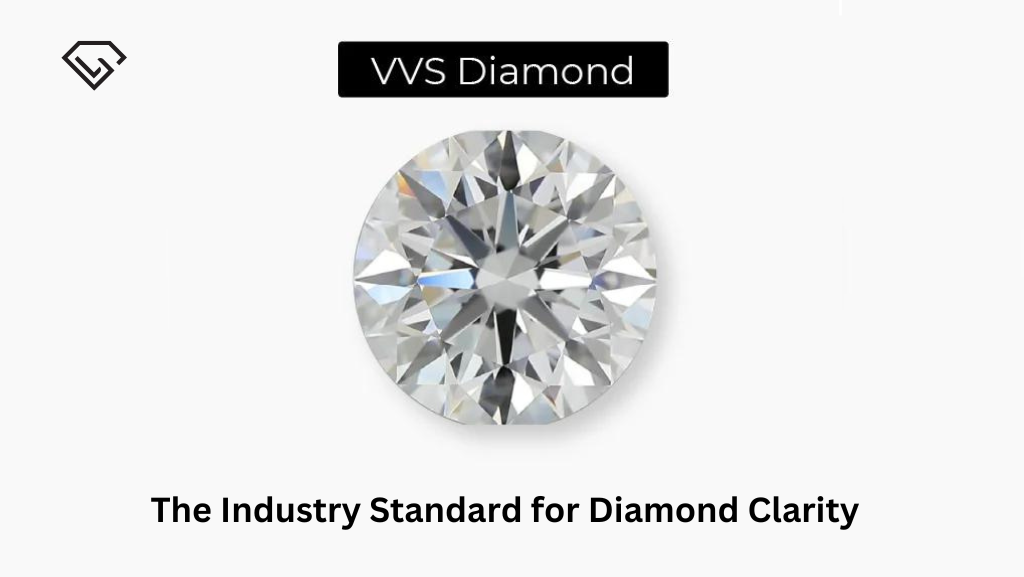
VVS Diamonds: The Industry Standard for Diamond Clarity

You might be wondering if the VVS diamonds are not top-grade diamonds, so why have we named them the dream diamonds? Well, the answer is simple, VVS diamonds or very very slightly included diamonds are as close as you get to flawless diamonds but without the exorbitant cost attached to them.

If you are someone who either is not able to buy a flawless diamond or does not have the time to look for it, a VVS diamond clarity can be a lifesaver. We are here to sing their praises and tell you why we are doing so. Here are all the reasons why you should love VVS diamonds as much as we love them! 

What Are VVS Diamonds?

Very very slightly included diamonds are a diamond rating given to those diamonds with slight inclusions. Inclusions are slight imperfections inside the diamond. Inclusions formed in a diamond are a natural part of the diamond-forming process, and they appear while the diamond is undergoing extreme heat and pressure.

Inclusions are an essential part when grading the clarity of the diamonds: the higher the inclusions, the lower the clarity grade. Very Very slightly included diamonds are the third level on the clarity scale. There are two subclasses in the category of VVS diamonds. VVS1 and VVS2 diamonds are divided based on the number of inclusions and their visibility in the diamond.

What Are VVS1 Diamonds?

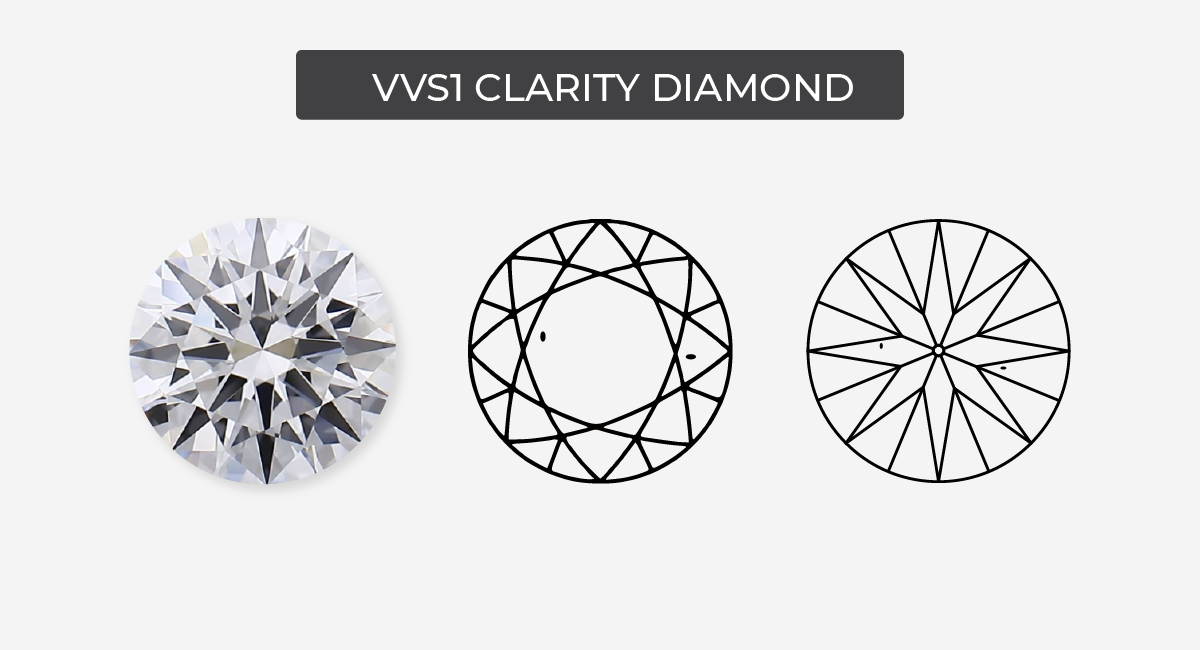
The VVS1 diamond grading comes just after the grading of internally flawless diamonds. The straightforward thing about VVS1 diamonds is that the inclusions in these diamonds are not visible even after maximum magnification. 

Only a trained gemologist with a suitable microscope or magnifying glass can spot any inclusion in the VVS1 diamond. VVS1 grade is obtained by inspecting the size and location of the inclusions present in the gem. 

A trained professional ensures that all inclusions are not visible even after 10x of magnification, and only then can the diamond be graded as a VVS1 diamond. 

vvs1 clarity diamond

Other than the size of the inclusion, even the location of the inclusions is taken into account when grading the diamond’s clarity. Gemologists work along with diamond graders to analyze the number of inclusions the location of inclusions in the size of inclusions to put them in the proper category that will define their grading.

The inclusion location significantly affects whether the inclusion will be visible to the naked eye or not. 

[blog_page_inventory shape=”Radiant,Emerald,Oval,pear,round,cushion,heart,princess,kite,hexagon,old mine,rose cut,marquise” carat=”1.70,3.10″ cut=”1,4″ color=”0,10″ clarity=”9,9″]
[blog_page_btn title”Buy Now” url=”https://www.loosegrowndiamond.com/inventory/?”]

What Are VVS2 Diamonds?

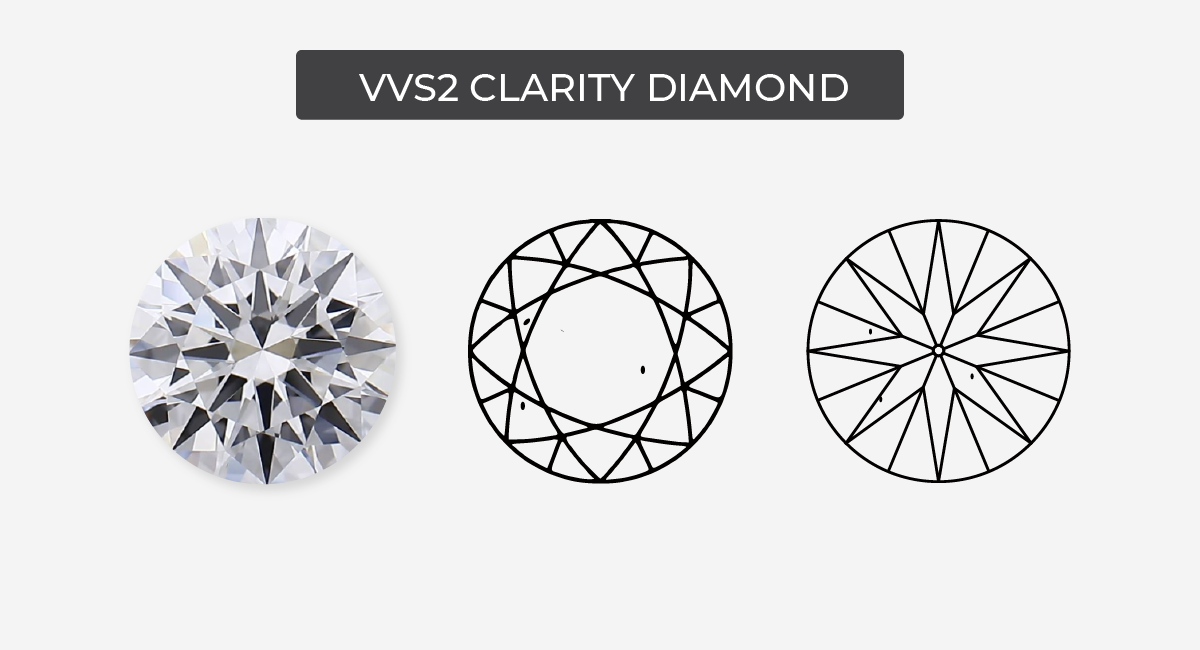
The second grade of the Very Very Slightly Included is classified on the basis that the inclusions present within the diamond are barely visible to the naked eye upon 10x magnification. Similar to VVS1 the grade VVS2 is given based on the size of inclusion, location of inclusion, and even color. Only a trained professional gemologist will be able to spot these inclusions upon verification.

vvs2 clarity diamond

[blog_page_inventory shape=”Round,Princess,Cushion” carat=”2.00,2.10″ cut=”1,4″ color=”0,10″ clarity=”8,8″]
[blog_page_btn title”Buy Now” url=”https://www.loosegrowndiamond.com/inventory/?”]

How Are VVS Diamonds Graded?

Any diamond is mainly checked for four parameters when it is being graded: the cut, the clarity, the color, and the diamond’s carat. This is more than often called the 4C rule of the diamond industry. The grading signifies the quality and cost of the diamond. 

The process of grading a diamond’s clarity starts with first checking the number of inclusions in the diamond. Once the number of inclusions is recorded, the size and density of the inclusions are analyzed. If the inclusions are small in size and are far apart from each other, then the clarity grade is high, but if the size of the inclusions is big and they are close by, the clarity grading of diamonds goes down. 

Another important factor taken into account when checking clarity is visibility. If the inclusions are visible, then the grading is low. The visibility is heavily affected by the location of the imperfection. 

An excellent example of this would be if inclusions are found beneath the table of the diamond that is far more visible than the encryption that is on the sides of the diameter of the diamond; this is what the gemologist checks for and puts diamonds in different clarity gradings. 

After checking all of these parameters, a diamond is graded. VVS diamonds have minute inclusions that have low visibility. VVS1 diamonds in specific have inclusions that are only visible under 10x magnification, and that too with a diamond-specific magnifying glass called a loupe. VVS2 diamonds possess relatively more inclusions than VVS1. 

Also Check: Lab-Grown VVS Diamond versus VS Diamond: What’s the Difference

VVS Diamond Price

You may have searched this question online: “What is the cost of a 1-carat VVS diamond?”. And might not have gotten an exact number. Well, that is because the cost of such a gem depends on the 4Cs, and as these vary from stone to stone, the prices will also fluctuate.

To give you a broad idea, the cost of a 1-carat VVS diamond will be around $2000 to $6000 per carat. If you go higher in color, like a D-colored, VVS round diamond with an ideal cut, the price can go up to $8,000 per carat.

In the VVS grade, VVS1 diamonds will be more expensive than VVS2 diamonds, which will be more expensive than VS1 diamonds, and so on.

For a more affordable alternative, you can opt for a lab grown VVS diamond, which will be around 40% cheaper. 

How Much Do The VVS Diamonds Cost?

In the better part of the last decade, the value and reputation of VVS diamonds have only seen a positive rise because they are affordable yet of excellent quality. 

Many in the diamond world appreciate the amazing pricing of VVS diamonds simply because you pay considerably less than what you would pay for a Flawless grade diamond or an Internally Flawless grade diamond. Still, at the same time, it is almost impossible to differentiate between a VVS-grade diamond from its higher-rated diamond counterparts.  

However, the actual cost of a VVS diamond is also dependent on other factors, like if you choose a VVS1 or VVS2 grade diamond. The final price is also affected by three other factors: color, carat, and cut. 

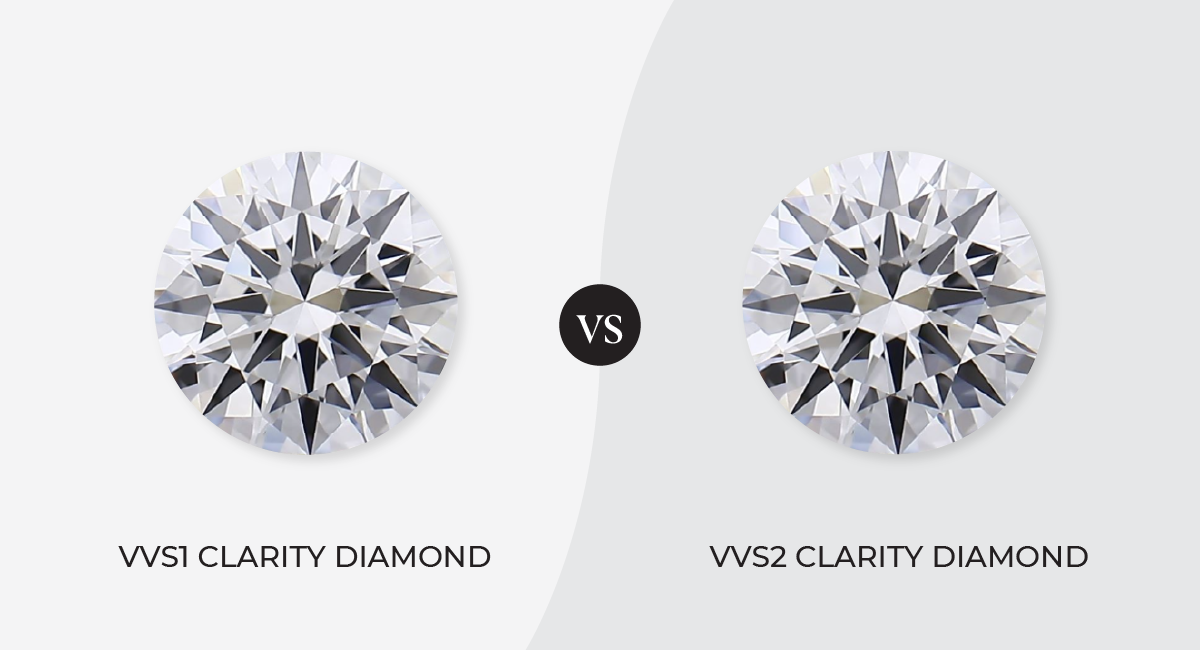
What Is The Difference Between VVS1 Diamonds And VVS2 Diamonds?

vvs1 vs vvs2

The difference between Very Very Slightly Included diamonds in the first category and Very Very Slightly Included in the second category depends on the imperfections’ visibility and location. VVS1 diamonds often possess some inclusions that are not visible to the naked eye; this is because of the size of the inclusion and the location of inclusion.

However, in VVS2 diamonds, the location or size of the inclusions are such that they might be visible to the naked eye at times without even a diamond-specified magnifying glass. 

What To Look Or When Buying VVS Diamonds?

Many people have a lot of confusion when they go diamond shopping. The myth about buying diamonds is that only the highest grades are of actual value, but in reality, diamonds that look the same have similar values in the retail market. 

Diamonds are not just pretty stones, they are also a great asset to have, which someone should invest in with utmost care. VVS diamonds have almost the same value as Flawless or Internally Flawless diamonds. VVS diamonds are a great investment as they are priced not too high, and they still remain a great investment. 

You should definitely use online tools available to assess the value of the diamond and cross-check it with various certified retailers.
You can use our diamond price calculator to determine the right price for your diamond. If you have access to gemologists, a good idea is also to get your diamond checked to ensure the quality of the product you are buying. 

Why Choose VVS Diamonds? 

If you’re still wondering why you should buy VVS diamonds, here are all the reasons you should. First is the brilliance of VVS diamonds. They have minimal flaws, and hence they have great sparkle. 

Secondly, the cost of the diamond is quite affordable, and yet they look virtually the same as higher clarity grade diamonds. Lastly, VVS diamonds are a great financial investment, and their value is generally appreciated with time. 

Where To Buy VVS Diamonds? 

VVS diamonds are one of the most popular diamonds in the market for engagement rings. This does not mean that it is super easy to buy them. You need to be very careful when choosing the jeweler or the retailer you’re purchasing diamonds from.

Make sure you only approach retailers who have received certification from verified diamond authorities like the Gemological Institute of America (GIA) or the International Gemological Institute (IGI), or Gem Certification & Assurance Lab (GCAL).

We at Loose Grown Diamond offer a wide range of VVS1 and VVS2 diamonds with proper certification from GIA, GCAL or IGI. Be sure to check out our inventory. Additionally, unlock exclusive savings with our promo code to enhance your diamond shopping experience.


Conclusion

VVS diamonds are a great buy. They offer many advantages like being cost-friendly, having excellent quality, and valuing money. It depends on your personal preference or requirements for a VVS1 diamond or a VVS2 diamond.

Remember to be super careful when choosing who to buy your diamonds from and always check the retailer’s credentials and from which statutory body they have gotten their certification. There are many reasons to buy VVS diamonds, and they make for a beautiful piece of jewelry and investment.  

Frequently Asked Questions (FAQs)

Should I purchase a VVS diamond?
VVS diamonds are a great buy, but they might not be the perfect diamond for everyone, so here is a list of pros and cons for you to understand if it is the dream diamond for you. 

Who should buy a VVS diamond?
If you are someone with a decent budget which is maybe not fitting for  F or IF clarity grade but a little lower than that,
VVS diamonds are perfect. If you do not wish to compromise much on quality, then again, VVS diamonds are a good buy for you. If you are someone who likes to explore different cuts, sizes, and colors, then you should know that VVS diamonds are super flexible with different cuts, colors, sizes and designs as well. 

Who shouldn’t buy VVS diamonds?
If you are running on a tight budget, then
VVS diamonds are not the perfect buy for you because their price can be a bit expensive. If you are someone who absolutely does not wish to compromise on quality, then again, you should look for a higher clarity grade in a diamond.
We would suggest you explore VS diamonds as they can be a great and adjustable alternative that might suit your requirements better than
VVS clarity diamonds

Understanding the SI2 Clarity Diamonds: What is it and Deciding Whether or Not to Buy?

Are you looking for a dazzling diamond? What if we told you there are affordable diamonds available in the market? We are talking about SI2 diamond clarity. What is it? How much does it cost? We’ll be mentioning all of that in this article.

It is important to know how to detect the clarity of any diamond when shopping for one, or else you won’t be able to tell if a diamond is truly worth the price it is being sold for.

All diamonds sold by retailers have a grading report issued by a diamond testing laboratory. The report informs about the diamond’s clarity, color, cut, carat, and all the flaws present in the diamond.

The clarity defines simple transparency and lets you know about the type, number, and size of imperfections the gem has. The larger the flaws or the greater the number, the lower the clarity grade will be.

These grades range from high grade “flawless” (F) to low grade “included” (l). We also have the SI category between this range and the SI category, which has two types (SI1 clarity and SI2 clarity). A very divided topic is whether SI2 clarity diamonds are worth spending money on.

Let us briefly understand SI2 clarity diamonds and the pros and cons of buying an SI2 lab diamond.

What are SI2 Diamonds?

GIA developed the clarity grading scale to make diamond purchases easy and reliable for customers. It has eight upper clarity grades, including SI clarity, and three low clarity grades, which have poor beauty and durability and are also unsuitable for jewelry making.

What are SI2 Diamonds?

The grading of diamonds is a complex task; it needs a diamond expert working in a diamond laboratory to observe the diamond carefully. In case of clarity, note down the size, location, number, and type of inclusion within a gem.

The SI in SI clarity grade stands for “Slightly Included.” On the clarity grade scale, this grade stands above the I diamonds and below the VVS2 diamonds. SI2 diamond clarity inclusions can be seen by the naked eye sometimes, but mostly with 10x magnification, a skilled gemologist can detect the flaws easily.

An SI2 diamond is a lower grade, but that doesn’t mean you should discredit it. With some patience and being on the lookout, one can find a great deal on these gems.

Getting an upstanding deal depends on how well you can browse through diamonds. With some effort, one can find SI2 diamonds, which appear fully eye-clean and have a lower price than other brilliant diamonds.

There are some SI2 diamonds present in the market that have noticeable inclusions and do not require any magnification to see. It is not necessary that these diamonds have cloudiness or milkiness in them. Either way, it is best to avoid such diamonds.

Despite the lower clarity grade, SI2 diamonds have a beautiful shine and spark. The spark of a diamond mainly depends on the cut of a diamond, not on the clarity. If you have a low budget, you have to grind a little to find a low-inclusion SI2 diamond and give it a good cut; by doing this, you can have a stunning diamond at a low price.

SI1 vs SI2 Diamonds

If we look at the clarity grade scale, both SI1 and SI2 lie in the sweet spot of affordable price and adequate quality. If anyone wants a diamond for a romantic purpose, one that looks prestigious, and one that lies within a decent budget, then these two clarity grades are the perfect fit.

SI1 vs SI2 Diamonds

It is already clear by the given name that SI1 diamonds come above and are always considered higher quality than SI2 diamonds. However, not every SI1 diamond needs to always be better than or similar to an SI2 diamond, as the clarity grading system doesn’t work with the positions of inclusions inside the diamond nor the color of the diamond.

These two factors can make SI1 look less or more appreciable compared to SI2 diamond clarity.

The position of flaws and color inclusions is what makes the difference. Sometimes the dark-colored inclusions present on the center table of the SI1 diamond can be visible if we put the diamond on a blank sheet of paper.

Whereas, sometimes, the color inclusions present near the pavilion part of the SI2 diamond cannot be seen by the naked eye.

So, one should buy a diamond that will pass the unaided eye test and not fully depend on the clarity grade system. The main motive for buying a diamond should be that it is eye-clean, which is the most important factor.

SI2 diamond is a little cheaper than SI1 due to its lower grade. But if you can find an SI2 diamond that is eye clean, then it isn’t of any use to look for an SI1 diamond and pay a higher price.

To achieve this, it is important to see the diamond carefully and patiently from all sides. Also, view it under magnification so you can get a flawless one for yourself.

SI2 Clarity Grade

To get a better idea of what to look for in an SI2 diamond clarity, it is essential to know where the SI2 clarity lies on the clarity grading scale. Diamonds that are graded by IGI, GIA and GCAL are preferred, as they are considered to be more authentic.

SI2 Clarity Grade

Below are the GIA clarity grades, from highest to lowest:

  • Flawless (FL)
  • Internally Flawless (IF)
  • Very Very Small Inclusions (VVS1)
  • Very Very Small Inclusions (VVS2)
  • Very Small Inclusions 1 (VS1)
  • Very Small Inclusions 2 (VS2)
  • Small Inclusions 1 (SI1)
  • Small Inclusions 2 (SI2)
  • Inclusions 1 (I1)
  • Inclusions 2 (I2)
  • Inclusions 3 (I3)

As you can see, SI2 diamond clarity is closer to the bottom. not exactly the best choice when it comes to diamonds. However, it will not be cheap.

The imperfections in diamonds are from nature or when they were formed. The clarity of a diamond depends mainly on inclusions. The type, size, and amount of inclusion can make any diamond beautiful or unfit for jewelry. Generally, diamonds with more significant and larger flaws are categorized as having a low clarity grade. Expert gemologists look at diamonds from all angles under high magnification to locate all flaws.

It’s rare to find a diamond without any flaws. Even a high-clarity diamond might have some imperfections. So it would be beneficial if you looking for a diamond that is eye-clean and will look good on your jewelry.

Is SI2 Diamond Clarity Good?

On the SI2 clarity grade, the SI stands for “slightly included.” In this clarity grade, there might be a chance of seeing an internal flaw with the naked eye. However, the internal flaws are mostly invisible to the naked eye but can be seen under high magnification.

Is SI2 Diamond Clarity Good?

It will be no surprise if pure, flawless, and eye-clean diamonds are available at premium prices. As we go down the clarity scale, the diamonds become much more affordable, even for big diamonds of high carat weight.

The clarity grade scale has a range from Flawless (Fl) to included (I) and, more precisely, to included level 3 (I3). Generally, the included diamonds I1, I2, and I3 are not used in jewelry because of their low clarity. Due to low demand, jewelers also don’t keep stocks of these diamonds.

SI2 (Slightly Included 2) diamonds are the lowest and most affordable grade on the market. But you cannot dismiss the idea of buying an SI2 diamond just because of its clarity.

There are numerous reasons why purchasing this can be a good investment. The price can be a primary factor. As for the sparkle, you can choose a good cut; by doing this, no one will be able to tell that this diamond is an SI2 diamond.

Eye-Clean SI2 Diamonds

Everyone wastes lots of time stressing over GIA clarity grades. However, clarity is not everything; the actual appearance of the diamond to the naked eye is what really matters.

It is important to note that not all SI2 diamonds are the same; some can have high blemishes, and some are very beautiful. Instead of focusing on the diamond’s clarity grade scale, you should look for a diamond that is pleasing to the eyes, or, in simple words, an “eye-clean diamond.”

The term “eye clean” is used when we talk about the diamond’s clear appearance and imperfection-free appearance to the naked eye. Expert jewelers can see inclusions inside the diamond with a magnifying glass or a microscope, but the most important thing is what you see under normal conditions.

However, it is also possible that the same diamond can appear at different clarity levels to different people. Some people find SI2 clarity diamonds eye clean, whereas others can see flaws without magnification.

This all depends on the person’s eyesight or ability to find the flawed characteristics inside the diamonds. You should also know how the industry determines whether the diamond is eye-clean or not. The expert grading team observes the diamond from a distance of about 9 to 12 inches. If they cannot see any flaws at that distance, the diamond is considered eye-clean.

Generally, people who go to buy diamonds for engagement rings do not use this technique. We recommend you ask the diamond vendors about the inclusions in a little more depth to avoid confusion while observing. You can ask for the percentage of visible inclusions. These methods can lead you to the perfect eye-clean diamond.

How Much Does a SI2 Diamond Cost?

The SI2 diamond can offer a great deal if we discuss the price. However, depending on the shape and size of the diamond, the transaction could go wrong.

How Much Does a SI2 Diamond Cost?

If we talk about the exclusive SI2 clarity grade diamonds, then the rate for high quality would be around $500 per carat, so a diamond can cost you more than $5,000.

Basically, it is impossible to put a fixed price tag on an SI2 diamond. Two diamonds of the same carat and cut and color grade can cost hundreds or thousands of dollars apart simply because one is an SI2 diamond and the other is a higher clarity grade diamond.

On the other hand, an SI diamond of almost the same appeal can cost less than a diamond with a VS or VVS clarity grade; this can be a great deal for you.

Finding an SI2 eye-clean diamond can be hard work, but they exist. Also, remember that most of them have high inclusion. Eye cleanliness is a thing that we can’t define with words; it is something that can be seen only with our naked eye.

A diamond can look perfect in pictures, but you have to be careful and check out all the angles of a diamond. An SI2 diamond is worth the price, but finding a good one is not easy. These diamonds can cost anywhere from $1,000 to $6,000 per carat, depending on the other four Cs.

Only SI2 diamonds that are eye clean and offer a low price are worth buying. For comments on worth, you should judge diamonds’ cleanliness by yourself and should always go for specifics with your jeweler. The best way to observe is to place the diamond six to twelve inches away from your eyes. Price confusion you can use our diamond pricing calculator to determine the right price for your diamond.

How Should You Buy an SI2 Clarity?

Buying any type of diamond can be an excellent investment if done properly. Below are some tips that will help you buy an SI2 diamond:

Buying Tips for SI2 Diamonds

  • Look for inclusions along the edge of the diamond: You don’t have to look at all the inclusions present in the diamond, but inclusions like feathers and clouds will be a problem for you. However, you can go for an SI2 diamond with inclusions along the edges, as it is possible that afterward, they can be hidden with a setting.
    It is also possible that sometimes when the jeweler crafts the prong setting, the feather inclusion can increase.
  • Look for inclusions that are lighter in color: Light-colored inclusions are harder to detect than dark inclusions. Due to this, if you can see dark or black inclusions within a diamond, it would be wise not to buy that stone.
    Even if these inclusions are on the edge, there is an excellent chance that they will be visible from a different angle due to their dark color.
  • Look for GIA or GCAL-graded diamonds: most people don’t know that there are many different grading laboratories. GIA is the world’s most widely known, reliable, and accepted laboratory.
    It should also be your topic choice. The GCAL laboratory has a system with the Angular Spectrum Evaluation Tool that gives the most accurate insight, so this has a big advantage in grading.
  • Sparkle factor and performance are important: everyone likes an engagement ring with a great shine or sparkle. If you also want that, you should pay attention to both clarity and cut quality. The sparkly diamonds have the power to attract every eye present in the room.
    If you want an eye-clean face-up for a sparkle, a VS2 diamond is generally recommended. However, this doesn’t mean that SI2 can’t give your ring a good spark.
  • Choose a diamond shape that hides inclusions: To hide inclusions, shapes can be of great use. A good shape chiseled into a rough stone can make inclusions harder to detect. The round brilliant cut is the most common and best cut for hiding inclusions.
    The brilliant facet pattern of the round cut produces a huge spark, which challenges the inclusion’s presence. On the other hand, a diamond with a step cut like an Emerald or Asscher cut will highlight the inclusions due to its large table, which can be a big disaster.

If you’re ready to start your search, choose diamonds from hundreds of styles on loosegrowndiamonds.com and elevate your diamond shopping experience with a generous discount using a promo code.


Conclusion

SI2 diamonds have a high probability of having visible inclusions. Still, most of them can only be seen under high magnification, which leads to a lower value and grade for the SI2 diamond. But you can find a pretty good deal with these diamonds if you can get a hold of the right one.

One can find a diamond that appears eye clean and is an SI2 diamond at a lower price than high-clarity ones, which almost look the same. An SI2 diamond can be 70% cheaper than FL or VVS diamonds. You can give the diamond a round brilliant cut to make it look more sparkly and avoid having a step cut.

You just have to know what to look for in SI2 diamonds while buying, and you just have to find a diamond with an eye-clean look.

FAQs

Do SI2 clarity diamonds sparkle?
SI2 diamonds can sparkle beautifully when well-cut and have good light performance.

What does SI2 diamond clarity mean?
SI2 diamond clarity means the diamond has slight inclusions that are visible under 10x magnification, but generally not visible to the naked eye.

Are SI2 diamonds a good choice for engagement rings?
SI2 diamonds can be a good choice for engagement rings, especially if you are looking for a balance between diamond quality and price.

How does SI2 clarity affect the price of a diamond?
SI2 diamonds are typically more affordable than higher clarity grades, making them a budget-friendly option.